

Bacteriostatic and Antibiofilm Efficacy of a Nisin Z Solution against Co-Cultures of Staphylococcus aureus and Pseudomonas aeruginosa from Diabetic Foot Infections
Open accessThe DOI matches its Crossref record; 44 of the 44 references it cites were found in a registry or an index; 2 of the 55 sources its claims cite were checked for support.
Abstract
Diabetes mellitus (DM) patients frequently develop diabetic foot ulcers (DFU) which are generally infected by a community of microorganisms, mainly Staphylococcus aureus and Pseudomonas aeruginosa. These bacteria exhibit a multi-drug resistance profile and biofilm-forming ability which represent a hurdle in the treatment of diabetic foot infections (DFI). We aimed to evaluate the potential of Nisin Z, an antimicrobial peptide (AMP), as an alternative treatment for severe DFI. Nisin Z shows antibacterial activity against Gram-positive and Gram-negative bacteria and an increased antibacterial effect against Gram-negatives when added to EDTA. As such, Minimum Inhibitory Concentration (MIC), Minimum Bactericidal Concentration (MBC), Minimum Biofilm Inhibitory Concentration (MBIC), and Minimum Biofilm Eradication Concentration (MBEC) were determined for Nisin Z, Nisin Z + EDTA (0.4%), and Nisin Z + EDTA incorporated into guar gum, in order to test its efficacy against S. aureus and P. aeruginosa isolated from the same DFU. Results showed that Nisin Z added to the chelation agent EDTA displayed higher antibacterial and bacteriostatic efficacy against mono and dual co-cultures of S. aureus and P. aeruginosa, and higher antibiofilm efficiency against monocultures. Nisin Z was moderately cytotoxic at 200 µg/mL. Prospect in vivo studies are needed to confirm the potential of Nisin Z supplemented with EDTA to be used as a complement to conventional antibiotic therapy for severe DFI.
Overview
CoChat Summary
TL;DR
Nisin Z supplemented with EDTA (0.4%) was the most promising tested solution against diabetic foot infection isolates of *S. aureus* and *P. aeruginosa*, showing higher antibacterial/bacteriostatic efficacy against mono- and dual planktonic co-cultures and higher antibiofilm efficacy against monocultures. However, biofilm eradication was not achieved at moderate-cytotoxic levels, and in vivo studies are still needed.
Key findings
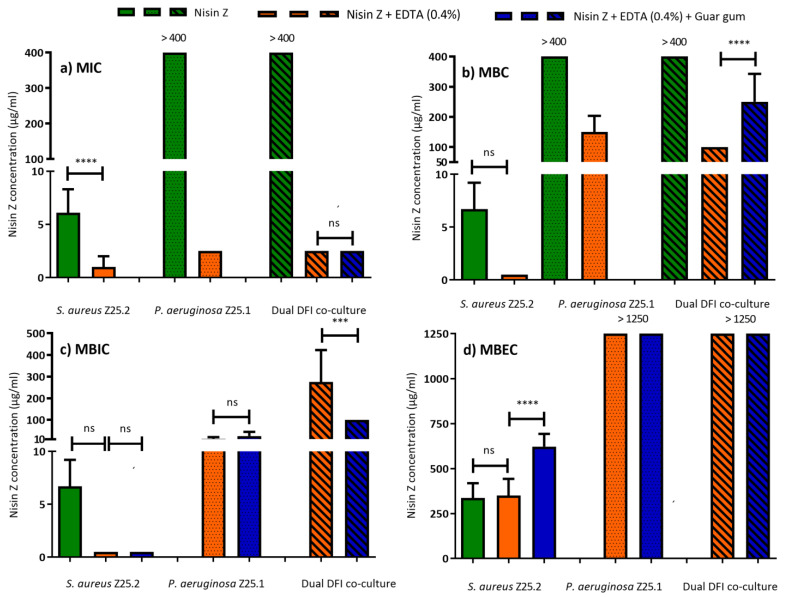
- Nisin Z alone inhibited *S. aureus* Z25.2 with MIC mean 6.11 ± 2.2 µg/mL and MBC mean 18.8 ± 6.9 µg/mL, while *P. aeruginosa* Z25.1 and the dual DFI co-culture were resistant (MIC and MBC > 400 µg/mL). EDTA alone showed no inhibitory effect from 250 to 8000 µg/mL (MIC/MBC > 8000 ± 0 µg/mL).
- Adding EDTA (0.4%) made all tested planktonic suspensions susceptible: *S. aureus* MIC mean 1.0 ± 1.1 µg/mL and MBC mean 8.6 ± 5.3 µg/mL; *P. aeruginosa* MIC mean 2.5 ± 0 µg/mL and MBC mean 150.0 ± 53.5 µg/mL; dual DFI co-culture MIC mean 2.5 ± 0 µg/mL and MBC mean 100.0 ± 0 µg/mL. The paper classifies Nisin Z + EDTA as bacteriostatic against *S. aureus* Z25.2, *P. aeruginosa* Z25.1, and dual co-cultures.
- For biofilms, *S. aureus* Z25.2 was susceptible to Nisin Z solutions at low MBIC values: Nisin Z MBIC mean 6.7 ± 2.5 µg/mL and MBEC mean 366.7 ± 81.6 µg/mL; Nisin Z + EDTA MBIC mean 0.5 ± 0 µg/mL and MBEC mean 350.0 ± 92.6 µg/mL; Nisin Z + EDTA + guar gum MBEC mean 622.2 ± 210.8 µg/mL. *P. aeruginosa* and dual DFI co-culture biofilms had MBEC > 1250 µg/mL, and guar gum decreased dual DFI co-culture MBIC from 275.0 ± 147.5 to 100 ± 0.0 µg/mL.
- Cytotoxicity against HEKa cells: Nisin Z was non-cytotoxic from 5 µg/mL (90.3% viability) to 25 µg/mL (84.6%), weakly cytotoxic at 50 and 100 µg/mL (78.9% and 68.2%), moderately cytotoxic at 200 µg/mL (56.7%), and strongly cytotoxic at 400 and 1250 µg/mL (2.5% and 0.9%). EDTA-containing solutions were cytotoxic at all tested concentrations (9.2–33.1% with EDTA; 4.6–17.4% with EDTA + guar gum).
Methods
- In vitro study using biofilm-producing DFI strains *S. aureus* Z25.2 and *P. aeruginosa* Z25.1, co-isolated from the same diabetic foot ulcer, plus reference strains *S. aureus* ATCC 29213 and *P. aeruginosa* ATCC 27853.
- Tested three Nisin Z solutions: Nisin Z alone, Nisin Z + EDTA (0.4%), and Nisin Z + EDTA (0.4%) incorporated into 0.75% (w/v) guar gum gel, against mono- and dual planktonic and biofilm cultures.
- MIC/MBC by microtitre broth dilution; MBIC/MBEC using a modified Calgary Biofilm Pin Lid Device; cytotoxicity by MTT assay on adult human primary epidermal keratinocytes (HEKa). Data analyzed with GraphPad Prism, mean ± SEM, one-way ANOVA (p < 0.0001) and Tukey’s multiple comparisons test, with triplicate experiments and at least three independent replicates.
Limitations
- The paper states that in vivo studies are needed to confirm efficacy and safety; Nisin Z at 200 µg/mL was moderately cytotoxic, and EDTA cytotoxicity must be analyzed carefully because it may be associated with specific in vitro conditions and probably does not relate to in vivo cell toxicity.
- The paper notes that after guar gum addition, only dual co-cultures were evaluated for MIC/MBC, and Nisin Z MBIC/MBEC toward *P. aeruginosa* and dual DFI biofilms were not evaluated because those cultures were assumed to remain resistant.
- Evident from the text: findings are based on a single DFI strain pair, rely on in vitro visual endpoints for MIC/MBIC/MBEC, and biofilm eradication was not attainable in any tested Nisin Z solution at moderate-cytotoxic levels.
Model-written summary. Check it against the paper before relying on it.
Integrity signals
Registry
Cites
Statistics
Figures
Verification
Claims the paper makes
1 Valid · 0 Not valid · 30 Not checked · 58 Own results and interpretations
The cited sources support only part of this claim — read each source’s verdict below.
In the paper
“Nisin Z presents antibacterial activity against both Gram-positive and Gram-negative bacteria [24,26]”
§ Bacteriostatic and Antibiofilm Efficacy of a Nisin Z Solution against Co-Cultures of Staphylococcus aureus and Pseudomonas aeruginosa from Diabetic Foot Infections > 1. Introduction
What the sources say
- Supportedcites [24] Shin J.M. Gwak J.W. Kamarajan P. Fenno J.C. Rickard A.H. Kapila Y.L. Biomedical applications of nisin J. Appl. Microbiol. 2016 120 1449 1465 10.1111/jam.13033 26678028 PMC4866897 source
The Abstract of Shin et al. (2016) states that 'Nisin has now been shown to have antimicrobial activity against both Gram-positive and Gram-negative disease-associated pathogens,' and the body applies this to nisin Z specifically: 'Nisin A, Z, F and Q have antimicrobial activity against a range of Staphylococcus aureus targets' (Natural and Bioengineered Variants of Nisin) and 'high purity nisin Z can inhibit the growth of Gram-negative oral colonizing pathogens, including Porphyromonas gingivalis, Prevotella intermedia, Aggregatibacter actinomycetemcomitans and Treponema denticola' (Nisin and Oral Health). The review therefore supports nisin Z acting against both Gram-positive and Gram-negative bacteria, although its single-sentence dual-spectrum attribution in the introduction is framed around nisin variants/bioengineered forms (citing Kuwano et al. 2005). (LLM, conf=0.82)
- Partly supportedcites [26] Field D. O’ Connor R. Cotter P.D. Ross R.P. Hill C. In Vitro Activities of Nisin and Nisin Derivatives Alone and In Combination with Antibiotics against Staphylococcus Biofilms Front. Microbiol. 2016 7 508 10.3389/fmicb.2016.00508 27148197 PMC4834297 sourceExperimental — accuracy not yet measured
The Introduction states that nisin 'exhibits antibacterial activity against a wide range of Gram-positive bacteria' and that 'both nisin A (and its natural variant nisin Z) are effective against the Gram-positive pathogens responsible for bovine mastitis', which supports the Gram-positive half of the claim. Our copy nowhere attributes Gram-negative activity to nisin Z: the Abstract limits the lantibiotic family to 'potent antibacterial activity against many Gram-positive bacteria', and the only Gram-negative organisms mentioned (P. aeruginosa, P. fluorescens, Salmonella Typhimurium) appear as cases where nisin acted synergistically with conventional antibiotics (Giacometti et al., 2000; Naghmouchi et al., 2012; Rishi et al., 2014), while spectrum widening is credited to bioengineered derivatives, not to nisin Z. The Gram-negative component of the claim is therefore unsupported by this source. (LLM, conf=0.82)
plainstates a cause- Asserted: passes — The authors put it forward as true.
- Checkable: passes — It can be checked against evidence.
- Load-bearing: passes — The paper’s conclusions depend on it.
- Based: passes — The paper gives a reason why it holds.
- Supported
A result the paper reports from its own data — it cites no other source for it, so there is none to check. The quote shows it is in the paper.
In the paper
“MIC and MBC of EDTA were evaluated and showed no inhibitory effect in any tested concentration (250 to 8000 µg/mL) towards planktonic DFI and control strains. EDTA exhibited a MIC and MBC mean value of >8000 ± 0 µg/mL.”
§ Bacteriostatic and Antibiofilm Efficacy of a Nisin Z Solution against Co-Cultures of Staphylococcus aureus and Pseudomonas aeruginosa from Diabetic Foot Infections > 3. Results > 3.1. MIC and MBC
plain- Asserted: passes — The authors put it forward as true.
- Checkable: passes — It can be checked against evidence.
- Load-bearing: passes — The paper’s conclusions depend on it.
- Based: passes — The paper gives a reason why it holds.
A result the paper reports from its own data — it cites no other source for it, so there is none to check. The quote shows it is in the paper.
In the paper
“Therefore, Nisin Z was non-cytotoxic from 5 µg/mL (HEKa cell viability of 90.3%) to 25 µg/mL (HEKa cell viability of 84.6%), weakly cytotoxic at 50 and 100 µg/mL (HEKa cell viability of 78.9% and 68.2%), moderately cytotoxic at 200 µg/mL (HEKa cell viability of 56.7%), and strongly cytotoxic at 400 and 1250 µg/mL (HEKa cell viability of 2.5 and 0.9%, respectively).”
§ Bacteriostatic and Antibiofilm Efficacy of a Nisin Z Solution against Co-Cultures of Staphylococcus aureus and Pseudomonas aeruginosa from Diabetic Foot Infections > 3. Results > 3.3. Cell Toxicity
plainstates a cause- Asserted: passes — The authors put it forward as true.
- Checkable: passes — It can be checked against evidence.
- Load-bearing: passes — The paper’s conclusions depend on it.
- Based: passes — The paper gives a reason why it holds.
A result the paper reports from its own data — it cites no other source for it, so there is none to check. The quote shows it is in the paper.
In the paper
“Comparing the results for P. aeruginosa Z.25.1 to those for the reference strain, only Nisin Z + EDTA (0.4%) MIC value was significantly different.”
§ Bacteriostatic and Antibiofilm Efficacy of a Nisin Z Solution against Co-Cultures of Staphylococcus aureus and Pseudomonas aeruginosa from Diabetic Foot Infections > 3. Results > 3.1. MIC and MBC
plain- Asserted: passes — The authors put it forward as true.
- Checkable: passes — It can be checked against evidence.
- Load-bearing: unclear — It is unclear whether the paper’s conclusions depend on it.
- Based: passes — The paper gives a reason why it holds.
A result the paper states — it cites no source for it, so there is none to check. The quote shows it is in the paper.
In the paper
“Nisin Z was moderately cytotoxic at 200 µg/mL.”
§ Bacteriostatic and Antibiofilm Efficacy of a Nisin Z Solution against Co-Cultures of Staphylococcus aureus and Pseudomonas aeruginosa from Diabetic Foot Infections > Abstract
plainstates a cause- Asserted: passes — The authors put it forward as true.
- Checkable: passes — It can be checked against evidence.
- Load-bearing: unclear — It is unclear whether the paper’s conclusions depend on it.
- Based: passes — The paper gives a reason why it holds.
- Rests on an assumption not shown here.
46 more claims
Create a free account to see all 89 claims and to verify the 52 references still open.
- It may state two separate claims as one. 31
- The quote only partly states this claim. 2
- Probably not a substantial claim. 12
Self-check
Percentages, sums and reported differences re-computed from the paper’s own numbers.
Each contradiction between two passages listed here was confirmed by an independent check.
Rated major: it would touch a result — a value a result rests on, reported and recomputed p-values on opposite sides of the significance level, two passages that conflict with no sign which is right, or a cited work retracted before this paper was published.
In the paper
§ Bacteriostatic and Antibiofilm Efficacy of a Nisin Z Solution against Co-Cultures of Staphylococcus aureus and Pseudomonas aeruginosa from Diabetic Foot Infections > 4. Discussion
“The addition of guar gum was beneficial for dual DFI co-cultures because it significantly increased the antibiofilm efficacy to nontoxic Nisin Z levels.”
§ Bacteriostatic and Antibiofilm Efficacy of a Nisin Z Solution against Co-Cultures of Staphylococcus aureus and Pseudomonas aeruginosa from Diabetic Foot Infections > 3. Results > 3.3. Cell Toxicity
“The addition of EDTA (0.4%), and of EDTA (0.4%) + guar gum gel 0.75% (w/v) to Nisin Z render these solutions cytotoxic in all concentrations tested, with cell viability ranging from 9.2% to 33.1% and from 4.6% to 17.4%, respectively (Table 2).”
Rated minor: it would not touch a result — a value no result rests on, a p-value that stays on the same side of the significance level, or a conflict that is clerical, resolved elsewhere in the paper, or outside its own findings.
In the paper
“MBC values were two to 2.5-fold higher than MIC (MBC mean of 18.8 ± 6.9 µg/mL, ranging from 10 to 25 µg/mL).”
§ Bacteriostatic and Antibiofilm Efficacy of a Nisin Z Solution against Co-Cultures of Staphylococcus aureus and Pseudomonas aeruginosa from Diabetic Foot Infections > 3. Results > 3.1. MIC and MBC
Reported 2.5 · recomputed 3.076923
Rated minor: it would not touch a result — a value no result rests on, a p-value that stays on the same side of the significance level, or a conflict that is clerical, resolved elsewhere in the paper, or outside its own findings.
In the paper
“MBC was four- to six-fold higher, with a mean of 8.6 ± 5.3 µg/mL, ranging between 1 and 15 µg/mL.”
§ Bacteriostatic and Antibiofilm Efficacy of a Nisin Z Solution against Co-Cultures of Staphylococcus aureus and Pseudomonas aeruginosa from Diabetic Foot Infections > 3. Results > 3.1. MIC and MBC
Reported 6 · recomputed 8.6
Citations
Cites
Wiegand, I., Hilpert, K., & Hancock, R. E. W. (2008) · Nature Protocols · doi:10.1038/nprot.2007.521 · Cited by 6,156 · cited 1×
“1 to 400 μg/mL) were determined by microtitre broth dilution method [37].”
MethodTacconelli, E., Carrara, E., Savoldi, A., Harbarth, S., Mendelson, M., Monnet, D. L., Pulcini, C., Kahlmeter, G., Kluytmans, J., Carmeli, Y., et al. (2018) · The Lancet Infectious Diseases · doi:10.1016/s1473-3099(17)30753-3 · Cited by 6,142
Ceri, H., Olson, M. E., Stremick, C., Read, R. R., Morck, D., & Buret, A. (1999) · Journal of Clinical Microbiology · doi:10.1128/jcm.37.6.1771-1776.1999 · Cited by 2,155
Bacteriocins—A viable alternative to antibiotics?
Cotter, P. D., Ross, R. P., & Hill, C. (2013) · Nature Reviews Microbiology · doi:10.1038/nrmicro2937 · Cited by 1,793
The antimicrobial peptides and their potential clinical applications.
Lei, J., Sun, L., Huang, S., Zhu, C., Li, P., He, J., Mackey, V., Coy, D. H., & He, Q. (2019) · PubMed Central · Cited by 1,459
Practical Guidelines on the prevention and management of diabetic foot disease (IWGDF 2019 update)
Schaper, N. C., van Netten, J. J., Apelqvist, J., Bus, S. A., Hinchliffe, R. J., Lipsky, B. A., & IWGDF Editorial Board (2020) · Diabetes/Metabolism Research and Reviews · doi:10.1002/dmrr.3266 · Cited by 970
Guar gum as a promising starting material for diverse applications: A review
Thombare, N., Jha, U., Mishra, S., & Siddiqui, M. Z. (2016) · International Journal of Biological Macromolecules · doi:10.1016/j.ijbiomac.2016.04.001 · Cited by 670
Biomedical applications of nisin
Shin, J. M., Gwak, J. W., Kamarajan, P., Fenno, J. C., Rickard, A. H., & Kapila, Y. L. (2016) · Journal of Applied Microbiology · doi:10.1111/jam.13033 · Cited by 607 · cited 5×
“The difference in a single amino acid residue at position 27 (asparagine instead of histidine) [24,25], between”
BackgroundResultInfluentialRelease of lipopolysaccharide by EDTA treatment of E., coli
Leive, L. (1965) · Biochemical and Biophysical Research Communications · doi:10.1016/0006-291x(65)90191-9 · Cited by 466
Bactericidal agents in the treatment of MRSA infections--the potential role of daptomycin
French, G. L. (2006) · Journal of Antimicrobial Chemotherapy · doi:10.1093/jac/dkl393 · Cited by 441
Research works printed but not linked: 2
- Serrano I. Antimicrobial Peptides Frontiers in Antimicrobial Agents—The Challenging of Antibiotic Resistance in the Development of New Therapeutics Oliveira M. Serrano I. Bentham Science Publishers Sharjah, United Arab Emirates 2015 Volume 1 33 68
- George T. Brady M.F. Ethylenediaminetetraacetic Acid (EDTA) StatPearls StatPearls Publishing Treasure Island, FL, USA 2022 33351441
Cited by
Wang, Q., Liu, C., An, J., Liu, J., Wang, Y., & Cai, Y. (2025) · Frontiers in Endocrinology · doi:10.3389/fendo.2025.1657928 · Cited by 103
Derakhshan-sefidi, M., Bakhshi, B., & Rasekhi, A. (2024) · BMC Microbiology · doi:10.1186/s12866-024-03400-7 · Cited by 37
Biofilm in Diabetic Foot Ulcers: A Systematic Narrative Review
Theodorakopoulos, G., & Armstrong, D. G. (2025) · International Wound Journal · doi:10.1111/iwj.70795 · Cited by 33
Antimicrobial Resistance in Pseudomonas aeruginosa before and during the COVID-19 Pandemic
Serretiello, E., Manente, R., Dell’Annunziata, F., Folliero, V., Iervolino, D., Casolaro, V., Perrella, A., Santoro, E., Galdiero, M., Capunzo, M., et al. (2023) · Microorganisms · doi:10.3390/microorganisms11081918 · Cited by 28
Qin, X., Cai, X., Wang, Y., Chen, L., Zhao, J., Zhang, Y., Bi, S., Zhou, Y., Zhu, Q., Cheng, Y., et al. (2024) · International Journal of Biological Macromolecules · doi:10.1016/j.ijbiomac.2024.134548 · Cited by 24
Development and Control of Biofilms in Diabetic Foot Infections: A Narrative Review
Ray, H., Weis, C., Nwaeze, C., Zhou, V., Basu, P., & Mitra, A. (2025) · Acta Microbiologica Hellenica · doi:10.3390/amh70010009 · Cited by 24
Jokar, J., Abdulabbas, H. T., Javanmardi, K., Mobasher, M. A., Jafari, S., Ghasemian, A., Rahimian, N., Zarenezhad, A., & Hekmat, A. S. (2023) · Virus Genes · doi:10.1007/s11262-023-02037-4 · Cited by 20
Mosa, F. E. S., Alqahtani, M. A., El‐Ghiaty, M. A., Barakat, K., & El‐Kadi, A. O. S. (2024) · Archives of Biochemistry and Biophysics · doi:10.1016/j.abb.2024.109958 · Cited by 14
Portieles, R., Xu, H., Chen, F., Gao, J., Du, L., Gao, X., Nordelo, C. B., Yue, Q., Zhao, L., González, N. P., et al. (2023) · PLoS ONE · doi:10.1371/journal.pone.0281175 · Cited by 14
Baky, M. H., Kamal, I. M., Wessjohann, L. A., & Farag, M. A. (2024) · RSC Advances · doi:10.1039/d4ra00100a · Cited by 13
Antimicrobial management of complex biofilms in diabetic foot ulcers: a microbiological perspective
Oliveira, M., Cunha, E. S., Tavares, L. M., & Serrano, I. D. (2025) · Expert Review of Anti-infective Therapy · doi:10.1080/14787210.2025.2538614 · Cited by 10
Self-citationTavares, T. D., Pinho, S. L. C., Delgado-Pujol, E. J., Begines, B., Alcudia, A., Silva, C. M., Antunes, J. C., & Felgueiras, H. P. (2025) · International Journal of Pharmaceutics · doi:10.1016/j.ijpharm.2025.126208 · Cited by 9
Huang, Y., Hao, S., Chen, J., Wang, M., Lin, Z.-H., & Liu, Y. (2024) · Marine Drugs · doi:10.3390/md22090428 · Cited by 9
Dart, A., Sarviya, N., Babaie, A., Clare, J., Bhave, M. R., Sümer, H., de Haan, J. B., Giri, J., & Kingshott, P. (2023) · Biomaterials Advances · doi:10.1016/j.bioadv.2023.213641 · Cited by 10
Xie, L., Yuan, T., Hu, S., Zhao, C., Huang, W., Ding, W., Zhang, Y., & Hu, X. (2025) · Materials & Design · doi:10.1016/j.matdes.2025.114558 · Cited by 7
Karabatak, N., Gök, B., & Budama‐Kilinc, Y. (2024) · Journal of the Turkish Chemical Society Section A Chemistry · doi:10.18596/jotcsa.1418645 · Cited by 7
Zina, R., Cunha, E. S., Serrano, I. D., Silva, E., Tavares, L. M., & Oliveira, M. (2023) · Antibiotics · doi:10.3390/antibiotics12050794 · Cited by 6
Self-citationDevelopment of the product for pre-milking cow-udder care on the basis of nisin and lactic acid
Trukhanovych, T., & Perkiy, Y. B. (2024) · Науковий вісник Львівського національного університету ветеринарної медицини та біотехнологій імені С.З. Ґжицького · doi:10.32718/nvlvet11317 · Cited by 5
Ekpenyong, M. G., Edet, P., Asitok, A. D., Amenaghawon, A. N., Eshiemogie, S. A., Ubi, D. S., Echa, C. U., Kusuma, H. S., & Antai, S. P. (2025) · Bioprocess and Biosystems Engineering · doi:10.1007/s00449-025-03183-9 · Cited by 3
Bacteriophage as an anti-biofilm agent against Pseudomonas aeruginosa from wound infection
Shrestha, P., Tandukar, S., Shrestha, M., Shrestha, S., Subedee, A., Shakya, J., & Tuladhar, R. (2025) · PLoS ONE · doi:10.1371/journal.pone.0334139 · Cited by 4
Functional Peptides: Comparing Synthetic and Sequence-Engineered Antibiofilm Pharmaceutics
Aslam, B., Khalid, M. H., & Aljasir, S. F. (2026) · Pharmaceutics · doi:10.3390/pharmaceutics18040441 · Cited by 3
Mourão, A. M., Serrano, I. D., Cunha, E. S., Tavares, L. M., Lourenço, A. M., & Oliveira, M. (2024) · Veterinary Dermatology · doi:10.1111/vde.13294 · Cited by 3
Self-citationSerrano, I. D., Mil‐Homens, D., Pires, R. F., Bonifácio, V. D. B., Guerreiro, J. F., Cunha, E. S., Costa, S. S., Tavares, L. M., & Oliveira, M. (2025) · Antibiotics · doi:10.3390/antibiotics14050444 · Cited by 3
Self-citationBarizi, A. Z. M., Abdullah, M. N. H., Lim, V., & Yong, Y. K. (2025) · Food Bioscience · doi:10.1016/j.fbio.2025.106972 · Cited by 3
Júnior, P. N. D. S., Nunes, J. V. S., Duque, B. R., Pereira, A. J. B., Magalhães, E. P., Oliveira, C. S., Freire, K. A., Pedron, C. N., Oliveira, V. X., Sampaio, T. L., et al. (2023) · Toxicon · doi:10.1016/j.toxicon.2023.107190 · Cited by 6
In vitro activity of Houttuynia cordata against bacteria isolated from diabetic foot
Geng, C., An, L., Niu, L., Cui, X., Zhang, S., Yuan, X., & Ma, Q. (2025) · Hereditas · doi:10.1186/s41065-025-00505-5 · Cited by 1
Fernández, M., Torices, M. I., Teso-Pérez, C., Moreno, C., Maqueda, M., Valdivia, E., & Montalbán‐López, M. (2025) · Probiotics and Antimicrobial Proteins · doi:10.1007/s12602-025-10770-5 · Cited by 1
Plant Antimicrobial Peptides and Bacteriocins: Emerging Strategies Against Biofilms
Chauhan, A., yadav, I., Khan, M. A., Santhiya, D., & Sharma, J. G. (2026) · Probiotics and Antimicrobial Proteins · doi:10.1007/s12602-026-11151-2 · Cited by 1
Shukla, S., & Iyer, B. D. (2026) · Critical Reviews in Microbiology · doi:10.1080/1040841x.2026.2709509 · Cited by 1
Daji, M., Dauda, W. P., Abraham, P., Ogra, I. O., Tumba, D. E., Jonathan, E. U., Glen, E., Iroha, O. K., Nathaniel, M., Usman, S., et al. (2025) · medRxiv · doi:10.1101/2025.10.14.25337998 · Cited by 1
Tanweer, T., Grant, M. M., Rana, N. F., Javaid, S., & Ahmad, N. M. (2025) · Biomedical Engineering International Conference · doi:10.1109/bmeicon66226.2025.11113737
El-ssayad, M. F., Elaaser, M. M., Fatah, S. I. A.-E., & Salem, S. H. (2026) · Scientific Reports · doi:10.1038/s41598-026-59959-w
Fernandes, J., Gomes, M., Bastos, A. R. C., Pinho, S. L. C., & Felgueiras, H. P. (2026) · Biomaterials Advances · doi:10.1016/j.bioadv.2026.215171
Metadata
- Authors
- Serrano, I., Alhinho, B., Cunha, E., Tavares, L., Trindade, A., & Oliveira, M.
- Affiliations
- University of Lisbon (PT)
- Corresponding author
- Oliveira, Manuela
- Venue
- Life
- Publisher
- MDPI AG
- Published
- 2023-02-11
- Volume
- 13
- Issue
- 2
- Pages
- 504
- ISSN
- 2075-1729 (ISSN-L)
- PMC
- PMC9964538
- OpenAlex
- W4320491567
- Semantic Scholar
- bd6f58c15995f1306d145b96757788c45b823795
- Cited by
- 33
- References
- 44
- Citations by year
- 2026: 5 · 2025: 14 · 2024: 8 · 2023: 6
- FWCI
- 5.03
- Type
- journal article
- Language
- en
- Open access
- gold
- doi.org
- Licence
- Locations
- Life (publishedVersion, cc-by)
- PubMed Central (publishedVersion, cc-by)
- PubMed (publishedVersion)
- Portuguese National Funding Agency for Science, Research and Technology (RCAAP Project by FCT) (submittedVersion, other-oa)
- DOAJ (DOAJ: Directory of Open Access Journals) (submittedVersion, cc-by-sa)
- Funders
- FCT—Fundação para a Ciência e a Tecnologia (PTDC/SAUINF/28466/2017)
- Topics
- Life Sciences › Immunology and Microbiology › Microbiology › Antimicrobial Peptides and Activities
- Life Sciences › Biochemistry, Genetics and Molecular Biology › Molecular Biology › Bacterial biofilms and quorum sensing
- Life Sciences › Immunology and Microbiology › Applied Microbiology and Biotechnology › Antimicrobial agents and applications
- Keywords
- nisin Z, antimicrobial peptides, diabetic foot infection, diabetic foot ulcer, Staphylococcus aureus, Pseudomonas aeruginosa, co-culture, biofilm eradication, EDTA chelation, guar gum, bacteriostatic activity, minimum biofilm inhibitory concentration, minimum biofilm eradication concentration, cytotoxicity, multidrug resistance
About these checks
Registry, retraction, Cites and statistics results are computed, not judged, with one exception: a printed reference that no index lists is read once by a model before it counts as a citation error. Claims are extracted by a model and kept only when their quote appears verbatim in the text; each cited source is then checked, with a model’s help, for whether it says what the claim relies on. Those verdicts can be wrong — read the claim’s quote and the cited source before relying on one.
The claim verdicts this report counts are experimental: their accuracy is not yet measured.
A language model drew the claims from the paper on 2026-11-15, under version 3 of the claim definition (model deepseek-v4.1-flash, prompt extract-v3).
A second model labelled each claim on 2026-11-15 (model jev-1.13-20260917, definition revision gold-guideline-v0.2).
Cited sources are checked with a language model’s help (qwen3.8-omni-flash).
Statistics and arithmetic are recomputed, not judged.
Confidence bands are shown only for fields calibrated on our annotated test set. None is calibrated yet, so no band is shown.
What counts as a claim ›How we measure confidence ›How we check this ›
Are you an author, or do you see a problem with this page? Request a review
Data sources
Bibliographic data: Semantic Scholar, OpenAlex, Crossref.
Contains information from the Semantic Scholar Academic Graph Datasets, made available under the ODC Attribution License (ODC-BY 1.0).
Semantic Scholar’s data is described in: Kinney, R., et al. (2023). The Semantic Scholar Open Data Platform. arXiv:2301.10140.
