

Neurosarcoidosis: The Presentation, Diagnosis and Treatment Review of Two Cases
Open accessThe DOI matches its Crossref record; 38 of the 38 references it cites were found in a registry or an index; none of the 68 sources its claims cite is checked for support yet.
Abstract
Sarcoidosis is a chronic granulomatous disease of unknown cause characterized by the presence of non-caseating granulomas. The disease can affect any organ including the nervous system. Neurosarcoidosis occurs in about 5% patients with sarcoidosis. The clinical presentation of neurosarcoidosis is varied, and it can involve the brain, spinal cord and peripheral nervous system, separately or in different combinations. The diagnosis of neurosarcoidosis is challenging, as biopsies from the nervous system are not readily available. Anti-TNFα agents are becoming one of the cornerstone treatments for neurosarcoidosis. In this case-based review, we discuss two cases of neurosarcoidosis with different clinical presentations. The first patient presented with confusion, while the second presented with walking difficulty and neurogenic bladder. Both patients were treated with methylprednisolone pulse therapy with rapid, but non-complete, improvement. Therefore, infliximab was initiated in both cases with subsequent improvement in the clinical manifestations and imaging findings, emphasizing the effectiveness and safety of infliximab in cases of severe neurosarcoidosis. In conclusion, the goal of neurosarcoidosis management is to prevent organ system damage and minimize the toxic cumulative adverse effects of glucocorticoid use. In this case-based review we discuss the various presentations, the diagnosis and the treatment of neurosarcoidosis.
Overview
CoChat Summary
TL;DR
This case-based review describes two patients with neurosarcoidosis presenting as confusion and as walking difficulty/neurogenic bladder, both improving after methylprednisolone pulse and infliximab. It reviews the heterogeneous presentations, diagnostic criteria, and treatment of neurosarcoidosis, emphasizing anti-TNFα agents for severe disease.
Key findings
- Neurosarcoidosis occurs in about 5% of patients with sarcoidosis (abstract; introduction says 5–10%), and neurological symptoms are the first defining manifestation of sarcoidosis in almost 50% of cases.
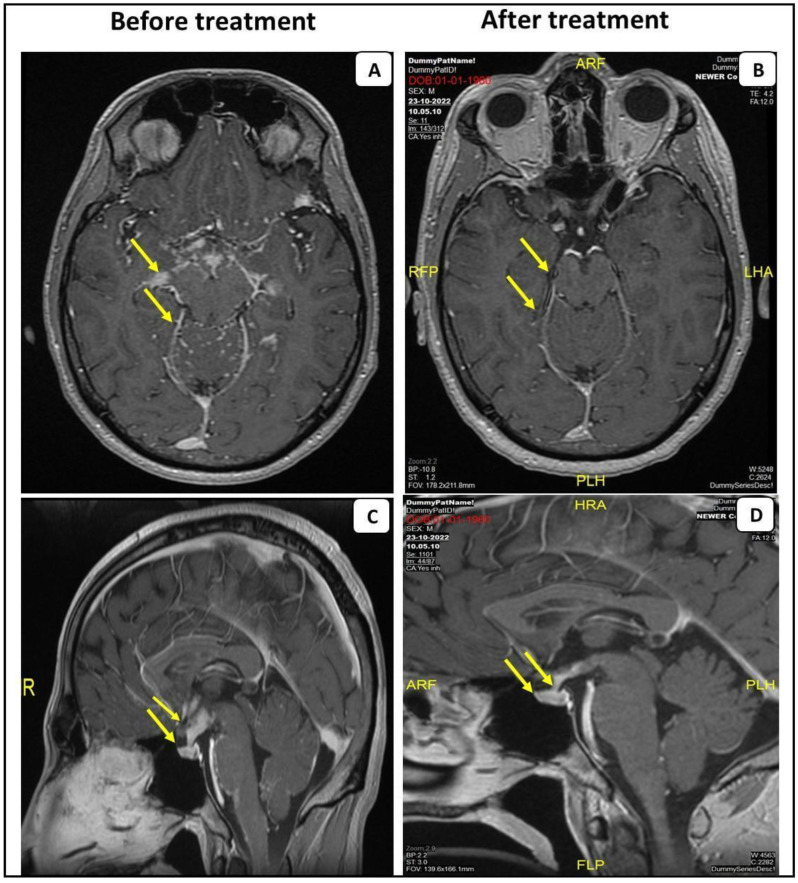
- Case 1: a 34-year-old male with confusion had MRI evidence of a hypothalamic lesion involving the pituitary stalk with leptomeningeal spread; CSF showed 98 white blood cells (lymphocyte-predominant), protein 330 mg/dL, and glucose 30 mg/dL; mediastinal lymph node biopsy showed non-necrotizing granuloma. He received methylprednisolone 1000 mg/day for three sequential days, then prednisone taper plus methotrexate; infliximab 5 mg/kg was added for residual MRI disease, with clinical and imaging improvement.
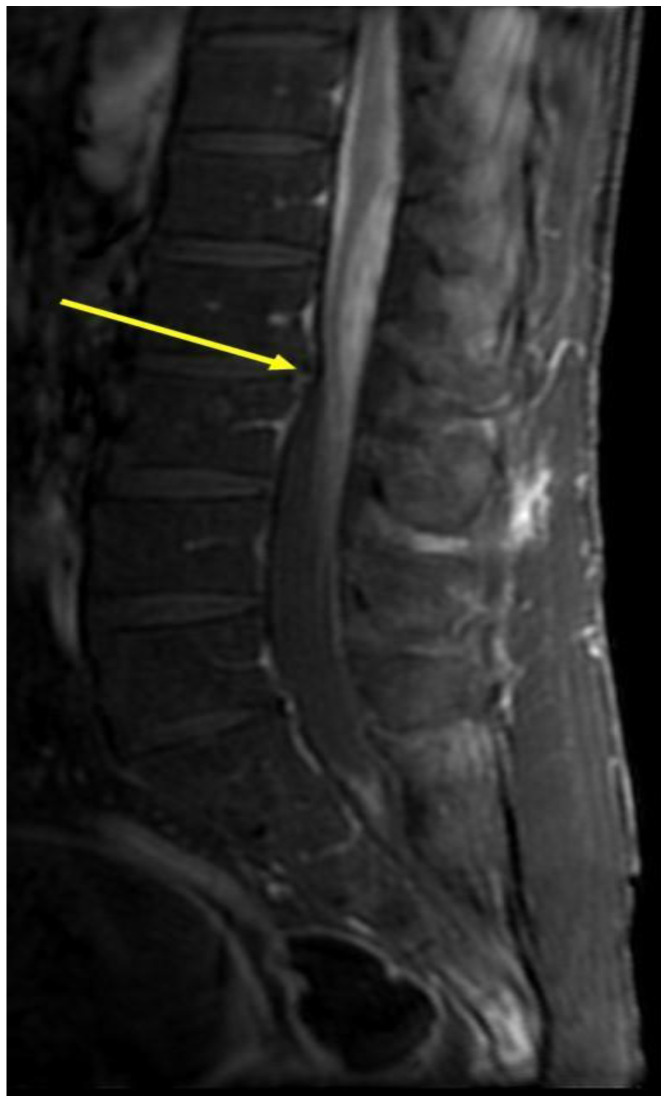
- Case 2: a 49-year-old male with known sarcoidosis presented with left leg weakness, walking difficulty, recurrent falls, and confusion; CSF showed 213 white blood cells, protein 988 mg/dL, and glucose 35 mg/dL; spinal MRI showed lumbar nerve root enhancement and intra-dural CSF space enhancement at the conus medullaris; CSF ACE was very high at 159,000 U/L. Methylprednisolone pulse therapy produced clinical improvement, and infliximab was started after methotrexate and azathioprine failure, with successful prednisone tapering and clinical improvement.
- In reviewed literature, infliximab for CNS sarcoidosis showed a favorable clinical response in 77% (29% complete remission) and a favorable MRI response in 82% (44% complete remission); mortality in neurosarcoidosis remains 5%, and about one third of patients do not experience significant clinical improvement with treatment.
Methods
- Design: case-based review of two cases plus narrative review of neurological involvement, diagnosis, and treatment of neurosarcoidosis.
- Data or sample: two adult male patients (34 and 49 years old) with neurosarcoidosis, alongside cited literature on diagnostic criteria, imaging, CSF findings, and therapies.
- Main analysis: descriptive synthesis of clinical presentation, laboratory and imaging findings, treatment course, and published evidence; no formal statistical analysis or systematic search is described.
Limitations
- Stated limitations: Not stated in the paper.
- Evident from the text: conclusions are based on only two cases and a narrative review, with no control group or systematic review methodology, limiting generalizability.
- Evident from the text: treatment response and safety of infliximab are inferred from the two case courses and cited studies rather than from a prospective comparative trial conducted in this paper.
Model-written summary. Check it against the paper before relying on it.
Integrity signals
Registry
Cites
Statistics
Figures
Verification
Claims the paper makes
0 Valid · 0 Not valid · 26 Not checked · 20 Own results and interpretations
A result the paper reports from its own data — it cites no other source for it, so there is none to check. The quote shows it is in the paper.
In the paper
“Angiotensin converting enzyme (ACE) levels in the CSF were very high (159,000 U/L), which may confirm the diagnosis of neurosarcoidosis.”
§ Neurosarcoidosis: The Presentation, Diagnosis and Treatment Review of Two Cases > 2. Cases Presentation > 2.2. Case 2
plainSingle case- Asserted: passes — The authors put it forward as true.
- Checkable: passes — It can be checked against evidence.
- Load-bearing: passes — The paper’s conclusions depend on it.
- Based: passes — The paper gives a reason why it holds.
A result the paper reports from its own data — it cites no other source for it, so there is none to check. The quote shows it is in the paper.
In the paper
“Both patients were treated with methylprednisolone pulse therapy with rapid, but non-complete, improvement.”
§ Neurosarcoidosis: The Presentation, Diagnosis and Treatment Review of Two Cases > Abstract
plainstates a causen = 2- Asserted: passes — The authors put it forward as true.
- Checkable: passes — It can be checked against evidence.
- Load-bearing: passes — The paper’s conclusions depend on it.
- Based: passes — The paper gives a reason why it holds.
A result the paper reports from its own data — it cites no other source for it, so there is none to check. The quote shows it is in the paper.
In the paper
“The first patient presented with confusion, while the second presented with walking difficulty and neurogenic bladder.”
§ Neurosarcoidosis: The Presentation, Diagnosis and Treatment Review of Two Cases > Abstract
plainSingle case- Asserted: passes — The authors put it forward as true.
- Checkable: passes — It can be checked against evidence.
- Load-bearing: unclear — It is unclear whether the paper’s conclusions depend on it.
- Based: passes — The paper gives a reason why it holds.
A result the paper reports from its own data — it cites no other source for it, so there is none to check. The quote shows it is in the paper.
In the paper
“Due to residual disease on the following brain MRI, intravenous infliximab was added to treatment, 5 mg/kg (0, 2 and 6 weeks of a loading dose and every 8 weeks for maintenance), with subsequent clinical and imaging improvement (Figure 1B,D).”
§ Neurosarcoidosis: The Presentation, Diagnosis and Treatment Review of Two Cases > 2. Cases Presentation > 2.1. Case 1
plainSingle case- Asserted: passes — The authors put it forward as true.
- Checkable: passes — It can be checked against evidence.
- Load-bearing: passes — The paper’s conclusions depend on it.
- Based: passes — The paper gives a reason why it holds.
A result the paper reports from its own data — it cites no other source for it, so there is none to check. The quote shows it is in the paper.
In the paper
“Methylprednisolone pulse therapy was initiated with subsequent clinical improvement.”
§ Neurosarcoidosis: The Presentation, Diagnosis and Treatment Review of Two Cases > 2. Cases Presentation > 2.2. Case 2
plainstates a causeSingle case- Asserted: passes — The authors put it forward as true.
- Checkable: passes — It can be checked against evidence.
- Load-bearing: unclear — It is unclear whether the paper’s conclusions depend on it.
- Based: passes — The paper gives a reason why it holds.
14 more claims
Create a free account to see all 46 claims and to verify the 68 references still open.
- It may state two separate claims as one. 18
- Probably not a substantial claim. 12
Self-check
Percentages, sums and reported differences re-computed from the paper’s own numbers.
Each contradiction between two passages listed here was confirmed by an independent check.
Rated minor: it would not touch a result — a value no result rests on, a p-value that stays on the same side of the significance level, or a conflict that is clerical, resolved elsewhere in the paper, or outside its own findings.
In the paper
§ Neurosarcoidosis: The Presentation, Diagnosis and Treatment Review of Two Cases > 4. Diagnosis of Neurosarcoidosis > 4.1. Treatment
“In 2017, a multi-institutional study reported a benefit of the use of infliximab for CNS sarcoidosis [30].”
§ Neurosarcoidosis: The Presentation, Diagnosis and Treatment Review of Two Cases > References
“30. Hutto S.K. Kyle K. Cavanagh J.J. Reda H. Venna N. Adalimumab for CNS sarcoidosis: Single-center experience and literature review J. Neurol. 2022 269 2064 2072 10.1007/s00415-021-10793-2 34487233”
Rated minor: it would not touch a result — a value no result rests on, a p-value that stays on the same side of the significance level, or a conflict that is clerical, resolved elsewhere in the paper, or outside its own findings.
In the paper
§ Neurosarcoidosis: The Presentation, Diagnosis and Treatment Review of Two Cases > 2. Cases Presentation > 2.2. Case 2
“Angiotensin converting enzyme (ACE) levels in the CSF were very high (159,000 U/L), which may confirm the diagnosis of neurosarcoidosis.”
§ Neurosarcoidosis: The Presentation, Diagnosis and Treatment Review of Two Cases > 4. Diagnosis of Neurosarcoidosis
“The ACE level is not a biomarker because it increases in proportion to CSF proteins and is elevated in many inflammatory and infective diseases in which the protein content is elevated [20].”
Citations
Cites
Clinical Characteristics of Patients in a Case Control Study of Sarcoidosis
BAUGHMAN, R. P., TEIRSTEIN, A. S., JUDSON, M. A., ROSSMAN, M. D., YEAGER, H., BRESNITZ, E. A., DePALO, L., HUNNINGHAKE, G., IANNUZZI, M. C., JOHNS, C. J., et al. (2001) · American Journal of Respiratory and Critical Care Medicine · doi:10.1164/ajrccm.164.10.2104046 · Cited by 1,808 · cited 2×
“Any tissue can be affected, although the lungs, skin, eyes and liver are the most commonly affected [1–3].”
BackgroundValeyre, D., Prasse, A., Nunes, H., Uzunhan, Y., Brillet, P.-Y., & Müller-Quernheim, J. (2014) · The Lancet · doi:10.1016/s0140-6736(13)60680-7 · Cited by 1,087 · cited 8×
“Sarcoidosis is a multisystemic inflammatory disease characterized by the formation of non-caseating granulomas in various organ systems, mainly in the lungs and lymphatic system [1,2].”
BackgroundInfluentialCrouser, E. D., Maier, L. A., Wilson, K. C., Bonham, C. A., Morgenthau, A. S., Patterson, K. C., Abston, E., Bernstein, R. C., Blankstein, R., Chen, E. S., et al. (2020) · American Journal of Respiratory and Critical Care Medicine · doi:10.1164/rccm.202002-0251st · Cited by 1,086
Infliximab Therapy in Patients with Chronic Sarcoidosis and Pulmonary Involvement
Baughman, R. P., Drent, M., Kavuru, M., Judson, M. A., Costabel, U., du Bois, R., Albera, C., Brutsche, M., Davis, G., Donohue, J. F., et al. (2006) · American Journal of Respiratory and Critical Care Medicine · doi:10.1164/rccm.200603-402oc · Cited by 714 · cited 1×
“Although new treatments such as TNF-alpha antagonists are increasingly used, the mortality rate in patients with neurosarcoidosis remains at 5% and about one third of patients do not experience significant clinical improvement with treatment [21,22,28,29].”
BackgroundERS clinical practice guidelines on treatment of sarcoidosis
Baughman, R. P., Valeyre, D., Korsten, P., Mathioudakis, A. G., Wuyts, W. A., Wells, A., Rottoli, P., Nunes, H., Lower, E. E., Judson, M. A., et al. (2021) · European Respiratory Journal · doi:10.1183/13993003.04079-2020 · Cited by 629 · cited 6×
“The goal of the treatment of neurosarcoidosis is to reduce or prevent damage to organ systems from the deleterious effects of granulomatous inflammation and to minimize the toxic effects of long-term glucocorticoid treatment [18,21–38].”
BackgroundInfluentialStern, B. J., Royal, W., Gelfand, J. M., Clifford, D. B., Tavee, J., Pawate, S., Berger, J. R., Aksamit, A. J., Krumholz, A., Pardo, C. A., et al. (2018) · JAMA Neurology · doi:10.1001/jamaneurol.2018.2295 · Cited by 398 · cited 2×
“Neurological symptoms represent the first defining manifestation of sarcoidosis in almost 50% of cases [6,7].”
BackgroundClinical features, treatment and outcome in neurosarcoidosis: systematic review and meta-analysis
Fritz, D., van de Beek, D., & Brouwer, M. C. (2016) · BMC Neurology · doi:10.1186/s12883-016-0741-x · Cited by 385 · cited 2×
“A systematic review showed that the mortality seen in the majority of the studies ranges from 0 to 33% [23].”
BackgroundNeurosarcoidosis: Pathophysiology, Diagnosis, and Treatment
Bradshaw, M. J., Pawate, S., Koth, L. L., Cho, T. A., & Gelfand, J. M. (2021) · Neurology Neuroimmunology & Neuroinflammation · doi:10.1212/nxi.0000000000001084 · Cited by 282
Infection risk associated with anti-TNF-α agents: a review
Murdaca, G., Spanò, F., Contatore, M., Guastalla, A., Penza, E., Magnani, O., & Puppo, F. (2015) · Expert Opinion on Drug Safety · doi:10.1517/14740338.2015.1009036 · Cited by 186 · cited 1×
“Hepatitis B and C and HIV should be ruled out as well and the patients should be vaccinated according to guidelines, including pneumococcal, influenza and herpes zoster virus vaccines [25].”
BackgroundInfliximab for the treatment of CNS sarcoidosis: A multi-institutional series
Gelfand, J. M., Bradshaw, M. J., Stern, B. J., Clifford, D. B., Wang, Y., Cho, T. A., Koth, L. L., Hauser, S. L., Dierkhising, J., Vu, N., et al. (2017) · Neurology · doi:10.1212/wnl.0000000000004644 · Cited by 183 · cited 2×
“%) of patients [29,30].”
Background
Cited by
Sarcoidosis: federal clinical guidelines 2025
Чучалин, А. Г., Avdeev, S. N., Vizel, A. A., Айсанов, З. Р., Baranova, O., Belevskiy, А. S., Borisov, S. E., Vasilyeva, I. A., Vizel, I. Y., Vasilev, I. V., et al. (2026) · PULMONOLOGIYA · doi:10.18093/0869-0189-2026-36-3-389-413 · Cited by 3
Neurosarcoidosis: symptoms, diagnosis, and treatment – current state of knowledge
Mazurkiewicz, M. A., & Skrzypczak, I. S. (2025) · Aktualności Neurologiczne · doi:10.15557/an.2025.0002 · Cited by 1
An Atypical Presentation of a Patient With Neurosarcoidosis: A Case Report
Tam, R., Howard, S., Jimenez-Artiles, M., Sharma, M., & Makdisy, F. (2024) · Cureus · doi:10.7759/cureus.68229 · Cited by 1
“On the other hand, the involvement of cranial nerves III, IV, V, VI, and VIII is less commonly affected [2].”
BackgroundInfluentialZheng, A. X., Chiu, R. G., Secola, S. A., & Payne, R. A. (2024) · Cureus · doi:10.7759/cureus.73241 · Cited by 1
Beggerow, R., Silva, M. D., & Wijeratne, T. (2025) · Cureus · doi:10.7759/cureus.87926 · Cited by 1
Metadata
- Authors
- Basheer, M., Waked, H., Jeries, H., Azrilin, O., Paz, D., Assy, N., Naffaa, M. E., & Badarny, S.
- Affiliations
- Western Galilee Hospital (IL)
- Bar-Ilan University (IL)
- Corresponding author
- Basheer, Maamoun
- Waked, Hamd
- Venue
- Life
- Publisher
- MDPI AG
- Published
- 2023-12-31
- Volume
- 14
- Issue
- 1
- Pages
- 69
- ISSN
- 2075-1729 (ISSN-L)
- PMC
- PMC10820900
- OpenAlex
- W4390467165
- Semantic Scholar
- 082546fb7ac4a947014153c70beddafbea35fd35
- Cited by
- 11
- References
- 38
- Citations by year
- 2026: 4 · 2025: 3 · 2024: 4
- FWCI
- 0.43
- Type
- journal article
- Language
- en
- Open access
- gold
- doi.org
- Licence
- Locations
- Life (publishedVersion, cc-by)
- PubMed Central (publishedVersion, cc-by)
- PubMed (publishedVersion)
- DOAJ (DOAJ: Directory of Open Access Journals) (submittedVersion)
- Topics
- Health Sciences › Medicine › Pulmonary and Respiratory Medicine › Sarcoidosis and Beryllium Toxicity Research
- Health Sciences › Medicine › Hematology › Histiocytic Disorders and Treatments
- Health Sciences › Medicine › Rheumatology › Vasculitis and related conditions
- Keywords
- neurosarcoidosis, sarcoidosis, non-caseating granulomas, infliximab, anti-TNF therapy, methylprednisolone pulse therapy, neurogenic bladder, confusion, spinal cord involvement, glucocorticoid adverse effects, diagnosis
About these checks
Registry, retraction, Cites and statistics results are computed, not judged, with one exception: a printed reference that no index lists is read once by a model before it counts as a citation error. Claims are extracted by a model and kept only when their quote appears verbatim in the text; each cited source is then checked, with a model’s help, for whether it says what the claim relies on. Those verdicts can be wrong — read the claim’s quote and the cited source before relying on one.
A language model drew the claims from the paper on 2026-11-27, under version 3 of the claim definition (model deepseek-v4.1-flash, prompt extract-v3).
A second model labelled each claim on 2026-11-27 (model jev-1.13-20260917, definition revision gold-guideline-v0.2).
Statistics and arithmetic are recomputed, not judged.
Confidence bands are shown only for fields calibrated on our annotated test set. None is calibrated yet, so no band is shown.
What counts as a claim ›How we measure confidence ›How we check this ›
Are you an author, or do you see a problem with this page? Request a review
How to cite
Cite CoChat for the checks on this page, and the paper for its own findings.
- This page
- CoChat. (2026). Citation check: Neurosarcoidosis: The Presentation, Diagnosis and Treatment Review of Two Cases. https://app.cochat.ai/papers/10.3390/life14010069
- The paper
- Basheer, M., Waked, H., Jeries, H., Azrilin, O., Paz, D., Assy, N., Naffaa, M. E., & Badarny, S. (2023). Neurosarcoidosis: The Presentation, Diagnosis and Treatment Review of Two Cases. Life. https://doi.org/10.3390/life14010069
Data sources
Bibliographic data: Semantic Scholar, OpenAlex, Crossref.
Contains information from the Semantic Scholar Academic Graph Datasets, made available under the ODC Attribution License (ODC-BY 1.0).
Semantic Scholar’s data is described in: Kinney, R., et al. (2023). The Semantic Scholar Open Data Platform. arXiv:2301.10140.
