

The DOI matches its Crossref record; 151 of the 152 references it cites were found in a registry or an index.
Terpenoids and Their Biosynthesis in Cyanobacteria
Open accessAbstract
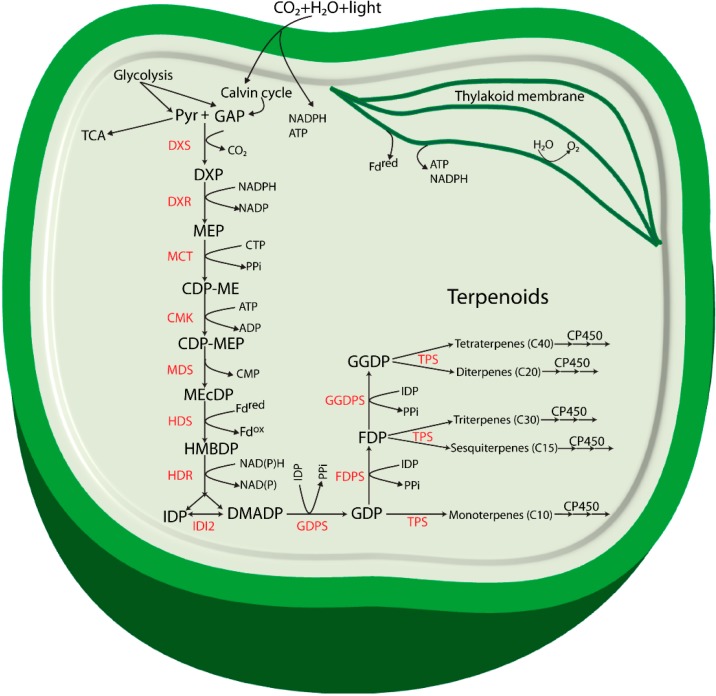
Terpenoids, or isoprenoids, are a family of compounds with great structural diversity which are essential for all living organisms. In cyanobacteria, they are synthesized from the methylerythritol-phosphate (MEP) pathway, using glyceraldehyde 3-phosphate and pyruvate produced by photosynthesis as substrates. The products of the MEP pathway are the isomeric five-carbon compounds isopentenyl diphosphate and dimethylallyl diphosphate, which in turn form the basic building blocks for formation of all terpenoids. Many terpenoid compounds have useful properties and are of interest in the fields of pharmaceuticals and nutrition, and even potentially as future biofuels. The MEP pathway, its function and regulation, and the subsequent formation of terpenoids have not been fully elucidated in cyanobacteria, despite its relevance for biotechnological applications. In this review, we summarize the present knowledge about cyanobacterial terpenoid biosynthesis, both regarding the native metabolism and regarding metabolic engineering of cyanobacteria for heterologous production of non-native terpenoids.
Overview
The claims and statistics of this paper haven’t been checked yet.
Run the check — free, no account needed. It reads the open-access text and checks the sources it cites.
Integrity signals
Registry
Cites
Statistics
Figures
Verification
Claims the paper makes
The claims and statistics of this paper haven’t been checked yet.
Run the check — free, no account needed. It reads the open-access text and checks the sources it cites.
Claims other papers make about this one
Each is checked against this paper’s own text: does it say what the citing paper says it does?
The cited source says what the claim attributes to it.
In the citing paper
“terpenoids from the MEP pathway, which uses pyruvate and glyceraldehyde-3-phosphate as precursors [29]”
From Cyanobacteria as a Photosynthetic Chassis for Metabolic Pathway Engineering with Heterologous Gene Expression (2026) · cites this paper as [29]
Self-check
Percentages, sums and reported differences re-computed from the paper’s own numbers.
The self-check needs the paper’s full text.
Citations
Cites
1 retracted
RETRACTED: Cyanobacteria and microalgae: A positive prospect for biofuels
Parmar, A., Singh, N. K., Pandey, A., Gnansounou, E., & Madamwar, D. (2011) · Bioresource Technology · doi:10.1016/j.biortech.2011.08.030 · Cited by 542
RetractedHandbook of Hydrocarbon and Lipid Microbiology
Timmis, K. N. (2009) · Springer eBooks · doi:10.1007/978-3-540-77587-4 · Cited by 1,959
Engineering a mevalonate pathway in Escherichia coli for production of terpenoids
Martin, V. J. J., Pitera, D. J., Withers, S. T., Newman, J. D., & Keasling, J. D. (2003) · Nature Biotechnology · doi:10.1038/nbt833 · Cited by 1,720
Rohmer, M., Knani, M., Simonin, P., Sutter, B., & Sahm, H. (1993) · Biochemical Journal · doi:10.1042/bj2950517 · Cited by 1,200
Rohmer, M., & Rohmer, M. (1999) · Natural Product Reports · doi:10.1039/a709175c · Cited by 1,193
Microbial engineering for the production of advanced biofuels
Peralta‐Yahya, P., Zhang, F., del Cardayré, S. B., & Keasling, J. D. (2012) · Nature · doi:10.1038/nature11478 · Cited by 1,100
Cytochromes P450: a success story.
Werck‐Reichhart, D., & Feyereisen, R. (2000) · Genome biology · doi:10.1186/gb-2000-1-6-reviews3003 · Cited by 962
Beta-caryophyllene is a dietary cannabinoid.
Gertsch, J., Leonti, M., Raduner, S., Racz, I., Chen, J.-Z., Xie, X.-Q., Altmann, K.-H., Karsak, M., & Zimmer, A. (2008) · Proceedings of the National Academy of Sciences · doi:10.1073/pnas.0803601105 · Cited by 906
Terpene synthases and the regulation, diversity and biological roles of terpene metabolism
Tholl, D. (2006) · Current Opinion in Plant Biology · doi:10.1016/j.pbi.2006.03.014 · Cited by 886
Isoprenoid biosynthesis: The evolution of two ancient and distinct pathways across genomes
Lange, B. M., Rujan, T., Martin, W., & Croteau, R. (2000) · Proceedings of the National Academy of Sciences · doi:10.1073/pnas.240454797 · Cited by 881
Research works printed but not linked: 1
- Ramawat, K.G., and Mérillon, J.-M. (2013). Natural Products, Springer. · DOI
Cited by
Sorted by citations
Singh, R., Parihar, P., Singh, M., Bajguz, A., Kumar, J., Singh, S., Singh, V. P., & Prasad, S. M. (2017) · Frontiers in Microbiology · doi:10.3389/fmicb.2017.00515 · Cited by 399
Natural Products from Cyanobacteria: Focus on Beneficial Activities
Demay, J., Bernard, C., Reinhardt, A., & Marie, B. (2019) · Marine Drugs · doi:10.3390/md17060320 · Cited by 346
Cpf1 Is a Versatile Tool for CRISPR Genome Editing Across Diverse Species of Cyanobacteria
Ungerer, J., & Pakrasi, H. B. (2016) · Scientific Reports · doi:10.1038/srep39681 · Cited by 308
Metabolic engineering of cyanobacteria for the synthesis of commodity products
Angermayr, S. A., Gorchs Rovira, A., & Hellingwerf, K. J. (2015) · Trends in Biotechnology · doi:10.1016/j.tibtech.2015.03.009 · Cited by 273
Gonçalves, A. L. (2021) · Applied Sciences · doi:10.3390/app11020871 · Cited by 280
Metadata
- Authors
- Pattanaik, B., & Lindberg, P.
- Affiliations
- Uppsala University (SE)
- Corresponding author
- Lindberg, Pia
- ORCID
- Lindberg, Pia
- Venue
- Life
- Publisher
- MDPI AG
- Published
- 2015-01-21
- Volume
- 5
- Issue
- 1
- Pages
- 269-293
- ISSN
- 2075-1729 (ISSN-L)
- PMC
- PMC4390852
- OpenAlex
- W2058582378
- Cited by
- 173
- References
- 152
- Citations by year
- 2026: 10 · 2025: 9 · 2024: 25 · 2023: 19 · 2022: 15 · 2021: 19 · 2020: 29 · 2019: 13 · 2018: 12 · 2017: 10 · 2016: 8 · 2015: 4
- FWCI
- 1.10
- Type
- journal article
- Language
- en
- Open access
- gold
- doi.org
- Licence
- Locations
- Life (publishedVersion, cc-by)
- Europe PMC (PubMed Central) (publishedVersion, cc-by)
- PubMed Central (publishedVersion, cc-by)
- PubMed (publishedVersion)
- DOAJ (DOAJ: Directory of Open Access Journals) (submittedVersion, cc-by-sa)
- Funders
- Carl Tryggers Stiftelse för Vetenskaplig Forskning
- Knut och Alice Wallenbergs Stiftelse
- Energimyndigheten
- Topics
- Life Sciences › Biochemistry, Genetics and Molecular Biology › Molecular Biology › Plant biochemistry and biosynthesis
- Life Sciences › Biochemistry, Genetics and Molecular Biology › Molecular Biology › Microbial Metabolic Engineering and Bioproduction
- Life Sciences › Immunology and Microbiology › Applied Microbiology and Biotechnology › Microbial Natural Products and Biosynthesis
- Keywords
- terpenoids, cyanobacteria, methylerythritol phosphate pathway, isopentenyl pyrophosphate, dimethylallyl diphosphate, terpenoid biosynthesis, metabolic engineering, heterologous production, biofuels
About these checks
Registry, retraction, Cites and statistics results are computed, not judged, with one exception: a printed reference that no index lists is read once by a model before it counts as a citation error. Claims are extracted by a model and kept only when their quote appears verbatim in the text; each cited source is then checked, with a model’s help, for whether it says what the claim relies on. Those verdicts can be wrong — read the claim’s quote and the cited source before relying on one.
Statistics and arithmetic are recomputed, not judged.
Confidence bands are shown only for fields calibrated on our annotated test set. None is calibrated yet, so no band is shown.
What counts as a claim ›How we measure confidence ›How we check this ›
Are you an author, or do you see a problem with this page? Request a review
