

Coupled Phases and Combinatorial Selection in Fluctuating Hydrothermal Pools: A Scenario to Guide Experimental Approaches to the Origin of Cellular Life
Open accessThe DOI matches its Crossref record; 37 of the 37 references it cites were found in a registry or an index.
Abstract
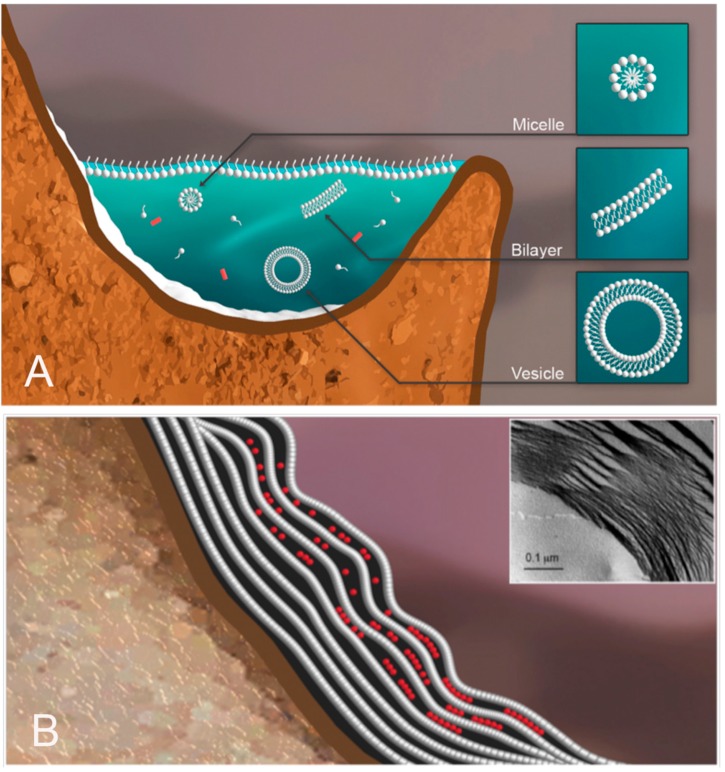
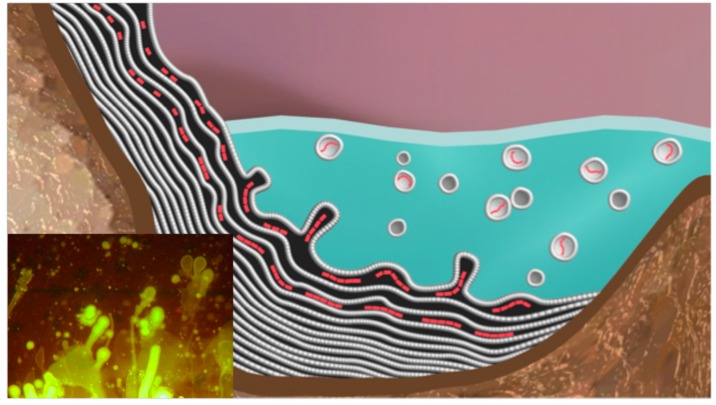
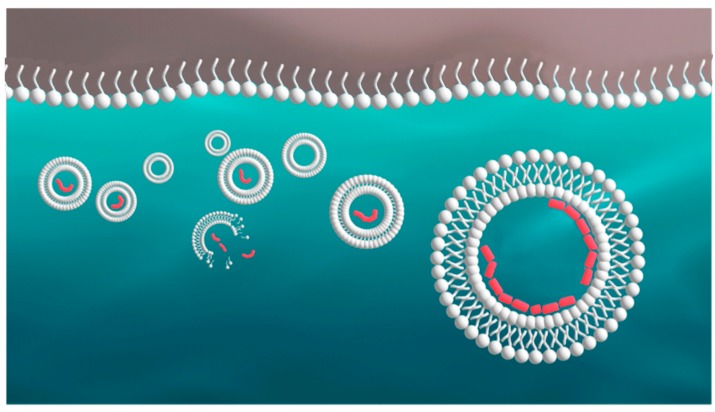
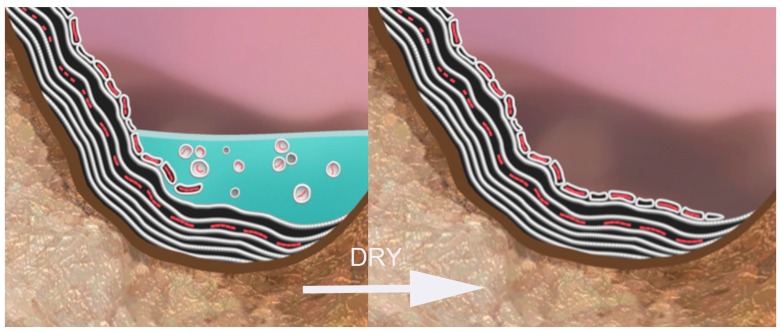
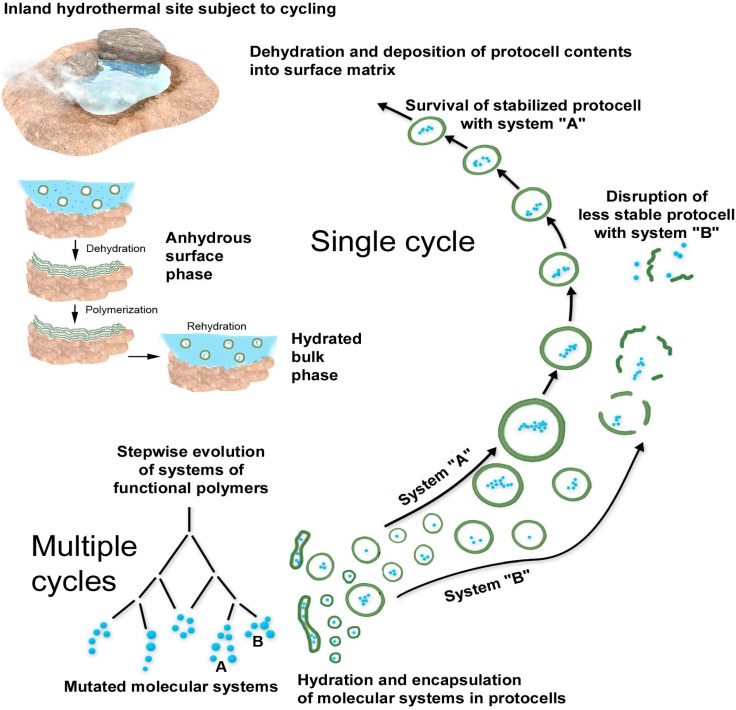
Hydrothermal fields on the prebiotic Earth are candidate environments for biogenesis. We propose a model in which molecular systems driven by cycles of hydration and dehydration in such sites undergo chemical evolution in dehydrated films on mineral surfaces followed by encapsulation and combinatorial selection in a hydrated bulk phase. The dehydrated phase can consist of concentrated eutectic mixtures or multilamellar liquid crystalline matrices. Both conditions organize and concentrate potential monomers and thereby promote polymerization reactions that are driven by reduced water activity in the dehydrated phase. In the case of multilamellar lipid matrices, polymers that have been synthesized are captured in lipid vesicles upon rehydration to produce a variety of molecular systems. Each vesicle represents a protocell, an “experiment” in a natural version of combinatorial chemistry. Two kinds of selective processes can then occur. The first is a physical process in which relatively stable molecular systems will be preferentially selected. The second is a chemical process in which rare combinations of encapsulated polymers form systems capable of capturing energy and nutrients to undergo growth by catalyzed polymerization. Given continued cycling over extended time spans, such combinatorial processes will give rise to molecular systems having the fundamental properties of life.
Overview
The claims and statistics of this paper haven’t been checked yet.
Free: it reads the open-access text and checks the first 5 claims that cite a source we can check. Create a free account to check every claim.
Integrity signals
Registry
Cites
Statistics
Figures
Verification
Claims the paper makes
The claims and statistics of this paper haven’t been checked yet.
Free: it reads the open-access text and checks the first 5 claims that cite a source we can check. Create a free account to check every claim.
Claims other papers make about this one
Each is checked against this paper’s own text: does it say what the citing paper says it does?
The cited source says what the claim attributes to it.
In the citing paper
“If some of the organics were amphiphilic compounds, they would self-assemble into vast numbers of microscopic membranous compartments called protocells that encapsulate systems of potential reactants and products [11].”
From The Role of Lipid Membranes in Life’s Origin (2017) · cites this paper as [11]
The cited source says what the claim attributes to it.
In the citing paper
“We have proposed (Damer and Deamer, 2015; Deamer, 2019) that the first selective step initiating evolution in a population of protocells is that polymers interact with the membranes in such a way that the protocells become more resistant to environmental stresses such as shear forces.”
From The Hot Spring Hypothesis for an Origin of Life (2020) · cites this paper as Damer and Deamer, 2015
The cited source says what the claim attributes to it.
In the citing paper
“Whether or not this was really the case (indeed, cells could have emerged in a number of environments around the globe), it is possible that various prebiotic molecules could have been formed in a variety of environments, ranging from subaerial springs (Damer and Deamer 2015), to coastal volcanic splash pools (Fox and Strasdeit 2013), to pumice rafts (Brasier et al. 2011), or submarine”
From The Emergence of Life (2019) · cites this paper as Damer and Deamer 2015
Self-check
Percentages, sums and reported differences re-computed from the paper’s own numbers.
The self-check needs the paper’s full text.
Citations
Cites
Phylogenetic Classification and the Universal Tree
Doolittle, W. F. (1999) · Science · doi:10.1126/science.284.5423.2124 · Cited by 1,888 · cited 1×
“[7] and Doolittle [8] that the first forms of life continuously exchanged genetic information rather than existing as individual organisms.”
BackgroundHydrothermal vents and the origin of life
Martin, W., Baross, J., Kelley, D., & Russell, M. J. (2008) · Nature Reviews Microbiology · doi:10.1038/nrmicro1991 · Cited by 1,608 · cited 1×
“Two such sites have been proposed, one associated with submarine hydrothermal activity [1,2] and a second associated with volcanic land-masses emerging through a global ocean [3].”
BackgroundChyba, C., & Sagan, C. (1992) · Nature · doi:10.1038/355125a0 · Cited by 1,321 · cited 1×
“This fact makes it plausible that they were likely to be available in the prebiotic environment, either delivered during late accretion or synthesized geochemically [30–32].”
BackgroundIsolation of New Ribozymes from a Large Pool of Random Sequences
Bartel, D. P., & Szostak, J. W. (1993) · Science · doi:10.1126/science.7690155 · Cited by 900 · cited 1×
“In an earlier demonstration of the power of large numbers, Bartel and Szostak [37] exposed random sequence RNA to cycles of selection and amplification, with the selection target being ligase activity.”
BackgroundOrganic compounds in carbonaceous meteorites
Sephton, M. A. (2002) · Natural Product Reports · doi:10.1039/b103775g · Cited by 704
FtsZ in Bacterial Cytokinesis: Cytoskeleton and Force Generator All in One
Erickson, H. P., Anderson, D. E., & Osawa, M. (2010) · Microbiology and Molecular Biology Reviews · doi:10.1128/mmbr.00021-10 · Cited by 638 · cited 1×
“The first D-polymer may have been a primitive version of FtsZ protein that forms a contractile ring in today's bacteria and is required for cell division [29].”
BackgroundSegré, D., Ben-Eli, D., Deamer, D. W., & Lancet, D. (2001) · Origins of life and evolution of the biosphere · doi:10.1023/a:1006746807104 · Cited by 620
Self-citationOrigin of first cells at terrestrial, anoxic geothermal fields
Mulkidjanian, A. Y., Bychkov, A. Y., Dibrova, D. V., Galperin, M. Y., & Koonin, E. V. (2012) · Proceedings of the National Academy of Sciences · doi:10.1073/pnas.1117774109 · Cited by 447 · cited 1×
“Two such sites have been proposed, one associated with submarine hydrothermal activity [1,2] and a second associated with volcanic land-masses emerging through a global ocean [3].”
BackgroundCollective evolution and the genetic code
Vetsigian, K., Woese, C., & Goldenfeld, N. (2006) · Proceedings of the National Academy of Sciences · doi:10.1073/pnas.0603780103 · Cited by 379
A Reassessment of Prebiotic Organic Synthesis in Neutral Planetary Atmospheres
Cleaves, H. J., Chalmers, J. H., Lazcano, A., Miller, S. L., & Bada, J. L. (2008) · Origins of Life and Evolution of Biospheres · doi:10.1007/s11084-007-9120-3 · Cited by 313 · cited 1×
“Two obvious possibilities, not mutually exclusive, include the continuous influx of organic material on interplanetary dust particles that is still occurring today [34], synthesis in the atmosphere [35] or volcanic geochemical processes [36].”
Background
Cited by
Items 201–300 of 310
Paleos, C. M. (2019) · Astrobiology · doi:10.1089/ast.2018.1832 · Cited by 5
“T he origin of life remains an unsolved scientific challenge (Luisi et al. , 1999; Bada and Lazcano, 2002; Heckl, 2002; Monnard and Deamer, 2002; Rafelski and Marshall, 2008; Tirard et al. , 2010; Mann, 2012; Root-Bernstein, 2012; Damer and Deamer, 2015; Krishnamurthy, 2017).”
Galactic distribution of chirality sources of organic molecules
Helman, D. S. (2018) · Acta Astronautica · doi:10.1016/j.actaastro.2018.07.008 · Cited by 3
“ubstrates for cell-like structures. Galena is a sulfide mineral that is abundant in the mid-ocean ridge environment as well as others, such as geothermal fields, where abiogenesis may have occurred [24]. Alunite and serpentine are secondary (alteration) minerals; they are significant if the origin of life occurs in we…”
BackgroundTo What Inanimate Matter Are We Most Closely Related and Does the Origin of Life Harbor Meaning?
Martin, W. F., Nagies, F. S. P., & Vieira, A. D. N. (2021) · Philosophies · doi:10.3390/philosophies6020033 · Cited by 3
Circular at the very beginning: on the initial genomes in the RNA world
Luo, Y., Liang, M., Yu, C., & Ma, W. (2024) · RNA Biology · doi:10.1080/15476286.2024.2380130 · Cited by 2
“In reality, the energy source may have involved chemical energy in the hatchery of the primordial life, such as hydrothermal vents at the sea bottom [68–70] or hydrothermal fields on land [71,72], as supposed.”
Ignatov, I. (2025) · Hydrogen · doi:10.3390/hydrogen6030067 · Cited by 2
“This is a static concentration-based approximation conceptually inspired by molecular dynamics but not involving real simulations or interaction potentials [40], combined with volumetric concentration-based methods commonly applied in systems biology and prebiotic modeling [34].”
Shinoda, T., Noda, N. N., Watanabe, T., Kaneko, K., Sekine, Y., & Matsuura, T. (2025) · Chemical Science · doi:10.1039/d5sc04710b · Cited by 3
Robust Synthesis of Prebiotic Precursors in Drying Reactions of Amino Acids and Keto Acids
Marland, E., Lipson, G., Edri, R., Cohen, O., Guzmán-Martínez, A., Shalev, O., Salván, C. M., & Frenkel‐Pinter, M. (2025) · ChemSystemsChem · doi:10.1002/syst.202500018 · Cited by 2
Damer, B., & Deamer, D. W. (2026) · Astrobiology · doi:10.1177/15311074261428661 · Cited by 3
“Alternatively, it is the cycling stream of encapsulated polymers, coupling between lipid-bounded wet – dry encapsulation, which would collectively engage the battery of available selective processes driving molecular evolution (Damer and Deamer, 2015).”
Self-citationProgress and persistent questions in understanding the origin of life on Earth
Ansari, A. H. (2026) · Discover Life · doi:10.1007/s11084-026-09753-5 · Cited by 2
“Several research groups conducted theoretical and experimental experiments to further develop this idea [53, 179, 226, 372–376].”
Abiotic Synthesis and Role of Amphiphiles in the Encapsulation Process in Life’s Origin
Lopez, A., Chieffo, C., & Fiore, M. (2021) · Advances in astrobiology and biogeophysics · doi:10.1007/978-3-030-81039-9_6 · Cited by 4
An Aminoisoxazole‐Based Proto‐RNA
Xu, F., Wiedemann, S., Feldmann, J., Becker, S. M., & Carell, T. (2023) · ChemistryEurope · doi:10.1002/ceur.202300057 · Cited by 2
Spontaneous Emergence of Lipid Vesicles in a Coacervate‐Based Compartmentalized System
Yin, C., Yu, X., Wu, B., & Tian, L. (2024) · Angewandte Chemie · doi:10.1002/ange.202414372 · Cited by 3
The Origin and Early Evolution of Life: Prebiotic Chemistry of Biomolecules
Fiore, M. (2019) · MDPI eBooks · doi:10.3390/books978-3-03921-607-9 · Cited by 2
Ma, W., & Liang, Y. (2022) · Royal Society of Chemistry eBooks · doi:10.1039/9781839164798-00347 · Cited by 3
Kauffman, S. A., & Lehman, N. (2022) · OSF Preprints (OSF Preprints) · doi:10.31219/osf.io/mev9d · Cited by 3
Nonenzymatic template-directed replication using 2′-3′ cyclic nucleotides under wet-dry cyclesPreprint
Dagar, S., Sarkar, S., & Rajamani, S. (2022) · bioRxiv · doi:10.1101/2022.07.11.499554 · Cited by 1
“Lipids have been shown to form multilamellar films during the dry phase, which upon rehydration can encapsulate the surrounding solutes (e.g. informational oligomers), resulting in protocell-like entities (20– 22).”
BackgroundHow to Make a Transmembrane Domain at the Origin of Life
Gordon, R., & Gordon, N. K. (2023) · Wiley eBooks · doi:10.1002/9781119555568.ch7 · Cited by 2
Prebiotic Gas Flow Environment Enables Isothermal Nucleic Acid ReplicationPreprint
Schwintek, P., Eren, E., Mast, C. B., & Braun, D. (2024) · eLife · doi:10.7554/elife.100152.2 · Cited by 2
Physical aspects of origins of life scenarios
Blokhuis, A. W. P. (2019) · theses.fr (ABES) · doi:10.70675/6cda43e2za86ez4758z9553zae340bcda014 · Cited by 5
Theoretical perspective on synthetic man‐made life: Learning from the origin of life
Lu, P., Zhang, Z., Wang, X., Qiu, W., Zhou, L., Xiao, H. J., Liu, C., Tang, S., Qin, Z., Jiang, J., et al. (2023) · Quantitative Biology · doi:10.1002/qub2.22 · Cited by 1
“As in Damer and Deamer’s theory, it was postulated that forming the lipid membrane in water ponds is the kick ‐ off of the emergence of life, with these membranes featuring many pores that selectively filter incoming and outgoing molecules [64].”
Saha, R., Poduval, P., Baratam, K., Nagesh, J., & Srivastava, A. K. (2024) · The Journal of Physical Chemistry B · doi:10.1021/acs.jpcb.3c08061 · Cited by 1
Reflections on the Origin of Coded Protein Biosynthesis
Fontecilla-Camps, J. C. (2024) · Biomolecules · doi:10.3390/biom14050518 · Cited by 2
“In fact, these cycles have been considered to be essential for the evolution of the metabolism and proto-cells [39,40].”
BackgroundPrebiotic gas flow environment enables isothermal nucleic acid replication
Schwintek, P., Eren, E., Mast, C. B., & Braun, D. (2025) · eLife · doi:10.1101/2024.06.13.598889 · Cited by 1
“These strands must separate again to complete 43 a full replication cycle.”
The master molecule that built biology: How water shaped the chemistry of life
Digiacomo, J. C., Rose, G., & Williams, L. D. (2026) · Protein Science · doi:10.1002/pro.70532 · Cited by 2
Membranes as the earliest entropy resisting structures in the origin of life
Laouris, Y. (2026) · Discover Life · doi:10.1007/s11084-026-09730-y · Cited by 3
“A growing body of research suggests that a near-universal feature of extant life is compartmentalization, i.e., the presence of boundaries that help sustain internal chemistry, enable selective exchange with the environment, and support energy transduction [12, 17, 36, 57].”
Membranes Composed of Lipopeptides and Liponucleobases Inspired Protolife Evolution
Sproul, G. D. (2019) · Origins of Life and Evolution of Biospheres · doi:10.1007/s11084-019-09587-4 · Cited by 1
Hitting Times of Some Critical Events in RNA Origins of Life
Bastian, C. D., & RABITZ, H. A. (2021) · Life · doi:10.3390/life11121419 · Cited by 1
Prebiotic Amphiphiles: The Systems Chemistry Perspective
Fiore, M. (2022) · Royal Society of Chemistry eBooks · doi:10.1039/9781839164798-00269 · Cited by 1
Chatterjee, S. (2023) · Springer eBooks · doi:10.1007/978-3-031-23397-5_6 · Cited by 1
Müller, G. A. (2025) · Bioengineering · doi:10.3390/bioengineering12050532 · Cited by 2
The Protein/RNA World and the Origin of Life
Chatterjee, S. (2019) · Cited by 2
Mechanical Energy before Chemical Energy at the Origins of Life?
Hansma, H. G. (2020) · Sci · doi:10.3390/sci2020019 · Cited by 1
Chatterjee, S., & Yadav, S. B. (2018) · Preprints.org · doi:10.20944/preprints201810.0127.v1
“This process of membrane formation is driven by the cycles of hydration and dehydration within the fluctuating hydrothermal crater basins [31].”
BackgroundChaos, Order and Systematics in Evolution of the Genetic CodePreprint
Lei, L., & Burton, Z. F. (2020) · Preprints.org · doi:10.20944/preprints202009.0162.v2 · Cited by 2
Extremophiles and Horizontal Gene Transfer: Clues to the Emergence of Life
Jheeta, S. (2020) · Wiley eBooks · doi:10.1002/9781119593096.ch16 · Cited by 2
Can prebiotic reaction systems survive in the wild? An interference chemistry approachPreprint
Walton, C. R., Rimmer, P. B., & Shorttle, O. (2021) · doi:10.33774/chemrxiv-2021-4p7pq-v2 · Cited by 1
Scum of the Earth: a hypothesis for prebiotic multi-compartmentalised environments}Preprint
Walton, C. R., & Shorttle, O. (2021) · EarthArXiv (California Digital Library) · doi:10.31223/x58332 · Cited by 1
Peng, Z., Linderoth, J., & Baum, D. (2021) · ChemRxiv · doi:10.26434/chemrxiv-2021-1nj64-v3 · Cited by 1
Peng, Z., Linderoth, J., & Baum, D. (2021) · doi:10.33774/chemrxiv-2021-1nj64-v3 · Cited by 1
Peng, Z., Linderoth, J., & Baum, D. (2021) · doi:10.33774/chemrxiv-2021-1nj64 · Cited by 1
Fares, H. M., Marras, A. E., Ting, J., Tirrell, M., & Keating, C. D. (2020) · ChemRxiv · doi:10.26434/chemrxiv.12278318 · Cited by 1
A Nuclear Geyser Origin of Life
Maruyama, S., & Ebisuzaki, T. (2023) · Wiley eBooks · doi:10.1002/9781119555568.ch13 · Cited by 6
Membrane bioenergetics at major transitions in evolution
Martinez, V. S. (2016) · UCL Discovery (University College London) · Cited by 2
From Life-Related Molecules to Life
Makishima, A. (2017) · Elsevier eBooks · doi:10.1016/b978-0-12-812058-3.00010-7
Mechanical Energy before Chemical Energy at the Origins of Life?
Hansma, H. G. (2019) · Sci · doi:10.3390/sci1020050 · Cited by 1
“136 As Damer describes the wet/dry cycles, there was a 3rd stage – a moist gel stage 137 - in the cycles of vesicles forming and breaking [37, 39, 47].”
BackgroundCell Compartment Stabilization in the Prebiotic Environment
Karagiannis, C., & Deamer, D. W. (2018) · doi:10.22186/jyi.35.1.29-37
“It has been suggested that one of the first stabilizing factors in a primitive membrane would be interactions between a peptide polymer and a simplified lipid bilayer (Damer & Deamer, 2015).”
BackgroundSelf-citationTransient Compartmentalization dynamics in the presence of mutations and noisePreprint
Blokhuis, A. W. P., Nghe, P., Peliti, L., & Lacoste, D. (2019) · bioRxiv (Cold Spring Harbor Laboratory) · doi:10.1101/521211
“[20] B.”
MethodDie erste Zelle und das Problem vom Ursprung des Lebens
Schulze‐Makuch, D., & Bains, W. (2019) · Springer eBooks · doi:10.1007/978-3-662-58430-9_3
Ursprung und Evolution des Lebendigen
Janjic, A. (2019) · Springer eBooks · doi:10.1007/978-3-662-59492-6_3
The Origin(s) of Cell: Some Radical New HypothesesPreprint
Tang, S. (2020) · Preprints.org · doi:10.20944/preprints202002.0039.v1
“…originate in TAGTFs, then a geological rupture or an inundation induced by a high tide could have washed FUCAs from a “warm little pond” (or a geothermal field) to the ocean and ignited the process of life eventually conquering the whole biosphere (Mulkidjanian et al 2012; Damer and Deamer 2015).”
BackgroundMethodInfluentialKompanichenko, V. N., & Levchenko, V. F. (2020) · Wiley eBooks · doi:10.1002/9781119593096.ch15
Sousa, C. (2021) · The American Biology Teacher · doi:10.1525/abt.2021.83.2.76
Possible Traces and Clues of Early Life Forms
Maurel, M. (2021) · Wiley eBooks · doi:10.1002/9781119818441.ch1
Life—Stabilization of the Unstable Through Controlling Influence of Quantum Information
Görnitz, T. (2021) · Integrated science · doi:10.1007/978-3-030-65273-9_10 · Cited by 1
Peng, Z., Linderoth, J., & Baum, D. (2021) · doi:10.33774/chemrxiv-2021-1nj64-v2
Membrane Catalysed Formation of Nucleotide Clusters and Its Role in the Origins of LifePreprint
Saha, R., Poduval, P., Nagesh, J., & Srivastava, A. K. (2020) · ChemRxiv · doi:10.26434/chemrxiv.13083989.v1
The Importance of Water for Life
Westall, F., & Brack, A. (2018) · Space sciences series of ISSI · doi:10.1007/978-94-024-1628-2_2
Peng, Z., Linderoth, J., & Baum, D. (2021) · doi:10.33774/chemrxiv-2021-1nj64-v4
Membrane Catalysed Formation of Nucleotide Clusters and Its Role in the Origins of LifePreprint
Saha, R., Poduval, P., Nagesh, J., & Srivastava, A. K. (2020) · ChemRxiv · doi:10.26434/chemrxiv.13083989
Peng, Z., Linderoth, J., & Baum, D. (2021) · ChemRxiv · doi:10.26434/chemrxiv-2021-1nj64-v2 · Cited by 2
Chaos, Order and Systematics in Evolution of The Genetic CodePreprint
Lei, L., & Burton, Z. F. (2020) · Preprints.org · doi:10.20944/preprints202009.0162.v1
Peng, Z., Linderoth, J., & Baum, D. (2021) · ChemRxiv · doi:10.26434/chemrxiv-2021-1nj64
Hinman, N. W., Mave, M. A., Powers, L. C., Schmitt‐Kopplin, P., Cabrol, N. A., & Gonsior, M. J. (2022) · Frontiers in Astronomy and Space Sciences · doi:10.3389/fspas.2022.727015
“On Earth, the majority of H2O2 is formed by photochemical reactions in surface waters (e.g., Cooper et al., 1994, 2000; Scully et al., 1996).”
BackgroundInfluentialFirst Steps of Prebiotic Chemistry Catalyzed by Minerals and Metals
Huber, L., & Trapp, O. (2022) · Royal Society of Chemistry eBooks · doi:10.1039/9781839164798-00077 · Cited by 1
Woźniak, K., & Brzeziński, K. (2023) · Biomolecules · doi:10.3390/biom13050782
Chemical Stage: The Analog Information System
Chatterjee, S. (2023) · Springer eBooks · doi:10.1007/978-3-031-23397-5_8
Chatterjee, S. (2023) · Springer eBooks · doi:10.1007/978-3-031-23397-5_5
Noncoding RNAs: The Hybrid Information System
Chatterjee, S. (2023) · Springer eBooks · doi:10.1007/978-3-031-23397-5_11
The Lipid Membrane: Encapsulating Life
Chatterjee, S. (2023) · Springer eBooks · doi:10.1007/978-3-031-23397-5_9
Lynch, M. (2024) · Oxford University Press eBooks · doi:10.1093/oso/9780192847287.003.0002
Piast, R. W. (2024) · Theory in Biosciences · doi:10.1007/s12064-024-00417-4
“…many proposed mechanisms like 1) a result of multilamellar matrix interaction with water during hydration–dehydration cycles in hydrothermal pools (Damer and Deamer 2015); 2) in alkaline hydrothermal vents (Jordan et al. 2019); 3) as a result of the inverted micelle aerosol reentering water…”
BackgroundEmergence of Polygonal Shapes in Oil Droplets and Living Cells
Gordon, R., Hanczyc, M. M., Denkov, N. D., Tiffany, M. A., & Smoukov, S. K. (2024) · Wiley eBooks · doi:10.1002/9781119901228.ch4
How to Make a Transmembrane Domain at the Origin of Life
Gordon, R., & Gordon, N. K. (2024) · Wiley eBooks · doi:10.1002/9781119901228.ch7
A Fresh Start on the Problem of the Origin of Life
Gordon, R. (2024) · Wiley eBooks · doi:10.1002/9781119901228.ch1
Prebiotic gas flow environment enables isothermal nucleic acid replicationPreprint
Schwintek, P., Eren, E., Mast, C. B., & Braun, D. (2024) · eLife · doi:10.7554/elife.100152.1 · Cited by 1
Shinoda, T., Noda, N., Watanabe, T., Kaneko, K., Sekine, Y., & Matsuura, T. (2025) · bioRxiv · doi:10.1101/2025.04.16.648126
“As a plausible prebiotic driver for chemical evolution, dry-wet cycles have been well discussed 41,42 .”
A niche construction-based perspective on chemical evolution before replication and reproductionPreprint
Papale, F., Kulish, Y., Bielawski, J. P., & Haraoui, L. (2025) · bioRxiv (Cold Spring Harbor Laboratory) · doi:10.1101/2025.07.29.667458
“This also includes an interest in empirical prebiotic evolutionary scenarios that gave geochemistry a central place in grounding ACSs approaches to the origins of life (68 – 70).”
Rimoldi, I., Facchetti, G., Feni, L., Gatta, G. D., Lotti, P., Rizzato, S., Christodoulou, M. S., Silvestrini, L., & Presti, L. L. (2025) · Scientific Reports · doi:10.1038/s41598-025-14072-2
Amino acids as molecular linchpins in fundamental prebiotic processesPreprint
Bandyopadhyay, U., Das, S., Mulewar, S. S., Tejashwini, R., & Rajamani, S. (2025) · Research Square · doi:10.21203/rs.3.rs-7866707/v1
Shah, S. H. M. A. (2025) · SSRN Electronic Journal · doi:10.2139/ssrn.5732602
Biophysical and biochemical principles behind the creation of life’s early building blocks
Ashrafuzzaman, M. (2025) · Elsevier eBooks · doi:10.1016/b978-0-443-36368-9.00001-9
Harvesting chemical power from cyclic environments
Jaiswal, P., Haugerud, I. S., Vuijk, H. D., & Weber, C. A. (2026) · Physical Review Research · doi:10.1103/kfmy-lb48 · Cited by 2
Die Entstehung komplexer Ordnung: Der Weg zur ersten Zelle
Schreiber, U. C., & Mayer, C. (2026) · Springer eBooks · doi:10.1007/978-3-662-72716-4_10
Prebiotic oligomerization of amino acids: A step in molecular evolution toward biological complexity
Vargas-García, A., & Heredia, A. (2026) · Biosystems · doi:10.1016/j.biosystems.2026.105773
PROTOMEMBRANES AT THE ORIGIN OF LIFE
Misuraca, L., Demé, B., Peters, J., Oger, P., & M. Oger, P. (2019) · HAL · doi:10.70675/42646c7fze3a9z45c1z89cfz86545cdfa4cb
Bradford, K. J. (2026) · Oxford University Press eBooks · doi:10.1093/9780197846032.003.0004
Developmental Plasticity, Ecology and Evolution
Bradford, K. J. (2026) · Oxford University Press eBooks · doi:10.1093/9780197846032.003.0007
Origin and Integration of Biological Processes
Bradford, K. J. (2026) · Oxford University Press eBooks · doi:10.1093/9780197846032.003.0003
Implications and Anticipations
Bradford, K. J. (2026) · Oxford University Press eBooks · doi:10.1093/9780197846032.003.0008
Bradford, K. J. (2026) · Oxford University Press eBooks · doi:10.1093/9780197846032.005.0001
Bradford, K. J. (2026) · Oxford University Press eBooks · doi:10.1093/9780197846032.002.0005
Bradford, K. J. (2026) · Oxford University Press eBooks · doi:10.1093/9780197846032.002.0006
Bradford, K. J. (2026) · Oxford University Press eBooks · doi:10.1093/9780197846032.003.0001
Albeck, J. G. (2026) · Oxford University Press eBooks · doi:10.1093/9780197846032.002.0004
Metadata
- Authors
- Damer, B., & Deamer, D.
- Affiliations
- University of California, Santa Cruz (US)
- Corresponding author
- Damer, Bruce
- Venue
- Life
- Publisher
- MDPI AG
- Published
- 2015-03-13
- Volume
- 5
- Issue
- 1
- Pages
- 872-887
- ISSN
- 2075-1729 (ISSN-L)
- PMC
- PMC4390883
- OpenAlex
- W1993942594
- Cited by
- 309
- References
- 37
- Citations by year
- 2026: 29 · 2025: 22 · 2024: 25 · 2023: 23 · 2022: 27 · 2021: 36 · 2020: 34 · 2019: 38 · 2018: 31 · 2017: 18 · 2016: 17 · 2015: 7
- FWCI
- 13.84
- Type
- journal article
- Language
- en
- Open access
- gold
- doi.org
- Licence
- Locations
- Life (publishedVersion, cc-by)
- Europe PMC (PubMed Central) (publishedVersion, cc-by)
- PubMed Central (publishedVersion, cc-by)
- PubMed (publishedVersion)
- DOAJ (DOAJ: Directory of Open Access Journals) (submittedVersion, cc-by-sa)
- Funders
- National Aeronautics and Space Administration
- Topics
- Physical Sciences › Physics and Astronomy › Astronomy and Astrophysics › Origins and Evolution of Life
- Life Sciences › Biochemistry, Genetics and Molecular Biology › Genetics › Evolution and Genetic Dynamics
- Life Sciences › Biochemistry, Genetics and Molecular Biology › Molecular Biology › RNA and protein synthesis mechanisms
- Keywords
- origin of life, hydrothermal vents, prebiotic chemistry, biogenesis, eutectic mixtures, lipid vesicles, protocells, combinatorial selection, encapsulation, polymerization, water activity, chemical evolution
About these checks
Registry, retraction, Cites and statistics results are computed, not judged, with one exception: a printed reference that no index lists is read once by a model before it counts as a citation error. Claims are extracted by a model and kept only when their quote appears verbatim in the text; each cited source is then checked, with a model’s help, for whether it says what the claim relies on. Those verdicts can be wrong — read the claim’s quote and the cited source before relying on one.
Statistics and arithmetic are recomputed, not judged.
Confidence bands are shown only for fields calibrated on our annotated test set. None is calibrated yet, so no band is shown.
What counts as a claim ›How we measure confidence ›How we check this ›
Are you an author, or do you see a problem with this page? Request a review
Data sources
Bibliographic data: Semantic Scholar, OpenAlex, Crossref.
Contains information from the Semantic Scholar Academic Graph Datasets, made available under the ODC Attribution License (ODC-BY 1.0).
Semantic Scholar’s data is described in: Kinney, R., et al. (2023). The Semantic Scholar Open Data Platform. arXiv:2301.10140.
