

Dry/Wet Cycling and the Thermodynamics and Kinetics of Prebiotic Polymer Synthesis
Open accessThe DOI matches its Crossref record; 54 of the 54 references it cites were found in a registry or an index.
Abstract
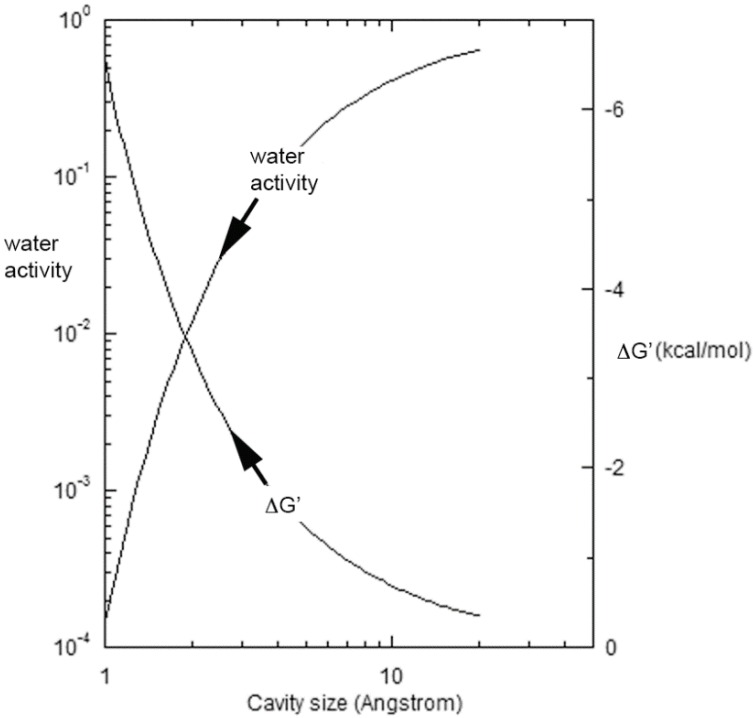
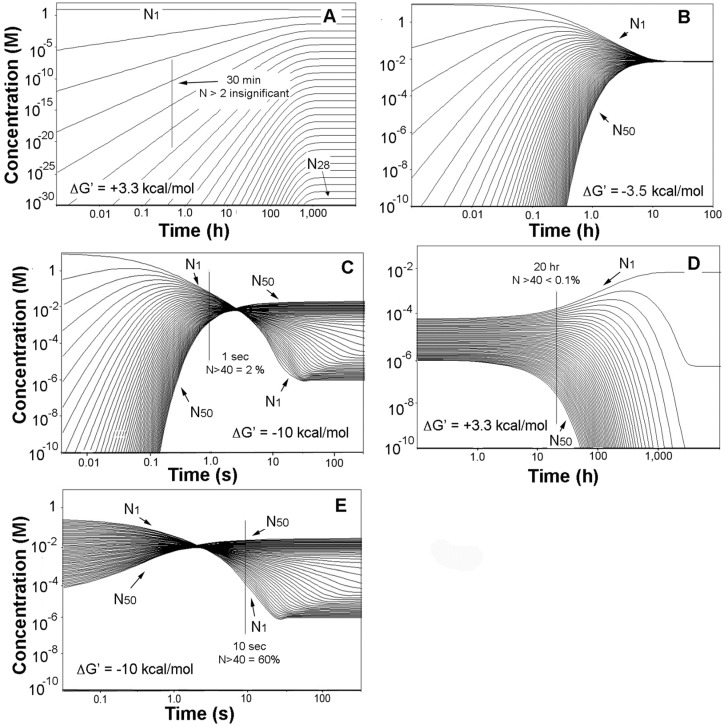
The endoergic nature of protein and nucleic acid assembly in aqueous media presents two questions that are fundamental to the understanding of life’s origins: (i) how did the polymers arise in an aqueous prebiotic world; and (ii) once formed in some manner, how were they sufficiently persistent to engage in further chemistry. We propose here a quantitative resolution of these issues that evolved from recent accounts in which RNA-like polymers were produced in evaporation/rehydration cycles. The equilibrium Nm + Nn ↔ Nm+n + H2O is endoergic by about 3.3 kcal/mol for polynucleotide formation, and the system thus lies far to the left in the starting solutions. Kinetic simulations of the evaporation showed that simple Le Châtelier’s principle shifts were insufficient, but the introduction of oligomer-stabilizing factors of 5–10 kcal/mol both moved the process to the right and respectively boosted and retarded the elongation and hydrolysis rates. Molecular crowding and excluded volume effects in present-day cells yield stabilizing factors of that order, and we argue here that the crowded conditions in the evaporites generate similar effects. Oligomer formation is thus energetically preferred in those settings, but the process is thwarted in each evaporation step as diffusion becomes rate limiting. Rehydration dissipates disordered oligomer clusters in the evaporites, however, and subsequent dry/wet cycling accordingly “ratchets up” the system to an ultimate population of kinetically trappedthermodynamically preferred biopolymers.
Overview
The claims and statistics of this paper haven’t been checked yet.
Free: it reads the open-access text and checks the first 5 claims that cite a source we can check. Create a free account to check every claim.
Integrity signals
Registry
Cites
Statistics
Figures
Verification
Claims the paper makes
The claims and statistics of this paper haven’t been checked yet.
Free: it reads the open-access text and checks the first 5 claims that cite a source we can check. Create a free account to check every claim.
Claims other papers make about this one
Each is checked against this paper’s own text: does it say what the citing paper says it does?
The source backs part of the claim, not all of it — or backs it for a different population, condition or comparison.
In the citing paper
“One example is the requirement for wet–dry cycles for polymerization, mostly discussed in the context of geothermal fields [180], even though wet-dry cycles can also be found in hydrothermal pores [181] and even at the water-air interface [20].”
From The Future of Origin of Life Research: Bridging Decades-Old Divisions (2020) · cites this paper as [180]
Experimental — accuracy not yet measuredThe source backs part of the claim, not all of it — or backs it for a different population, condition or comparison.
In the citing paper
“These include a constant energy and CHNOPS source, heterogeneous or homogeneous catalysts, non-equilibrium conditions and conditions that enable aggregation of molecules to form life’s building blocks and, eventually, polymerization of said building blocks [22,103,152,180].”
From The Future of Origin of Life Research: Bridging Decades-Old Divisions (2020) · cites this paper as [180]
Experimental — accuracy not yet measuredThe cited source says what the claim attributes to it.
In the citing paper
“a surprising amount of chemical energy is introduced by concentrating potential reactants in dilute solutions as they evaporate to form dry films on mineral surfaces (Ross and Deamer, 2016).”
From The Hot Spring Hypothesis for an Origin of Life (2020) · cites this paper as Ross and Deamer, 2016
The cited source says what the claim attributes to it.
In the citing paper
“Wet-dry cycles in fresh water would be abundant in the prebiotic environment as long as volcanic land masses had emerged from the global ocean”
From The Hot Spring Hypothesis for an Origin of Life (2020) · cites this paper as Ross and Deamer, 2016
Self-check
Percentages, sums and reported differences re-computed from the paper’s own numbers.
The self-check needs the paper’s full text.
Citations
Cites
Instability and decay of the primary structure of DNA
Lindahl, T. (1993) · Nature · doi:10.1038/362709a0 · Cited by 5,679
Lorenz, R., Bernhart, S. H., Höner zu Siederdissen, C., Tafer, H., Flamm, C., Stadler, P. F., & Hofacker, I. L. (2011) · Algorithms for Molecular Biology · doi:10.1186/1748-7188-6-26 · Cited by 5,098 · cited 1×
“Helix P18 in Escherichia coli RNase P RNA, for example, is a 20-mer, one of 1012 possible sequences [50], stabilized through base pairing by about 11 kcal/mol [51].”
BackgroundMacromolecular crowding: obvious but underappreciated
Ellis, R. J. (2001) · Trends in Biochemical Sciences · doi:10.1016/s0968-0004(01)01938-7 · Cited by 2,309
A principle of natural self-organization: Part A: Emergence of the hypercycle
Eigen, M., & Schuster, P. (1977) · Naturwissenschaften · doi:10.1007/bf00450633 · Cited by 1,752
The chemical thermodynamics of organic compounds
Stull, D. R., WESTRUM, E. F. J., & Sinke, G. C. (1969) · Medical Entomology and Zoology · Cited by 1,575
Minton, A. P. (2001) · Journal of Biological Chemistry · doi:10.1074/jbc.r100005200 · Cited by 1,474 · cited 1×
“The effects of molecular crowding and excluded volumes in such settings provoke extraordinary thermochemical effects that can enhance association and macromolecular folding rates and equilibria by orders of magnitude [21,22].”
BackgroundImproved free-energy parameters for predictions of RNA duplex stability.
Freier, S. M., Kierzek, R., Jaeger, J. A., Sugimoto, N., Caruthers, M. H., Neilson, T., & Turner, D. H. (1986) · Proceedings of the National Academy of Sciences · doi:10.1073/pnas.83.24.9373 · Cited by 1,470
The Depth of Chemical Time and the Power of Enzymes as Catalysts
Wolfenden, R., & Snider, M. J. (2001) · Accounts of Chemical Research · doi:10.1021/ar000058i · Cited by 930
Improved predictions of secondary structures for RNA.
Jaeger, J. A., Turner, D. H., & Zuker, M. (1989) · Proceedings of the National Academy of Sciences · doi:10.1073/pnas.86.20.7706 · Cited by 817
Effects of Molecular Crowding on the Structures, Interactions, and Functions of Nucleic Acids
Nakano, S.-I., Miyoshi, D., & Sugimoto, N. (2014) · Chemical Reviews · doi:10.1021/cr400113m · Cited by 567
Research works printed but not linked: 4
- Tinoco J.I. Sauer K. Wang J. Physical Chemistry—Principles and Applications in Biological Sciences Prentice Hall Upper Saddle River, New Jersey, USA 1995 141
- Laidler K. Chemical Kinetics 2nd ed. McGraw-Hill New York, NY, USA 1965
- Benson S. Thermochemical Kinetics John Wiley and Sons New York, NY, USA 1998
- Moore J. Pearson R. New S. Kinetics and Mechanism 3rd ed. Wiley New York, NY, USA 1981 358 359
Cited by
Items 101–158 of 158
Chemical Routes to Primitive Membranes: Prebiotic Lipid Formation at the Origin of Life
Shvetsova, A., & Fiore, M. (2026) · Life · doi:10.3390/life16030497 · Cited by 3
Equilibrium and Non‐equilibrium Reaction Schemes for Prebiotic Polymerization of Ribonucleotides
Kitson, V., Sanders, Q., Dass, A. V., & Higgs, P. G. (2023) · ChemSystemsChem · doi:10.1002/syst.202300033 · Cited by 3
On the Origin of Information Dynamics in Early Life
Gatenby, R. A., Gallaher, J. A., Subramanian, H., Hammarlund, E. U., & Whelan, C. J. (2025) · Life · doi:10.3390/life15020234 · Cited by 5
“Our assumed initial conditions include the availability of lipids, polypeptides, and nucleotides that formed through condensation reactions [27].”
Mobility of a Mononucleotide within a Lipid Matrix: A Neutron Scattering Study
Misuraca, L., Natali, F., da Silva, L. C. E., Peters, J., Demé, B., Ollivier, J., Seydel, T., Laux, V., Haertlein, M., Zaccaï, G., et al. (2017) · Life · doi:10.3390/life7010002 · Cited by 4
Self-citationModelling Wet-Dry Cycles in the Binary Polymer Model
Senatore, F., Serra, R., & Villani, M. (2023) · Communications in computer and information science · doi:10.1007/978-3-031-31183-3_10 · Cited by 5
Template-Directed Replication and Chiral Resolution during Wet–Dry Cycling in Hydrothermal Pools
Ross, D. S., & Deamer, D. W. (2023) · Life · doi:10.3390/life13081749 · Cited by 3
Self-citationVisualizing ribonuclease digestion of RNA-like polymers produced by hot wet-dry cycles
da Silva, L. C. E., Eiby, S. H. J., Bjerrum, M. J., Thulstrup, P. W., Deamer, D. W., & Hassenkam, T. (2024) · Biochemical and Biophysical Research Communications · doi:10.1016/j.bbrc.2024.149938 · Cited by 6
Self-citationTo What Inanimate Matter Are We Most Closely Related and Does the Origin of Life Harbor Meaning?
Martin, W. F., Nagies, F. S. P., & Vieira, A. D. N. (2021) · Philosophies · doi:10.3390/philosophies6020033 · Cited by 3
Kompanichenko, V. N., & El-Registan, G. I. (2022) · AIMS Geosciences · doi:10.3934/geosci.2022023 · Cited by 3
Did Biology Emerge from Biotite in Micaceous Clay?Preprint
Hansma, H. G. (2020) · Preprints.org · doi:10.20944/preprints202009.0409.v1 · Cited by 3
Thermodynamic and kinetic selection in evolving chemical mixturesPreprint
Capera-Aragones, P., Matange, K., Rajaei, V., Williams, L. D., & Frenkel‐Pinter, M. (2023) · ChemRxiv · doi:10.26434/chemrxiv-2023-b3glp · Cited by 2
Natural Size Variation Amongst Protocells Leads to Survival and Growth Under Hypoosmotic Conditions
Lowe, L. A., Kapoor‐Kaushik, N., & Wang, A. (2024) · Small · doi:10.1002/smll.202406241 · Cited by 4
Robust Synthesis of Prebiotic Precursors in Drying Reactions of Amino Acids and Keto Acids
Marland, E., Lipson, G., Edri, R., Cohen, O., Guzmán-Martínez, A., Shalev, O., Salván, C. M., & Frenkel‐Pinter, M. (2025) · ChemSystemsChem · doi:10.1002/syst.202500018 · Cited by 2
Damer, B., & Deamer, D. W. (2026) · Astrobiology · doi:10.1177/15311074261428661 · Cited by 3
“The result of this cycling is a version of a kinetic trap that permits rates of polymer synthesis to exceed the rates of degradation (Ross and Deamer, 2016).”
Self-citationProgress and persistent questions in understanding the origin of life on Earth
Ansari, A. H. (2026) · Discover Life · doi:10.1007/s11084-026-09753-5 · Cited by 2
“…crust stabilized and emergent land areas increased during the late Hadean, tidal flats, geothermal fields, and evaporative lakes could have provided opportunities for concentration, phosphorylation, polymerization, and molecular selection through repeated wet-dry cycles [11, 29, 227, 257, 321].”
Prebiotic Gels as the Cradle of Life
Khanum, R., Satthiyasilan, N., Tharumen, N., Kee, T. P., Mayer, C., Menon, P. S., Jia, T. Z., & Chandru, K. (2025) · ChemSystemsChem · doi:10.1002/syst.202500038 · Cited by 2
The Origin and Early Evolution of Life: Prebiotic Chemistry of Biomolecules
Fiore, M. (2019) · MDPI eBooks · doi:10.3390/books978-3-03921-607-9 · Cited by 2
Decorated Vesicles as Prebiont Systems (a Hypothesis)
Fisk, M. R., & Popa, R. (2023) · Origins of Life and Evolution of Biospheres · doi:10.1007/s11084-023-09643-0 · Cited by 2
“Clays sequester organic compounds and can facilitate organic condensation reactions (Paecht-Horowitz 1976; Laszlo 1987; Ferris et al. 1996) favored by hydration/dehydration cold/hot cycles (Ross and Deamer 2016).”
Nonenzymatic template-directed replication using 2′-3′ cyclic nucleotides under wet-dry cyclesPreprint
Dagar, S., Sarkar, S., & Rajamani, S. (2022) · bioRxiv · doi:10.1101/2022.07.11.499554 · Cited by 1
“DH-RH cycles are a recurring geological phenomenon facilitated readily in terrestrial hydrothermal pools and have been demonstrated to facilitate condensation reactions and the formation of different biopolymers under prebiotic settings (18, 19).”
BackgroundOrigins of Life: Chemistry and EvolutionPreprint
Matange, K., Rajaei, V., Schuster, G. B., Hud, N. V., Menor-Salván, C. A., Capera-Aragones, P., Frenkel‐Pinter, M., & Williams, L. D. (2023) · ChemRxiv · doi:10.26434/chemrxiv-2023-1jrcq-v2 · Cited by 1
Tour, J., Parker, M. C., & Jeynes, C. (2025) · BioCosmos · doi:10.2478/biocosmos-2025-0010 · Cited by 2
“Ross and Deamer (4) call this ‘ question of how life-relevant polymers overcame the thermodynamic barriers to their formation ’ a ‘ significant conundrum ’.”
Surface‐Driven Protocell Formation in Geologically Relevant Early Earth Environment
Knoll, P., & Holler, S. (2026) · ChemSystemsChem · doi:10.1002/syst.202500062 · Cited by 2
The master molecule that built biology: How water shaped the chemistry of life
DiGiacomo, J., Rose, G. D., & Williams, L. D. (2026) · Protein Science · doi:10.1002/pro.70532 · Cited by 4
Enhancement of Prebiotic Peptide Formation in Cyclic Environments
Boigenzahn, H., Gagrani, P., & Yin, J. (2023) · Origins of Life and Evolution of Biospheres · doi:10.1007/s11084-023-09641-2 · Cited by 2
“The formation of longer peptides in water is thermodynamically limited (Ross and Deamer 2016).”
Sithamparam, M., He, M.-J., Tharumen, N., Afrin, R., Ding, N., Chen, C., Yi, R., Wang, P., Jia, T. Z., & Chandru, K. (2025) · Polymer Journal · doi:10.1038/s41428-025-01048-2 · Cited by 1
“AHAs can then polymerize into polyesters through dehydration synthesis via heating under mild temperatures, mimicking the dry phase of wet-dry cycles [11 – 13]; dehydration reactions with both AHAs and alpha-amino acids produce depsipeptides [14], a proposed primitive precursor to peptides.”
Retour sur les origines de la vie
Danchin, A. (2018) · médecine/sciences · doi:10.1051/medsci/2018234 · Cited by 1
Thermodynamic Jump from Prebiotic Microsystems to Primary Living Cells
Kompanichenko, V. N. (2019) · Sci · doi:10.3390/sci1020035 · Cited by 1
From Minimal to Minimized Genomes: Functional Design of Microbial Cell Factories
Lubrano, P., Danchin, A., & Acevedo‐Rocha, C. G. (2019) · Springer eBooks · doi:10.1007/978-3-030-31897-0_7 · Cited by 1
Mechanical Energy before Chemical Energy at the Origins of Life?
Hansma, H. G. (2020) · Sci · doi:10.3390/sci2020019 · Cited by 1
Thermodynamic Jump from Prebiotic Microsystems to Primary Living Cells
Kompanichenko, V. N. (2019) · Sci · doi:10.3390/sci1030058 · Cited by 1
From Amino Acids to Peptides before the Coming of Ribosomes
Leqraa, N., & Vallée, Y. (2022) · Royal Society of Chemistry eBooks · doi:10.1039/9781839164798-00177 · Cited by 2
Scum of the Earth: a hypothesis for prebiotic multi-compartmentalised environments}Preprint
Walton, C. R., & Shorttle, O. (2021) · EarthArXiv (California Digital Library) · doi:10.31223/x58332 · Cited by 1
Fares, H. M., Marras, A. E., Ting, J., Tirrell, M., & Keating, C. D. (2020) · ChemRxiv · doi:10.26434/chemrxiv.12278318 · Cited by 1
Chemical Evolution ReimaginedPreprint
Frenkel‐Pinter, M., Matange, K., Rajaei, V., Costner, J. T., Robertson, A., Kim, J. S., Petrov, A. S., Bowman, J. C., & Williams, L. D. (2022) · ChemRxiv · doi:10.26434/chemrxiv-2022-s3cr2-v2 · Cited by 1
Studies in Mineral‐Assisted Protometabolisms
Lambert, J., Ter‐Ovanessian, L. M. P., & Maurel, M. (2023) · Wiley eBooks · doi:10.1002/9781394264155.ch9 · Cited by 1
Mechanical Energy before Chemical Energy at the Origins of Life?
Hansma, H. G. (2019) · Sci · doi:10.3390/sci1020050 · Cited by 1
Temporal nanofluidic confinements induce prebiotic condensation in waterPreprint
de Herrera, A. G., Markert, T., & Trixler, F. (2021) · Research Square · doi:10.21203/rs.3.rs-163645/v2
Miller, I. (2021) · doi:10.3847/25c2cfeb.ac673819
“Nucleotides could be condensed to polymers of between 10 – 100 mers (Ross and Deamer, 2016).”
Fluctuating nanofluid environments induce prebiotic RNA formation in waterPreprint
de Herrera, A. G., Markert, T., & Trixler, F. (2022) · Research Square · doi:10.21203/rs.3.rs-1301270/v1
Fluctuating nanofluid environments induce prebiotic condensation in waterPreprint
de Herrera, A. G., Markert, T., & Trixler, F. (2022) · Research Square · doi:10.21203/rs.3.rs-1301270/v2
de Herrera, A. G., Markert, T., & Trixler, F. (2022) · Research Square · doi:10.21203/rs.3.rs-1301270/v3
Temporal nanofluidic confinements induce prebiotic condensation in waterPreprint
de Herrera, A. G., Markert, T., & Trixler, F. (2021) · Research Square · doi:10.21203/rs.3.rs-163645/v3
Chemical Evolution ReimaginedPreprint
Frenkel‐Pinter, M., Matange, K., Rajaei, V., Costner, J. T., Robertson, A., Kim, J. S., Petrov, A. S., Bowman, J. C., & Williams, L. D. (2022) · ChemRxiv · doi:10.26434/chemrxiv-2022-s3cr2 · Cited by 3
First Steps of Prebiotic Chemistry Catalyzed by Minerals and Metals
Huber, L., & Trapp, O. (2022) · Royal Society of Chemistry eBooks · doi:10.1039/9781839164798-00077 · Cited by 1
Theories of the Origin of Biomolecular Homochirality
(2022) · Royal Society of Chemistry eBooks · doi:10.1039/9781839163685-00033
Construction of Artificial Cell as an Autonomous Supramolecular Machine
Sugawara, T., Matsuo, M., & Suzuki, K. (2022) · Journal of Synthetic Organic Chemistry Japan · doi:10.5059/yukigoseikyokaishi.80.1149 · Cited by 1
Chatterjee, S. (2023) · Springer eBooks · doi:10.1007/978-3-031-23397-5_14 · Cited by 1
The Lipid Membrane: Encapsulating Life
Chatterjee, S. (2023) · Springer eBooks · doi:10.1007/978-3-031-23397-5_9
Gordon, R., & Mikhailovsky, G. E. (2024) · Wiley eBooks · doi:10.1002/9781119901228.ch3
Reciprocating thermochemical mediator of pre-biotic polymer decomposition on mineral surfaces
Ball, R. V., & Brindley, J. (2025) · Journal of The Royal Society Interface · doi:10.1098/rsif.2024.0492 · Cited by 1
“The emergence of a ‘kinetic trap’ when the rate of synthesis exceeds that of the back reaction was recognized by Ross & Deamer [32] and Damer [18].”
Origins of Life and the Fossil Record
Bernard, S. (2025) · Wiley eBooks · doi:10.1002/9781394417865.ch8
Geology and Surface Properties of the Galilean Moons
Prieto‐Ballesteros, O., Tosi, F., McKinnon, W. B., Rhoden, A. R., Schenk, P. M., Vance, S. D., Wagner, R., Hao, J., Finkel, P. D. L., de Dios-Cubillas, A., et al. (2026) · Space Science Reviews · doi:10.1007/s11214-026-01273-y
Tilting a ground-state reactivity landscape by vibrational strong coupling
Lethuillier‐Karl, L. (2019) · theses.fr (ABES) · doi:10.70675/a100524bz1f81z4749z8c98z7e20127a2b3d
Fonseca-González, E., Fuentes-Carreón, C. A., & Heredia, A. (2026) · Journal of Molecular Evolution · doi:10.1007/s00239-026-10309-4
“In addition, the thermodynamic challenge of peptide bond formation in aqueous environments presents a fundamental paradox for origins-of-life scenarios (Ross and Deamer 2016; Vitas and Dobovišek 2025).”
Ezerzer, Y., Hiregange, D., Bashan, A., Yonath, A., & Frenkel‐Pinter, M. (2026) · BioCosmos · doi:10.2478/biocosmos-2026-0002 · Cited by 1
Eiby, S. H. J., Bjerrum, M. J., Hajdu, B., Silva, L. D., Thulstrup, P. W., & Hassenkam, T. (2026) · ChemSystemsChem · doi:10.1002/syst.70043 · Cited by 1
Highway to the Hot Springs: Park science builds our origin stories
Lull, R. B. (2026) · Oxford University Press eBooks · doi:10.1093/9780197824450.003.0007
Metadata
- Authors
- Ross, D., & Deamer, D.
- Affiliations
- SRI International (US)
- University of California, Santa Cruz (US)
- Corresponding author
- Ross, David
- Venue
- Life
- Publisher
- MDPI AG
- Published
- 2016-07-26
- Volume
- 6
- Issue
- 3
- Pages
- 28
- ISSN
- 2075-1729 (ISSN-L)
- PMC
- PMC5041004
- OpenAlex
- W2490072086
- Cited by
- 157
- References
- 53
- Citations by year
- 2026: 11 · 2025: 13 · 2024: 12 · 2023: 18 · 2022: 24 · 2021: 20 · 2020: 20 · 2019: 16 · 2018: 14 · 2017: 7 · 2016: 1
- FWCI
- 6.06
- Type
- journal article
- Language
- en
- Open access
- gold
- doi.org
- Licence
- Locations
- Life (publishedVersion, cc-by)
- Europe PMC (PubMed Central) (publishedVersion, cc-by)
- PubMed Central (publishedVersion, cc-by)
- PubMed (publishedVersion)
- DOAJ (DOAJ: Directory of Open Access Journals) (submittedVersion, cc-by-sa)
- Topics
- Physical Sciences › Physics and Astronomy › Astronomy and Astrophysics › Origins and Evolution of Life
- Life Sciences › Biochemistry, Genetics and Molecular Biology › Molecular Biology › RNA and protein synthesis mechanisms
- Life Sciences › Biochemistry, Genetics and Molecular Biology › Genetics › Evolution and Genetic Dynamics
- Keywords
- wetting-drying cycles, endergonic reactions, macromolecular crowding, excluded volume, diffusion-controlled kinetics, origin of life, kinetic trapping
About these checks
Registry, retraction, Cites and statistics results are computed, not judged, with one exception: a printed reference that no index lists is read once by a model before it counts as a citation error. Claims are extracted by a model and kept only when their quote appears verbatim in the text; each cited source is then checked, with a model’s help, for whether it says what the claim relies on. Those verdicts can be wrong — read the claim’s quote and the cited source before relying on one.
Statistics and arithmetic are recomputed, not judged.
Confidence bands are shown only for fields calibrated on our annotated test set. None is calibrated yet, so no band is shown.
What counts as a claim ›How we measure confidence ›How we check this ›
Are you an author, or do you see a problem with this page? Request a review
Data sources
Bibliographic data: Semantic Scholar, OpenAlex, Crossref.
Contains information from the Semantic Scholar Academic Graph Datasets, made available under the ODC Attribution License (ODC-BY 1.0).
Semantic Scholar’s data is described in: Kinney, R., et al. (2023). The Semantic Scholar Open Data Platform. arXiv:2301.10140.
