

A Self-Assembled Aggregate Composed of a Fatty Acid Membrane and the Building Blocks of Biological Polymers Provides a First Step in the Emergence of Protocells
Open accessThe DOI matches its Crossref record; 86 of the 86 references it cites were found in a registry or an index.
Abstract
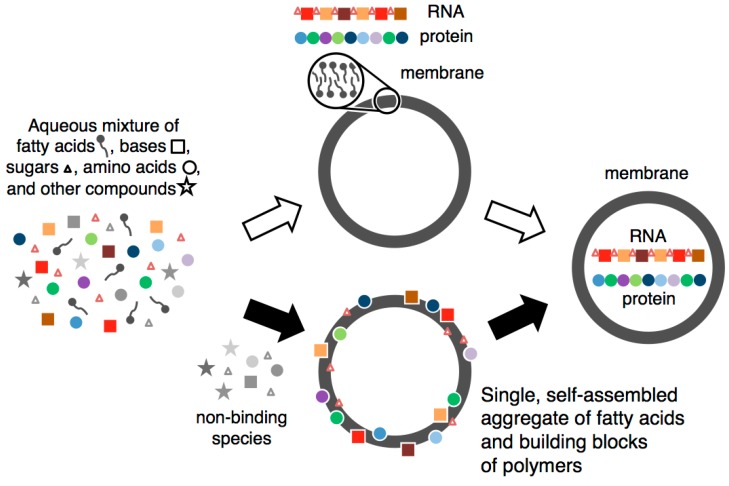
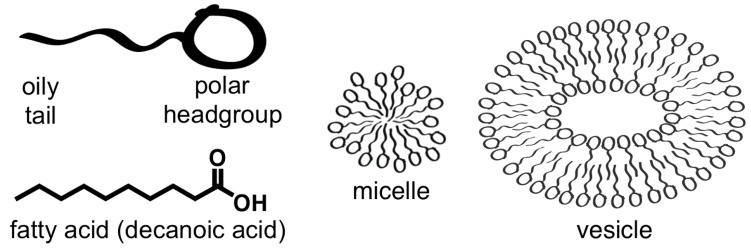
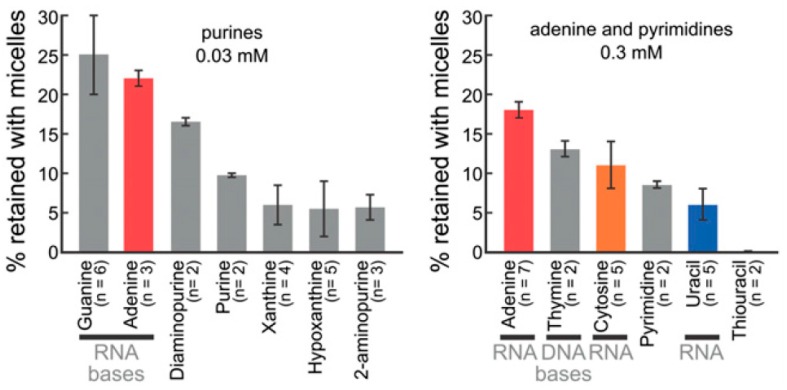
We propose that the first step in the origin of cellular life on Earth was the self-assembly of fatty acids with the building blocks of RNA and protein, resulting in a stable aggregate. This scheme provides explanations for the selection and concentration of the prebiotic components of cells; the stabilization and growth of early membranes; the catalysis of biopolymer synthesis; and the co-localization of membranes, RNA and protein. In this article, we review the evidence and rationale for the formation of the proposed aggregate: (i) the well-established phenomenon of self-assembly of fatty acids to form vesicles; (ii) our published evidence that nucleobases and sugars bind to and stabilize such vesicles; and (iii) the reasons why amino acids likely do so as well. We then explain how the conformational constraints and altered chemical environment due to binding of the components to the membrane could facilitate the formation of nucleosides, oligonucleotides and peptides. We conclude by discussing how the resulting oligomers, even if short and random, could have increased vesicle stability and growth more than their building blocks did, and how competition among these vesicles could have led to longer polymers with complex functions.
Overview
The claims and statistics of this paper haven’t been checked yet.
Free: it reads the open-access text and checks the first 5 claims that cite a source we can check. Create a free account to check every claim.
Integrity signals
Registry
Cites
Statistics
Figures
Verification
Claims the paper makes
The claims and statistics of this paper haven’t been checked yet.
Free: it reads the open-access text and checks the first 5 claims that cite a source we can check. Create a free account to check every claim.
Claims other papers make about this one
Each is checked against this paper’s own text: does it say what the citing paper says it does?
The cited source says what the claim attributes to it.
In the citing paper
“Significantly, Black et al. [63,64] reported that adenine had a stabilizing effect on fatty acid membranes, suggesting that water soluble nucleobases may also have a role in stabilizing primitive membranes.”
From The Role of Lipid Membranes in Life’s Origin (2017) · cites this paper as [64]
In the citing paper
“The principal capability of membrane vesicles for the early steps of life has been described on numerous occasions [27,28,29]. Recently, it was shown that a possible prebiotic amphiphile (decanoic acid) undergoes distinct binding interactions with nucleobases and proteins [30,31]. So, at this stage, they may serve as containments for initial metabolic steps and, most prominently, as an ensemble of”
From Selection of Prebiotic Molecules in Amphiphilic Environments (2017) · cites this paper as [31]
Self-check
Percentages, sums and reported differences re-computed from the paper’s own numbers.
The self-check needs the paper’s full text.
Citations
Cites
Synthesis of activated pyrimidine ribonucleotides in prebiotically plausible conditions.
Powner, M. W., Gerland, B., & Sutherland, J. D. (2009) · Nature · doi:10.1038/nature08013 · Cited by 1,383 · cited 1×
“Recent efforts have succeeded in synthesizing pyrimidine [56] and purine [57] nucleosides by starting with compounds smaller than bases and sugars, although the prebiotic plausibility of the sequences of reactions employed has been questioned [58].”
BackgroundCommon origins of RNA, protein and lipid precursors in a cyanosulfidic protometabolism
Patel, B. H., Percivalle, C., Ritson, D. J., Duffy, C. D., & Sutherland, J. D. (2015) · Nature Chemistry · doi:10.1038/nchem.2202 · Cited by 949
Prebiotic Systems Chemistry: New Perspectives for the Origins of Life
Ruiz-Mirazo, K., Briones, C., & de la Escosura, A. (2014) · Chemical Reviews · doi:10.1021/cr2004844 · Cited by 930 · cited 1×
“Ruiz-Mirazo [10] and Sutherland [11] have recently advanced the case for a systems chemistry approach to the origin of protocells to replace the more typical approach of explaining one structure at a time.”
BackgroundSynthesis of long prebiotic oligomers on mineral surfaces.
Ferris, J. P., Hill, A. R., Liu, R., & Orgel, L. E. (1996) · Nature · doi:10.1038/381059a0 · Cited by 865 · cited 1×
“, not prebiotically plausible) nucleotides [65].”
Abiogenic Hydrocarbon Production at Lost City Hydrothermal Field
Proskurowski, G., Lilley, M. D., Seewald, J. S., Früh-Green, G. L., Olson, E. J., Lupton, J. E., Sylva, S. P., & Kelley, D. S. (2008) · Science · doi:10.1126/science.1151194 · Cited by 851 · cited 5×
“How did prebiotic molecules on the early Earth assemble into machinery (proteins) and stores of information (RNA) surrounded by a membrane?”
BackgroundInfluentialExperimental Models of Primitive Cellular Compartments: Encapsulation, Growth, and Division
Hanczyc, M. M., Fujikawa, S. M., & Szostak, J. W. (2003) · Science · doi:10.1126/science.1089904 · Cited by 848 · cited 2×
“Szostak’s group broke new ground by showing that certain mineral surfaces stimulate membrane formation as well as increase the polymerization of nucleotides [8,9], but this work did not address how nucleotides arose or how proteins were incorporated into protocells.”
BackgroundBorate Minerals Stabilize Ribose
Ricardo, A., Carrigan, M. A., Olcott, A. N., & Benner, S. A. (2004) · Science · doi:10.1126/science.1092464 · Cited by 646 · cited 2×
“These compounds are generated by the formose reaction, which starts with simple prebiotic compounds [32].”
BackgroundCarbonaceous Meteorites Contain a Wide Range of Extraterrestrial Nucleobases
Callahan, M. P., Smith, K. E., Cleaves, H. J., Ruzicka, J., Stern, J. C., Glavin, D. P., House, C. H., & Dworkin, J. P. (2011) · Proceedings of the National Academy of Sciences · doi:10.1073/pnas.1106493108 · Cited by 590 · cited 1×
“The nucleobases (the bases found in RNA and DNA) have been identified in meteorites [29] and/or are generated by plausibly prebiotic reactions [1].”
BackgroundRobertson, M. P., & Joyce, G. F. (2012) · Cold Spring Harbor Perspectives in Biology · doi:10.1101/cshperspect.a003608 · Cited by 556 · cited 3×
“Explaining the prebiotic polymerization of nucleosides to form RNA is as challenging as explaining th generation of nucleosides [3,4,55,58,63].”
BackgroundThe Emergence of Life: From Chemical Origins to Synthetic Biology
Luisi, P. L. (2006) · Cambridge University Press eBooks · doi:10.1017/cbo9780511817540 · Cited by 547
Cited by
Prebiotic Peptides: Molecular Hubs in the Origin of Life
Frenkel-Pinter, M., Samanta, M., Ashkenasy, G., & Leman, L. J. (2020) · Chemical Reviews · doi:10.1021/acs.chemrev.9b00664 · Cited by 354
The Role of Lipid Membranes in Life’s Origin
Deamer, D. (2017) · Life · doi:10.3390/life7010005 · Cited by 261
“[63,64] reported that adenine had a stabilizing effect on fatty acid membranes, suggesting that water soluble nucleobases may also have a role in stabilizing primitive membranes.”
Prebiotic amino acids bind to and stabilize prebiotic fatty acid membranes
Cornell, C. E., Black, R. A., Xue, M., Litz, H. E., Ramsay, A., Gordon, M., Mileant, A., Cohen, Z. R., Williams, J. A., Lee, K. K., et al. (2019) · Proceedings of the National Academy of Sciences · doi:10.1073/pnas.1900275116 · Cited by 114
“We have proposed an alternate autoamplification scenario in which fatty acid vesicles bound and concentrated the building blocks of proteins and RNA, which in turn, stabilized fatty acid vesicles, leading to further binding of the building blocks (21, 22).”
BackgroundSelf-citationLopez, A., & Fiore, M. (2019) · Life · doi:10.3390/life9020049 · Cited by 89
“It was proven lately that nucleobases, sugars and potentially amino acids, are responsible for the formation and the stability of fatty acid membranes [58].”
BackgroundPhenylalanine Increases Membrane Permeability
Perkins, R., & Vaida, V. (2017) · Journal of the American Chemical Society · doi:10.1021/jacs.7b09219 · Cited by 85
Spontaneous assembly of redox-active iron-sulfur clusters at low concentrations of cysteine
Jordan, S. F., Ioannou, I., Rammu, H., Halpern, A., Bogart, L. K., Ahn, M., Vasiliadou, R., Christodoulou, J., Maréchal, A., & Lane, N. (2021) · Nature Communications · doi:10.1038/s41467-021-26158-2 · Cited by 69
The interaction of heat shock proteins with cellular membranes: a historical perspective
Maio, A. D., & Hightower, L. E. (2021) · Cell Stress and Chaperones · doi:10.1007/s12192-021-01228-y · Cited by 58
Primordial membranes: more than simple container boundaries
Hanczyc, M. M., & Monnard, P. (2017) · Current Opinion in Chemical Biology · doi:10.1016/j.cbpa.2017.07.009 · Cited by 50
Molecular Evolution in a Peptide-Vesicle System
Mayer, C., Schreiber, U., Dávila, M. J., Schmitz, O. J., Bronja, A., Meyer, M., Klein, J., & Meckelmann, S. W. (2018) · Life · doi:10.3390/life8020016 · Cited by 48
“They also have the capability to select and accumulate other prebiotic molecules [13,14], especially if those molecules are amphiphilic as well [15,16].”
BackgroundJoshi, M. P., Sawant, A. A., & Rajamani, S. (2021) · Chemical Science · doi:10.1039/d0sc05650b · Cited by 50
From vesicles toward protocells and minimal cells
Imai, M., Sakuma, Y., Kurisu, M., & Walde, P. (2022) · Soft Matter · doi:10.1039/d1sm01695d · Cited by 52
Selection of Prebiotic Molecules in Amphiphilic Environments
Mayer, C., Schreiber, U., & Dávila, M. (2017) · Life · doi:10.3390/life7010003 · Cited by 39
Heat shock proteins and the biogenesis of cellular membranes
Maio, A. D., & Hightower, L. E. (2020) · Cell Stress and Chaperones · doi:10.1007/s12192-020-01173-2 · Cited by 35
“Thus, the formation of these vesicles has been proposed as the first step in protocell assembly (Black and Blosser 2016), which has also been coined the “The Lipid World” (Segre et al. 2001).”
BackgroundXue, M., Black, R. A., Cornell, C. E., Drobny, G. P., & Keller, S. L. (2020) · ChemBioChem · doi:10.1002/cbic.202000260 · Cited by 23
Self-citationXue, M., Black, R. A., Cohen, Z. R., Roehrich, A. M., Drobny, G. P., & Keller, S. L. (2021) · The Journal of Physical Chemistry B · doi:10.1021/acs.jpcb.1c01485 · Cited by 19
Self-citationCohen, Z. R., Cornell, C. E., Catling, D. C., Black, R. A., & Keller, S. L. (2022) · Langmuir · doi:10.1021/acs.langmuir.1c03296 · Cited by 17
Self-citationCohen, Z. R., Ding, D., Zhou, L., DasGupta, S., Haas, S., Sinclair, K. P., Todd, Z. R., Black, R. A., Szostak, J. W., & Catling, D. C. (2024) · PNAS Nexus · doi:10.1093/pnasnexus/pgae084 · Cited by 19
Self-citationSpontaneous Emergence of Lipid Vesicles in a Coacervate‐Based Compartmentalized System
Yin, C., Yu, X., Wu, B., & Tian, L. (2024) · Angewandte Chemie International Edition · doi:10.1002/anie.202414372 · Cited by 13
Fatty Acid-Based Coacervates as a Membrane-free Protocell Model
Zhou, L., Koh, J. J., Wu, J., Fan, X., Chen, H., Hou, X., Jiang, L., Lu, X., Li, Z., & He, C. (2022) · Bioconjugate Chemistry · doi:10.1021/acs.bioconjchem.1c00559 · Cited by 12
Cohen, Z. R., Todd, Z. R., Maibaum, L., Catling, D. C., & Black, R. A. (2024) · Langmuir · doi:10.1021/acs.langmuir.4c00150 · Cited by 12
Self-citationSpontaneous Formation of Functional Structures in Messy Environments
Mayer, C. (2022) · Life · doi:10.3390/life12050720 · Cited by 10
Li, L., Fang, Y., Xia, Y., Bo, C., & Ye, F. (2022) · Journal of Molecular Liquids · doi:10.1016/j.molliq.2022.118656 · Cited by 9
The GARD Prebiotic Reproduction Model Described in Order and Complexity
Mayer, C., Lancet, D., & Markovitch, O. (2024) · Life · doi:10.3390/life14030288 · Cited by 10
“In the following, the new compo-some increase in successful evolution functionality.”
BackgroundGetting Beyond the Toy Domain. Meditations on David Deamer’s “Assembling Life”
Bains, W. (2020) · Life · doi:10.3390/life10020018 · Cited by 9
“But Black and co-workers have found that amino acids can bind to fatty acids (non-covalently) and allow them to form bilayers in the presence of divalent cations [32,33], i.”
BackgroundProto-Neurons from Abiotic Polypeptides
Mougkogiannis, P., & Adamatzky, A. (2024) · Encyclopedia · doi:10.3390/encyclopedia4010034 · Cited by 12
Double Emulsion Droplets as a Plausible Step to Fatty Acid Protocells
Douliez, J. (2023) · Small Methods · doi:10.1002/smtd.202300530 · Cited by 8
Prebiotic Membranes and Micelles Do Not Inhibit Peptide Formation During Dehydration
Cohen, Z. R., Kessenich, B. L., Hazra, A., Nguyen, J., Johnson, R. S., MacCoss, M. J., Lalić, G., Black, R. A., & Keller, S. L. (2021) · ChemBioChem · doi:10.1002/cbic.202100614 · Cited by 10
Self-citationExploration of the Tolerance Ability of a Cell-Free Biosynthesis System to Toxic Substances
Zhang, P., Wang, J., Ding, X., Lin, J., Jiang, H., Zhou, H., & Lu, Y. (2019) · Applied Biochemistry and Biotechnology · doi:10.1007/s12010-019-03039-5 · Cited by 11
Al-Mahmood, S., & Rajab, N. A. (2024) · Current Drug Delivery · doi:10.2174/0115672018302045240510114907 · Cited by 10
Protocell Self‐Assembly Driven by Sodium Trimetaphosphate
Chen, Y., Yan, L., Chi, Y., Liu, Y., & Zhao, Y. (2023) · Chemistry - A European Journal · doi:10.1002/chem.202300512 · Cited by 7
Expanded Archaeal Genomes Shed New Light on the Evolution of Isoprenoid Biosynthesis
Zhu, P., Hou, J., Xiong, Y., Xie, R., Wang, Y., & Wang, F. (2024) · Microorganisms · doi:10.3390/microorganisms12040707 · Cited by 6
Primitive nucleobases @ sodium 2-Ketooctanoate vesicles with high salt resistance
Yao, Z., Du, N., Chen, N., Liu, J., & Hou, W. (2022) · Journal of Molecular Liquids · doi:10.1016/j.molliq.2022.119516 · Cited by 5
Sepúlveda, R. V., Sbarbaro, C., Opazo, M. C., Duarte, Y., González-Nilo, F. D., & Aguayo, D. (2023) · Membranes · doi:10.3390/membranes13050469 · Cited by 5
“Decanoic acid (DA) are monocarboxylic acids with single 10-carbon hydrocarbon chains (C10), which, despite being short-chain fatty acids (SCFAs), are long enough to have amphiphile properties [1] and form vesicular membranes under defined pH conditions, ionic composition, and concentration.”
BackgroundNucleotide‐Protocell Interactions: A Reciprocal Relationship in Prebiotically Pertinent Environments
Deshpande, K., Kulshreshtha, N. N., Mulewar, S. S., & Rajamani, S. (2024) · ChemSystemsChem · doi:10.1002/syst.202300031 · Cited by 3
Abiotic Synthesis and Role of Amphiphiles in the Encapsulation Process in Life’s Origin
Lopez, A., Chieffo, C., & Fiore, M. (2021) · Advances in astrobiology and biogeophysics · doi:10.1007/978-3-030-81039-9_6 · Cited by 4
Spontaneous Emergence of Lipid Vesicles in a Coacervate‐Based Compartmentalized System
Yin, C., Yu, X., Wu, B., & Tian, L. (2024) · Angewandte Chemie · doi:10.1002/ange.202414372 · Cited by 3
Baba, A., Yokoyama, K., Sato, K., Asanuma, S., Kawahata, T., Olsson, U., Unabara, D., Hamaguchi, T., Yonekura, K., & Imai, M. (2026) · Communications Chemistry · doi:10.1038/s42004-026-02043-1 · Cited by 2
“Sinceformationoffatty acidvesiclesisrestrictedtopH rangeof6 – 8, usually DA vesicles are prepared by adjusting the pH using buffer solutions 31 .”
Luginbühl, S., Iwasaki, F., Varkey, E. C., Umakoshi, H., & Walde, P. (2017) · Helvetica Chimica Acta · doi:10.1002/hlca.201700027 · Cited by 1
Membranes Composed of Lipopeptides and Liponucleobases Inspired Protolife Evolution
Sproul, G. D. (2019) · Origins of Life and Evolution of Biospheres · doi:10.1007/s11084-019-09587-4 · Cited by 1
Paula, S., Acosta, A., Judge, N., Ramirez, S., Sandhu, A., & Deamer, D. W. (2024) · Biosystems · doi:10.1016/j.biosystems.2024.105189 · Cited by 1
Müller, G. A. (2025) · Bioengineering · doi:10.3390/bioengineering12050532 · Cited by 2
Picimbon, J. (2020) · Cited by 1
On the Origin of Genetically Coded Protein Synthesis
Коваленко, С. П. (2021) · Russian Journal of Bioorganic Chemistry · doi:10.1134/s1068162021060121 · Cited by 1
Nurkić, P. (2022) · Belgrade Philosophical Annual · doi:10.5937/bpa2235049n · Cited by 1
“Prebiotic fatty acids are spontaneously assembled into compartments that look like cells and have the capacity for growth (Black and Blosser, 2016: 4). occur (Vitousek et al., 2002).”
BackgroundOn the Likelihood of Life Originating
Speijer, D. (2019) · BioEssays · doi:10.1002/bies.201900085
Antibacterial Potential of Rumex Vesicarius: A Phytochemical Perspective
Akasha, R., Hussein, W., Moni, S. S., Alafnan, A., Alsaikhan, H. A., Alturaifi, D. G. M., Alharbi, S. N. K., Alhejaili, S., Alanazi, A. K., Alzubir, H., et al. (2025) · Oriental Journal Of Chemistry · doi:10.13005/ojc/410534
Introduction to Cells in Health and Disease
Minden, A. (2026) · Springer eBooks · doi:10.1007/978-3-032-20529-2_2
Chemical Pathways to the Origin of Life
Zhu, S., & Liu, T. (2026) · Chinese Journal of Organic Chemistry · doi:10.6023/cjoc202605021
Metadata
- Authors
- Black, R., & Blosser, M.
- Affiliations
- University of Washington (US)
- University of Oxford (GB)
- Corresponding author
- Black, Roy
- ORCID
- Black, Roy
- Venue
- Life
- Publisher
- MDPI AG
- Published
- 2016-08-11
- Volume
- 6
- Issue
- 3
- Pages
- 33
- ISSN
- 2075-1729 (ISSN-L)
- PMC
- PMC5041009
- OpenAlex
- W2516844160
- Cited by
- 52
- References
- 85
- Citations by year
- 2026: 3 · 2025: 2 · 2024: 10 · 2023: 6 · 2022: 8 · 2021: 7 · 2020: 5 · 2019: 5 · 2018: 1 · 2017: 5
- FWCI
- 0.26
- Type
- journal article
- Language
- en
- Open access
- gold
- doi.org
- Licence
- Locations
- Life (publishedVersion, cc-by)
- Europe PMC (PubMed Central) (publishedVersion, cc-by)
- PubMed Central (publishedVersion, cc-by)
- PubMed (publishedVersion)
- DOAJ (DOAJ: Directory of Open Access Journals) (submittedVersion, cc-by-sa)
- Funders
- National Science Foundation (MCB1402059)
- National Institutes of Health (NRSA 1F32GM115236)
- Topics
- Physical Sciences › Physics and Astronomy › Astronomy and Astrophysics › Origins and Evolution of Life
- Life Sciences › Biochemistry, Genetics and Molecular Biology › Molecular Biology › RNA and protein synthesis mechanisms
- Life Sciences › Biochemistry, Genetics and Molecular Biology › Genetics › Evolution and Genetic Dynamics
- Keywords
- origin of life, protocells, fatty acid self-assembly, vesicles, nucleobases, sugar, amino acids, peptide formation, biopolymer production, vesicle stability
About these checks
Registry, retraction, Cites and statistics results are computed, not judged, with one exception: a printed reference that no index lists is read once by a model before it counts as a citation error. Claims are extracted by a model and kept only when their quote appears verbatim in the text; each cited source is then checked, with a model’s help, for whether it says what the claim relies on. Those verdicts can be wrong — read the claim’s quote and the cited source before relying on one.
Statistics and arithmetic are recomputed, not judged.
Confidence bands are shown only for fields calibrated on our annotated test set. None is calibrated yet, so no band is shown.
What counts as a claim ›How we measure confidence ›How we check this ›
Are you an author, or do you see a problem with this page? Request a review
Data sources
Bibliographic data: Semantic Scholar, OpenAlex, Crossref.
Contains information from the Semantic Scholar Academic Graph Datasets, made available under the ODC Attribution License (ODC-BY 1.0).
Semantic Scholar’s data is described in: Kinney, R., et al. (2023). The Semantic Scholar Open Data Platform. arXiv:2301.10140.
