

Event-Centric Temporal Knowledge Graph Construction: A Survey
Open accessThe DOI matches its Crossref record; 142 of the 143 references it cites were found in a registry or an index; none of the 87 sources its claims cite is checked for support yet.
Abstract
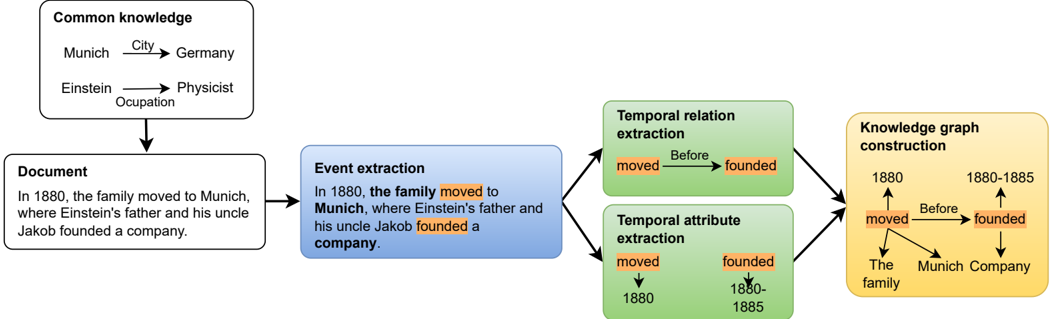
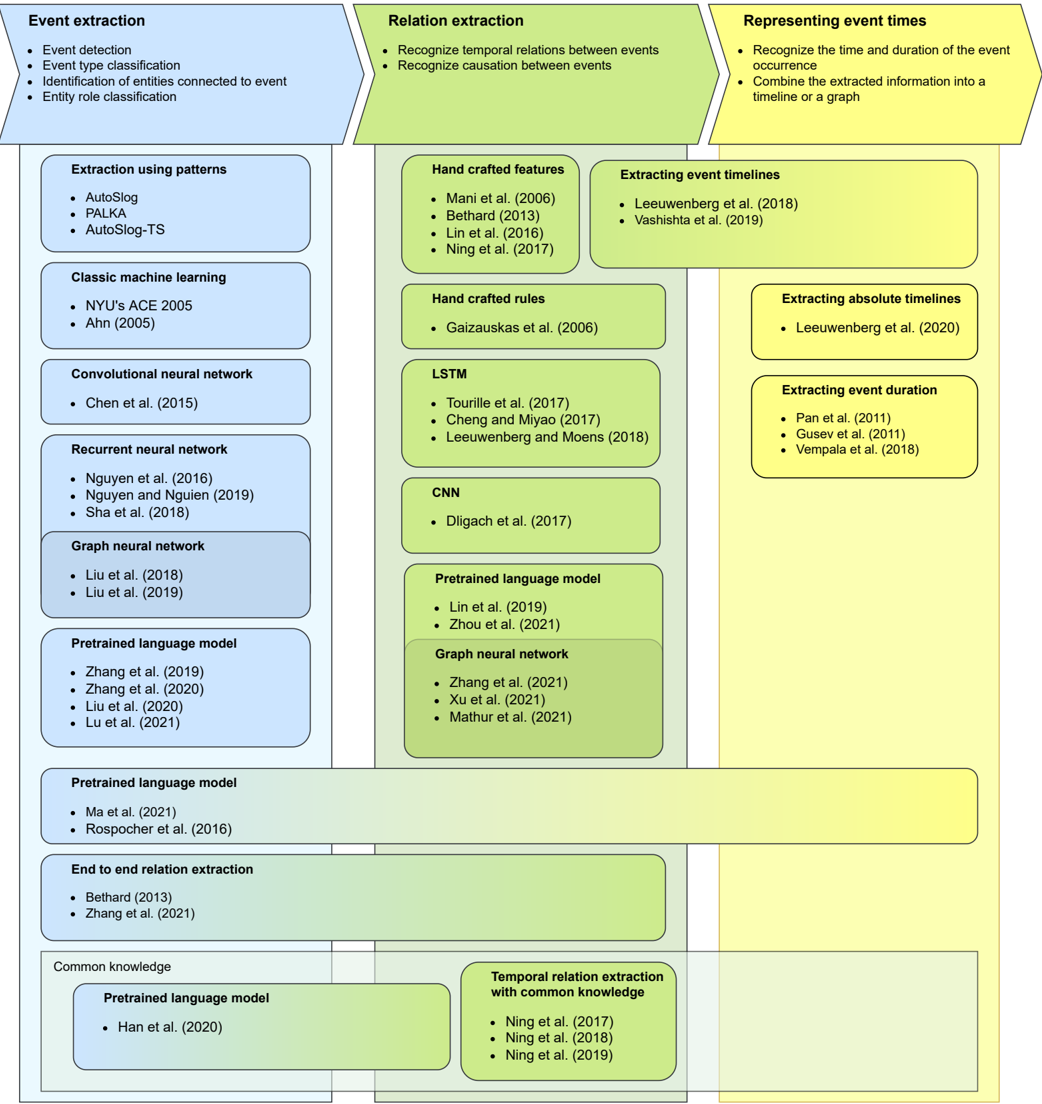
Textual documents serve as representations of discussions on a variety of subjects. These discussions can vary in length and may encompass a range of events or factual information. Present trends in constructing knowledge bases primarily emphasize fact-based common sense reasoning, often overlooking the temporal dimension of events. Given the widespread presence of time-related information, addressing this temporal aspect could potentially enhance the quality of common-sense reasoning within existing knowledge graphs. In this comprehensive survey, we aim to identify and evaluate the key tasks involved in constructing temporal knowledge graphs centered around events. These tasks can be categorized into three main components: (a) event extraction, (b) the extraction of temporal relationships and attributes, and (c) the creation of event-based knowledge graphs and timelines. Our systematic review focuses on the examination of available datasets and language technologies for addressing these tasks. An in-depth comparison of various approaches reveals that the most promising results are achieved by employing state-of-the-art models leveraging large pre-trained language models. Despite the existence of multiple datasets, a noticeable gap exists in the availability of annotated data that could facilitate the development of comprehensive end-to-end models. Drawing insights from our findings, we engage in a discussion and propose four future directions for research in this domain. These directions encompass (a) the integration of pre-existing knowledge, (b) the development of end-to-end systems for constructing event-centric knowledge graphs, (c) the enhancement of knowledge graphs with event-centric information, and (d) the prediction of absolute temporal attributes.
Overview
CoChat Summary
TL;DR
This survey reviews methods and datasets for constructing event-centric temporal knowledge graphs from unstructured documents, organizing the process into event extraction, temporal relation/attribute extraction, and knowledge graph/timeline construction. It finds that pretrained language models, especially BERT, and graph neural networks currently yield the strongest results, while end-to-end construction and absolute temporal attribute prediction remain underdeveloped.
Key findings
- The survey identifies three main task components: (a) event extraction, (b) extraction of temporal relationships and attributes, and (c) creation of event-based knowledge graphs and timelines.
- The most promising results are achieved by state-of-the-art models leveraging large pre-trained language models. For event extraction, Zhang et al. (2019) report F1 scores on ACE 2005 of 0.761 for event identification, 0.738 for event classification, 0.574 for argument identification, and 0.533 for argument role classification. For temporal relation extraction, Xu et al. (2021) report 0.732 on TimeBank-Dense with BERT + GNN, and Mathur et al. (2021) report 0.823 on MATRES with BERT + GNN; ChatGPT-based approaches score lower, e.g., Yuan et al. (2023) report 0.366 on TimeBank-Dense and 0.193 on MATRES, while Chan et al. (2023) report 0.233 and 0.350.
- A noticeable gap exists in annotated data that could facilitate comprehensive end-to-end models; only two systems presented encompass the complete process from event extraction to knowledge base construction. As an example of an event-centric knowledge graph, EventKG comprises 322,669 events with 88,473,111 relations.
- Four future directions are proposed: integration of pre-existing knowledge, development of end-to-end systems for constructing event-centric knowledge graphs, enhancement of knowledge graphs with event-centric information, and prediction of absolute temporal attributes.
Methods
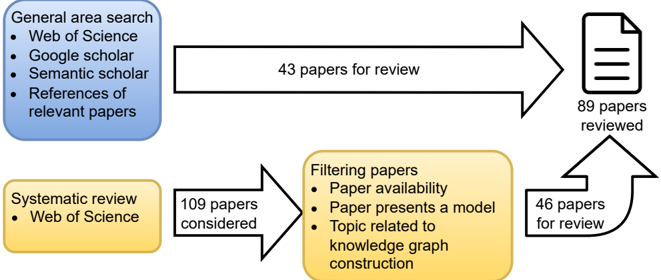
- Systematic review. The authors queried Google Scholar, Semantic Scholar, and Web of Science with general queries, then used task-specific Web of Science queries for event extraction, temporal relation extraction, and event-centric knowledge graph/timeline extraction or construction; they also considered references of relevant papers.
- Inclusion criteria required a paper to present a functional model or pipeline and address a task directly related to constructing event-centric temporal knowledge graphs; already-included papers were excluded. They assessed 109 papers and incorporated 46 into the survey.
- The analysis categorizes tasks into event extraction, temporal relation/attribute extraction, and knowledge graph/timeline construction, and compares schemas, datasets, and systems in tables. No new data were created or analyzed.
Limitations
- Stated: there is a gap in annotated data for comprehensive end-to-end models; only two systems cover the complete process; absolute temporal attributes remain underexplored; there is no unified schema for precise temporal relations; and pretrained conversational models like ChatGPT perform poorly on most tasks connected to event-centric knowledge graph construction.
- Stated/evident: comparisons are limited because reported scores come from individual papers and are not directly comparable, and traditional machine learning models use different datasets, preventing meaningful performance comparison.
- Evident: this is a qualitative systematic review rather than a meta-analysis, and it creates no new data; dataset coverage is concentrated in English, news, and medical domains, though non-English datasets are also listed.
Model-written summary. Check it against the paper before relying on it.
Integrity signals
Registry
Cites
Statistics
Figures
Verification
Claims the paper makes
0 Valid · 2 Not valid · 64 Not checked · 22 Own results and interpretations
A result the paper reports from its own data — it cites no other source for it, so there is none to check. The quote shows it is in the paper.
In the paper
“We identified event extraction, temporal relation, and attribute extraction, as well as knowledge graph or timeline construction as the three main steps required for constructing an event-centered knowledge graph.”
§ Event-Centric Temporal Knowledge Graph Construction: A Survey > 3. Methodology
plain- Asserted: passes — The authors put it forward as true.
- Checkable: passes — It can be checked against evidence.
- Load-bearing: passes — The paper’s conclusions depend on it.
- Based: passes — The paper gives a reason why it holds.
A result the paper states — it cites no source for it, so there is none to check. The quote shows it is in the paper.
In the paper
“Temporal attributes other than the time and duration of an event remain unexplored.”
§ Event-Centric Temporal Knowledge Graph Construction: A Survey > 4.3. Capturing Temporal Properties of Events
plain- Asserted: passes — The authors put it forward as true.
- Checkable: passes — It can be checked against evidence.
- Load-bearing: unclear — It is unclear whether the paper’s conclusions depend on it.
- Based: passes — The paper gives a reason why it holds.
None of the sources cited for this claim have been checked yet.
In the paper
“In contrast, there are fewer surveys dedicated to the topics of event extraction [56] and temporal relation extraction [57,58].”
§ Event-Centric Temporal Knowledge Graph Construction: A Survey > Representing event times
What the sources say
- Not checked yetcites [56] Xiang, W.; Wang, B. A survey of event extraction from text. IEEE Access 2019, 7, 173111-173137. source
- Not checked yetcites [57] Gumiel, Y.B.; Silva e Oliveira, L.E.; Claveau, V.; Grabar, N.; Paraiso, E.C.; Moro, C.; Carvalho, D.R. Temporal Relation Extraction in Clinical Texts: A Systematic Review. ACM Comput. Surv. (CSUR) 2021, 54, 1-36. source
- Not checked yetcites [58] Alfattni, G.; Peek, N.; Nenadic, G. Extraction of temporal relations from clinical free text: A systematic review of current approaches. J. Biomed. Inform. 2020, 108, 103488. source
plain- Asserted: passes — The authors put it forward as true.
- Checkable: passes — It can be checked against evidence.
- Load-bearing: unclear — It is unclear whether the paper’s conclusions depend on it.
- Based: passes — The paper gives a reason why it holds.
A result the paper states — it cites no source for it, so there is none to check. The quote shows it is in the paper.
In the paper
“Despite the existence of multiple datasets, a noticeable gap exists in the availability of annotated data that could facilitate the development of comprehensive end-to-end models.”
§ Event-Centric Temporal Knowledge Graph Construction: A Survey > Abstract
plain- Asserted: passes — The authors put it forward as true.
- Checkable: passes — It can be checked against evidence.
- Load-bearing: passes — The paper’s conclusions depend on it.
- Based: passes — The paper gives a reason why it holds.
A result the paper reports from its own data — it cites no other source for it, so there is none to check. The quote shows it is in the paper.
In the paper
“Notably, only two of the systems we present encompass the complete process, spanning from event extraction to knowledge base construction.”
§ Event-Centric Temporal Knowledge Graph Construction: A Survey > Document
plain- Asserted: passes — The authors put it forward as true.
- Checkable: passes — It can be checked against evidence.
- Load-bearing: unclear — It is unclear whether the paper’s conclusions depend on it.
- Based: passes — The paper gives a reason why it holds.
26 more claims
Create a free account to see all 88 claims and to verify the 87 references still open.
- Probably not a substantial claim. 55
- It may state two separate claims as one. 15
Self-check
Percentages, sums and reported differences re-computed from the paper’s own numbers.
Each contradiction between two passages listed here was confirmed by an independent check.
Rated minor: it would not touch a result — a value no result rests on, a p-value that stays on the same side of the significance level, or a conflict that is clerical, resolved elsewhere in the paper, or outside its own findings.
In the paper
§ Event-Centric Temporal Knowledge Graph Construction: A Survey > 4.4. General Datasets for Temporal Description and Relation Extraction
“In 2013, SemEval introduced TempEval-3 [78]”
§ Event-Centric Temporal Knowledge Graph Construction: A Survey > References
“78. Verhagen, M.; Sauri, R.; Caselli, T.; Pustejovsky, J. SemEval-2010 Task 13: TempEval-2.”
Rated minor: it would not touch a result — a value no result rests on, a p-value that stays on the same side of the significance level, or a conflict that is clerical, resolved elsewhere in the paper, or outside its own findings.
In the paper
§ Event-Centric Temporal Knowledge Graph Construction: A Survey > 4.5. Domain Specific Datasets
“This dataset, drawn from clinical notes on patients with colon cancer from the Mayo Clinic, comprises approximately 600 documents, each painstakingly annotated.”
§ Event-Centric Temporal Knowledge Graph Construction: A Survey > 9. Conclusions
“| THYME (TempEval 2015) 2015 Notes on colon cancer | 440 documents | |”
Citations
Cites
Wikidata: a free collaborative knowledgebase
Vrandečić, D., & Krötzsch, M. (2014) · Communications of the ACM · doi:10.1145/2629489 · Cited by 3,342
DBpedia – A large-scale, multilingual knowledge base extracted from Wikipedia
Lehmann, J., Isele, R., Jakob, M., Jentzsch, A., Kontokostas, D., Mendes, P. N., Hellmann, S., Morsey, M., van Kleef, P., Auer, S., et al. (2015) · Semantic Web · doi:10.3233/sw-140134 · Cited by 3,168
A Survey on Knowledge Graphs: Representation, Acquisition, and Applications
Ji, S., Pan, S., Cambria, E., Marttinen, P., & Yu, P. S. (2022) · IEEE Transactions on Neural Networks and Learning Systems · doi:10.1109/tnnls.2021.3070843 · Cited by 2,947
Yago: a core of semantic knowledge
Suchanek, F. M., Kasneci, G., & Weikum, G. (2007) · Proceedings of the 16th international conference on World Wide Web · doi:10.1145/1242572.1242667 · Cited by 2,512
Ray, P. P. (2023) · Internet of Things and Cyber-Physical Systems · doi:10.1016/j.iotcps.2023.04.003 · Cited by 2,463
Event Extraction via Dynamic Multi-Pooling Convolutional Neural Networks
Chen, Y., Xu, L., Liu, K., Zeng, D., & Zhao, J. (2015) · Proceedings of the 53rd Annual Meeting of the Association for Computational Linguistics and the 7th International Joint Conference on Natural Language Processing (Volume 1: Long Papers) · doi:10.3115/v1/p15-1017 · Cited by 906
K-BERT: Enabling Language Representation with Knowledge Graph
Liu, W., Zhou, P., Zhao, Z., Wang, Z., Ju, Q., Deng, H., & Wang, P. (2020) · Proceedings of the AAAI Conference on Artificial Intelligence · doi:10.1609/aaai.v34i03.5681 · Cited by 894
Rogers, R. (2013) · The MIT Press eBooks · doi:10.7551/mitpress/8718.001.0001 · Cited by 746
Joint Event Extraction via Recurrent Neural Networks
Nguyen, T. H., Cho, K., & Grishman, R. (2016) · Proceedings of the 2016 Conference of the North American Chapter of the Association for Computational Linguistics: Human Language Technologies · doi:10.18653/v1/n16-1034 · Cited by 647
The stages of event extraction
Ahn, D. (2006) · doi:10.3115/1629235.1629236 · Cited by 589
Research works printed but not linked: 16
- Saurí, R.; Littman, J.; Knippen, B.; Gaizauskas, R.; Setzer, A.; Pustejovsky, J. TimeML annotation guidelines. Version 2006, 1, 31.
- Nguyen, N.T., Chbeir, R., Exposito, E., Aniorté, P., Trawi ński, B., Eds.; Springer: Cham, Switzerland, 2019; pp. 207-218.
- Pustejovsky, J.; Hanks, P.; Sauri, R.; See, A.; Gaizauskas, R.; Setzer, A.; Radev, D.; Sundheim, B.; Day, D.; Ferro, L.; et al. The timebank corpus. In Proceedings of the Corpus Linguistics, Lancaster, UK, 28-31 March 2003; Volume 2003, p. 40.
- Pustejovsky, J.; Littman, J.; Saurí, R.; Verhagen, M. Timebank 1.2 Documentation; Linguistic Data Consortium: Philadelphia, PA, USA, 2006; pp. 6-11; Event London no. April
- Verhagen, M.; Sauri, R.; Caselli, T.; Pustejovsky, J. SemEval-2010 Task 13: TempEval-2. In Proceedings of the 5th International Workshop on Semantic Evaluation, Uppsala, Sweden, 15-16 July 2010; pp. 57-62.
- Parker, R.; Graff, D.; Kong, J.; Chen, K.; Maeda, K. English Gigaword Fifth Edition; Linguistic Data Consortium: Philadelphia, PA, USA, 2011.
- Caselli, T.; Miller, B.; van Erp, M.; Vossen, P.; Palmer, M.; Hovy, E.; Mitamura, T.; Caswell, D. Events and Stories in the News. In Proceedings of the Events and Stories in the News Workshop, Vancouver, BC, Canada, 4 August 2017.
- Caselli, T.; Lenzi, V.B.; Sprugnoli, R.; Pianta, E.; Prodanof, I. Annotating events, temporal expressions and relations in Italian: The It-TimeML experience for the Ita-TimeBank. In Proceedings of the 5th Linguistic Annotation Workshop, Portland, OR, USA, 23-24 June 2011; pp. 143-151.
- Event (2022). Oxford English Dictionary, Oxford University Press.
- Piskorski, J.; Tanev, H.; Atkinson, M.; Goot, E.v.d.; Zavarella, V. Online news event extraction for global crisis surveillance. In Transactions on Computational Collective Intelligence V; Springer: Berlin/Heidelberg, Germany, 2011; pp. 182-212. 104.
- Iqbal, 2019, On extraction of event information from social text streams: An unpretentious nlp solution, IJCSNS, 19, 1
- Zeng, Y., Yang, H., Feng, Y., Wang, Z., and Zhao, D. (2016). Natural Language Understanding and Intelligent Applications, Springer.
- Li, B., Fang, G., Yang, Y., Wang, Q., Ye, W., Zhao, W., and Zhang, S. (2023). Evaluating ChatGPT’s Information Extraction Capabilities: An Assessment of Performance, Explainability, Calibration, and Faithfulness. arXiv.
- Gao, J., Zhao, H., Yu, C., and Xu, R. (2023). Exploring the feasibility of chatgpt for event extraction. arXiv.
- Chan, C., Cheng, J., Wang, W., Jiang, Y., Fang, T., Liu, X., and Song, Y. (2023). Chatgpt evaluation on sentence level relations: A focus on temporal, causal, and discourse relations. arXiv.
- Leetaru, K., and Schrodt, P.A. (2013, January 3–6). Gdelt: Global data on events, location, and tone, 1979–2012. Proceedings of the ISA Annual Convention, San Francisco, CA, USA.
Cited by
Knowledge Graph Construction: Extraction, Learning, and Evaluation
Choi, S., & Jung, Y. (2025) · Applied Sciences · doi:10.3390/app15073727 · Cited by 81
Beniwal, H., Patel, D., Kowsik Nandagopan, D., Ladia, H., Yadav, A. K., & Singh, M. (2024) · Findings of the Association for Computational Linguistics: EMNLP (Findings of EMNLP) · doi:10.18653/v1/2024.findings-emnlp.953 · Cited by 10
Hu, Y., Wang, H., Chen, J., Zhang, C., Ren, M., Dong, M., Zhang, H., Hu, Z., & Dong, X. T. (2025) · Expert Systems with Applications · doi:10.1016/j.eswa.2025.129291 · Cited by 8
Cross-lingual transfer learning for knowledge graph acquisition: Paradigms, resources and challenges
Chen, W.-L., Zhou, K.-Q., Sarkheyli-Hägele, A., Qin, F. Y., Hasikin, K. B., Kang, D.-W., & Zain, A. M. (2025) · Expert Systems with Applications · doi:10.1016/j.eswa.2025.130434 · Cited by 7
Event Knowledge Graph for a Knowledge-Based Design Process Model for Additive Manufacturing
Chen, G., Haruna, A., Youze, C., Li, L., Noman, K., Li, Y., & Eliker, K. (2025) · Machines · doi:10.3390/machines13020112 · Cited by 7
Zhang, Y. (2025) · Future Technology · doi:10.55670/fpll.futech.4.3.21 · Cited by 5
Towards a Unified Temporal and Event Logic Paradigm for Multi-Hop Path Reasoning in Knowledge Graphs
Zeng, Y., Hou, X., Wang, X., & Li, J. (2025) · Electronics · doi:10.3390/electronics14030516 · Cited by 4
Yao, L., Ren, F., & Du, Q. (2025) · Expert Systems with Applications · doi:10.1016/j.eswa.2025.130178 · Cited by 4
Fu, Y., Lyu, T., Chen, Y., & Lv, Z. (2026) · ENGINEERING Management · doi:10.1007/s42524-026-4237-0 · Cited by 3
Lin, Y.-D., & Liao, G. (2025) · arXiv (Cornell University) · doi:10.48550/arxiv.2504.12309 · Cited by 3
EOAC-LLM: An LLM-driven event ontology automatic construction system
Lu, Z., Yang, J., Guo, C., Zhang, C., & Yao, L. (2026) · Intelligent Systems with Applications · doi:10.1016/j.iswa.2026.200650 · Cited by 3
Zeginis, D., & Tarabanis, K. A. (2025) · Lecture notes in business information processing · doi:10.1007/978-3-031-81322-1_27 · Cited by 3
Bao, W., Wang, Y. A., Gao, R., Leng, F., Bao, Y., & Yu, G. (2026) · Lecture notes in computer science · doi:10.1007/978-981-92-0378-9_22 · Cited by 2
ECS-KG: An event-centric semantic knowledge graph for event-related news articles
Lakshika, M. V. P. T., Caldera, A., & De Zoysa, T. N. K. (2025) · Data & Knowledge Engineering · doi:10.1016/j.datak.2025.102451 · Cited by 2
Comparing Human and Large Language Model Interpretation of Implicit Information
Santis, A. D., Bonetti, T., Tocchetti, A., & Brambilla, M. (2026) · Findings of the Association for Computational Linguistics: ACL (Findings of ACL) · doi:10.18653/v1/2026.findings-acl.1111 · Cited by 2
A Model of Proactive Safety Based on Knowledge GraphPreprint
Wen, H. (2024) · arXiv (Cornell University) · doi:10.48550/arxiv.2407.15127 · Cited by 2
Semi-automatic Knowledge Graph Construction Based on Deep Learning
Xu, Y., Mariano, V. Y., Abisado, M., & Hernandez, A. A. (2024) · Journal of Electrical Systems · doi:10.52783/jes.1096 · Cited by 1
A Framework of Project Risk Simulation with Event Knowledge Graph
Wen, H., AbouRizk, S., Mohamed, Y., & Huang, R. (2024) · Winter Simulation Conference · doi:10.1109/wsc63780.2024.10838960 · Cited by 1
Zhou, G., & Li, H. (2026) · ASCE-ASME Journal of Risk and Uncertainty in Engineering Systems Part A Civil Engineering · doi:10.1061/ajrua6.rueng-2082
AOCG-LLM+: automatic ontology construction and generation method
Lu, Z., Yang, J., Zhang, C., & Li, Y. (2026) · Complex & Intelligent Systems · doi:10.1007/s40747-026-02372-7
Temporal knowledge graph embeddings for brand advocate prediction in microblogging
Abu-Salih, B., Alotaibi, S., Alanazi, A. L., Elshqeirat, B., Issa, T., Almiani, M., & Aljaafari, M. A. H. (2026) · Cluster Computing · doi:10.1007/s10586-026-05989-y
Sarabadani, A., & Tajvidiyan, M. (2026) · arXiv (Cornell University) · doi:10.48550/arxiv.2606.15778
Dorsey, T., & Huggins, K. L. (2026) · arXiv (Cornell University) · doi:10.48550/arxiv.2605.02106
Грибенко, Є., & Novotarskyi, M. (2026) · Information, computing and intelligent systems · doi:10.20535/2786-8729.9.2026.365516
Večmodalno učenje za izdelavo in obogatitev časovnih relacij v grafih znanja
Knez, T. (2026) · Repository of the University of Ljubljana (University of Ljubljana)
Self-citationTemporal-Aware Person-Job Matching via LLM-Extracted Knowledge Graphs and Graph Convolution
Liu, M., Gong, H., Lin, X., Song, X., Zhu, R., & Pan, L. (2026) · International Conference on Big Data and Information Analytics (BigDIA) · doi:10.1109/bigdia71496.2026.11684658
Modeling and Managing Temporal Obligations in GUCON Using SPARQL-star and RDF-starPreprint
Akaichi, I., Flouris, G., Fundulaki, I., & Kirrane, S. (2025) · arXiv (Cornell University) · doi:10.48550/arxiv.2510.04652
Pretrained language models with semantic embeddings for temporal knowledge graph completion
Lv, S., Dong, J., & Wang, X. (2026) · Knowledge and Information Systems · doi:10.1007/s10115-026-02932-w
Distinguishing Revision and Delayed Elaboration in Incremental Narrative InterpretationPreprint
Chen, Y.-C. (2026) · arXiv (Cornell University) · doi:10.48550/arxiv.2608.21364
Hong, L., Deng, N., Meng, J., Cai, J., Wu, Y., Zhang, X., & Wang, Y. (2026) · IEEE Access · doi:10.1109/access.2026.3751669
Comparing Human and Large Language Model Interpretation of Implicit InformationPreprint
Santis, A. D., Bonetti, T., Tocchetti, A., & Brambilla, M. (2026) · arXiv (Cornell University) · doi:10.48550/arxiv.2604.17085
Generative neural network for AI engineering education courses based on knowledge evolution
Wang, K. (2026) · International Journal of Continuing Engineering Education and Life-Long Learning · doi:10.1504/ijceell.2026.156535
Metadata
- Authors
- Knez, T., & Žitnik, S.
- Affiliations
- University of Ljubljana (SI)
- Corresponding author
- Knez, Timotej
- Venue
- Mathematics
- Publisher
- MDPI AG
- Published
- 2023-12-02
- Volume
- 11
- Issue
- 23
- Pages
- 4852
- ISSN
- 2227-7390 (ISSN-L)
- OpenAlex
- W4389274456
- Cited by
- 32
- References
- 139
- Citations by year
- 2026: 17 · 2025: 11 · 2024: 4
- FWCI
- 1.74
- Type
- journal article
- Language
- en
- Open access
- gold
- doi.org
- Licence
- Locations
- Mathematics (publishedVersion, cc-by)
- RePEc: Research Papers in Economics (submittedVersion)
- DOAJ (DOAJ: Directory of Open Access Journals) (submittedVersion)
- Funders
- Slovenian Research Agency
- Topics
- Physical Sciences › Computer Science › Artificial Intelligence › Topic Modeling
- Physical Sciences › Computer Science › Computer Vision and Pattern Recognition › Multimodal Machine Learning Applications
- Physical Sciences › Computer Science › Artificial Intelligence › Natural Language Processing Techniques
- Keywords
- temporal knowledge graphs, event extraction, temporal relation extraction, chronology of events, commonsense reasoning, large pre-trained language models, annotated dataset, knowledge graph construction
About these checks
Registry, retraction, Cites and statistics results are computed, not judged, with one exception: a printed reference that no index lists is read once by a model before it counts as a citation error. Claims are extracted by a model and kept only when their quote appears verbatim in the text; each cited source is then checked, with a model’s help, for whether it says what the claim relies on. Those verdicts can be wrong — read the claim’s quote and the cited source before relying on one.
A language model drew the claims from the paper on 2026-11-23, under version 3 of the claim definition (model deepseek-v4.1-flash, prompt extract-v3).
A second model labelled each claim on 2026-11-23 (model jev-1.13-20260917, definition revision gold-guideline-v0.2).
Statistics and arithmetic are recomputed, not judged.
Confidence bands are shown only for fields calibrated on our annotated test set. None is calibrated yet, so no band is shown.
What counts as a claim ›How we measure confidence ›How we check this ›
Are you an author, or do you see a problem with this page? Request a review
Data sources
Bibliographic data: Semantic Scholar, OpenAlex, Crossref.
Contains information from the Semantic Scholar Academic Graph Datasets, made available under the ODC Attribution License (ODC-BY 1.0).
Semantic Scholar’s data is described in: Kinney, R., et al. (2023). The Semantic Scholar Open Data Platform. arXiv:2301.10140.
