

Event-Centric Temporal Knowledge Graph Construction: A Survey
Open accessThe DOI matches its Crossref record; 142 of the 143 references it cites were found in a registry or an index; none of the 87 sources its claims cite is checked for support yet.
Abstract
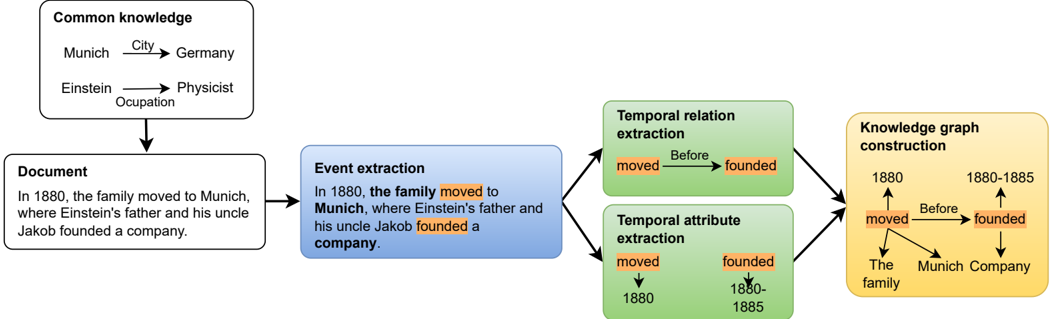
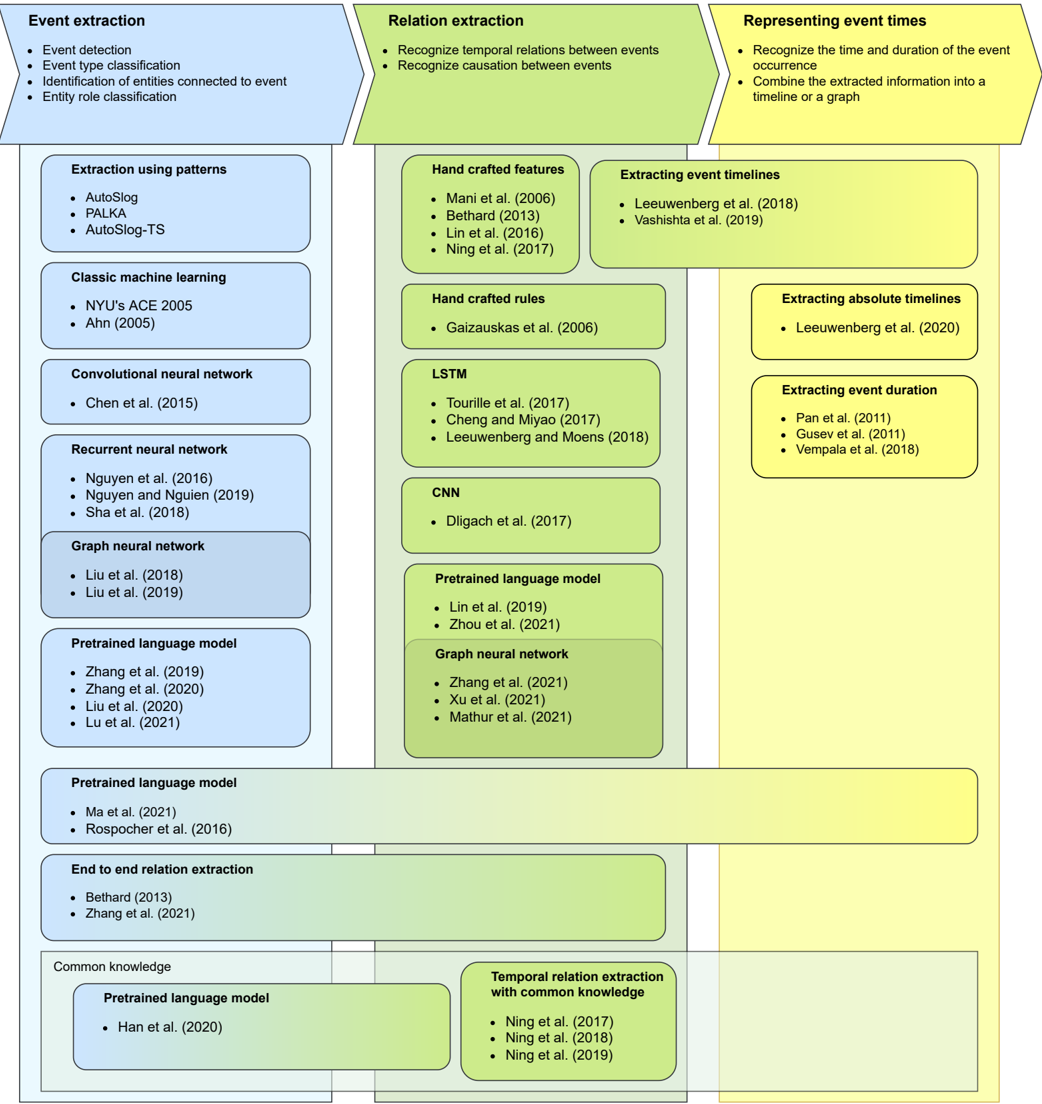
Textual documents serve as representations of discussions on a variety of subjects. These discussions can vary in length and may encompass a range of events or factual information. Present trends in constructing knowledge bases primarily emphasize fact-based common sense reasoning, often overlooking the temporal dimension of events. Given the widespread presence of time-related information, addressing this temporal aspect could potentially enhance the quality of common-sense reasoning within existing knowledge graphs. In this comprehensive survey, we aim to identify and evaluate the key tasks involved in constructing temporal knowledge graphs centered around events. These tasks can be categorized into three main components: (a) event extraction, (b) the extraction of temporal relationships and attributes, and (c) the creation of event-based knowledge graphs and timelines. Our systematic review focuses on the examination of available datasets and language technologies for addressing these tasks. An in-depth comparison of various approaches reveals that the most promising results are achieved by employing state-of-the-art models leveraging large pre-trained language models. Despite the existence of multiple datasets, a noticeable gap exists in the availability of annotated data that could facilitate the development of comprehensive end-to-end models. Drawing insights from our findings, we engage in a discussion and propose four future directions for research in this domain. These directions encompass (a) the integration of pre-existing knowledge, (b) the development of end-to-end systems for constructing event-centric knowledge graphs, (c) the enhancement of knowledge graphs with event-centric information, and (d) the prediction of absolute temporal attributes.
Overview
CoChat Summary
TL;DR
This survey reviews methods and datasets for constructing event-centric temporal knowledge graphs from unstructured documents, organizing the process into event extraction, temporal relation/attribute extraction, and knowledge graph/timeline construction. It finds that pretrained language models, especially BERT, and graph neural networks currently yield the strongest results, while end-to-end construction and absolute temporal attribute prediction remain underdeveloped.
Key findings
- The survey identifies three main task components: (a) event extraction, (b) extraction of temporal relationships and attributes, and (c) creation of event-based knowledge graphs and timelines.
- The most promising results are achieved by state-of-the-art models leveraging large pre-trained language models. For event extraction, Zhang et al. (2019) report F1 scores on ACE 2005 of 0.761 for event identification, 0.738 for event classification, 0.574 for argument identification, and 0.533 for argument role classification. For temporal relation extraction, Xu et al. (2021) report 0.732 on TimeBank-Dense with BERT + GNN, and Mathur et al. (2021) report 0.823 on MATRES with BERT + GNN; ChatGPT-based approaches score lower, e.g., Yuan et al. (2023) report 0.366 on TimeBank-Dense and 0.193 on MATRES, while Chan et al. (2023) report 0.233 and 0.350.
- A noticeable gap exists in annotated data that could facilitate comprehensive end-to-end models; only two systems presented encompass the complete process from event extraction to knowledge base construction. As an example of an event-centric knowledge graph, EventKG comprises 322,669 events with 88,473,111 relations.
- Four future directions are proposed: integration of pre-existing knowledge, development of end-to-end systems for constructing event-centric knowledge graphs, enhancement of knowledge graphs with event-centric information, and prediction of absolute temporal attributes.
Methods
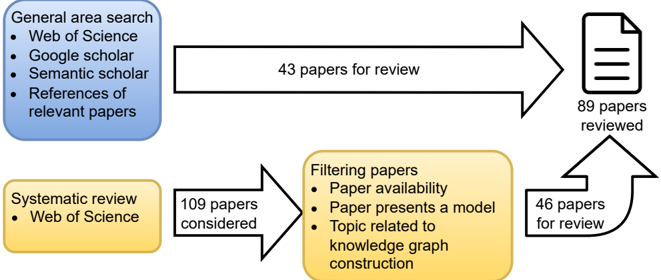
- Systematic review. The authors queried Google Scholar, Semantic Scholar, and Web of Science with general queries, then used task-specific Web of Science queries for event extraction, temporal relation extraction, and event-centric knowledge graph/timeline extraction or construction; they also considered references of relevant papers.
- Inclusion criteria required a paper to present a functional model or pipeline and address a task directly related to constructing event-centric temporal knowledge graphs; already-included papers were excluded. They assessed 109 papers and incorporated 46 into the survey.
- The analysis categorizes tasks into event extraction, temporal relation/attribute extraction, and knowledge graph/timeline construction, and compares schemas, datasets, and systems in tables. No new data were created or analyzed.
Limitations
- Stated: there is a gap in annotated data for comprehensive end-to-end models; only two systems cover the complete process; absolute temporal attributes remain underexplored; there is no unified schema for precise temporal relations; and pretrained conversational models like ChatGPT perform poorly on most tasks connected to event-centric knowledge graph construction.
- Stated/evident: comparisons are limited because reported scores come from individual papers and are not directly comparable, and traditional machine learning models use different datasets, preventing meaningful performance comparison.
- Evident: this is a qualitative systematic review rather than a meta-analysis, and it creates no new data; dataset coverage is concentrated in English, news, and medical domains, though non-English datasets are also listed.
Model-written summary. Check it against the paper before relying on it.
Integrity signals
Registry
Cites
Statistics
Figures
Verification
Claims the paper makes
0 Valid · 2 Not valid · 64 Not checked · 22 Own results and interpretations
A result the paper reports from its own data — it cites no other source for it, so there is none to check. The quote shows it is in the paper.
In the paper
“We identified event extraction, temporal relation, and attribute extraction, as well as knowledge graph or timeline construction as the three main steps required for constructing an event-centered knowledge graph.”
§ Event-Centric Temporal Knowledge Graph Construction: A Survey > 3. Methodology
plain- Asserted: passes — The authors put it forward as true.
- Checkable: passes — It can be checked against evidence.
- Load-bearing: passes — The paper’s conclusions depend on it.
- Based: passes — The paper gives a reason why it holds.
A result the paper states — it cites no source for it, so there is none to check. The quote shows it is in the paper.
In the paper
“Temporal attributes other than the time and duration of an event remain unexplored.”
§ Event-Centric Temporal Knowledge Graph Construction: A Survey > 4.3. Capturing Temporal Properties of Events
plain- Asserted: passes — The authors put it forward as true.
- Checkable: passes — It can be checked against evidence.
- Load-bearing: unclear — It is unclear whether the paper’s conclusions depend on it.
- Based: passes — The paper gives a reason why it holds.
None of the sources cited for this claim have been checked yet.
In the paper
“In contrast, there are fewer surveys dedicated to the topics of event extraction [56] and temporal relation extraction [57,58].”
§ Event-Centric Temporal Knowledge Graph Construction: A Survey > Representing event times
What the sources say
- Not checked yetcites [56] Xiang, W.; Wang, B. A survey of event extraction from text. IEEE Access 2019, 7, 173111-173137. source
- Not checked yetcites [57] Gumiel, Y.B.; Silva e Oliveira, L.E.; Claveau, V.; Grabar, N.; Paraiso, E.C.; Moro, C.; Carvalho, D.R. Temporal Relation Extraction in Clinical Texts: A Systematic Review. ACM Comput. Surv. (CSUR) 2021, 54, 1-36. source
- Not checked yetcites [58] Alfattni, G.; Peek, N.; Nenadic, G. Extraction of temporal relations from clinical free text: A systematic review of current approaches. J. Biomed. Inform. 2020, 108, 103488. source
plain- Asserted: passes — The authors put it forward as true.
- Checkable: passes — It can be checked against evidence.
- Load-bearing: unclear — It is unclear whether the paper’s conclusions depend on it.
- Based: passes — The paper gives a reason why it holds.
A result the paper states — it cites no source for it, so there is none to check. The quote shows it is in the paper.
In the paper
“Despite the existence of multiple datasets, a noticeable gap exists in the availability of annotated data that could facilitate the development of comprehensive end-to-end models.”
§ Event-Centric Temporal Knowledge Graph Construction: A Survey > Abstract
plain- Asserted: passes — The authors put it forward as true.
- Checkable: passes — It can be checked against evidence.
- Load-bearing: passes — The paper’s conclusions depend on it.
- Based: passes — The paper gives a reason why it holds.
A result the paper reports from its own data — it cites no other source for it, so there is none to check. The quote shows it is in the paper.
In the paper
“Notably, only two of the systems we present encompass the complete process, spanning from event extraction to knowledge base construction.”
§ Event-Centric Temporal Knowledge Graph Construction: A Survey > Document
plain- Asserted: passes — The authors put it forward as true.
- Checkable: passes — It can be checked against evidence.
- Load-bearing: unclear — It is unclear whether the paper’s conclusions depend on it.
- Based: passes — The paper gives a reason why it holds.
26 more claims
Create a free account to see all 88 claims and to verify the 87 references still open.
- Probably not a substantial claim. 55
- It may state two separate claims as one. 15
Self-check
Percentages, sums and reported differences re-computed from the paper’s own numbers.
Each contradiction between two passages listed here was confirmed by an independent check.
Rated minor: it would not touch a result — a value no result rests on, a p-value that stays on the same side of the significance level, or a conflict that is clerical, resolved elsewhere in the paper, or outside its own findings.
In the paper
§ Event-Centric Temporal Knowledge Graph Construction: A Survey > 4.4. General Datasets for Temporal Description and Relation Extraction
“In 2013, SemEval introduced TempEval-3 [78]”
§ Event-Centric Temporal Knowledge Graph Construction: A Survey > References
“78. Verhagen, M.; Sauri, R.; Caselli, T.; Pustejovsky, J. SemEval-2010 Task 13: TempEval-2.”
Rated minor: it would not touch a result — a value no result rests on, a p-value that stays on the same side of the significance level, or a conflict that is clerical, resolved elsewhere in the paper, or outside its own findings.
In the paper
§ Event-Centric Temporal Knowledge Graph Construction: A Survey > 4.5. Domain Specific Datasets
“This dataset, drawn from clinical notes on patients with colon cancer from the Mayo Clinic, comprises approximately 600 documents, each painstakingly annotated.”
§ Event-Centric Temporal Knowledge Graph Construction: A Survey > 9. Conclusions
“| THYME (TempEval 2015) 2015 Notes on colon cancer | 440 documents | |”
Citations
Cites
Wikidata: a free collaborative knowledgebase
Vrandečić, D., & Krötzsch, M. (2014) · Communications of the ACM · doi:10.1145/2629489 · Cited by 3,342
DBpedia – A large-scale, multilingual knowledge base extracted from Wikipedia
Lehmann, J., Isele, R., Jakob, M., Jentzsch, A., Kontokostas, D., Mendes, P. N., Hellmann, S., Morsey, M., van Kleef, P., Auer, S., et al. (2015) · Semantic Web · doi:10.3233/sw-140134 · Cited by 3,168
A Survey on Knowledge Graphs: Representation, Acquisition, and Applications
Ji, S., Pan, S., Cambria, E., Marttinen, P., & Yu, P. S. (2022) · IEEE Transactions on Neural Networks and Learning Systems · doi:10.1109/tnnls.2021.3070843 · Cited by 2,947
Yago: a core of semantic knowledge
Suchanek, F. M., Kasneci, G., & Weikum, G. (2007) · Proceedings of the 16th international conference on World Wide Web · doi:10.1145/1242572.1242667 · Cited by 2,512
Ray, P. P. (2023) · Internet of Things and Cyber-Physical Systems · doi:10.1016/j.iotcps.2023.04.003 · Cited by 2,463
Event Extraction via Dynamic Multi-Pooling Convolutional Neural Networks
Chen, Y., Xu, L., Liu, K., Zeng, D., & Zhao, J. (2015) · Proceedings of the 53rd Annual Meeting of the Association for Computational Linguistics and the 7th International Joint Conference on Natural Language Processing (Volume 1: Long Papers) · doi:10.3115/v1/p15-1017 · Cited by 906
K-BERT: Enabling Language Representation with Knowledge Graph
Liu, W., Zhou, P., Zhao, Z., Wang, Z., Ju, Q., Deng, H., & Wang, P. (2020) · Proceedings of the AAAI Conference on Artificial Intelligence · doi:10.1609/aaai.v34i03.5681 · Cited by 894
Rogers, R. (2013) · The MIT Press eBooks · doi:10.7551/mitpress/8718.001.0001 · Cited by 746
Joint Event Extraction via Recurrent Neural Networks
Nguyen, T. H., Cho, K., & Grishman, R. (2016) · Proceedings of the 2016 Conference of the North American Chapter of the Association for Computational Linguistics: Human Language Technologies · doi:10.18653/v1/n16-1034 · Cited by 647
The stages of event extraction
Ahn, D. (2006) · doi:10.3115/1629235.1629236 · Cited by 589
Evaluating temporal relations in clinical text: 2012 i2b2 Challenge
Sun, W., Rumshisky, A., & Uzuner, O. (2013) · Journal of the American Medical Informatics Association · doi:10.1136/amiajnl-2013-001628 · Cited by 473
Automatically constructing a dictionary for information extraction tasks
Riloff, E. (1993) · Cited by 453
Jointly Multiple Events Extraction via Attention-based Graph Information Aggregation
Liu, X., Luo, Z., & Huang, H. (2018) · Proceedings of the 2018 Conference on Empirical Methods in Natural Language Processing · doi:10.18653/v1/d18-1156 · Cited by 397
Domain-specific knowledge graphs: A survey
Abu-Salih, B. (2021) · Journal of Network and Computer Applications · doi:10.1016/j.jnca.2021.103076 · Cited by 379
Event Extraction as Machine Reading Comprehension
Liu, J., Chen, Y., Liu, K., Bi, W., & Liu, X. (2020) · Proceedings of the 2020 Conference on Empirical Methods in Natural Language Processing (EMNLP) · doi:10.18653/v1/2020.emnlp-main.128 · Cited by 303
Multi-Sentence Argument Linking
Ebner, S., Xia, P., Culkin, R., Rawlins, K., & Durme, B. V. (2020) · Proceedings of the conference - Association for Computational Linguistics. Meeting · doi:10.18653/v1/2020.acl-main.718 · Cited by 299
SemEval-2007 task 15: TempEval temporal relation identification
Verhagen, M., Gaizauskas, R., Schilder, F., Hepple, M., Katz, G., & Pustejovsky, J. (2007) · Proceedings of the 4th International Workshop on Semantic Evaluations - SemEval '07 · doi:10.3115/1621474.1621488 · Cited by 296
(Comet-) Atomic 2020: On Symbolic and Neural Commonsense Knowledge Graphs
Hwang, J. D., Bhagavatula, C., Le Bras, R., Da, J., Sakaguchi, K., Bosselut, A., & Choi, Y. (2021) · Proceedings of the AAAI Conference on Artificial Intelligence · doi:10.1609/aaai.v35i7.16792 · Cited by 286
Machine learning of temporal relations
Mani, I., Verhagen, M., Wellner, B., Lee, C. M., & Pustejovsky, J. (2006) · Proceedings of the 21st International Conference on Computational Linguistics and the 44th annual meeting of the ACL - ACL '06 · doi:10.3115/1220175.1220270 · Cited by 282
Sha, L., Qian, F., Chang, B., & Sui, Z. (2018) · Proceedings of the AAAI Conference on Artificial Intelligence · doi:10.1609/aaai.v32i1.12034 · Cited by 249
Text2Event: Controllable Sequence-to-Structure Generation for End-to-end Event Extraction
Lu, Y., Lin, H., Xu, J., Han, X., Tang, J., Li, A., Sun, L., Liao, M., & Chen, S. (2021) · Proceedings of the 59th Annual Meeting of the Association for Computational Linguistics and the 11th International Joint Conference on Natural Language Processing (Volume 1: Long Papers) · doi:10.18653/v1/2021.acl-long.217 · Cited by 229
Joint Extraction of Events and Entities within a Document Context
Yang, B., & Mitchell, T. M. (2016) · Proceedings of the 2016 Conference of the North American Chapter of the Association for Computational Linguistics: Human Language Technologies · doi:10.18653/v1/n16-1033 · Cited by 220
NYU's English ACE 2005 System Description
Grishman, R., Westbrook, D. A., & Meyers, A. (2005) · Cited by 207
Building event-centric knowledge graphs from news
Rospocher, M., van Erp, M., Vossen, P., Fokkens, A., Aldabe, I., Rigau, G., Soroa, A., Ploeger, T., & Bogaard, T. (2016) · Journal of Web Semantics · doi:10.1016/j.websem.2015.12.004 · Cited by 200
Relation Extraction : A SurveyPreprint
Pawar, S. S., Palshikar, G. K., & Bhattacharyya, P. (2017) · arXiv (Cornell University) · doi:10.48550/arxiv.1712.05191 · Cited by 196
A Survey of Event Extraction From Text
Xiang, W., & Wang, B. (2019) · IEEE Access · doi:10.1109/access.2019.2956831 · Cited by 195
SemEval-2016 Task 12: Clinical TempEval
Bethard, S., Savova, G., Chen, W.-T., Derczynski, L., Pustejovsky, J., & Verhagen, M. (2016) · Proceedings of the 10th International Workshop on Semantic Evaluation (SemEval-2016) · doi:10.18653/v1/s16-1165 · Cited by 182
SemEval-2017 Task 12: Clinical TempEval
Bethard, S. J., Savova, G., Palmer, M. S., & Pustejovsky, J. D. (2017) · International Workshop on Semantic Evaluation (SemEval) · doi:10.18653/v1/s17-2093 · Cited by 171
Moments and points in an interval‐based temporal logic
Allen, J. F., & Hayes, P. J. (1989) · Computational Intelligence · doi:10.1111/j.1467-8640.1989.tb00329.x · Cited by 170
SemEval-2015 Task 6: Clinical TempEval
Bethard, S., Derczynski, L., Savova, G., Pustejovsky, J., & Verhagen, M. (2015) · Proceedings of the 9th International Workshop on Semantic Evaluation (SemEval 2015) · doi:10.18653/v1/s15-2136 · Cited by 169
ClearTK-TimeML: A minimalist approach to TempEval 2013
Bethard, S. J. (2013) · Joint Conference on Lexical and Computational Semantics · Cited by 163
One for All: Neural Joint Modeling of Entities and Events
Nguyen, T. M., & Nguyen, T. H. (2019) · Proceedings of the AAAI Conference on Artificial Intelligence · doi:10.1609/aaai.v33i01.33016851 · Cited by 154
Acquisition of linguistic patterns for knowledge-based information extraction
Kim, J.-T., & MOLDOVAN, D. I. (1995) · IEEE Transactions on Knowledge and Data Engineering · doi:10.1109/69.469825 · Cited by 151
Multi-level Recommendation Reasoning over Knowledge Graphs with Reinforcement Learning
Wang, X., Liu, K., Wang, D., Wu, L., Fu, Y., & Xie, X. (2022) · International World Wide Web Conference (WWW) · doi:10.1145/3485447.3512083 · Cited by 143
ChatIE: Zero-Shot Information Extraction via Chatting with ChatGPT
Wei, X., Cui, X., Cheng, N., Wang, X., Zhang, X., Huang, S., Xie, P., Xu, J., Chen, Y., Zhang, M., et al. (2023) · arXiv (Cornell University) · doi:10.48550/arxiv.2302.10205 · Cited by 141
Relation Extraction Using Distant Supervision: A Survey
Smirnova, A., & Cudré-Mauroux, P. (2019) · ACM Computing Surveys · doi:10.1145/3241741 · Cited by 139
WikiWars: A New Corpus for Research on Temporal Expressions
Mazur, P., & Dale, R. (2010) · Conference on Empirical Methods in Natural Language Processing (EMNLP) · Cited by 128
Adverse drug event detection and extraction from open data: A deep learning approach
Fan, B., Fan, W., Smith, C., & Garner, H. “. (2020) · Information Processing & Management · doi:10.1016/j.ipm.2019.102131 · Cited by 127
Classifying Temporal Relations by Bidirectional LSTM over Dependency Paths
Cheng, F., & Miyao, Y. (2017) · Proceedings of the conference - Association for Computational Linguistics. Meeting · doi:10.18653/v1/p17-2001 · Cited by 124
Tourille, J., Ferret, O., Névéol, A., & Tannier, X. (2017) · Proceedings of the conference - Association for Computational Linguistics. Meeting · doi:10.18653/v1/p17-2035 · Cited by 120
Neural Temporal Relation Extraction
Dligach, D., Miller, T., Lin, C., Bethard, S., & Savova, G. (2017) · Proceedings of the 15th Conference of the European Chapter of the Association for Computational Linguistics: Volume 2, Short Papers · doi:10.18653/v1/e17-2118 · Cited by 109
A Survey on Recent Named Entity Recognition and Relationship Extraction Techniques on Clinical Texts
Bose, P., Srinivasan, S., Sleeman, W. C., Palta, J., Kapoor, R., & Ghosh, P. (2021) · Applied Sciences · doi:10.3390/app11188319 · Cited by 109
EventKG: A Multilingual Event-Centric Temporal Knowledge Graph
Gottschalk, S., & Demidova, E. (2018) · Lecture Notes in Computer Science · doi:10.1007/978-3-319-93417-4_18 · Cited by 108
Kovačević, A., Dehghan, A., Filannino, M., Keane, J. A., & Nenadic, G. (2013) · Journal of the American Medical Informatics Association · doi:10.1136/amiajnl-2013-001625 · Cited by 91
Lin, C., Miller, T., Dligach, D., Bethard, S., & Savova, G. (2019) · Proceedings of the 2nd Clinical Natural Language Processing Workshop · doi:10.18653/v1/w19-1908 · Cited by 81
Magge, A., Tutubalina, E. V., Miftahutdinov, Z., Alimova, I., Dirkson, A. R., Verberne, S., Weissenbacher, D., & Gonzalez‐Hernandez, G. (2021) · Journal of the American Medical Informatics Association · doi:10.1093/jamia/ocab114 · Cited by 80
Labrak, Y., Rouvier, M., & Dufour, R. (2023) · International Conference on Language Resources and Evaluation · doi:10.48550/arxiv.2307.12114 · Cited by 78
A Two-Step Approach for Implicit Event Argument Detection
Zhang, Z., Kong, X., Liu, Z., Ma, X., & Hovy, E. H. (2020) · Proceedings of the conference - Association for Computational Linguistics. Meeting · doi:10.18653/v1/2020.acl-main.667 · Cited by 73
Extracting Entities and Events as a Single Task Using a Transition-Based Neural Model
Zhang, J., Qin, Y., Zhang, Y., Liu, M., & Ji, D. (2019) · International Joint Conference on Artificial Intelligence · doi:10.24963/ijcai.2019/753 · Cited by 72
Time Expression Analysis and Recognition Using Syntactic Token Types and General Heuristic Rules
Zhong, X., Sun, A., & Cambria, E. (2017) · Proceedings of the conference - Association for Computational Linguistics. Meeting · doi:10.18653/v1/p17-1039 · Cited by 68
Multilayered temporal modeling for the clinical domain
Lin, C., Dligach, D., Miller, T. A., Bethard, S., & Savova, G. K. (2016) · Journal of the American Medical Informatics Association · doi:10.1093/jamia/ocv113 · Cited by 68
Neural Cross-Lingual Event Detection with Minimal Parallel Resources
Liu, J., Chen, Y., Liu, K., & Zhao, J. (2019) · Conference on Empirical Methods in Natural Language Processing (EMNLP) · doi:10.18653/v1/d19-1068 · Cited by 61
Lybarger, K., Ostendorf, M., Thompson, M., & Yetişgen, M. (2021) · Journal of Biomedical Informatics · doi:10.1016/j.jbi.2021.103761 · Cited by 60
Extraction of events and temporal expressions from clinical narratives
Jindal, P., & Roth, D. (2013) · Journal of Biomedical Informatics · doi:10.1016/j.jbi.2013.08.010 · Cited by 56
Can one language bootstrap the other: a case study on event extraction
Chen, Z., & Ji, H. (2009) · doi:10.3115/1621829.1621838 · Cited by 56
An ensemble of neural models for nested adverse drug events and medication extraction with subwords
Ju, M., Nguyen, N. T. H., Miwa, M., & Ananiadou, S. (2019) · Journal of the American Medical Informatics Association · doi:10.1093/jamia/ocz075 · Cited by 55
Lancet: a high precision medication event extraction system for clinical text
Li, Z., Liu, F., Antieau, L. D., Cao, Y.-G., & Yu, H. Q. (2010) · Journal of the American Medical Informatics Association · doi:10.1136/jamia.2010.004077 · Cited by 55
MTTLADE: A multi-task transfer learning-based method for adverse drug events extraction
El-allaly, E.-D., Sarrouti, M., En-Nahnahi, N., & Alaoui, S. O. E. (2021) · Information Processing & Management · doi:10.1016/j.ipm.2020.102473 · Cited by 54
Timely YAGO: harvesting, querying, and visualizing temporal knowledge from Wikipedia
Wang, Y., Zhu, M., Qu, L., Spaniol, M., & Weikum, G. (2010) · Proceedings of the 13th International Conference on Extending Database Technology · doi:10.1145/1739041.1739130 · Cited by 54
An Annotation Framework for Dense Event Ordering
Cassidy, T., McDowell, B., Chambers, N., & Bethard, S. (2014) · Proceedings of the 52nd Annual Meeting of the Association for Computational Linguistics (Volume 2: Short Papers) · doi:10.3115/v1/p14-2082 · Cited by 52
Automatically Acquiring Conceptual Patterns without an Annotated Corpus.
Riloff, E., & Shoen, J. (1995) · Cited by 52
Medical Dead-ends and Learning to Identify High-risk States and Treatments
Fatemi, M., Killian, T. W., Subramanian, J., & Ghassemi, M. (2021) · neural information processing systems · doi:10.48550/arxiv.2110.04186 · Cited by 50
Improving Event Extraction via Multimodal Integration
Zhang, T., Whitehead, S., Zhang, H., Li, H., Ellis, J. G., Huang, L., Liu, W., Ji, H., & Chang, S. (2017) · ACM International Conference on Multimedia (ACM MM) · doi:10.1145/3123266.3123294 · Cited by 50
Using query patterns to learn the duration of events
Gusev, A., Chambers, N., Khaitan, P., Khilnani, D., Bethard, S. J., & Jurafsky, D. (2011) · Cited by 49
Forecasting Crude Oil Price Using Event Extraction
Liu, J., & Huang, X. (2021) · IEEE Access · doi:10.1109/access.2021.3124802 · Cited by 48
Event temporal relation extraction with attention mechanism and graph neural network
Xu, X., Gao, T., Wang, Y., & Xuan, X. (2022) · Tsinghua Science and Technology · doi:10.26599/tst.2020.9010063 · Cited by 47
EventPlus: A Temporal Event Understanding Pipeline
Ma, M. D., Sun, J., Yang, M., Huang, K.-H., Wen, N., Singh, S., Han, R., & Peng, N. (2021) · doi:10.18653/v1/2021.naacl-demos.7 · Cited by 45
Biomedical event extraction based on GRU integrating attention mechanism
Li, L., Wan, J., Zheng, J., & Wang, J. (2018) · BMC Bioinformatics · doi:10.1186/s12859-018-2275-2 · Cited by 41
Extraction of temporal relations from clinical free text: A systematic review of current approaches
Alfattni, G., Peek, N., & Nenadic, G. (2020) · Journal of Biomedical Informatics · doi:10.1016/j.jbi.2020.103488 · Cited by 41
A Dataset for Answering Time-Sensitive Questions
Chen, W., Wang, X., & Wang, W. Y. (2021) · arXiv · doi:10.48550/arxiv.2108.06314 · Cited by 40
A BERT-based One-Pass Multi-Task Model for Clinical Temporal Relation Extraction
Lin, C., Miller, T., Dligach, D., Sadeque, F., Bethard, S. J., & Savova, G. (2020) · Workshop on Biomedical Language Processing (BioNLP) · doi:10.18653/v1/2020.bionlp-1.7 · Cited by 37
Han, X., Gao, T., Lin, Y., Peng, H., Yang, Y., Xiao, C., Liu, Z., Li, P., Zhou, J., & Sun, M. (2020) · Proceedings of the 1st Conference of the Asia-Pacific Chapter of the Association for Computational Linguistics and the 10th International Joint Conference on Natural Language Processing · doi:10.18653/v1/2020.aacl-main.75 · Cited by 35
An Improved Neural Baseline for Temporal Relation Extraction
Ning, Q., Subramanian, S., & Roth, D. (2019) · Proceedings of the 2019 Conference on Empirical Methods in Natural Language Processing and the 9th International Joint Conference on Natural Language Processing (EMNLP-IJCNLP) · doi:10.18653/v1/d19-1642 · Cited by 34
Annotating and Learning Event Durations in Text
Pan, F., Mulkar-Mehta, R., & Hobbs, J. R. (2011) · Computational Linguistics · doi:10.1162/coli_a_00075 · Cited by 33
Shi, Y., Xiao, Y., Quan, P., Lei, M., & Niu, L. (2021) · Pattern Recognition Letters · doi:10.1016/j.patrec.2021.06.012 · Cited by 32
Temporal Relation Extraction in Clinical Texts: A Systematic Review
Gumiel, Y. B., Silva e Oliveira, L. E., Claveau, V., Grabar, N., Paraiso, E. C., Moro, C., & Carvalho, D. R. (2022) · ACM Computing Surveys · doi:10.1145/3462475 · Cited by 31
Romanian TimeBank: An Annotated Parallel Corpus for Temporal Information
Forăscu, C., & Tufis, D. I. (2012) · Language Resources and Evaluation Conference (LREC) · doi:10.63317/3e7pegoxq8fa · Cited by 31
A Space-Time Framework for Sentiment Scope Analysis in Social Media
Bonifazi, G., Cauteruccio, F., Corradini, E., Marchetti, M., Sciarretta, L., Ursino, D., & Virgili, L. (2022) · Big Data and Cognitive Computing · doi:10.3390/bdcc6040130 · Cited by 30
TIMERS: Document-level Temporal Relation Extraction
Mathur, P., Jain, R., Dernoncourt, F., Morariu, V., Tran, Q. H., & Manocha, D. (2021) · Proceedings of the 59th Annual Meeting of the Association for Computational Linguistics and the 11th International Joint Conference on Natural Language Processing (Volume 2: Short Papers) · doi:10.18653/v1/2021.acl-short.67 · Cited by 29
A survey on neural relation extraction
Liu, K. (2020) · Science China Technological Sciences · doi:10.1007/s11431-020-1673-6 · Cited by 28
A Structured Learning Approach to Temporal Relation Extraction
Ning, Q., Feng, Z., & Roth, D. (2017) · Proceedings of the 2017 Conference on Empirical Methods in Natural Language Processing · doi:10.18653/v1/d17-1108 · Cited by 27
HIGH-PRECISION BIOLOGICAL EVENT EXTRACTION: EFFECTS OF SYSTEM AND OF DATA
Cohen, K. B., Verspoor, K. M., Johnson, H. L., Roeder, C., Ogren, P. V., Baumgartner, W. A., White, E. K., Tipney, H., & Hunter, L. (2011) · Computational Intelligence · doi:10.1111/j.1467-8640.2011.00405.x · Cited by 27
Make It Directly: Event Extraction Based on Tree-LSTM and Bi-GRU
Yu, W., Yi, M., Huang, X., Yi, X., & Yuan, Q. (2020) · IEEE Access · doi:10.1109/access.2020.2965964 · Cited by 27
Adaptable, high recall, event extraction system with minimal configuration
Miwa, M., & Ananiadou, S. (2015) · BMC Bioinformatics · doi:10.1186/1471-2105-16-s10-s7 · Cited by 26
TimeBank evolution as a community resource for TimeML parsing
Boguraev, B., Pustejovsky, J., Ando, R., & Verhagen, M. (2007) · Language Resources and Evaluation · doi:10.1007/s10579-007-9018-8 · Cited by 26
Zhou, Y., Yan, Y., Han, R., Caufield, J. H., Chang, K.-W., Sun, Y., Ping, P., & Wang, W. (2021) · Proceedings of the AAAI Conference on Artificial Intelligence · doi:10.1609/aaai.v35i16.17721 · Cited by 24
Cinelli, L. P., de Oliveira, J. F. L., Pinho, V., Passos, W. L., Padilla, R., Braz, P. F., Galves, B. L., Dalvi, D. P., Lewenfus, G., Ferreira, J. O., et al. (2021) · Journal of Petroleum Science and Engineering · doi:10.1016/j.petrol.2021.108939 · Cited by 23
Bilingual Event Extraction: a Case Study on Trigger Type Determination
Zhu, Z., Li, S., Zhou, G., & Xia, R. (2014) · Proceedings of the conference - Association for Computational Linguistics. Meeting · doi:10.3115/v1/p14-2136 · Cited by 22
A Comprehensive Typing System for Information Extraction from Clinical NarrativesPreprint
Caufield, J. H., Zhou, Y., Bai, Y., Liem, D. A., Garlid, A. O., Chang, K.-W., Sun, Y., Ping, P., & Wang, W. W. (2019) · medRxiv · doi:10.1101/19009118 · Cited by 22
Task-Oriented Extraction of Temporal Information: The Case of Clinical Narratives
Gaizauskas, R., Harkema, H., Hepple, M., & Setzer, A. (2006) · International Symposium on Temporal Representation and Reasoning · doi:10.1109/time.2006.27 · Cited by 22
Bonifazi, G., Cecchini, S., Corradini, E., Giuliani, L., Ursino, D., & Virgili, L. (2022) · Social Network Analysis and Mining · doi:10.1007/s13278-022-00893-w · Cited by 21
Domain Knowledge Empowered Structured Neural Net for End-to-End Event Temporal Relation Extraction
Han, R., Zhou, Y., & Peng, N. (2020) · Proceedings of the 2020 Conference on Empirical Methods in Natural Language Processing (EMNLP) · doi:10.18653/v1/2020.emnlp-main.461 · Cited by 21
Extracting Temporal Event Relation with Syntax-guided Graph Transformer
Zhang, S., Ning, Q., & Huang, L. (2022) · Findings of the Association for Computational Linguistics: NAACL 2022 · doi:10.18653/v1/2022.findings-naacl.29 · Cited by 21
Knowledge Graph Enhanced Event Extraction in Financial Documents
Guo, K., Jiang, T., & Zhang, H. (2020) · IEEE International Conference on Big Data (BigData) · doi:10.1109/bigdata50022.2020.9378471 · Cited by 19
TDDiscourse: A Dataset for Discourse-Level Temporal Ordering of Events
Naik, A., Breitfeller, L., & Rose, C. (2019) · Proceedings of the 20th Annual SIGdial Meeting on Discourse and Dialogue · doi:10.18653/v1/w19-5929 · Cited by 19
Fine-Grained Temporal Relation Extraction
Vashishtha, S., Van Durme, B., & White, A. S. (2019) · Proceedings of the 57th Annual Meeting of the Association for Computational Linguistics · doi:10.18653/v1/p19-1280 · Cited by 18
Labrak, Y., Rouvier, M., & Dufour, R. (2024) · Proceedings of the Language Resources and Evaluation Conference · doi:10.63317/2fcovvb4zao3 · Cited by 18
Improving Temporal Relation Extraction with a Globally Acquired Statistical Resource
Ning, Q., Wu, H., Peng, H., & Roth, D. (2018) · Proceedings of the 2018 Conference of the North American Chapter of the Association for Computational Linguistics: Human Language Technologies, Volume 1 (Long Papers) · doi:10.18653/v1/n18-1077 · Cited by 18
Temporal relation extraction with contrastive prototypical sampling
Yuan, C., Xie, Q., & Ananiadou, S. (2024) · Knowledge-Based Systems · doi:10.1016/j.knosys.2024.111410 · Cited by 18
Abdulkadhar, S., Bhasuran, B., & Natarajan, J. (2020) · Knowledge and Information Systems · doi:10.1007/s10115-020-01514-8 · Cited by 18
Integrating crisis early warning systems: power in the community of practice
Zwolski, K. (2016) · Journal of European Integration · doi:10.1080/07036337.2016.1138944 · Cited by 17
A Platform for Event Extraction in Hindi
Sahoo, S. K., Saha, S., Ekbal, A., & Bhattacharyya, P. (2020) · Language Resources and Evaluation · Cited by 17
Temporal Information Extraction by Predicting Relative Time-lines
Leeuwenberg, A., & Moens, M.-F. (2018) · Proceedings of the 2018 Conference on Empirical Methods in Natural Language Processing · doi:10.18653/v1/d18-1155 · Cited by 16
Chinese Event Extraction via Graph Attention Network
Wu, X., Wang, T., Fan, Y., & Yu, F. (2022) · ACM Transactions on Asian and Low-Resource Language Information Processing · doi:10.1145/3494533 · Cited by 16
Determining Event Durations: Models and Error Analysis
Vempala, A., Blanco, E., & Palmer, A. (2018) · Conference of the North American Chapter of the Association for Computational Linguistics: Human Language Technologies (NAACL-HLT) · doi:10.18653/v1/n18-2026 · Cited by 14
Topic-informed neural approach for biomedical event extraction
Zhang, J., Liu, M., & Zhang, Y. (2019) · Artificial Intelligence in Medicine · doi:10.1016/j.artmed.2019.101783 · Cited by 14
Towards extracting absolute event timelines from english clinical reports
Leeuwenberg, A., & Moens, M.-F. (2020) · IEEE/ACM Transactions on Audio, Speech, and Language Processing · doi:10.1109/taslp.2020.3027201 · Cited by 13
Annotation and extraction of age and temporally-related events from clinical histories
Hong, J. H., Davoudi, A., Yu, S., & Mowery, D. L. (2020) · BMC Medical Informatics and Decision Making · doi:10.1186/s12911-020-01333-5 · Cited by 13
Han, X., Kim, J., & Kwoh, C. K. (2016) · Journal of Biomedical Semantics · doi:10.1186/s13326-016-0059-z · Cited by 13
Temporal Information Extraction from Korean Texts
Jeong, Y.-S., Kim, Z. M., Do, H.-W., Lim, C.-G., & Choi, H. (2015) · Conference on Computational Natural Language Learning · doi:10.18653/v1/k15-1028 · Cited by 12
Dorr, B. J., & Gaasterland, T. (2007) · Information Processing & Management · doi:10.1016/j.ipm.2007.01.008 · Cited by 12
Survey on Temporal Knowledge Graph
Mo, C., Wang, Y., Jia, Y., & Liao, Q. (2021) · 2021 IEEE Sixth International Conference on Data Science in Cyberspace (DSC) · doi:10.1109/dsc53577.2021.00047 · Cited by 10
A Supervised Machine Learning Approach for Events Extraction out of Arabic Tweets
AL-Smadi, M., & Qawasmeh, O. (2018) · International Conference on Social Networks Analysis, Management and Security (SNAMS) · doi:10.1109/snams.2018.8554560 · Cited by 10
Associative attention networks for temporal relation extraction from electronic health records
Zhao, S., Li, L., Lu, H., Zhou, A., & Qian, S. (2019) · Journal of Biomedical Informatics · doi:10.1016/j.jbi.2019.103309 · Cited by 9
Bio-molecular event extraction using Support Vector Machine
Saha, S., Majumder, A., Hasanuzzaman, M., & Ekbal, A. (2011) · International Conference on Advanced Computing · doi:10.1109/icoac.2011.6165192 · Cited by 9
Building a Cross-document Event-Event Relation Corpus
Hong, Y., Zhang, T., O'Gorman, T., Horowit-Hendler, S., Ji, H., & Palmer, M. (2016) · Proceedings of the 10th Linguistic Annotation Workshop held in conjunction with ACL 2016 (LAW-X 2016) · doi:10.18653/v1/w16-1701 · Cited by 9
Event Annotation Schemes and Event Recognition in Spanish Texts
Wonsever, D., Rosá, A., Malcuori, M., Moncecchi, G., & Descoins, A. (2012) · Lecture notes in computer science · doi:10.1007/978-3-642-28601-8_18 · Cited by 9
Event Extraction from Classical Arabic Texts
Baradaran, R., & Bidgoli, B. M. (2015) · The International Arab Journal of Information Technology · Cited by 9
(2019) · Lecture Notes in Computer Science · doi:10.1007/978-3-030-28377-3 · Cited by 9
Llorens, H., Chambers, N., UzZaman, N., Mostafazadeh, N., Allen, J., & Pustejovsky, J. (2015) · Proceedings of the 9th International Workshop on Semantic Evaluation (SemEval 2015) · doi:10.18653/v1/s15-2134 · Cited by 8
Rules based event extraction from natural language text
Guda, V., & Sanampudi, S. K. (2016) · IEEE International Conference on Recent Trends in Electronics, Information & Communication Technology · doi:10.1109/rteict.2016.7807771 · Cited by 8
Kanev, A. I., Terekhov, V. I., Chernenky, V., & Proletarsky, A. V. (2021) · IEEE Conference of Russian Young Researchers in Electrical and Electronic Engineering · doi:10.1109/elconrus51938.2021.9396541 · Cited by 8
Ongoing Events in Wikipedia: A Cross-lingual Case Study
Gottschalk, S., Demidova, E., Bernacchi, V., & Rogers, R. (2017) · ACM Web Science Conference (WebSci) · doi:10.1145/3091478.3098879 · Cited by 8
DETECT: Feature extraction method for disease trajectory modeling in electronic health records.
Singhal, P., Guare, L. A., Morse, C., Lucas, A., Byrska‐Bishop, M. S., Guerraty, M. A., Kim, D., Ritchie, M. D., & Verma, A. (2023) · PubMed Central · Cited by 6
Construction of Event Knowledge Graph based on Semantic Analysis
(2021) · Tehnicki vjesnik - Technical Gazette · doi:10.17559/tv-20210427063132 · Cited by 6
Hierarchical Storyline Generation Based on Event-centric Temporal Knowledge Graph
Yan, Z., & Tang, X. (2022) · Communications in computer and information science · doi:10.1007/978-981-19-3610-4_11 · Cited by 6
TimeBankPT: A TimeML Annotated Corpus of Portuguese
Costa, F., & Branco, A. (2012) · Proceedings of the Language Resources and Evaluation Conference · doi:10.63317/5khj2cjcufak · Cited by 5
Bio-molecular event extraction by integrating multiple event-extraction systems
Majumder, A., Ekbal, A., & Naskar, S. K. (2019) · Sadhana · doi:10.1007/s12046-018-0998-4 · Cited by 4
Event extraction from cancer genetics literature
Sinha, D., Garain, U., & Bandyopadhyay, S. (2015) · International Conference on Advances in Pattern Recognition · doi:10.1109/icapr.2015.7050697 · Cited by 4
Cross-Supervised Joint-Event-Extraction with Heterogeneous Information Networks
Wang, Y., Xu, Z., Bai, L., Wan, Y., Cui, L., Zhao, Q., Hancock, E. R., & Yu, P. S. (2021) · Proceedings - International Conference on Pattern Recognition/Proceedings/International Conference on Pattern Recognition · doi:10.1109/icpr48806.2021.9413232 · Cited by 3
SWACG: A Hybrid Neural Network Integrating Sliding Window for Biomedical Event Trigger Extraction
He, X., Yu, B., & Ren, Y. (2021) · Journal of Imaging Science and Technology · doi:10.2352/j.imagingsci.technol.2021.65.6.060502 · Cited by 3
EEQuest: An Event Extraction and Query System
Jain, P., Bendapudi, H., & Rao, S. (2016) · Annual ACM India Conference (COMPUTE) · doi:10.1145/2998476.2998482 · Cited by 3
Temporal Relation Extraction with Contrastive Prototypical Sampling
Yuan, C., Xie, Q., & Ananiadou, S. (2023) · doi:10.2139/ssrn.4482481 · Cited by 3
Causal Event Extraction using Iterated Dilated Convolutions with Semantic Convolutional Filters
Gao, J., Luo, X., Wang, H., & Wang, Z. (2021) · IEEE International Conference on Tools with Artificial Intelligence (ICTAI) · doi:10.1109/ictai52525.2021.00099 · Cited by 2
Exploring Multiple Embedded Features on Event Extraction
Yi, S.-X., & Li, C. (2019) · Journal of Physics Conference Series · doi:10.1088/1742-6596/1267/1/012033 · Cited by 1
A Survey of Deep Learning Methods for Relation Extraction
Kumar, S. (2017) · arXiv · doi:10.48550/arxiv.1705.03645
(2013)
(2011) · HAL
The AQUAINT Corpus of English News Text
Graff, D. (2002) · Linguistic Data Consortium · doi:10.35111/pcbv-jq63
Fine-Grained Temporal Relation Extraction
Vashishtha, S., Durme, B. V., & White, A. S. (2019) · arXiv · doi:10.48550/arxiv.1902.01390
Jointly Multiple Events Extraction via Attention-based Graph Information Aggregation
Liu, X., Luo, Z., & Huang, H. (2018) · arXiv · doi:10.48550/arxiv.1809.09078
Extracting Temporal Event Relation with Syntax-guided Graph Transformer
Zhang, S., Huang, L., & Ning, Q. (2021) · arXiv · doi:10.48550/arxiv.2104.09570
Research works printed but not linked: 16
- Saurí, R.; Littman, J.; Knippen, B.; Gaizauskas, R.; Setzer, A.; Pustejovsky, J. TimeML annotation guidelines. Version 2006, 1, 31.
- Nguyen, N.T., Chbeir, R., Exposito, E., Aniorté, P., Trawi ński, B., Eds.; Springer: Cham, Switzerland, 2019; pp. 207-218.
- Pustejovsky, J.; Hanks, P.; Sauri, R.; See, A.; Gaizauskas, R.; Setzer, A.; Radev, D.; Sundheim, B.; Day, D.; Ferro, L.; et al. The timebank corpus. In Proceedings of the Corpus Linguistics, Lancaster, UK, 28-31 March 2003; Volume 2003, p. 40.
- Pustejovsky, J.; Littman, J.; Saurí, R.; Verhagen, M. Timebank 1.2 Documentation; Linguistic Data Consortium: Philadelphia, PA, USA, 2006; pp. 6-11; Event London no. April
- Verhagen, M.; Sauri, R.; Caselli, T.; Pustejovsky, J. SemEval-2010 Task 13: TempEval-2. In Proceedings of the 5th International Workshop on Semantic Evaluation, Uppsala, Sweden, 15-16 July 2010; pp. 57-62.
- Parker, R.; Graff, D.; Kong, J.; Chen, K.; Maeda, K. English Gigaword Fifth Edition; Linguistic Data Consortium: Philadelphia, PA, USA, 2011.
- Caselli, T.; Miller, B.; van Erp, M.; Vossen, P.; Palmer, M.; Hovy, E.; Mitamura, T.; Caswell, D. Events and Stories in the News. In Proceedings of the Events and Stories in the News Workshop, Vancouver, BC, Canada, 4 August 2017.
- Caselli, T.; Lenzi, V.B.; Sprugnoli, R.; Pianta, E.; Prodanof, I. Annotating events, temporal expressions and relations in Italian: The It-TimeML experience for the Ita-TimeBank. In Proceedings of the 5th Linguistic Annotation Workshop, Portland, OR, USA, 23-24 June 2011; pp. 143-151.
- Event (2022). Oxford English Dictionary, Oxford University Press.
- Piskorski, J.; Tanev, H.; Atkinson, M.; Goot, E.v.d.; Zavarella, V. Online news event extraction for global crisis surveillance. In Transactions on Computational Collective Intelligence V; Springer: Berlin/Heidelberg, Germany, 2011; pp. 182-212. 104.
- Iqbal, 2019, On extraction of event information from social text streams: An unpretentious nlp solution, IJCSNS, 19, 1
- Zeng, Y., Yang, H., Feng, Y., Wang, Z., and Zhao, D. (2016). Natural Language Understanding and Intelligent Applications, Springer.
- Li, B., Fang, G., Yang, Y., Wang, Q., Ye, W., Zhao, W., and Zhang, S. (2023). Evaluating ChatGPT’s Information Extraction Capabilities: An Assessment of Performance, Explainability, Calibration, and Faithfulness. arXiv.
- Gao, J., Zhao, H., Yu, C., and Xu, R. (2023). Exploring the feasibility of chatgpt for event extraction. arXiv.
- Chan, C., Cheng, J., Wang, W., Jiang, Y., Fang, T., Liu, X., and Song, Y. (2023). Chatgpt evaluation on sentence level relations: A focus on temporal, causal, and discourse relations. arXiv.
- Leetaru, K., and Schrodt, P.A. (2013, January 3–6). Gdelt: Global data on events, location, and tone, 1979–2012. Proceedings of the ISA Annual Convention, San Francisco, CA, USA.
Cited by
Knowledge Graph Construction: Extraction, Learning, and Evaluation
Choi, S., & Jung, Y. (2025) · Applied Sciences · doi:10.3390/app15073727 · Cited by 81
Beniwal, H., Patel, D., Kowsik Nandagopan, D., Ladia, H., Yadav, A. K., & Singh, M. (2024) · Findings of the Association for Computational Linguistics: EMNLP (Findings of EMNLP) · doi:10.18653/v1/2024.findings-emnlp.953 · Cited by 10
Hu, Y., Wang, H., Chen, J., Zhang, C., Ren, M., Dong, M., Zhang, H., Hu, Z., & Dong, X. T. (2025) · Expert Systems with Applications · doi:10.1016/j.eswa.2025.129291 · Cited by 8
Cross-lingual transfer learning for knowledge graph acquisition: Paradigms, resources and challenges
Chen, W.-L., Zhou, K.-Q., Sarkheyli-Hägele, A., Qin, F. Y., Hasikin, K. B., Kang, D.-W., & Zain, A. M. (2025) · Expert Systems with Applications · doi:10.1016/j.eswa.2025.130434 · Cited by 7
Event Knowledge Graph for a Knowledge-Based Design Process Model for Additive Manufacturing
Chen, G., Haruna, A., Youze, C., Li, L., Noman, K., Li, Y., & Eliker, K. (2025) · Machines · doi:10.3390/machines13020112 · Cited by 7
Metadata
- Authors
- Knez, T., & Žitnik, S.
- Affiliations
- University of Ljubljana (SI)
- Corresponding author
- Knez, Timotej
- Venue
- Mathematics
- Publisher
- MDPI AG
- Published
- 2023-12-02
- Volume
- 11
- Issue
- 23
- Pages
- 4852
- ISSN
- 2227-7390 (ISSN-L)
- OpenAlex
- W4389274456
- Cited by
- 32
- References
- 139
- Citations by year
- 2026: 17 · 2025: 11 · 2024: 4
- FWCI
- 1.74
- Type
- journal article
- Language
- en
- Open access
- gold
- doi.org
- Licence
- Locations
- Mathematics (publishedVersion, cc-by)
- RePEc: Research Papers in Economics (submittedVersion)
- DOAJ (DOAJ: Directory of Open Access Journals) (submittedVersion)
- Funders
- Slovenian Research Agency
- Topics
- Physical Sciences › Computer Science › Artificial Intelligence › Topic Modeling
- Physical Sciences › Computer Science › Computer Vision and Pattern Recognition › Multimodal Machine Learning Applications
- Physical Sciences › Computer Science › Artificial Intelligence › Natural Language Processing Techniques
- Keywords
- temporal knowledge graphs, event extraction, temporal relation extraction, chronology of events, commonsense reasoning, large pre-trained language models, annotated dataset, knowledge graph construction
About these checks
Registry, retraction, Cites and statistics results are computed, not judged, with one exception: a printed reference that no index lists is read once by a model before it counts as a citation error. Claims are extracted by a model and kept only when their quote appears verbatim in the text; each cited source is then checked, with a model’s help, for whether it says what the claim relies on. Those verdicts can be wrong — read the claim’s quote and the cited source before relying on one.
A language model drew the claims from the paper on 2026-11-23, under version 3 of the claim definition (model deepseek-v4.1-flash, prompt extract-v3).
A second model labelled each claim on 2026-11-23 (model jev-1.13-20260917, definition revision gold-guideline-v0.2).
Statistics and arithmetic are recomputed, not judged.
Confidence bands are shown only for fields calibrated on our annotated test set. None is calibrated yet, so no band is shown.
What counts as a claim ›How we measure confidence ›How we check this ›
Are you an author, or do you see a problem with this page? Request a review
Data sources
Bibliographic data: Semantic Scholar, OpenAlex, Crossref.
Contains information from the Semantic Scholar Academic Graph Datasets, made available under the ODC Attribution License (ODC-BY 1.0).
Semantic Scholar’s data is described in: Kinney, R., et al. (2023). The Semantic Scholar Open Data Platform. arXiv:2301.10140.
