

Optimal Homeostasis Model Assessment of Insulin Resistance (HOMA-IR) Cut-Offs: A Cross-Sectional Study in the Czech Population
Open accessThe DOI matches its Crossref record; 21 of the 22 references it cites were found in a registry or an index; 7 of the 11 sources its claims cite were checked for support.
Abstract
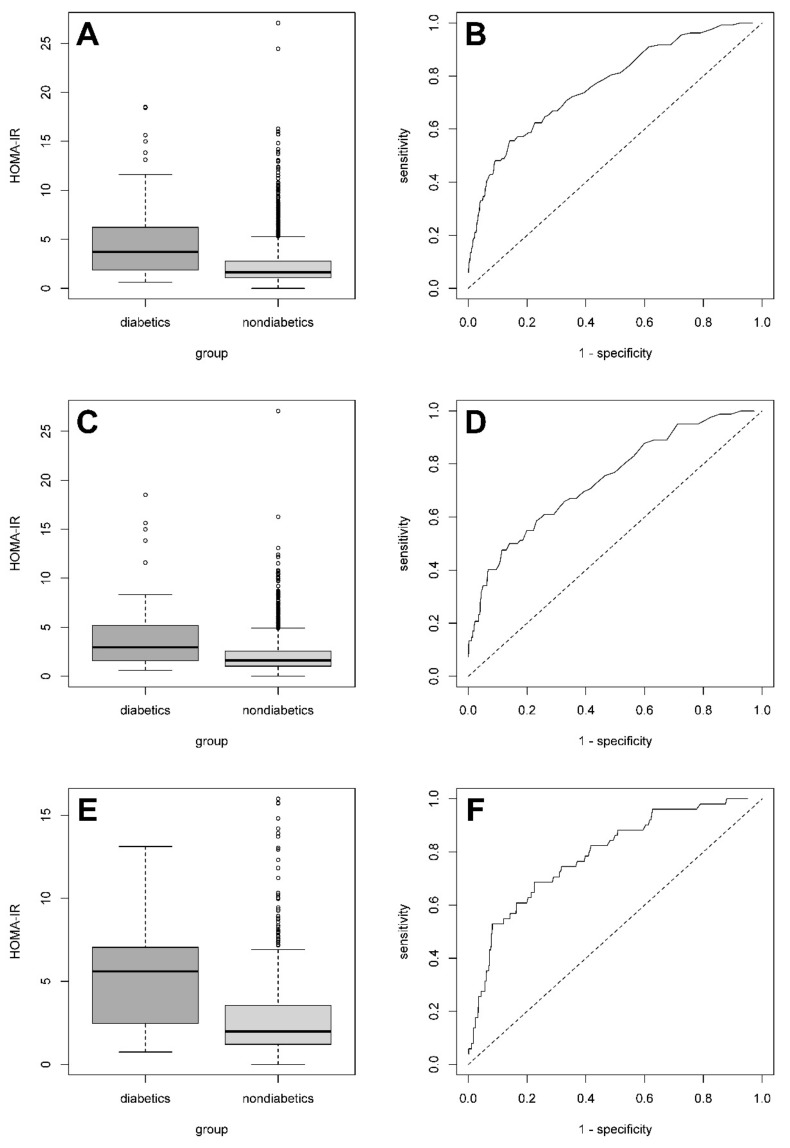
Background and Objectives: The key pathogenetic mechanism of glucose metabolism disorders, insulin resistance (IR), can be assessed using the Homeostasis Model Assessment of IR (HOMA-IR). However, its application in clinical practice is limited due to the absence of cut-offs. In this study, we aimed to define the cut-offs for the Czech population. Methods: After undergoing anthropometric and biochemical studies, the sample of 3539 individuals was divided into either nondiabetics, including both subjects with normal glucose tolerance (NGT, n = 1947) and prediabetics (n = 1459), or diabetics (n = 133). The optimal HOMA-IR cut-offs between subgroups were determined to maximize the sum of the sensitivity and specificity for diagnosing type 2 diabetes mellitus (T2DM) or prediabetes. The predictive accuracy was illustrated using receiver operating characteristic (ROC) curves. Logistic regression was performed to assess the association between a target variable (presence/absence of T2DM) depending on the HOMA-IR score as well as on the age and sex. Results: The HOMA-IR cut-off between nondiabetics and diabetics for both sexes together was 3.63, with a sensitivity of 0.56 and a specificity of 0.86. The area under the ROC curve was 0.73 for T2DM diagnosing in both sexes. The HOMA-IR cut-off between the NGT subjects and prediabetics was 1.82, with a sensitivity of 0.60 and a specificity of 0.66. Logistic regression showed that increased HOMA-IR is a risk factor for the presence of T2DM (odds ratio (OR) 1.2, 95% confidence interval (CI) 1.14–1.28, p < 0.0001). The predictive ability of HOMA-IR in diagnosing T2DM is statistically significantly lower in females (OR 0.66, 95% CI 0.44–0.98). The results are valid for middle-aged European adults. Conclusions: The results suggest the existence of HOMA-IR cut-offs signaling established IR. Introduction of the instrument into common clinical practice, together with the known cut-offs, may contribute to preventing T2DM.
Overview
CoChat Summary
TL;DR
In a cross-sectional Czech sample of 3539 middle-aged adults, the optimal HOMA-IR cut-off separating nondiabetics from type 2 diabetics was 3.63, and the cut-off separating normal glucose tolerance from prediabetes was 1.82. HOMA-IR was statistically associated with T2DM, but its low sensitivity meant it could not currently be recommended as a reliable screening test.
Key findings
- The HOMA-IR cut-off between nondiabetics and diabetics for both sexes combined was 3.63, with sensitivity 0.56 and specificity 0.86; the AUC for T2DM diagnosis was 0.7291 (95% CI 0.7272–0.7310).
- The HOMA-IR cut-off between NGT subjects and prediabetics was 1.82, with sensitivity 0.60 and specificity 0.66.
- In logistic regression, each unit increase in HOMA-IR increased the odds of T2DM by 1.2043-fold (95% CI 1.1365–1.2759, p < 0.0001); female sex was associated with lower odds (OR 0.6567, 95% CI 0.4431–0.9841, p = 0.0384).
- Sex-specific cut-offs were 3.634 for females and 3.691 for males; the AUC was 0.7075 in females and 0.7382 in males.
Methods
- Cross-sectional study of 3539 middle-aged individuals examined in Hradec Králové, Czech Republic, with data collected in 2009–2015; subgroups were NGT (n = 1947), prediabetes (n = 1459), and T2DM (n = 133).
- Venous blood was drawn after a 12-hour fast; glucose and insulin were measured, and HOMA-IR was calculated as glucose × insulin / 22.5.
- Cut-offs were chosen to maximize the sum of sensitivity and specificity (Youden’s index), with ROC curves and logistic regression used to assess predictive ability and association with T2DM.
Limitations
- The paper states that HOMA-IR was based on single measurements of blood glucose and insulin at one time point, the diabetic subgroup was much smaller than the nondiabetic subgroup, and the euglycemic clamp was not performed.
- The paper also notes that most diabetic subjects used oral antidiabetic drugs, which may have affected HOMA-IR scores, and that validity may be limited in subjects with lower BMI, lower beta cell function, or high fasting plasma glucose, though all subjects here had BMI in the obesity range and very high fasting glucose was excluded.
- Evident from the text: the cross-sectional design cannot establish temporal or causal relationships, and the single-center, middle-aged, largely obese Czech sample may limit generalizability to other populations.
Model-written summary. Check it against the paper before relying on it.
Integrity signals
Registry
Cites
Statistics
Figures
Verification
Claims the paper makes
7 Valid · 0 Not valid · 2 Not checked · 28 Own results and interpretations
The cited sources support only part of this claim — read each source’s verdict below.
In the paper
“The results are very similar to those reported in three European countries (Sweden 2.0, France 3.8 and Portugal 2.33) [4].”
§ Optimal Homeostasis Model Assessment of Insulin Resistance (HOMA-IR) Cut-Offs: A Cross-Sectional Study in the Czech Population > 4. Discussion
What the sources say
- Partly supportedcites [4] Tang, Q.; Li, X.; Song, P.; Xu, L. Optimal cut-off values for the homeostasis model assessment of insulin resistance (HOMA-IR) and pre-diabetes screening: Developments in research and prospects for the future. Drug Discov. Ther. 2015, 9, 380-385. [CrossRef] [PubMed] sourceExperimental — accuracy not yet measured
Section 3.3 says published HOMA-IR cut-off values vary widely, and the References list studies from Sweden, France, and Portugal. The passages available from our copy do not give the claimed values of 2.0, 3.8, and 2.33, so the numerical comparison is not supported. (LLM, conf=0.76)
plain- Asserted: passes — The authors put it forward as true.
- Checkable: passes — It can be checked against evidence.
- Load-bearing: unclear — It is unclear whether the paper’s conclusions depend on it.
- Based: passes — The paper gives a reason why it holds.
- Rests on an assumption not shown here.
- Partly supported
Every source the paper cites for this claim was checked and supports it.
In the paper
“Consequently, studies assessing the relationship between indices based on fasting plasma glucose (FPG) and insulin levels and clamp measures could reflect falsely inflated slopes and correlation coefficients in regression equations when data from nondiabetic and diabetic subjects are included in the same regression analyses [6].”
§ Optimal Homeostasis Model Assessment of Insulin Resistance (HOMA-IR) Cut-Offs: A Cross-Sectional Study in the Czech Population > 1. Introduction
What the sources say
- Supportedcites [6] Pisprasert, V.; Ingram, K.H.; Lopez-Davila, M.F.; Munoz, A.J.; Garvey, W.T. Limitations in the use of indices using glucose and insulin levels to predict insulin sensitivity: Impact of race and gender and superiority of the indices derived from oral glucose tolerance test in African Americans. Diabetes Care 2013, 36, 845-853. [CrossRef] [PubMed] source
The Abstract’s Conclusions state that combining nondiabetic and diabetic subjects in regressions of fasting glucose-and-insulin indices against clamp measures could falsely inflate slopes and correlation coefficients. The Discussion also explains why the stronger correlations in mixed groups may partly be an artifact. (LLM, conf=0.95)
hedgedstates a possible cause- Asserted: passes — The authors put it forward as true.
- Checkable: passes — It can be checked against evidence.
- Load-bearing: passes — The paper’s conclusions depend on it.
- Based: passes — The paper gives a reason why it holds.
- Supported
A result the paper reports from its own data — it cites no other source for it, so there is none to check. The quote shows it is in the paper.
In the paper
“The predictive ability of HOMA-IR in diagnosing T2DM is statistically significantly lower in females (OR 0.66, 95% CI 0.44-0.98).”
- Also stated in: § 3.3. Logistic Regression · plain
“when HOMA-IR scores are used to estimate the odds of T2DM, with the other variables remaining unchanged, the odds of T2DM are 0.6567-fold higher in females compared to males (p = 0.0384).”
§ Optimal Homeostasis Model Assessment of Insulin Resistance (HOMA-IR) Cut-Offs: A Cross-Sectional Study in the Czech Population > Abstract
plainstates an association- Asserted: passes — The authors put it forward as true.
- Checkable: passes — It can be checked against evidence.
- Load-bearing: unclear — It is unclear whether the paper’s conclusions depend on it.
- Based: passes — The paper gives a reason why it holds.
- Rests on an assumption not shown here.
- Also stated in: § 3.3. Logistic Regression · plain
A result the paper reports from its own data — it cites no other source for it, so there is none to check. The quote shows it is in the paper.
In the paper
“with a sensitivity of 0.60 and a specificity of 0.66”
- Also stated in: § 3.2. HOMA-IR Cut-Offs · plain
“The HOMA-IR cut-off distinguishing subjects with NGT and prediabetics was 1.82 (sensitivity 0.60, specificity 0.66).”
§ Optimal Homeostasis Model Assessment of Insulin Resistance (HOMA-IR) Cut-Offs: A Cross-Sectional Study in the Czech Population > Abstract
plain- Asserted: passes — The authors put it forward as true.
- Checkable: passes — It can be checked against evidence.
- Load-bearing: passes — The paper’s conclusions depend on it.
- Based: passes — The paper gives a reason why it holds.
- Rests on an assumption not shown here.
- Also stated in: § 3.2. HOMA-IR Cut-Offs · plain
A result the paper reports from its own data — it cites no other source for it, so there is none to check. The quote shows it is in the paper.
In the paper
“0.7382 (95% CI 0.7381-0.7383) in males”
§ Optimal Homeostasis Model Assessment of Insulin Resistance (HOMA-IR) Cut-Offs: A Cross-Sectional Study in the Czech Population > 3.2. HOMA-IR Cut-Offs
plainstates an association- Asserted: passes — The authors put it forward as true.
- Checkable: passes — It can be checked against evidence.
- Load-bearing: unclear — It is unclear whether the paper’s conclusions depend on it.
- Based: passes — The paper gives a reason why it holds.
- Rests on an assumption not shown here.
18 more claims
Create a free account to see all 37 claims and every source verdict.
- It may state two separate claims as one. 8
- Probably not a substantial claim. 9
Self-check
Percentages, sums and reported differences re-computed from the paper’s own numbers.
Each contradiction between two passages listed here was confirmed by an independent check.
Rated minor: it would not touch a result — a value no result rests on, a p-value that stays on the same side of the significance level, or a conflict that is clerical, resolved elsewhere in the paper, or outside its own findings.
In the paper
§ Optimal Homeostasis Model Assessment of Insulin Resistance (HOMA-IR) Cut-Offs: A Cross-Sectional Study in the Czech Population > 3.3. Logistic Regression
“the odds of T2DM are 0.6567-fold higher in females compared to males (p = 0.0384).”
§ Optimal Homeostasis Model Assessment of Insulin Resistance (HOMA-IR) Cut-Offs: A Cross-Sectional Study in the Czech Population > 5. Conclusions
“| Sex = female | 0.6567 | 0.4431 | 0.9841 | 0.0384 |”
Citations
Cites
Matthews, D. R., Hosker, J. P., Rudenski, A. S., Naylor, B. A., Treacher, D. F., & Turner, R. C. (1985) · Diabetologia · doi:10.1007/bf00280883 · Cited by 31,502 · cited 1×
“The HOMA-IR was calculated with the following formula (glucose levels in mmol/L, insulin levels in mIU/L) [7]:”
MethodToprak, O., Kurt, H., Sarı, Y., Şarkış, C., Us, H., & Kırık, A. (2017) · Kidney and Blood Pressure Research · doi:10.1159/000468530 · Cited by 29,627
Alberti, K. G. M. M., Eckel, R. H., Grundy, S. M., Zimmet, P. Z., Cleeman, J. I., Donato, K. A., Fruchart, J.-C., James, W. P. T., Loria, C. M., & Smith, S. C. (2009) · Circulation · doi:10.1161/circulationaha.109.192644 · Cited by 14,860 · cited 1×
“This condition is one of the main pathogenetic mechanisms of T2DM, atherosclerosis and metabolic syndrome which increasingly contribute to the morbidity and mortality of the affluent populations [9].”
Use and Abuse of HOMA Modeling
Wallace, T. M., Levy, J. C., & Matthews, D. R. (2004) · Diabetes Care · doi:10.2337/diacare.27.6.1487 · Cited by 5,114 · cited 1×
“HOMA-IR, on the contrary, provides a convenient and inexpensive means of estimating IR and the derived estimates have been shown to correlate very well with those derived from the euglycemic clamp [10,11].”
ResultDiabetes Prevention Program Research Group (2009) · The Lancet · doi:10.1016/s0140-6736(09)61457-4 · Cited by 3,020
Bonora, E., Targher, G., Alberiche, M., Bonadonna, R. C., Saggiani, F., Zenere, M. B., Monauni, T., & Muggeo, M. (2000) · Diabetes Care · doi:10.2337/diacare.23.1.57 · Cited by 2,456 · cited 1×
“HOMA-IR, on the contrary, provides a convenient and inexpensive means of estimating IR and the derived estimates have been shown to correlate very well with those derived from the euglycemic clamp [10,11].”
ResultRuopp, M. D., Perkins, N. J., Whitcomb, B. W., & Schisterman, E. F. (2008) · Biometrical Journal · doi:10.1002/bimj.200710415 · Cited by 1,320 · cited 1×
“In other words, we searched for the maximum of Youden’s index as a function of sensitivity and specificity [8].”
MethodPerreault, L., Pan, Q., Mather, K. J., Watson, K. E., Hamman, R. F., & Kahn, S. E. (2012) · The Lancet · doi:10.1016/s0140-6736(12)60525-x · Cited by 532
Limitations in the Use of Indices Using Glucose and Insulin Levels to Predict Insulin Sensitivity
Pisprasert, V., Ingram, K. H., Lopez-Davila, M. F., Munoz, A. J., & Garvey, W. T. (2013) · Diabetes Care · doi:10.2337/dc12-0840 · Cited by 302 · cited 1×
“Consequently, studies assessing the relationship between indices based on fasting plasma glucose (FPG) and insulin levels and clamp measures could reflect falsely inflated slopes and correlation coefficients in regression equations when data from nondiabetic and diabetic subjects are included in the same regression an…”
BackgroundTang, Q., Li, X., Song, P., & Xu, L. (2015) · Drug Discoveries & Therapeutics · doi:10.5582/ddt.2015.01207 · Cited by 286 · cited 2×
“What is more, the cut-off values of HOMA-IR need to be examined in subjects with NGT in order to devise a standard for the primary prevention of prediabetes and T2DM [4].”
BackgroundMethod
Research works printed but not linked: 1
- Freeman, A.M.; Pennings, N. Insulin Resistance. Available online: https://www.ncbi.nlm.nih.gov/books/ NBK507839/ (accessed on 15 December 2018).
Cited by
Bathina, S., Gundala, N. K. V., Rhenghachar, P., Polavarapu, S., Hari, A. D., Sadananda, M., & Das, U. N. (2020) · Archives of Medical Research · doi:10.1016/j.arcmed.2020.05.002 · Cited by 78
Insulin Resistance in Pediatric Obesity: From Mechanisms to Treatment Strategies
Luo, Y., Luo, D., Li, M., & Tang, B. (2024) · Pediatric Diabetes · doi:10.1155/2024/2298306 · Cited by 94
“…is no de fi nitive cutoff value for HOMA-IR due to geographic and ethnographic differences, a comprehensive study conducted in 2019 involving a large sample of Czech adults identi fi ed a speci fi c HOMA-IR cutoff point of 3.63, while Italian children have an established HOMA-IR standard > 4 [22].”
InfluentialPark, S., Kim, C., & Wu, X. (2022) · Diagnostics · doi:10.3390/diagnostics12010212 · Cited by 46
Krentowska, A., Łebkowska, A., Jacewicz‐Święcka, M., Hryniewicka, J., Leśniewska, M., Adamska, A., & Kowalska, I. (2021) · Endocrine · doi:10.1007/s12020-020-02596-8 · Cited by 40
Kim, J., Noh, W., Kim, A., Choi, Y., & Kim, Y. (2023) · International Journal of Molecular Sciences · doi:10.3390/ijms241813999 · Cited by 58
“By examining the lipid profile as an outcome, we intended to prove the efficacy of fenugreek in managing lipid profiles associated with diabetic complications.”
BackgroundBallena-Caicedo, J., Zuzunaga-Montoya, F. E., Loayza-Castro, J. A., Bustamante-Rodríguez, J. C., Vásquez-Romero, L. E. M., Tapia‐Limonchi, R., Carrillo, C. I. G. D., & Vera-Ponce, V. J. (2025) · Frontiers in Endocrinology · doi:10.3389/fendo.2025.1646258 · Cited by 51
Pieńkowska, A., Janicka, J., Duda, M., Dzwonnik, K., Lip, K., Mędza, A., Szlagatys‐Sidorkiewicz, A., & Brzeziński, M. (2023) · Nutrients · doi:10.3390/nu15040983 · Cited by 31
“The following inclusion criteria were applied: • participants with prediabetes, over 18 years of age, without other restrictions of age, sex, or ethnicity; • vitamin D supplementation in the chemical forms of calciferol-D2 or cholecalciferol-D3 in any dose, administered with any frequency and with any time of follow u…”
BackgroundInfluentialBiomarkers of insulin sensitivity/resistance
Kosmas, C. E., Sourlas, A., Oikonomakis, K., Zoumi, E.-A., Papadimitriou, A., & Kostara, C. E. (2024) · Journal of International Medical Research · doi:10.1177/03000605241285550 · Cited by 38
HOMA-IR in acromegaly: a systematic review and meta-analysis
Biagetti, B., Aulinas, A., Casteràs, A., et al. (2020) · Pituitary · doi:10.1007/s11102-020-01092-6 · Cited by 24
Barbu, E. M., Popescu, M. R., Popescu, A.-C., & Balanescu, S. M. (2021) · International Journal of Molecular Sciences · doi:10.3390/ijms22136864 · Cited by 27
Chen, X., Gu, J., & Huang, Y. (2023) · Lipids in Health and Disease · doi:10.1186/s12944-023-01982-1 · Cited by 17
“Based on the results of previous studies [10–14] insulin resistance was defined as a HOMA-IR value ≥ 2.0.”
ResultInfluentialMalagón-Soriano, V. A., Ledezma, A. J., Espinel-Pachón, C. F., Burgos-Cárdenas, Á. J., Garcés, M. F., Ramirez, G. E. O., Vega, R. F., Franco, J. J. P., Maldonado‐Acosta, L. M., Rubio-Romero, J. A., et al. (2024) · Frontiers in Endocrinology · doi:10.3389/fendo.2024.1343641 · Cited by 18
“The results showed a high-accuracy performance to determine IR for both indices; however, the HOMA-IR index presents multiple cutoff values across racial/ ethnic groups of population studies (80, 81).”
Association between dietary patterns with insulin resistance in an Iranian population
Ehrampoush, E., Nazari, N., Homayounfar, R., Ghaemi, A., Osati, S., Tahamtan, S., Hashempur, M. H., & Bahmanyar, M. (2020) · Clinical Nutrition ESPEN · doi:10.1016/j.clnesp.2020.02.011 · Cited by 16
Rajan, T., Umapathy, D., Jayasuriya, R., Ali, D., Kesavan, R., & Ramkumar, K. M. (2020) · Archives of Medical Research · doi:10.1016/j.arcmed.2020.10.011 · Cited by 13
Wang, X., Feng, H., Fan, D.-H., Zou, G., Han, Y., & Liu, L. (2020) · Complementary Therapies in Medicine · doi:10.1016/j.ctim.2020.102583 · Cited by 12
Association of HDL Subfraction Profile with the Progression of Insulin Resistance
Pikó, P., Jenei, T., Kósa, Z., Sándor, J., Kovács, N., Seres, I., Paragh, G., & Ádány, R. (2023) · International Journal of Molecular Sciences · doi:10.3390/ijms241713563 · Cited by 14
“63 were considered to have IR and an increased risk of developing diabetes mellitus [51].”
Kažukauskienė, N., Podlipskytė, A., Varoneckas, G., & Mickuvienė, N. (2021) · International Journal of Environmental Research and Public Health · doi:10.3390/ijerph18073388 · Cited by 13
“The results from the present study are very similar to those reported in a study defining HOMA-IR cut-offs for middle-aged men and women in the Czech Republic [62].”
ResultKeyif, B., & Yavuzcan, A. (2025) · Medicina · doi:10.3390/medicina61030424 · Cited by 11
“Higher HOMA-IR values indicate greater insulin resistance, which is a key feature of metabolic syndrome and type 2 diabetes [16].”
HOMA-IR mean values in healthy individuals: a population-based study in iranian subjects
Masoodian, S. M., Omidifar, A., Moradkhani, S., Asiabanha, M., & Khoshmirsafa, M. (2022) · Journal of Diabetes & Metabolic Disorders · doi:10.1007/s40200-022-01099-9 · Cited by 21
“The reference value of HOMA-IR has been assessed in several human studies [13, 14, 16, 17].”
BackgroundAhmadi, S. A., Tranmer, J. E., Ritonja, J. A., Flaten, L., Topouza, D. G., Duan, Q., Durocher, F., Aronson, K. J., & Bhatti, P. (2022) · Chronobiology International · doi:10.1080/07420528.2022.2032729 · Cited by 14
“Fasting plasma samples were analyzed for insulin concentration; insulin resistance was estimated through the homeostasis model for assessment of insulin resistance (HOMA-IR), using the formula {([fasting plasma insulin]/6) * [fasting blood glucose]}/22.5 (Horáková et al. 2019; Knopp et al. 2018).”
MethodInfluentialEpicardial fat and insulin resistance in healthy older adults: a cross-sectional analysis
Kalmpourtzidou, Α., Napoli, I. D., Vincenti, A., Giuseppe, R. D., Casali, P. M., Tomasinelli, C. E., Ferrara, F., Tursi, F., & Cena, H. (2023) · GeroScience · doi:10.1007/s11357-023-00972-6 · Cited by 11
HOMA-IR index in non-diabetic patient, a reliable method for early diagnosis of liver steatosis.
Motamed, B., Vajargah, M. K., Kalantari, S., & Shafaghi, A. (2022) · PubMed Central · doi:10.22088/cjim.13.3.519 · Cited by 14
“Evaluation of Homeostatic Model Assessment for Insulin Resistance (HOMA-IR) has become the most commonly used method in both clinical application and epidemiological studies (14, 15).”
MethodAccardi, G., Aiello, A., Aprile, S., Calabrò, A., Caldarella, R., Ciaccio, M., Caruso, C., Dieli, F., Ligotti, M. E., Meraviglia, S., et al. (2023) · Journal of Clinical Medicine · doi:10.3390/jcm12247591 · Cited by 9
What are the real associations of homeostasis model assessment (HOMA) with body mass index and age?
Horáková, D., Štěpánek, L., Štěpánek, L., Pastucha, D., Janoutová, J., Janout, V., Kron, V., Verner, M., & Martiník, D. (2022) · Endokrynologia Polska · doi:10.5603/ep.a2022.0031 · Cited by 13
Self-citationGhanbari, P., Raiesi, D., Alboebadi, R., Javid, A. Z., Dianatinasab, M., Razmi, H., & Bazyar, H. (2024) · BMC Complementary Medicine and Therapies · doi:10.1186/s12906-024-04477-3 · Cited by 19
“The minimal clinically important difference (MCID) for HOMA-IR has been reported to vary across different studies, with values ranging from 0.26 [28] to specific cut-off values like 3.63 [29] for identifying diabetes mellitus.”
MethodInfluentialThe Changes of Cholesterol Profile at the Different Insulin Resistance Range in the Czech Republic
Kron, V., Verner, M., Smetana, P., Horáková, D., Šlégr, J., Studnička, F., Bušovský, D., & Martiník, K. (2021) · Medicina · doi:10.3390/medicina57030249 · Cited by 9
Self-citationNanopore Sequencing of RAGE Gene Polymorphisms and Their Association with Type 2 Diabetes
Chaurasiya, A. H., Khilari, A. A., Kazi, R. S., Jaiswal, M. R., Bhoite, G. M., Padwal, M. K., Momin, A. A., Shanmugam, D., & Kulkarni, M. J. (2023) · ACS Omega · doi:10.1021/acsomega.3c00297 · Cited by 11
Nitrate reduction by salivary bacteria, glucose metabolism, and lifestyle
Morou-Bermúdez, E., Guo, K., Morales, J. M., Ricart, K. C., Patel, R. P., Clemente, J. C., & JOSHIPURA, K. J. (2025) · Journal of Oral Microbiology · doi:10.1080/20002297.2025.2489612 · Cited by 9
“HOMA-IR categories have been defined according to proposed thresholds for diabetes (<2: Normal, 2–2.9: Pre-diabetes, ≥3: Diabetes) [18–20]. demonstrated that saliva carries the highest proportions of nitrate-reducing bacteria in the mouth [30].”
InfluentialKalopitas, G., Mouskeftara, T., Liapikos, T., Arvanitakis, K., Ioannidis, A., Malandris, K., Theocharidou, E., Chourdakis, M., Sinakos, E., Gika, H., et al. (2023) · International Journal of Molecular Sciences · doi:10.3390/ijms241612717 · Cited by 7
“Moreover, a subgroup analysis was performed according to the HOMA-IR, which added further to our understanding of the role of lipids in NAFLD [28].”
MethodStaniek, H., Król, E., & Wójciak, R. W. (2020) · Nutrients · doi:10.3390/nu12103070 · Cited by 12
Kurniawan, L. B., Syamsir, B., Rahman, I. A., Adnan, E., Esa, T., Widaningsih, Y., Bahrun, U., & Arif, M. (2020) · Romanian Journal of Internal Medicine · doi:10.2478/rjim-2020-0015 · Cited by 7
Indices of insulin resistance and adiposity can detect obesity-related morbidity in pediatrics
Abdelhamed, M. H., Salah, S., ALqudsi, K. K., Jan, M. M., Alahdal, D. K., Alfaifi, S. A., Jafar, N. M., Alyahyawi, N. Y., & Al-Agha, A. A. (2022) · Saudi Medical Journal · doi:10.15537/smj.2022.43.2.20210720 · Cited by 8
Pikó, P., Werissa, N. A., & Ádány, R. (2022) · Biomedicines · doi:10.3390/biomedicines10071703 · Cited by 7
“The hyperinsulinemic-euglycemic clamp technique is considered the most accurate technique and the gold standard for IR measurement [49], but it is almost impossible to use this invasive method in population-level studies [50,51].”
BackgroundMethodVega-Cárdenas, M., Flores-Sánchez, J., Torres-Rodríguez, M. L., Capello, O. S.-A., Vargas-Morales, J., Cossío-Torres, P., Téran-García, M., & Aradillas-García, C. (2022) · Nutrición Hospitalaria · doi:10.20960/nh.04120 · Cited by 5
Ortiz, G. G. R., Maraver-Capdevila, L., & Granero, R. (2025) · Nutrients · doi:10.3390/nu17162651 · Cited by 6
“A high HOMA-IR value indicates metabolic dysfunction, even in the absence of obvious diabetic symptoms, and helps identify high-risk individuals [34,35].”
Shift work and insulin resistance (HOMA-IR) among professional drivers
Sadeghniiat‐Haghighi, K., Abbaslou, F., Sharifian, S. A., & Izadi, N. (2022) · Work · doi:10.3233/wor-210056 · Cited by 8
“8) indifferentstudies[29].”
Pulla, J. V. V., & Prieto, C. (2021) · Revista Vive · doi:10.33996/revistavive.v4i11.86 · Cited by 9
Examining the associations between testosterone and biomarkers as men age
Smith, S. J., Bekele, D., Lopresti, A. L., & Fairchild, T. J. (2023) · American Journal of Human Biology · doi:10.1002/ajhb.23942 · Cited by 7
Dietrich, J. W., Abood, A., Dasgupta, R., Anoop, S., Jebasingh, F., Spurgeon, R., Thomas, N., & Boehm, B. O. (2024) · Journal of Diabetes · doi:10.1111/1753-0407.13525 · Cited by 6
“…more advantageous are physiological parameters that can be mapped to meaningful pathogenetic processes of insulin sensitivity and beta-cell function, as demonstrated for the homeostatic model Body surface area, m 2 1.9 ± 0.3 assessment 25,26 or the OGTT-based DI according to Mat-suda and DeFronzo.”
InfluentialMohammed, S. N., Jasim, W. E., & Mohammed, N. A. (2022) · Journal of Techniques · doi:10.51173/jt.v4i3.538 · Cited by 7
Herwana, E., Yenny, Y., Alvina, A., Kurniasari, Febinia, C. A., & Pusparini, P. (2024) · Endocrine and Metabolic Science · doi:10.1016/j.endmts.2024.100214 · Cited by 4
Huang, B. X., Huang, W., Allen, J. C., Sun, L., Goh, H. J., Kong, S. C., Lee, D., Ding, C., Bosco, N., Egli, L., et al. (2022) · Frontiers in Nutrition · doi:10.3389/fnut.2022.979208 · Cited by 4
Setyawan, A. B. (2024) · Asian Journal of Medicine and Biomedicine · doi:10.37231/ajmb.2024.8.1.712 · Cited by 7
“Since a measurement of insulin or blood glucose cannot accurately detect insulin abnormalities, insulin resistance was assessed by the HOMA-IR, as follows [ 11 ] : HOMA-IR = fasting insulin (µU/L) x Fasting blood glucose (nmol/L)/ 22.5”
MethodInfluentialIndex of Cardiac Age Index and Cardiometabolic Biomarkers in Adults with Metabolic Syndrome
Choi, E. J., & Lee, S. Y. (2021) · Metabolic Syndrome and Related Disorders · doi:10.1089/met.2020.0095 · Cited by 5
“36 In addition, the cutoff point of our study was slightly lower than the cutoff value of previous studies conducted on Iranians 37 and Czechs, 38 but the sensitivity and specificity were similar.”
Khalili, S., Amouzegar, A., Dorost, S. S., Azizi, F., & Salahi‐Niri, A. (2025) · Clinical Biochemistry · doi:10.1016/j.clinbiochem.2025.110891 · Cited by 4
Zhuo, Y., He, J., Liangbing, W., Chow, C. B., & Ho, F. K. W. (2023) · Nutrition Metabolism and Cardiovascular Diseases · doi:10.1016/j.numecd.2023.11.016 · Cited by 3
Kron, V., Verner, M., Smetana, P., Janoutová, J., Janout, V., & Martiník, K. (2020) · Journal of Applied Biomedicine · doi:10.32725/jab.2020.018 · Cited by 3
“HOMA IR cut-off was set at 3.63, considered a signal of glucose metabolism alterations within the Czech population (Horáková et al., 2019).”
BackgroundInfluentialSelf-citationSetyawan, A. B. (2024) · Asian Journal of Medicine and Biomedicine · doi:10.37231/ajmb.2024.8.1.713 · Cited by 3
Unveiling the Significance of Surrogate Markers of Insulin Resistance in Metabolic Health Assessment
Prashant, A., Nataraj, S. M., Swetha, N., Gowda, J., Najmunnissa, F., & Guruswamy, K. M. (2024) · Indian Journal of Medical Biochemistry · doi:10.5005/jp-journals-10054-0227 · Cited by 4
“33”
Nowak, A., Podlewski, J., Hubalewska–Dydejczyk, A., & Trofimiuk-Müldner, M. (2025) · European Thyroid Journal · doi:10.1530/etj-24-0317 · Cited by 5
“So far, those have not been precisely determined, regardless of the studied populations (48, 49).”
Liu, W.-N., Hsu, Y., Lin, Y., Tsai, K., Lin, Y.-C., Liu, P., & Lin, G. (2025) · World Journal of Diabetes · doi:10.4239/wjd.v16.i5.101840 · Cited by 3
Kron, V., Verner, M., Pešl, L., Smetana, P., Kadlec, J., & Martiník, D. (2021) · Journal of Applied Biomedicine · doi:10.32725/jab.2021.023 · Cited by 2
“Equally, the values of total, HDL and LDL cholesterols (5.1, 1.5 and 3.1 mmol/l) within the reference range of C-peptide approached the mean values in glucose tolerant patients (5.11, 1.46, 3.02 mmol/l) in the same study (Horáková et al., 2019).”
ResultInfluentialKardus, M. F., Hallak, R. A., Alakedi, A., Abdulkarim, A. S., Alsheddi, S., Farhan, F. S., Alyousef, O. Y., Alturki, R. A., Kurdi, Y., & Mewally, S. A. (2024) · Dr Sulaiman Al Habib Medical Journal · doi:10.4103/dshmj.dshmj_64_24 · Cited by 5
Peng, L., Liu, Y., Deng, Y., Jing, J., Chen, G., Liu, Y., Wu, M., Lin, J., & Yin, W. (2025) · Lipids in Health and Disease · doi:10.1186/s12944-025-02507-8 · Cited by 2
“IR was defined as the threshold of HOMA-IR ≥ 2.0, consistent with earlier studies [21–23].”
InfluentialAz inzulinrezisztencia valós és téves értelmezése a klinikai gyakorlatban
Winkler, G. (2020) · Orvosi Hetilap · doi:10.1556/650.2020.31760 · Cited by 3
“[13] Horáková D, Štĕpánek L, Janout V, et al.”
Profiling the Skeletal Muscle Proteome in Patients on Atypical Antipsychotics and Mood Stabilizers
Burghardt, K. J., Calme, G., Caruso, M. A., Howlett, B. H., Sanders, E., Msallaty, Z., Mallisho, A., Seyoum, B., Qi, Y. A., Zhang, X., et al. (2022) · Brain Sciences · doi:10.3390/brainsci12020259 · Cited by 5
Prediction of Early Kidney Transplant Graft Outcome: Insulin Resistance Index
Lin, T.-C., Lin, K.-J., Chiang, Y., Chu, S., Liu, K., Lin, C.-T., Pan, P., Chen, S.-Y., Wang, J.-C., & Wang, H.-H. (2024) · Transplantation Proceedings · doi:10.1016/j.transproceed.2024.01.033 · Cited by 2
Gignac, T., Trépanier, G., Paquet, V., Ferland, S., & Carreau, A. (2023) · Canadian Journal of Diabetes · doi:10.1016/j.jcjd.2023.06.002 · Cited by 1
Nagy, E. N., Mostafa, M. S., Elsheimy, H. A., Mogahed, H. G. H., & Elsayed, M. M. (2025) · Journal of Evidence-Based Integrative Medicine · doi:10.1177/2515690x251372718 · Cited by 1
“40 The fi ndings of this study are in line with those of Martins et al 41 (12 weeks of HIIT among high-risk postmenopausal women with type 2 diabetes mellitus) and de Matos et al 42 (eight weeks of HIIT among obese sedentary individuals), who noticed a signi fi cant decrease in HOMA-IR ( P = 0.056…”
InfluentialSun, Y., Bai, C., Yin, S., & Liu, J. (2025) · Diabetes Metabolic Syndrome and Obesity · doi:10.2147/dmso.s539166 · Cited by 2
Fteah, A. M., Aly, D. M., Elrefaiy, M. A., & Rahim, A. A. (2026) · BMC Gastroenterology · doi:10.1186/s12876-026-04767-9 · Cited by 2
Beneficios de la podometría en la prevención de factores de riesgo cardiovascular
Laínez, C. E. O., Mejía, K. R. R., & Arango, W. A. H. (2021) · ALERTA Revista Científica del Instituto Nacional de Salud · doi:10.5377/alerta.v4i3.10315 · Cited by 2
Muntari, J., Umar, H., Tandean, P., Bakri, S., Sanusi, H. D., Tabri, N. A., & Seweng, A. (2023) · Journal of the ASEAN Federation of Endocrine Societies · doi:10.15605/jafes.038.01.03 · Cited by 1
Effect of Resisted Exercise on Vitamin D Levels in Obese Insulin Resistant Patients
Morris, O., Abdelwahab, M., Abdaziz, A., Atta, F. S., & Ghallab, M. A. (2024) · NILES Journal forGeriatric and Gerontology/NILES Journal for Geriatric and Gerontology · doi:10.21608/niles.2024.289891.1089 · Cited by 1
“• Vitamin D levels below 20 ng/ml, as per established guidelines [12], and Presence of insulin resistance, indicated by HOMA-IR levels between 1.82 and 3.63 [13].”
BackgroundInfluentialJoseph, N. A., Mvongo, C., Mfopa, A., et al. (2025) · Journal of Holistic Integrative Pharmacy · doi:10.1016/j.jhip.2025.02.006 · Cited by 1
Sunarti, S., Santoso, U., Pramana, A. A. C., Huriyati, E., & Rubi, D. S. (2020) · Open Access Macedonian Journal of Medical Sciences · doi:10.3889/oamjms.2020.5354 · Cited by 1
“899 Insulin resistance can be assessed using the HOMA-IR [15], which can be improved by the administration of beta carotene from pumpkin (Cucurbita maxima) [16].”
BackgroundShazman, S. (2021) · IntechOpen eBooks · doi:10.5772/intechopen.95336 · Cited by 2
Fernández, F. J. C., Marrero, M. R. G., Girón, M. J. I., de Armas, A. A. P., Rodríguez, E. C., de León, A. C., & Aguirre‐Jaime, A. (2021) · Medicina de Familia SEMERGEN · doi:10.1016/j.semerg.2021.05.007 · Cited by 2
Nosko, N. O., & Харченко, В. В. (2021) · Wiadomości Lekarskie · doi:10.36740/wlek202110212 · Cited by 1
Akilla, M. A., Banyeh, M., & Awinibuno, I. A. N. (2023) · Health Science Reports · doi:10.1002/hsr2.1200
“The HOMA‐IR was calculated using the formula below where FBG is fasting blood glucose in mmol/L and insulin in mIU/L.(26)”
MethodFour-week induction of type 2 diabetes mellitus in rats by streptozotocin and high-fat diet
Bowonsomsarit, W. (2021) · Chulalongkorn Medical Journal · doi:10.58837/chula.cmj.65.4.12 · Cited by 6
Liontos, A., Biros, D., Papagiannopoulos, C. K., Anastasiou, G., Adamidis, P., Bakogiannis, K., Milionis, H. J., Liberopoulos, E. N., Elisaf, M., & Liamis, G. L. (2022) · MAEDICA – a Journal of Clinical Medicine · doi:10.26574/maedica.2022.17.3.561
Fitoterapia Chinesa no tratamento complementar da Síndrome Metabólica: uma revisão sistemática
Campos, L. S., Soares, L. G., Leonel, C. F. S., da Rosa, R. D., & Byk, J. (2023) · Revista Eletrônica Acervo Saúde · doi:10.25248/reas.e12022.2023
Ilkhanipoor, H., Yazdani, N., Ebrahimzade, H., Moravej, H., Karamizadeh, Z., & Amirhakimi, A. (2024) · Health Scope · doi:10.5812/healthscope-143334
Akl, M. M., & Ahmed, A. K. K. (2024) · Qeios · doi:10.32388/okyos1 · Cited by 1
Hashim, R. K. (2024) · Al-Salam Journal for Medical Science · doi:10.55145/ajbms.2024.03.02.09 · Cited by 1
“It was noted that levels of C-peptide were significantly elevated in patients with metabolic syndrome, regardless of gender[34].”
BackgroundVlaisavljević, N., Urosevic, I., & Tomić-Naglić, D. (2024) · Srpski medicinski casopis Lekarske komore · doi:10.5937/smclk5-52480
Kron, V., Verner, M., Smetana, P., Vrzalova, R., Friebergerova, E., Martiník, D., Horáková, D., Štěpánek, L., Hamplová, L., & Kotrbová, K. (2025) · Journal of Applied Biomedicine · doi:10.32725/jab.2025.005
Self-citationBessi, N. O., Miliani, Y. T., Damou, R., Mehdaoui, M. A. E., Kemache, A., & Abdelkader, B. A. (2025) · Obesity Medicine · doi:10.1016/j.obmed.2025.100648 · Cited by 6
Fteah, A. M., Aly, D. M., Elrefaiy, M. A., et al. (2026) · Research Square · doi:10.21203/rs.3.rs-8796724/v1
Almeida, E. A., Mehndiratta, M., Madhu, S. V., Kar, R., & Kirubalenin, S. P. (2026) · Annals of the National Academy of Medical Sciences (India) · doi:10.25259/anams_27_2025
Rajasekar, R., & Alexander, H. (2026) · Indian Journal of Medical Biochemistry · doi:10.5005/jp-journals-10054-0334
Sestrin-2: a new biomarker for type 2 Diabetes Mellitus and Insulin resistance
Tyagi, S., Nagtilak, S., & Parashar, P. (2026) · Journal of Diabetes & Metabolic Disorders · doi:10.1007/s40200-026-02008-0
“Insulin resistance was estimated using the Homeostatic Model Assessment for Insulin Resistance (HOMA-IR), calculated from fasting glucose and fasting insulin concentrations according to the following formula [10]: HOMA-IR = (fasting insulin [µU/mL] x fasting glucose [mmol/L]) / 22.5.”
InfluentialRodzeń, Ł., Rodzeń, M., Dyńka, D., Łojko, D., Karakuła‐Juchnowicz, H., Kraszewski, S., Fazio, S., Unwin, D., & Bikman, B. T. (2026) · Nutrients · doi:10.3390/nu18162666
“A study conducted in the Czech population identified a HOMA-IR range of 1.82 to 3.63 as a potential borderline interval for prediabetes [92].”
InfluentialFeng, W., Zhang, W., Zhang, M., & Liu, K. (2026) · International Journal of Pharmaceutics · doi:10.1016/j.ijpharm.2026.127380
Jha, R. K., & Ambad, R. S. (2026) · Journal of Datta Meghe Institute of Medical Sciences University · doi:10.4103/jdmimsu.jdmimsu_166_26
Metadata
- Authors
- Horáková, D., Štěpánek, L., Janout, V., Janoutová, J., Pastucha, D., Kollárová, H., Petráková, A., Štěpánek, L., Husár, R., & Martiník, K.
- Affiliations
- Palacký University Olomouc (CZ)
- Charles University (CZ)
- Department of Healthcare Management, Faculty of Health Sciences, Palacký University Olomouc, Hněvotínská 3, 77515 Olomouc, Czech Republic
- ReFit Clinic s.r.o., U Reálky 4, 77900 Olomouc, Czech Republic
- Ambulance Prof. MUDr. Karla Martiníka DrSc. s.r.o, Bratří Štefanů 895, 50003 Hradec Králové, Czech Republic
- Corresponding author
- Štěpánek, Ladislav
- Venue
- Medicina
- Publisher
- MDPI AG
- Published
- 2019-05-17
- Volume
- 55
- Issue
- 5
- Pages
- 158
- ISSN
- 1010-660X (ISSN-L)
- 1648-9144
- PMC
- PMC6571793
- OpenAlex
- W2945344457
- Cited by
- 87
- References
- 22
- Citations by year
- 2026: 8 · 2025: 13 · 2024: 17 · 2023: 14 · 2022: 13 · 2021: 12 · 2020: 10
- FWCI
- 7.10
- Type
- journal article
- Language
- en
- Open access
- gold
- dx.doi.org
- Licence
- Locations
- Medicina (publishedVersion, cc-by)
- PubMed Central (publishedVersion, cc-by)
- PubMed (publishedVersion)
- DOAJ (DOAJ: Directory of Open Access Journals) (submittedVersion, cc-by-sa)
- Funders
- Univerzita Palackého v Olomouci (IGA UPOL LF 2019)
- Topics
- Health Sciences › Medicine › Endocrinology, Diabetes and Metabolism › Diabetes, Cardiovascular Risks, and Lipoproteins
- Health Sciences › Medicine › Endocrinology, Diabetes and Metabolism › Diabetes Management and Research
- Health Sciences › Medicine › Endocrinology, Diabetes and Metabolism › Pancreatic function and diabetes
- Keywords
- HOMA-IR, insulin resistance, cut-off values, type 2 diabetes, prediabetes, diagnostic accuracy, sex differences, Czech population, glucose metabolism disorders, diabetes risk factors, middle-aged adults, sex differences in diabetes risk, diabetes prevention, sex differences in prevalence
- MeSH terms
- Adult, Aged, Cholesterol, Cross-Sectional Studies, Female, Glucose, Glucose Tolerance Test, Homeostasis, Humans, Insulin, Insulin Resistance, Male, Middle Aged, Logistic Models, Odds Ratio, Czech Republic, Needs Assessment
About these checks
Registry, retraction, Cites and statistics results are computed, not judged, with one exception: a printed reference that no index lists is read once by a model before it counts as a citation error. Claims are extracted by a model and kept only when their quote appears verbatim in the text; each cited source is then checked, with a model’s help, for whether it says what the claim relies on. Those verdicts can be wrong — read the claim’s quote and the cited source before relying on one.
The claim verdicts this report counts are experimental: their accuracy is not yet measured.
A language model drew the claims from the paper on 2026-10-14, under version 3 of the claim definition (model deepseek-v4.1-flash, prompt extract-v3).
A second model labelled each claim on 2026-10-14 (model jev-1.13-20260917, definition revision gold-guideline-v0.2).
Cited sources are checked with a language model’s help (gpt-6-sol).
Statistics and arithmetic are recomputed, not judged.
Confidence bands are shown only for fields calibrated on our annotated test set. None is calibrated yet, so no band is shown.
What counts as a claim ›How we measure confidence ›How we check this ›
Are you an author, or do you see a problem with this page? Request a review
Data sources
Bibliographic data: Semantic Scholar, OpenAlex, Crossref.
Contains information from the Semantic Scholar Academic Graph Datasets, made available under the ODC Attribution License (ODC-BY 1.0).
Semantic Scholar’s data is described in: Kinney, R., et al. (2023). The Semantic Scholar Open Data Platform. arXiv:2301.10140.
