

Stimulation of Healing of Non-Infected Stagnated Diabetic Wounds by Copper Oxide-Impregnated Wound Dressings
Open accessThe DOI matches its Crossref record; 24 of the 24 references it cites were found in a registry or an index.
Abstract
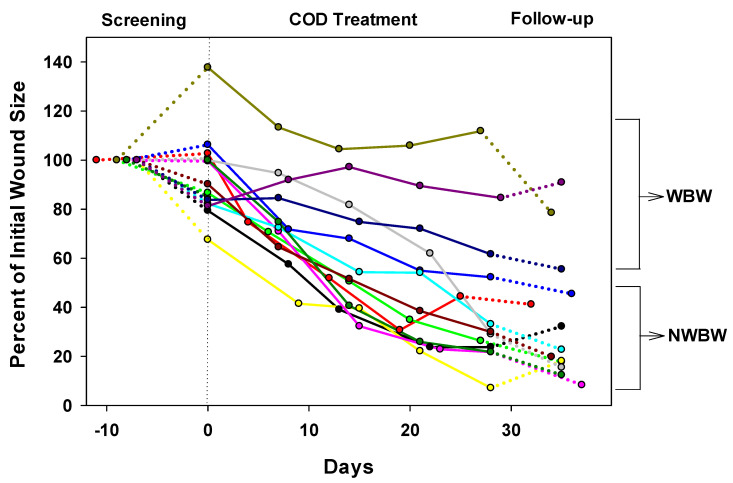
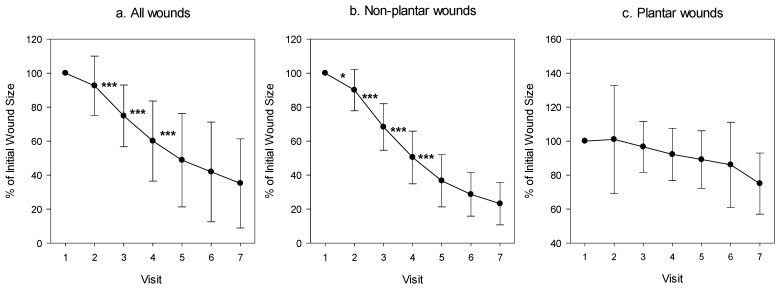
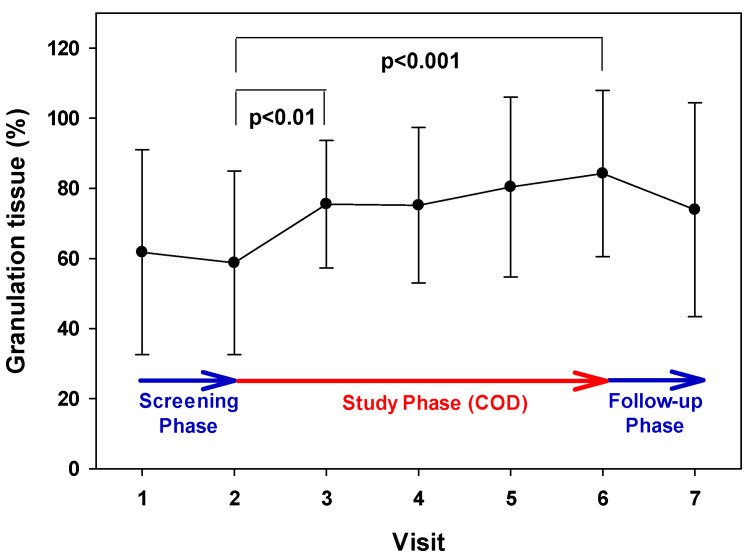
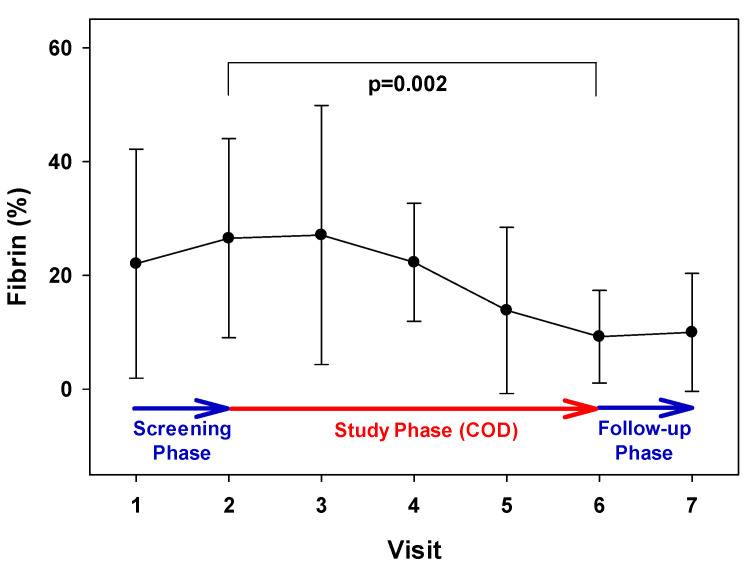
Background and Objective: Copper, a wide spectrum biocide, also plays a key role in angiogenesis and wound healing. Antibacterial wound dressings impregnated with copper oxide microparticles (COD) have been recently cleared by the U.S. FDA and other regulatory bodies for the treatment of acute and chronic wounds, including diabetic wounds. Our objective was to evaluate the capacity of COD in stimulating the healing of non-infected stagnated wounds in diabetic patients initially treated with standard of care (SOC) dressings. Materials and Methods: The trial was divided into the three following phases: 1–2 weeks of screening, during which the patients were treated with SOC dressings; 4 weeks of treatment, during which the COD was applied twice weekly; and 2 weeks of follow-up, during which the patients were again treated with SOC dressings. The wound conditions and sizes were assessed by clinical evaluation and a wound imaging artificial intelligence system. Results: Following 1 month of COD treatment, there was a clear reduction in the mean wound area (53.2%; p = 0.003), an increase in granulation tissue (43.37; p < 0.001), and a reduction in fibrins (47.8%; p = 0.002). In patients with non-weight-bearing wounds, the reduction in wound size was even more dramatic (66.9%; p < 0.001). Conclusions: The results of this study, showing a statistically significant influence of COD on wound healing of hard-to-heal wounds in diabetic patients, strongly supports the notion that copper oxide-impregnated dressings enhance wound healing directly. Further larger controlled studies should be conducted to substantiate our findings.
Overview
The claims and statistics of this paper haven’t been checked yet.
Free: it reads the open-access text and checks the first 5 claims that cite a source we can check. Create a free account to check every claim.
Integrity signals
Registry
Cites
Statistics
Figures
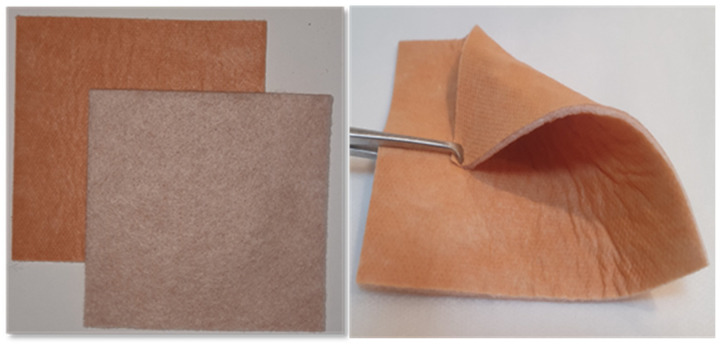
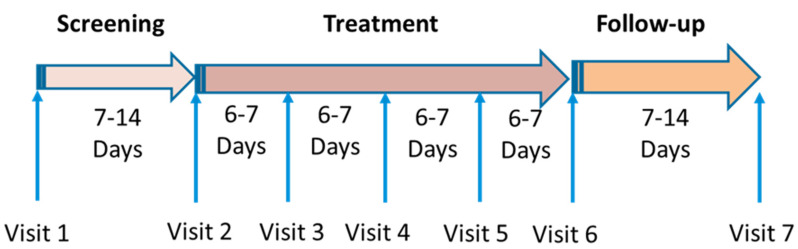
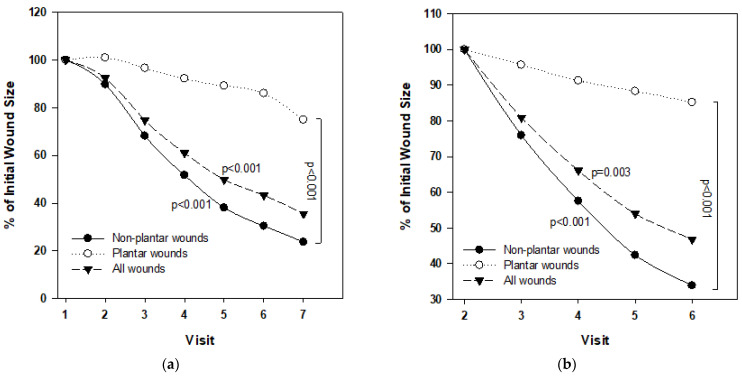
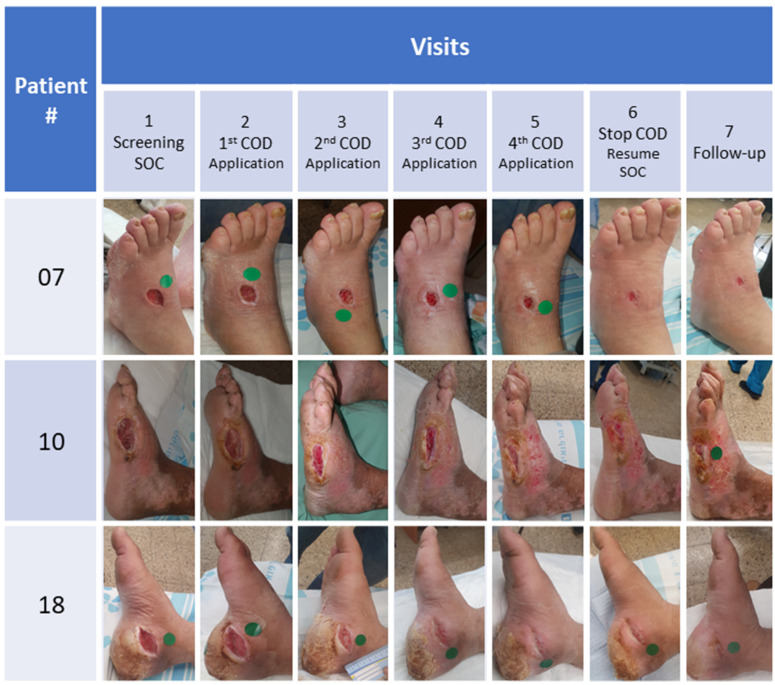
Verification
Claims the paper makes
The claims and statistics of this paper haven’t been checked yet.
Free: it reads the open-access text and checks the first 5 claims that cite a source we can check. Create a free account to check every claim.
Claims other papers make about this one
Each is checked against this paper’s own text: does it say what the citing paper says it does?
The source backs part of the claim, not all of it — or backs it for a different population, condition or comparison.
In the citing paper
“Numerous studies have demonstrated the ability of copper dressings to enhance healing in hard-to-heal wounds, including both infected and non-infected wounds, across all stages of the healing process [107,108,109,110,111,112,113,114,115,116,117,118,119,120,121,122].”
From The Journey of Copper-Impregnated Dressings in Wound Healing: From a Medical Hypothesis to Clinical Practice (2025) · cites this paper as [110]
Experimental — accuracy not yet measuredThe cited source says what the claim attributes to it.
In the citing paper
“However, when the copper dressings were applied twice weekly for a month, there was a 53.2% mean wound area reduction (p = 0.003) (Figure 1) and a 43.37% increase in mean granulation tissue formation (p < 0.001) [110].”
From The Journey of Copper-Impregnated Dressings in Wound Healing: From a Medical Hypothesis to Clinical Practice (2025) · cites this paper as [110]
Self-check
Percentages, sums and reported differences re-computed from the paper’s own numbers.
The self-check needs the paper’s full text.
Citations
Cites
Essentiality of copper in humans
Uauy, R., Olivares, M., & Gonzalez, M. (1998) · The American Journal of Clinical Nutrition · doi:10.1093/ajcn/67.5.952s · Cited by 1,052
Borkow, G., & Gabbay, J. (2005) · Current Medicinal Chemistry · doi:10.2174/0929867054637617 · Cited by 727 · cited 2×
“First, it is a potent wide-spectrum biocide, including against antibiotic-resistant bacteria and hard-to-kill bacterial spores and fungi [6,7].”
BackgroundSelf-citationWound healing essentials: Let there be oxygen
Sen, C. K. (2009) · Wound Repair and Regeneration · doi:10.1111/j.1524-475x.2008.00436.x · Cited by 713 · cited 1×
“Many factors, such as wound hypoxia and the inability to raise a sufficient inflammatory response, have been implicated as contributing to impaired wound healing, including in diabetic patients [15,16].”
BackgroundStatistical Methods for the Analysis of Repeated Measurements
Davis, C. S. (2002) · Springer Texts in Statistics · doi:10.1007/b97287 · Cited by 577
Copper-induced vascular endothelial growth factor expression and wound healing
Sen, C. K., Khanna, S., Venojarvi, M., Trikha, P., Ellison, E. C., Hunt, T. K., & Roy, S. (2002) · American Journal of Physiology-Heart and Circulatory Physiology · doi:10.1152/ajpheart.01015.2001 · Cited by 522 · cited 1×
“This hypothesis was based on the fact that many factors involved in the wound healing processes are dependent on their interaction with copper, including VEGF expression [10,20], the export of fibroblast growth factor [21], the modulation of integrins expressed by supra-basally differentiated keratinocytes during the…”
BackgroundThe stimulation of angiogenesis and collagen deposition by copper
Gérard, C., Bordeleau, L.-J., Barralet, J., & Doillon, C. J. (2010) · Biomaterials · doi:10.1016/j.biomaterials.2009.10.009 · Cited by 420 · cited 1×
“Secondly, copper (a) stimulates angiogenesis [8], (b) induces dermal fibroblast proliferation [9], (c) upregulates collagen and elastin fiber components production by fibroblasts, (d) stimulates HSP-47, which is essential to collagen fibril formation [10], (e) serves as a cofactor of lysyl oxidase (LOX), which is need…”
BackgroundCopper, lysyl oxidase, and extracellular matrix protein cross-linking
Rucker, R., Kosonen, T., Clegg, M., Mitchell, A., Rucker, B., Uriu-Hare, J., & Keen, C. (1998) · The American Journal of Clinical Nutrition · doi:10.1093/ajcn/67.5.996s · Cited by 371 · cited 2×
“Secondly, copper (a) stimulates angiogenesis [8], (b) induces dermal fibroblast proliferation [9], (c) upregulates collagen and elastin fiber components production by fibroblasts, (d) stimulates HSP-47, which is essential to collagen fibril formation [10], (e) serves as a cofactor of lysyl oxidase (LOX), which is need…”
BackgroundMolecular mechanisms of enhanced wound healing by copper oxide-impregnated dressings
Borkow, G., Gabbay, J., Dardik, R., Eidelman, A. I., Lavie, Y., Grunfeld, Y., Ikher, S., Huszar, M., Zatcoff, R. C., & Marikovsky, M. (2010) · Wound Repair and Regeneration · doi:10.1111/j.1524-475x.2010.00573.x · Cited by 253 · cited 4×
“, placental growth factor (PGF), hypoxia-inducible factor-1alpha ( IF-1α) and vascular endothelial gro th factor ( E F)), increased blood vessel for ation, and enhanced ound healing as co pared to control dressings ( ithout copper) or ound dressings containing silver [13].”
BackgroundResultSelf-citationThe non-classical export routes: FGF1 and IL-1α point the way
Prudovsky, I., Mandinova, A., Soldi, R., Bagala, C., Graziani, I., Landriscina, M., Tarantini, F., Duarte, M., Bellum, S., Doherty, H., et al. (2003) · Journal of Cell Science · doi:10.1242/jcs.00872 · Cited by 195 · cited 1×
“This hypothesis was based on the fact that many factors involved in the wound healing processes are dependent on their interaction with copper, including VEGF expression [10,20], the export of fibroblast growth factor [21], the modulation of integrins expressed by supra-basally differentiated keratinocytes during the…”
BackgroundJude, E. B., Apelqvist, J., Spraul, M., Martini, J., & the Silver Dressing Study Group (2007) · Diabetic Medicine · doi:10.1111/j.1464-5491.2007.02079.x · Cited by 164 · cited 1×
“Furthermore, some studies reported no statistically significant differences in wound healing outcomes between antimicrobial and non-antimicrobial wound dressings [3,4].”
ResultTopical antimicrobial agents for treating foot ulcers in people with diabetes
Dumville, J. C., Lipsky, B. A., Hoey, C., Cruciani, M., Fiscon, M., & Xia, J. (2017) · Cochrane Database of Systematic Reviews · doi:10.1002/14651858.cd011038.pub2 · Cited by 162 · cited 1×
“, the Cochrane Database of Systematic Reviews (CDSR)) [2].”
BackgroundThe diabetic foot in 2015: an overview
Markakis, K., Bowling, F. L., & Boulton, A. J. M. (2016) · Diabetes/Metabolism Research and Reviews · doi:10.1002/dmrr.2740 · Cited by 137 · cited 1×
“This finding supports the well-accepted notion that pressure on a wound hinders wound healing regardless of any adjunctive treatment modality [24].”
BackgroundIn vitro modulation of keratinocyte wound healing integrins by zinc, copper and manganese
TENAUD, SAINTE-MARIE, JUMBOU, LITOUX, & DRÉNO (1999) · British Journal of Dermatology · doi:10.1046/j.1365-2133.1999.02603.x · Cited by 126 · cited 1×
“This hypothesis was based on the fact that many factors involved in the wound healing processes are dependent on their interaction with copper, including VEGF expression [10,20], the export of fibroblast growth factor [21], the modulation of integrins expressed by supra-basally differentiated keratinocytes during the…”
BackgroundJeffcoate, W., Price, P., Phillips, C., Game, F., Mudge, E., Davies, S., Amery, C., Edmonds, M., Gibby, O., Johnson, A., et al. (2009) · Health Technology Assessment · doi:10.3310/hta13540 · Cited by 119 · cited 1×
“Furthermore, some studies reported no statistically significant differences in wound healing outcomes between antimicrobial and non-antimicrobial wound dressings [3,4].”
ResultPhilips, N., Hwang, H., Chauhan, S., Leonardi, D., & Gonzalez, S. (2010) · Connective Tissue Research · doi:10.3109/03008200903288431 · Cited by 95 · cited 1×
“Secondly, copper (a) stimulates angiogenesis [8], (b) induces dermal fibroblast proliferation [9], (c) upregulates collagen and elastin fiber components production by fibroblasts, (d) stimulates HSP-47, which is essential to collagen fibril formation [10], (e) serves as a cofactor of lysyl oxidase (LOX), which is need…”
BackgroundUsing Copper to Fight Microorganisms
Borkow, G. (2012) · Current Chemical Biology · doi:10.2174/187231312801254723 · Cited by 88 · cited 2×
“First, it is a potent wide-spectrum biocide, including against antibiotic-resistant bacteria and hard-to-kill bacterial spores and fungi [6,7].”
BackgroundSelf-citationCould chronic wounds not heal due to too low local copper levels?
Borkow, G., Gabbay, J., & Zatcoff, R. C. (2008) · Medical Hypotheses · doi:10.1016/j.mehy.2007.06.006 · Cited by 81
Self-citationClassification, diagnosis, and treatment of diabetic foot ulcers.
Doupis, J., & Veves, A. (2008) · PubMed · Cited by 76
Copper nanoparticle cues for biomimetic cellular assembly of crosslinked elastin fibers
Kothapalli, C. R., & Ramamurthi, A. (2009) · Acta Biomaterialia · doi:10.1016/j.actbio.2008.09.004 · Cited by 57 · cited 2×
“Secondly, copper (a) stimulates angiogenesis [8], (b) induces dermal fibroblast proliferation [9], (c) upregulates collagen and elastin fiber components production by fibroblasts, (d) stimulates HSP-47, which is essential to collagen fibril formation [10], (e) serves as a cofactor of lysyl oxidase (LOX), which is need…”
BackgroundInteraction of mineral salts with the skin: A literature survey
Polefka, T. G., Bianchini, R. J., & Shapiro, S. (2012) · International Journal of Cosmetic Science · doi:10.1111/j.1468-2494.2012.00731.x · Cited by 56 · cited 1×
“We have hypothesized that part of the incapacity of diabetic wounds to heal efficiently is due to low copper levels in the wound site [17], as copper is an essential element involved in all wound healing stages and processes [18,19].”
BackgroundHealing of Chronic Wounds by Copper Oxide-Impregnated Wound Dressings—Case Series
Melamed, E., Kiambi, P., Okoth, D., Honigber, I., Tamir, E., & Borkow, G. (2021) · Medicina · doi:10.3390/medicina57030296 · Cited by 55 · cited 1×
“Our results are in accordance with 10 case reports we recently reported, in which COD not only conferred protection to the wound and the dressing from microbial contamination, and in some cases, helped to clear the wound infections, but in addition, stimulated skin regeneration and wound healing [25].”
ResultSelf-citationPhilips, N., Samuel, P., Parakandi, H., Gopal, S., Siomyk, H., Ministro, A., Thompson, T., & Borkow, G. (2012) · Connective Tissue Research · doi:10.3109/03008207.2012.665970 · Cited by 44 · cited 2×
“Secondly, copper (a) stimulates angiogenesis [8], (b) induces dermal fibroblast proliferation [9], (c) upregulates collagen and elastin fiber components production by fibroblasts, (d) stimulates HSP-47, which is essential to collagen fibril formation [10], (e) serves as a cofactor of lysyl oxidase (LOX), which is need…”
BackgroundSelf-citationStabilization of fibronectin mats with micromolar concentrations of copper
Ahmed, Z., Idowu, B. D., & Brown, R. A. (1999) · Biomaterials · doi:10.1016/s0142-9612(98)00015-5 · Cited by 36 · cited 1×
“This hypothesis was based on the fact that many factors involved in the wound healing processes are dependent on their interaction with copper, including VEGF expression [10,20], the export of fibroblast growth factor [21], the modulation of integrins expressed by supra-basally differentiated keratinocytes during the…”
BackgroundSafety of Using Copper Oxide in Medical Devices and Consumer Products
Borkow, G. (2012) · Current Chemical Biology · doi:10.2174/2212796811206010086 · Cited by 34
Self-citation
Research works printed but not linked: 2
- Milanino R. Copper in medicine and personal care: A historical overview N. Y. Inf. Healthc. 2006 1 149 160
- Shai A. Maibach H.I. Wound Healing and Ulcers of the Skin, Diagnosis and Therapy-The Practical Approach Springer Berlin/Heidelberg, Germany 2005
Cited by
An Up-to-Date Review of Biomaterials Application in Wound Management
Niculescu, A.-G., & Grumezescu, A. M. (2022) · Polymers · doi:10.3390/polym14030421 · Cited by 146
“[106] have investigated copper oxide microparticle (COD)-impregnated wound dressings for the treatment of wounds in diabetic patients.”
BackgroundMetal Nanoparticles: Advanced and Promising Technology in Diabetic Wound Therapy
Zheng, Q., Chen, C., Liu, Y., Gao, J., Li, L., Yin, C., & Yuan, X. (2024) · International Journal of Nanomedicine · doi:10.2147/ijn.s434693 · Cited by 98
Progress in copper‐based materials for wound healing
Diao, W., Li, P., Jiang, X., Zhou, J., & Yang, S. (2023) · Wound Repair and Regeneration · doi:10.1111/wrr.13122 · Cited by 84
Citric Acid: A Nexus Between Cellular Mechanisms and Biomaterial Innovations
Xu, H. F., Yan, S., Gerhard, E. M., Xie, D., Liu, X., Zhang, B., Shi, D., Ameer, G. A., & Yang, J. Y. (2024) · Advanced Materials · doi:10.1002/adma.202402871 · Cited by 84
Exploring nanobioceramics in wound healing as effective and economical alternatives
Al-Naymi, H. A. S., Al‐Musawi, M. H., Mirhaj, M., Valizadeh, H., Momeni, A., Pajooh, A. M. D., Shahriari‐Khalaji, M., Sharifianjazi, F., Tavamaishvili, K., Kazemi, N., et al. (2024) · Heliyon · doi:10.1016/j.heliyon.2024.e38497 · Cited by 54
Metadata
- Authors
- Melamed, E., Rovitsky, A., Roth, T., Assa, L., & Borkow, G.
- Affiliations
- Rambam Health Care Campus (IL)
- MedCu Technologies Ltd., Herzliya 4672200, Israel
- Corresponding author
- Melamed, Eyal
- Borkow, Gadi
- Venue
- Medicina
- Publisher
- MDPI AG
- Published
- 2021-10-19
- Volume
- 57
- Issue
- 10
- Pages
- 1129
- ISSN
- 1010-660X (ISSN-L)
- 1648-9144
- PMC
- PMC8538133
- OpenAlex
- W3205495960
- Cited by
- 22
- References
- 24
- Citations by year
- 2026: 3 · 2025: 6 · 2024: 8 · 2023: 2 · 2022: 3
- FWCI
- 1.71
- Type
- journal article
- Language
- en
- Open access
- gold
- doi.org
- Licence
- Locations
- Medicina (publishedVersion, cc-by)
- PubMed Central (publishedVersion, cc-by)
- PubMed (publishedVersion)
- DOAJ (DOAJ: Directory of Open Access Journals) (submittedVersion, cc-by-sa)
- Funders
- MedCu Technologies Ltd (010)
- Topics
- Health Sciences › Medicine › Surgery › Wound Healing and Treatments
- Health Sciences › Medicine › Endocrinology, Diabetes and Metabolism › Diabetic Foot Ulcer Assessment and Management
- Health Sciences › Medicine › Surgery › Surgical site infection prevention
- Keywords
- copper oxide, wound dressings, diabetic wounds, wound healing, granulation tissue, angiogenesis
- MeSH terms
- Artificial Intelligence, Bandages, Copper, Diabetes Mellitus, Humans, Oxides, Wound Healing
About these checks
Registry, retraction, Cites and statistics results are computed, not judged, with one exception: a printed reference that no index lists is read once by a model before it counts as a citation error. Claims are extracted by a model and kept only when their quote appears verbatim in the text; each cited source is then checked, with a model’s help, for whether it says what the claim relies on. Those verdicts can be wrong — read the claim’s quote and the cited source before relying on one.
Statistics and arithmetic are recomputed, not judged.
Confidence bands are shown only for fields calibrated on our annotated test set. None is calibrated yet, so no band is shown.
What counts as a claim ›How we measure confidence ›How we check this ›
Are you an author, or do you see a problem with this page? Request a review
Data sources
Bibliographic data: Semantic Scholar, OpenAlex, Crossref.
Contains information from the Semantic Scholar Academic Graph Datasets, made available under the ODC Attribution License (ODC-BY 1.0).
Semantic Scholar’s data is described in: Kinney, R., et al. (2023). The Semantic Scholar Open Data Platform. arXiv:2301.10140.
