

The DOI matches its Crossref record; 114 of the 116 references it cites were found in a registry or an index.
Effects of Diaphragmatic Breathing on Health: A Narrative Review
Open accessAbstract
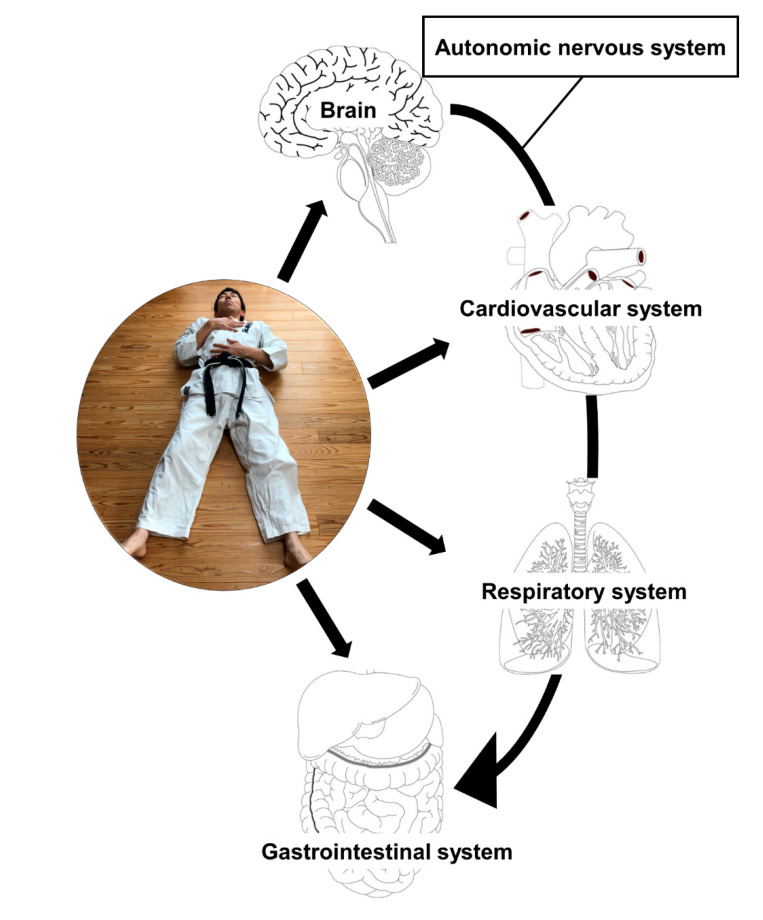
Background: Breathing is an essential part of life. Diaphragmatic breathing (DB) is slow and deep breathing that affects the brain and the cardiovascular, respiratory, and gastrointestinal systems through the modulation of autonomic nervous functions. However, the effects of DB on human health need to be further investigated. Methods: The author conducted a PubMed search regarding the current evidence of the effect of DB on health. Results: This review consists of a total of 10 systematic reviews and 15 randomized controlled trials (RCTs). DB appears to be effective for improving the exercise capacity and respiratory function in patients with chronic obstructive pulmonary disease (COPD). Although the effect of DB on the quality of life (QoL) of patients with asthma needs to be investigated, it may also help in reducing stress; treating eating disorders, chronic functional constipation, hypertension, migraine, and anxiety; and improving the QoL of patients with cancer and gastroesophageal reflux disease (GERD) and the cardiorespiratory fitness of patients with heart failure. Conclusions: Based on this narrative review, the exact usefulness of DB in clinical practice is unclear due to the poor quality of studies. However, it may be a feasible and practical treatment method for various disorders.
Overview
The claims and statistics of this paper haven’t been checked yet.
Run the check — free, no account needed. It reads the open-access text and checks the sources it cites.
Integrity signals
Registry
Cites
Statistics
Figures
Verification
Claims the paper makes
The claims and statistics of this paper haven’t been checked yet.
Run the check — free, no account needed. It reads the open-access text and checks the sources it cites.
Claims other papers make about this one
Each is checked against this paper’s own text: does it say what the citing paper says it does?
The check wasn’t confident either way, so it gives no verdict — never disputed.
In the citing paper
“Systematic reviews and meta-analyses demonstrate that evening exposure to bright or blue-enriched light suppresses melatonin production, delays sleep onset, and reduces overall sleep efficiency by signaling the brain to remain alert, whereas warm, dim lighting and blue-light filters on electronic devices during evening hours minimized circadian disruption [49].”
From Pre-Sleep Anxiety: Mechanisms and Therapeutic Approaches in Clinical Practice. (2026) · cites this paper as [49]
Experimental — accuracy not yet measured
Self-check
Percentages, sums and reported differences re-computed from the paper’s own numbers.
The self-check needs the paper’s full text.
Citations
Cites
Thayer, J. F., Yamamoto, S. S., & Brosschot, J. F. (2010) · International Journal of Cardiology · doi:10.1016/j.ijcard.2009.09.543 · Cited by 2,276
Heart Rate Variability ? A Historical Perspective
Billman, G. E. (2011) · Frontiers in Physiology · doi:10.3389/fphys.2011.00086 · Cited by 786
The physiological effects of slow breathing in the healthy human
Russo, M. A., Santarelli, D. M., & O’Rourke, D. (2017) · Breathe · doi:10.1183/20734735.009817 · Cited by 665 · cited 4×
“This physiological action is reversed in expiration [103].”
BackgroundInfluentialThe Effect of Diaphragmatic Breathing on Attention, Negative Affect and Stress in Healthy Adults
Ma, X., Yue, Z.-Q., Gong, Z.-Q., Zhang, H., Duan, N.-Y., Shi, Y.-T., Wei, G.-X., & Li, Y.-F. (2017) · Frontiers in Psychology · doi:10.3389/fpsyg.2017.00874 · Cited by 509
Self-Regulation of Breathing as a Primary Treatment for Anxiety
Jerath, R., Crawford, M. W., Barnes, V. A., & Harden, K. (2015) · Applied Psychophysiology and Biofeedback · doi:10.1007/s10484-015-9279-8 · Cited by 353
Thomas, M., McKinley, R. K., Freeman, E., & Foy, C. (2001) · BMJ · doi:10.1136/bmj.322.7294.1098 · Cited by 294
Zou, L., Sasaki, J. E., Wei, G.-X., Huang, T., Yeung, A. S., Neto, O. B., Chen, K. W., & Hui, S. S.-C. (2018) · Journal of Clinical Medicine · doi:10.3390/jcm7110404 · Cited by 267
Bernardi, L., Gabutti, A., Porta, C., & Spicuzza, L. (2001) · Journal of Hypertension · doi:10.1097/00004872-200112000-00016 · Cited by 243 · cited 1×
“DB that controlled RR at six breaths/min reduces the chemoreflex response to hypoxia and hypercapnia compared with normal breathing [104].”
BackgroundRicoy, J., Rodríguez‐Núñez, N., Álvarez-Dobaño, J. M., Toubes, M. E., Riveiro, V., & Valdés, L. (2018) · Pulmonology · doi:10.1016/j.pulmoe.2018.10.008 · Cited by 232
Breathing exercises for chronic obstructive pulmonary disease
Holland, A. E., Hill, C. J., JONES, A. Y. M., & McDonald, C. F. (2012) · Cochrane Database of Systematic Reviews · doi:10.1002/14651858.cd008250.pub2 · Cited by 231
Research works printed but not linked: 3
- Gridina, 2013, Prevalence of chronic hyperventilation syndrome in children and teenagers, Arch. Pediatr. Organe Off. Soc. Fr. Pediatr., 20, 265
- Lindeboom, 1980, Hyperventilation and therapy [Hyperventilatie en therapie], Ned. Tijdschr. Voor Fysiother., 90, 18
- Liu, 2014, Comparisons of different breathing ratios of slow breathing among outpatients with anxiety disorders, J. Med. Health, 3, 57
Cited by
Sorted by citations
Mitsea, E., Drigas, A. S., & Skianis, C. (2022) · Technium Social Sciences Journal · doi:10.47577/tssj.v29i1.6145 · Cited by 176
Breathing: a Powerfull Tool for Physical & Neuropsychological Regulation. The role of Mobile Apps
Drigas, A. S., & Mitsea, E. (2022) · Technium Social Sciences Journal · doi:10.47577/tssj.v28i1.5922 · Cited by 125
Slow breathing for reducing stress: The effect of extending exhale
Birdee, G. S., Nelson, K., Wallston, K., Nian, H., Diedrich, A., Paranjape, S. Y., Abraham, R. L., & Gamboa, A. C. (2023) · Complementary Therapies in Medicine · doi:10.1016/j.ctim.2023.102937 · Cited by 68
Breath Tools: A Synthesis of Evidence-Based Breathing Strategies to Enhance Human Running
Harbour, E. T., STÖGGL, T. L., Schwameder, H., & Finkenzeller, T. (2022) · Frontiers in Physiology · doi:10.3389/fphys.2022.813243 · Cited by 56
“…diaphragmatic breathing is correlated with various positive health benefits, including reduced resting heart rate, post-exercise oxidative stress, increased postural control, and baroreflex sensitivity (Hazlett-Stevens and Craske, 2009; Martarelli et al., 2011; Nelson, 2012; Hamasaki, 2020).”
BackgroundInfluentialNeuromodulation Applied to Diseases: The Case of HRV Biofeedback
Gitler, A., Vanacker, L., Couck, M., Leeuw, I. D., & Gidron, Y. (2022) · Journal of Clinical Medicine · doi:10.3390/jcm11195927 · Cited by 45
“Muscle tension in the abdominal area, pelvis, and lower back tends to restrict movement of the diaphragm, thus requiring the use of the accessory muscles of the chest and shoulders for breathing [69].”
Background
Metadata
- Authors
- Hamasaki, H.
- Affiliations
- Hamasaki Clinic, 2-21-4 Nishida, Kagoshima, Kagoshima 890-0046, Japan
- Corresponding author
- Hamasaki, Hidetaka
- ORCID
- Hamasaki, Hidetaka
- Venue
- Medicines
- Publisher
- MDPI AG
- Published
- 2020-10-15
- Volume
- 7
- Issue
- 10
- Pages
- 65
- ISSN
- 2305-6320 (ISSN-L)
- PMC
- PMC7602530
- OpenAlex
- W3093114155
- Cited by
- 173
- References
- 116
- Citations by year
- 2026: 28 · 2025: 42 · 2024: 43 · 2023: 35 · 2022: 21 · 2021: 4
- FWCI
- 2.55
- Type
- journal article
- Language
- en
- Open access
- gold
- doi.org
- Licence
- Locations
- Medicines (publishedVersion, cc-by)
- PubMed Central (publishedVersion, cc-by)
- PubMed (publishedVersion)
- DOAJ (DOAJ: Directory of Open Access Journals) (submittedVersion, cc-by-sa)
- Topics
- Health Sciences › Medicine › Cardiology and Cardiovascular Medicine › Heart Rate Variability and Autonomic Control
- Life Sciences › Neuroscience › Endocrine and Autonomic Systems › Neuroscience of respiration and sleep
- Health Sciences › Medicine › Pulmonary and Respiratory Medicine › Respiratory and Cough-Related Research
- Keywords
- diaphragmatic breathing, slow deep breathing, autonomic nervous system modulation, chronic obstructive pulmonary disease, asthma, stress reduction, eating disorders, chronic functional constipation, hypertension, migraine, anxiety, cancer, gastroesophageal reflux disease, heart failure, cardiorespiratory fitness, quality of life, respiratory function
About these checks
Registry, retraction, Cites and statistics results are computed, not judged, with one exception: a printed reference that no index lists is read once by a model before it counts as a citation error. Claims are extracted by a model and kept only when their quote appears verbatim in the text; each cited source is then checked, with a model’s help, for whether it says what the claim relies on. Those verdicts can be wrong — read the claim’s quote and the cited source before relying on one.
Statistics and arithmetic are recomputed, not judged.
Confidence bands are shown only for fields calibrated on our annotated test set. None is calibrated yet, so no band is shown.
What counts as a claim ›How we measure confidence ›How we check this ›
Are you an author, or do you see a problem with this page? Request a review
