

The DOI matches its Crossref record; 89 of the 90 references it cites were found in a registry or an index.
Assessment of the Safety and Probiotic Properties of Enterococcus faecium B13 Isolated from Fermented Chili
Open accessAbstract
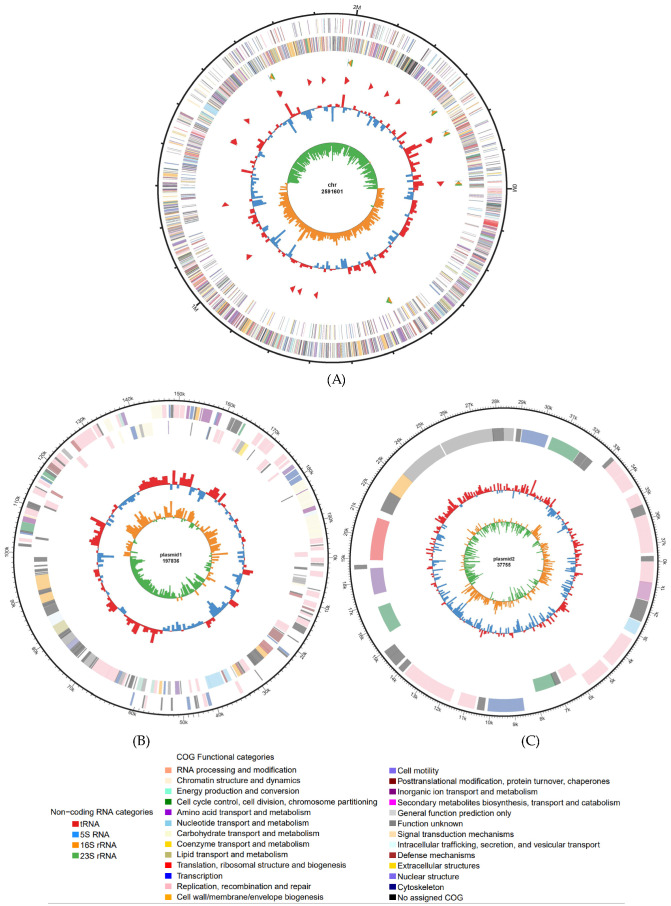
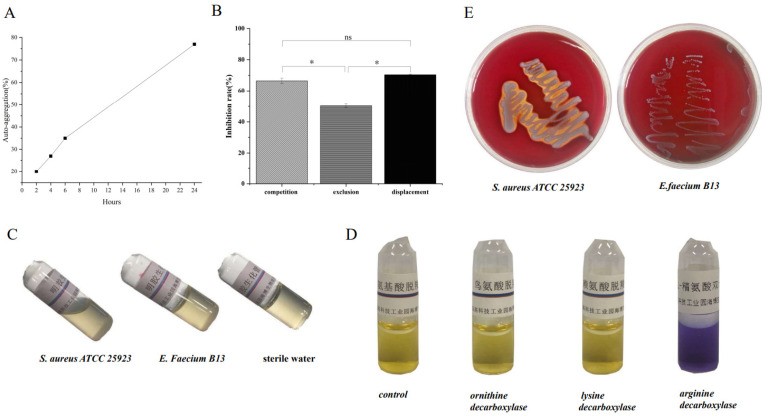
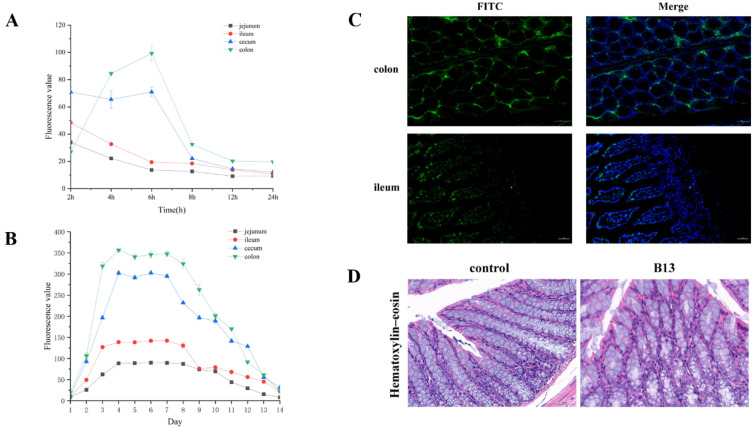
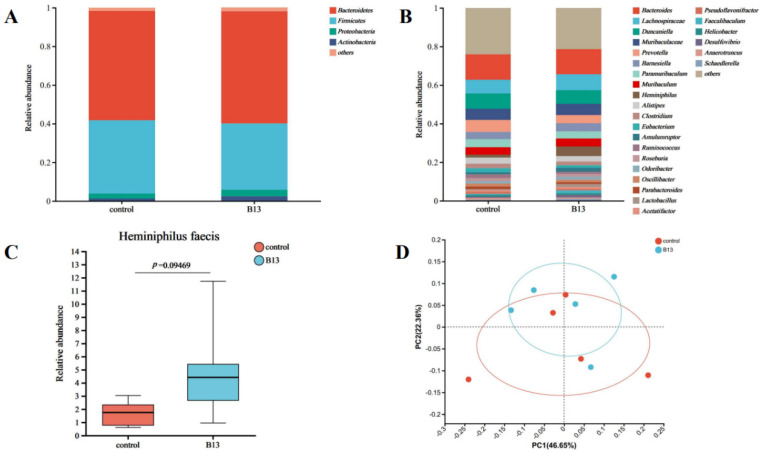
Enterococcus faecium B13, selected from fermentation chili, has been proven to promote animal growth by previous studies, but it belongs to opportunistic pathogens, so a comprehensive evaluation of its probiotic properties and safety is necessary. In this study, the probiotic properties and safety of B13 were evaluated at the genetic and phenotype levels in vitro and then confirmed in vivo. The genome of B13 contains one chromosome and two plasmids. The average nucleotide identity indicated that B13 was most closely related to the fermentation-plant-derived strain. The strain does not carry the major virulence genes of the clinical E. faecium strains but contains aac(6′)-Ii, ant (6)-Ia, msrC genes. The strain had a higher tolerance to acid at pH 3.0, 4.0, and 0.3% bile salt and a 32.83% free radical DPPH clearance rate. It can adhere to Caco-2 cells and reduce the adhesion of E. coli to Caco-2 cells. The safety assessment revealed that the strain showed no hemolysis and did not exhibit gelatinase, ornithine decarboxylase, lysine decarboxylase, or tryptophanase activity. It was sensitive to twelve antibiotics but was resistant to erythromycin, rifampicin, tetracycline, doxycycline, and minocycline. Experiments in vivo have shown that B13 can be located in the ileum and colon and has no adverse effects on experiment animals. After 28 days of feeding, B13 did not remarkable change the α-diversity of the gut flora or increase the virulence genes. Our study demonstrated that E. faecium B13 may be used as a probiotic candidate.
Overview
The claims and statistics of this paper haven’t been checked yet.
Run the check — free, no account needed. It reads the open-access text and checks the sources it cites.
Integrity signals
Registry
Cites
Statistics
Figures
Verification
Claims the paper makes
The claims and statistics of this paper haven’t been checked yet.
Run the check — free, no account needed. It reads the open-access text and checks the sources it cites.
Claims other papers make about this one
Each is checked against this paper’s own text: does it say what the citing paper says it does?
The cited source says what the claim attributes to it.
In the citing paper
“These observations support our interpretation that recurrent Enterococcus-associated background genes should not be treated as equivalent to acquired mobile ARGs.”
The cited source says what the claim attributes to it.
In the citing paper
“Similarly, Xiao et al. detected aac(6′)-Ii and msrC in a candidate E. faecium probiotic strain without major clinical virulence determinants [28].”
Self-check
Percentages, sums and reported differences re-computed from the paper’s own numbers.
The self-check needs the paper’s full text.
Citations
Cites
Hill (2014) · doi:10.1038/nrgastro.2014.66 · Cited by 9,592
CARD 2020: Antibiotic Resistome Surveillance with the Comprehensive Antibiotic Resistance Database
Alcock, B. P., Raphenya, A. R., Lau, T. T. Y., Tsang, K. K., Bouchard, M., Edalatmand, A., Huynh, W., Nguyen, A.-L. V., Cheng, A. A., Liu, S., et al. (2019) · Nucleic Acids Research · doi:10.1093/nar/gkz935 · Cited by 3,202
VFDB: a reference database for bacterial virulence factors
Chen, L. (2004) · Nucleic Acids Research · doi:10.1093/nar/gki008 · Cited by 2,112
VFDB 2022: a general classification scheme for bacterial virulence factors
Liu, B., Zheng, D., Zhou, S., Chen, L., & Yang, J. (2021) · Nucleic Acids Research · doi:10.1093/nar/gkab1107 · Cited by 1,849
TYPE III SECRETION SYSTEM EFFECTOR PROTEINS: Double Agents in Bacterial Disease and Plant Defense
Alfano, J. R., & Collmer, A. (2004) · Annual Review of Phytopathology · doi:10.1146/annurev.phyto.42.040103.110731 · Cited by 827
Bacterial coaggregation: an integral process in the development of multi-species biofilms
Rickard, A. H., Gilbert, P., High, N. J., Kolenbrander, P. E., & Handley, P. S. (2003) · Trends in Microbiology · doi:10.1016/s0966-842x(02)00034-3 · Cited by 765
Adhesion, autoaggregation and hydrophobicity of 13 strains of Bifidobacterium longum
Del Re, B., Sgorbati, B., Miglioli, M., & Palenzona, D. (2000) · Letters in Applied Microbiology · doi:10.1046/j.1365-2672.2000.00845.x · Cited by 731
Infections caused by Gram-positive bacteria: a review of the global challenge
Woodford, N., & Livermore, D. M. (2009) · Journal of Infection · doi:10.1016/s0163-4453(09)60003-7 · Cited by 418
Lanz, R., Kuhnert, P., & Boerlin, P. (2002) · Veterinary Microbiology · doi:10.1016/s0378-1135(02)00263-8 · Cited by 374
Enterococcus peptidoglycan remodeling promotes checkpoint inhibitor cancer immunotherapy
Griffin, M. E., Espinosa, J., Becker, J. L., Luo, J.-D., Carroll, T. S., Jha, J. K., Fanger, G. R., & Hang, H. C. (2021) · Science · doi:10.1126/science.abc9113 · Cited by 366
Research works printed but not linked: 4
- Ding, 2017, Effects of Enterococcus faecium B13 Yielding Bacteriocins on Growth Performance, Nutrient Digestibility, Serum Immune Indexes and Fecal Microbiota of Weaned Piglets, Acta Vet. Zootech. Sin., 48, 1902
- Kara, 2020, Investigation of Antibiotic Resistance and Virulence Factors of Enterococcus faecium and Enterococcus faecalis Strains Isolated from Clinical Samples, Mikrobiyol. Bul., 54, 26
- Zhu, 2017, Novel lnu(G) gene conferring resistance to lincomycin by nucleotidylation, located on Tn6260 from Enterococcus faecalis E531, J. Antimicrob. Chemother., 72, 993
- Wei, 2020, Optimization of Fermentation Conditions for Bacteriocin Production from Enterococcus faecium B13, Food Res. Dev., 41, 194
Cited by
Sorted by citations
Kh, A. A., Abdo, A. A. A., Khan, S. H., Aleryani, H., Mi, S., & Wang, X. (2025) · Food Reviews International · doi:10.1080/87559129.2025.2473009 · Cited by 14
Probiotic potential of three Enterococcus spp. isolated from raw milk: An in vitro assessment
Acar, B. Ç., Yüksekdağ, Z., & Yılmaz, E. Ş. (2025) · International Dairy Journal · doi:10.1016/j.idairyj.2025.106196 · Cited by 6
Pandit, N. K., Sharma, P., Sharma, P., Rout, P. R., Mohanty, A., & Meena, S. S. (2025) · Reviews in Environmental Science and Bio/Technology · doi:10.1007/s11157-025-09753-3 · Cited by 4
Billateh, A., Cheirsilp, B., & Suyotha, W. (2026) · Applied Food Research · doi:10.1016/j.afres.2026.102087 · Cited by 3
Lv, Q., Zheng, B., Tan, L., Wang, Q., Yang, Z., Jin, A., Qin, Y., & Zhang, R. (2025) · Environmental Technology · doi:10.1080/09593330.2025.2578774 · Cited by 2
Metadata
- Authors
- Xiao, J., Chen, C., Fu, Z., Wang, S., & Luo, F.
- Affiliations
- Southwest Minzu University (CN)
- Institute of Qinghai-Tibetan Plateau, Southwest Minzu University, Chengdu 610041, China
- Corresponding author
- Luo, Fan
- ORCID
- Venue
- Microorganisms
- Publisher
- MDPI AG
- Published
- 2024-05-15
- Volume
- 12
- Issue
- 5
- Pages
- 994
- ISSN
- 2076-2607 (ISSN-L)
- PMC
- PMC11123876
- OpenAlex
- W4396965634
- Cited by
- 17
- References
- 90
- Citations by year
- 2026: 7 · 2025: 10
- FWCI
- 3.65
- Type
- journal article
- Language
- en
- Open access
- gold
- doi.org
- Licence
- Locations
- Microorganisms (publishedVersion, cc-by)
- PubMed Central (publishedVersion, cc-by)
- PubMed (publishedVersion)
- DOAJ (DOAJ: Directory of Open Access Journals) (submittedVersion, cc-by-sa)
- Funders
- Natural Science Foundation of Sichuan Province (2022NSFSC0114, ZYN2024083)
- the Central Universities Project of Southwest Minzu University (2022NSFSC0114, ZYN2024083)
- Topics
- Life Sciences › Agricultural and Biological Sciences › Food Science › Probiotics and Fermented Foods
- Life Sciences › Agricultural and Biological Sciences › Animal Science and Zoology › Animal Nutrition and Physiology
- Life Sciences › Immunology and Microbiology › Immunology › Aquaculture disease management and microbiota
- Keywords
- Enterococcus faecium, probiotic candidate, virulence genes, antibiotic resistance, acid and bile tolerance, antioxidant activity, cell adhesion, gut microbiota, plasmids, animal growth promotion
About these checks
Registry, retraction, Cites and statistics results are computed, not judged, with one exception: a printed reference that no index lists is read once by a model before it counts as a citation error. Claims are extracted by a model and kept only when their quote appears verbatim in the text; each cited source is then checked, with a model’s help, for whether it says what the claim relies on. Those verdicts can be wrong — read the claim’s quote and the cited source before relying on one.
Statistics and arithmetic are recomputed, not judged.
Confidence bands are shown only for fields calibrated on our annotated test set. None is calibrated yet, so no band is shown.
What counts as a claim ›How we measure confidence ›How we check this ›
Are you an author, or do you see a problem with this page? Request a review
How to cite
Cite CoChat for the checks on this page, and the paper for its own findings.
- This page
- CoChat. (2026). Citation check: Assessment of the Safety and Probiotic Properties of Enterococcus faecium B13 Isolated from Fermented Chili. https://app.cochat.ai/papers/10.3390/microorganisms12050994
- The paper
- Xiao, J., Chen, C., Fu, Z., Wang, S., & Luo, F. (2024). Assessment of the Safety and Probiotic Properties of Enterococcus faecium B13 Isolated from Fermented Chili. Microorganisms. https://doi.org/10.3390/microorganisms12050994
