

The DOI matches its Crossref record; 3 of the 3 references it cites were found in a registry or an index.
Iron Acquisition of Urinary Tract Infection Escherichia coli Involves Pathogenicity in Caenorhabditis elegans
Open accessPublished version of a preprint
Abstract
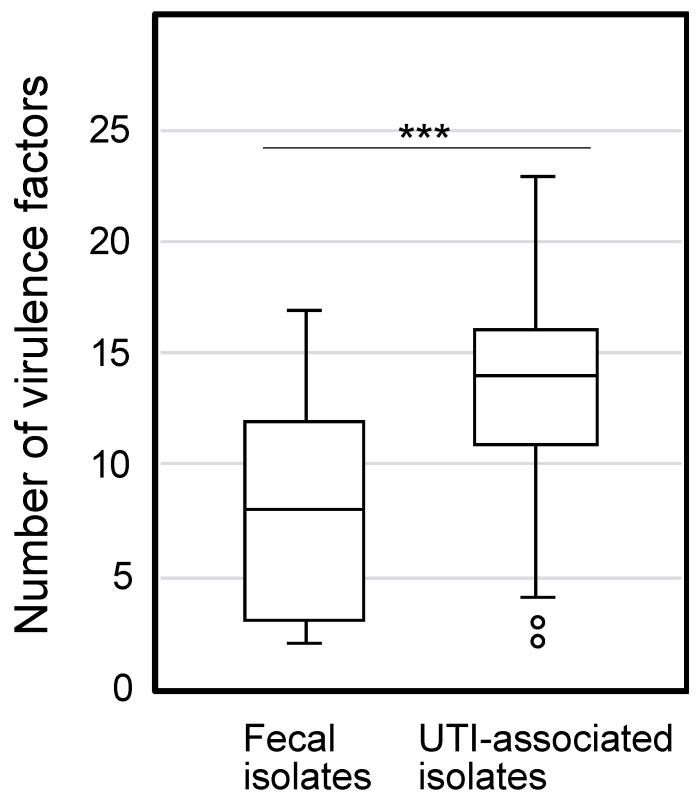
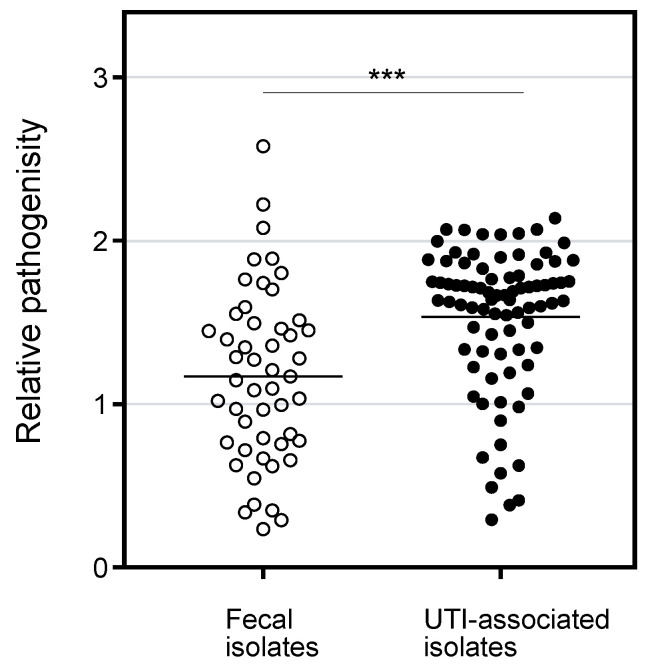
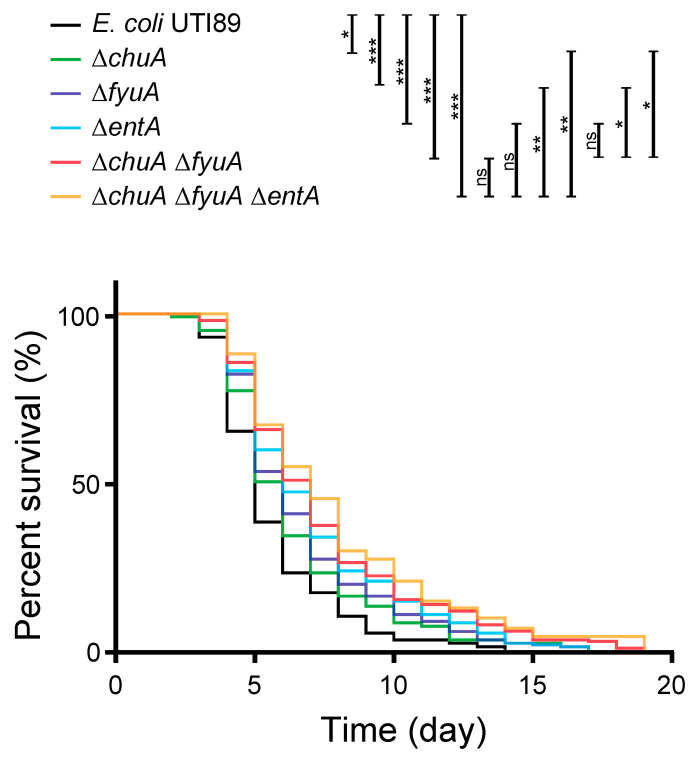
Uropathogenic Escherichia coli (UPEC) is a major bacterial pathogen that causes urinary tract infections (UTIs). The mouse is an available UTI model for studying the pathogenicity; however, Caenorhabditis elegans represents as an alternative surrogate host with the capacity for high-throughput analysis. Then, we established a simple assay for a UPEC infection model with C. elegans for large-scale screening. A total of 133 clinically isolated E. coli strains, which included UTI-associated and fecal isolates, were applied to demonstrate the simple pathogenicity assay. From the screening, several virulence factors (VFs) involved with iron acquisition (chuA, fyuA, and irp2) were significantly associated with high pathogenicity. We then evaluated whether the VFs in UPEC were involved in the pathogenicity. Mutants of E. coli UTI89 with defective iron acquisition systems were applied to a solid killing assay with C. elegans. As a result, the survival rate of C. elegans fed with the mutants significantly increased compared to when fed with the parent strain. The results demonstrated, the simple assay with C. elegans was useful as a UPEC infectious model. To our knowledge, this is the first report of the involvement of iron acquisition in the pathogenicity of UPEC in a C. elegans model.
Overview
The claims and statistics of this paper haven’t been checked yet.
Run the check — free, no account needed. It reads the open-access text and checks the sources it cites.
Integrity signals
Registry
Cites
Statistics
Figures
Verification
Claims the paper makes
The claims and statistics of this paper haven’t been checked yet.
Run the check — free, no account needed. It reads the open-access text and checks the sources it cites.
Self-check
Percentages, sums and reported differences re-computed from the paper’s own numbers.
The self-check needs the paper’s full text.
Citations
Cites
Iron in infection and immunity
Cassat, J. E., & Skaar, E. P. (2013) · Cell Host & Microbe · doi:10.1016/j.chom.2013.04.010 · Cited by 1,214
The pathogen-associated iroA gene cluster mediates bacterial evasion of lipocalin 2
Fischbach, M. A., Lin, H., Zhou, L., Yu, Y., Abergel, R. J., Liu, D. R., Raymond, K. N., Wanner, B. L., Strong, R. K., Walsh, C. T., et al. (2006) · Proceedings of the National Academy of Sciences · doi:10.1073/pnas.0604636103 · Cited by 319
Garcia, E. C., Brumbaugh, A. R., & Mobley, H. L. T. (2011) · Infection and Immunity · doi:10.1128/iai.01222-10 · Cited by 256
Research works printed but not linked: 38
- Foxman, 2002, Epidemiology of urinary tract infections: Incidence, morbidity, and economic costs, Am. J. Med., 113, 5, 10.1016/S0002-9343(02)01054-9 · DOI
- Francois, 2016, The economic burden of urinary tract infections in women visiting general practices in France: A cross-sectional survey, BMC Health Serv. Res., 16, 1, 10.1186/s12913-016-1620-2 · DOI
- Iv, 2017, Bacterial virulence phenotypes of Escherichia coli and host susceptibility determine risk for urinary tract infections, Sci. Transl. Med., 9, eaaf1283, 10.1126/scitranslmed.aaf1283 · DOI
- Tan, 1999, Killing of Caenorhabditis elegans by Pseudomonas aeruginosa used to model mammalian bacterial pathogenesis, Proc. Natl. Acad. Sci. USA, 96, 715, 10.1073/pnas.96.2.715 · DOI
- Garsin, 2001, A simple model host for identifying Gram-positive virulence factors, Proc. Natl. Acad. Sci. USA, 98, 10892, 10.1073/pnas.191378698 · DOI
- Kurz, 2003, Virulence factors of the human opportunistic pathogen Serratia marcescens identified by in vivo screening, EMBO J., 22, 1451, 10.1093/emboj/cdg159 · DOI
- Chou, 2013, Enterohaemorrhagic Escherichia coli O157:H7 Shiga-like toxin 1 is required for full pathogenicity and activation of the p38 mitogen-activated protein kinase pathway in Caenorhabditis elegans, Cell. Microbiol., 15, 82, 10.1111/cmi.12030 · DOI
- Couillault, 2002, Diverse Bacteria Are Pathogens of Caenorhabditis elegans, Infect. Immun., 70, 4705, 10.1128/IAI.70.8.4705-4707.2002 · DOI
- Diard, 2007, Caenorhabditis elegans as a simple model to study phenotypic and genetic virulence determinants of extraintestinal pathogenic Escherichia coli, Microbes Infect., 9, 214, 10.1016/j.micinf.2006.11.009 · DOI
- Kuo, 2018, A multi-omic analysis reveals the role of fumarate in regulating the virulence of enterohemorrhagic Escherichia coli, Cell Death Dis., 9, 1, 10.1038/s41419-018-0423-2 · DOI
- Lavigne, 2006, Virulence genotype and nematode-killing properties of extra-intestinal Escherichia coli producing CTX-M β-lactamases, Clin. Microbiol. Infect., 12, 1199, 10.1111/j.1469-0691.2006.01536.x · DOI
- Lavigne, J.-P., Vergunst, A.C., Goret, L., Sotto, A., Combescure, C., Blanco, J., O’Callaghan, D., and Nicolas-Chanoine, M.-H. (2012). Virulence Potential and Genomic Mapping of the Worldwide Clone Escherichia coli ST131. PLoS ONE, 7. · DOI
- Coors, 2013, Evaluating the Pathogenic Potential of Environmental Escherichia coli by Using the Caenorhabditis elegans Infection Model, Appl. Environ. Microbiol., 79, 2435, 10.1128/AEM.03501-12 · DOI
- Mao, 2012, Identification of Escherichia coli Genes Associated with Urinary Tract Infections, J. Clin. Microbiol., 50, 449, 10.1128/JCM.00640-11 · DOI
- Sambrook, J., Fritsch, E.F., and Maniatis, T. (1989). Molecular Cloning: A Laboratory Manual, Cold Spring Harbor Laboratory Press.
- Brenner, 1974, The Genetics of Caenorhabditis Elegans, Genetics, 77, 71, 10.1093/genetics/77.1.71 · DOI
- Clermont, 2000, Rapid and Simple Determination of the Escherichia coli Phylogenetic Group, Appl. Environ. Microbiol., 66, 4555, 10.1128/AEM.66.10.4555-4558.2000 · DOI
- Johnson, 2000, Extended Virulence Genotypes of Escherichia coli Strains from Patients with Urosepsis in Relation to Phylogeny and Host Compromise, J. Infect. Dis., 181, 261, 10.1086/315217 · DOI · Paper page
- Johnson, 2001, Clonal relationships and extended virulence genotypes among Escherichia coli isolates from women with a first or recurrent episode of cystitis, J. Infect. Dis., 183, 1508, 10.1086/320198 · DOI
- Johnson, J.R., Porter, S., Johnston, B., Kuskowski, M.A., Spurbeck, R.R., Mobley, H.L., and Williamson, D.A. (2015). Host characteristics and bacterial traits predict experimental virulence for Escherichia coli bloodstream isolates from patients with urosepsis. Open Forum Infectious Diseases, Oxford University Press. · DOI
- Luo, 2012, Similarity and Divergence of Phylogenies, Antimicrobial Susceptibilities, and Virulence Factor Profiles of Escherichia coli Isolates Causing Recurrent Urinary Tract Infections That Persist or Result from Reinfection, J. Clin. Microbiol., 50, 4002, 10.1128/JCM.02086-12 · DOI
- Datsenko, 2000, One-step inactivation of chromosomal genes in Escherichia coli K-12 using PCR products, Proc. Natl. Acad. Sci. USA, 97, 6640, 10.1073/pnas.120163297 · DOI
- Baba, 2006, Construction of Escherichia coli K-12 in-frame, single-gene knockout mutants: The Keio collection, Mol. Syst. Biol., 2, 8, 10.1038/msb4100050 · DOI · Paper page
- Bingen, 1998, Phylogenetic analysis of Escherichia coli strains causing neonatal meningitis suggests horizontal gene transfer from a predominant pool of highly virulent B2 group strains, J. Infect. Dis., 177, 642, 10.1086/514217 · DOI
- Henderson, J.P., Crowley, J.R., Pinkner, J.S., Walker, J.N., Tsukayama, P., Stamm, W.E., Hooton, T.M., and Hultgren, S.J. (2009). Quantitative Metabolomics Reveals an Epigenetic Blueprint for Iron Acquisition in Uropathogenic Escherichia coli. PLoS Pathog., 5. · DOI
- Torres, 1997, Haem iron-transport system in enterohaemorrhagic Escherichia coli O157:H7, Mol. Microbiol., 23, 825, 10.1046/j.1365-2958.1997.2641628.x · DOI
- Hagan, 2009, Haem acquisition is facilitated by a novel receptor Hma and required by uropathogenic Escherichia colifor kidney infection, Mol. Microbiol., 71, 79, 10.1111/j.1365-2958.2008.06509.x · DOI
- Brumbaugh, 2015, Blocking Yersiniabactin Import Attenuates Extraintestinal Pathogenic Escherichia coli in Cystitis and Pyelonephritis and Represents a Novel Target to Prevent Urinary Tract Infection, Infect. Immun., 83, 1443, 10.1128/IAI.02904-14 · DOI
- Walker, 2015, Urinary tract infections: Epidemiology, mechanisms of infection and treatment options, Nat. Rev. Genet., 13, 269, 10.1038/nrmicro3432 · DOI
- Watts, 2012, Contribution of Siderophore Systems to Growth and Urinary Tract Colonization of Asymptomatic Bacteriuria Escherichia coli, Infect. Immun., 80, 333, 10.1128/IAI.05594-11 · DOI
- Hantke, 2003, Salmochelins, siderophores of Salmonella enterica and uropathogenic Escherichia coli strains, are recognized by the outer membrane receptor IroN, Proc. Natl. Acad. Sci. USA, 100, 3677, 10.1073/pnas.0737682100 · DOI · Paper page
- Anderson, 2014, Mechanisms of iron metabolism in Caenorhabditis elegans, Front. Pharmacol., 5, 113, 10.3389/fphar.2014.00113 · DOI
- Kortman, 2015, Low dietary iron intake restrains the intestinal inflammatory response and pathology of enteric infection by food-borne bacterial pathogens, Eur. J. Immunol., 45, 2553, 10.1002/eji.201545642 · DOI · Paper page
- Bandyopadhyay, 2009, Functional assessment of Nramp-like metal transporters and manganese in Caenorhabditis elegans, Biochem. Biophys. Res. Commun., 390, 136, 10.1016/j.bbrc.2009.09.082 · DOI
- Simonsen, 2011, Quantitative proteomics identifies ferritin in the innate immune response of C. elegans, Virulence, 2, 120, 10.4161/viru.2.2.15270 · DOI
- Rao, 2005, Lack of heme synthesis in a free-living eukaryote, Proc. Natl. Acad. Sci. USA, 102, 4270, 10.1073/pnas.0500877102 · DOI
- Flo, 2004, Lipocalin 2 mediates an innate immune response to bacterial infection by sequestrating iron, Nat. Cell Biol., 432, 917
- Robinson, 2018, The iron hand of uropathogenic Escherichia coli: The role of transition metal control in virulence, Future Microbiol., 13, 745, 10.2217/fmb-2017-0295 · DOI
Metadata
- Authors
- Hashimoto, M., Ma, Y.-F., Wang, S.-T., Chen, C.-S., & Teng, C.-H.
- Affiliations
- National Cheng Kung University (TW)
- Corresponding author
- Hashimoto, Masayuki
- Teng, Ching-Hao
- Venue
- Microorganisms
- Publisher
- MDPI AG
- Published
- 2021-02-02
- Volume
- 9
- Issue
- 2
- Pages
- 310
- ISSN
- 2076-2607 (ISSN-L)
- PMC
- PMC7913171
- OpenAlex
- W3128597431
- Cited by
- 16
- References
- 3
- Citations by year
- 2026: 3 · 2025: 4 · 2024: 3 · 2023: 2 · 2022: 1 · 2021: 3
- FWCI
- 1.40
- Type
- journal article
- Language
- en
- Open access
- gold
- doi.org
- Licence
- Locations
- Microorganisms (publishedVersion, cc-by)
- PubMed Central (publishedVersion, cc-by)
- PubMed (publishedVersion)
- DOAJ (DOAJ: Directory of Open Access Journals) (submittedVersion, cc-by-sa)
- Funders
- Ministry of Science and Technology, Taiwan (MOST 106-2320-B-006-033, MOST 106-2320-B-006-032, MOST 108-2319-B-002-004)
- Topics
- Life Sciences › Immunology and Microbiology › Microbiology › Escherichia coli research studies
- Health Sciences › Medicine › Urology › Urinary Tract Infections Management
- Life Sciences › Biochemistry, Genetics and Molecular Biology › Genetics › Bacterial Genetics and Biotechnology
- Keywords
- uropathogenic Escherichia coli, urinary tract infection, iron acquisition, Caenorhabditis elegans, pathogenicity test, virulence factors, chuA, fyuA, IRP2, high-throughput screening
About these checks
Registry, retraction, Cites and statistics results are computed, not judged, with one exception: a printed reference that no index lists is read once by a model before it counts as a citation error. Claims are extracted by a model and kept only when their quote appears verbatim in the text; each cited source is then checked, with a model’s help, for whether it says what the claim relies on. Those verdicts can be wrong — read the claim’s quote and the cited source before relying on one.
Statistics and arithmetic are recomputed, not judged.
Confidence bands are shown only for fields calibrated on our annotated test set. None is calibrated yet, so no band is shown.
What counts as a claim ›How we measure confidence ›How we check this ›
Are you an author, or do you see a problem with this page? Request a review
How to cite
Cite CoChat for the checks on this page, and the paper for its own findings.
- This page
- CoChat. (2026). Citation check: Iron Acquisition of Urinary Tract Infection Escherichia coli Involves Pathogenicity in Caenorhabditis elegans. https://app.cochat.ai/papers/10.3390/microorganisms9020310
- The paper
- Hashimoto, M., Ma, Y.-F., Wang, S.-T., Chen, C.-S., & Teng, C.-H. (2021). Iron Acquisition of Urinary Tract Infection Escherichia coli Involves Pathogenicity in Caenorhabditis elegans. Microorganisms. https://doi.org/10.3390/microorganisms9020310
