

The DOI matches its Crossref record; 4 of the 4 references it cites were found in a registry or an index.
Cardamom, Cumin, and Dill Weed Essential Oils: Chemical Compositions, Antimicrobial Activities, and Mechanisms of Action against Campylobacter spp.
Abstract
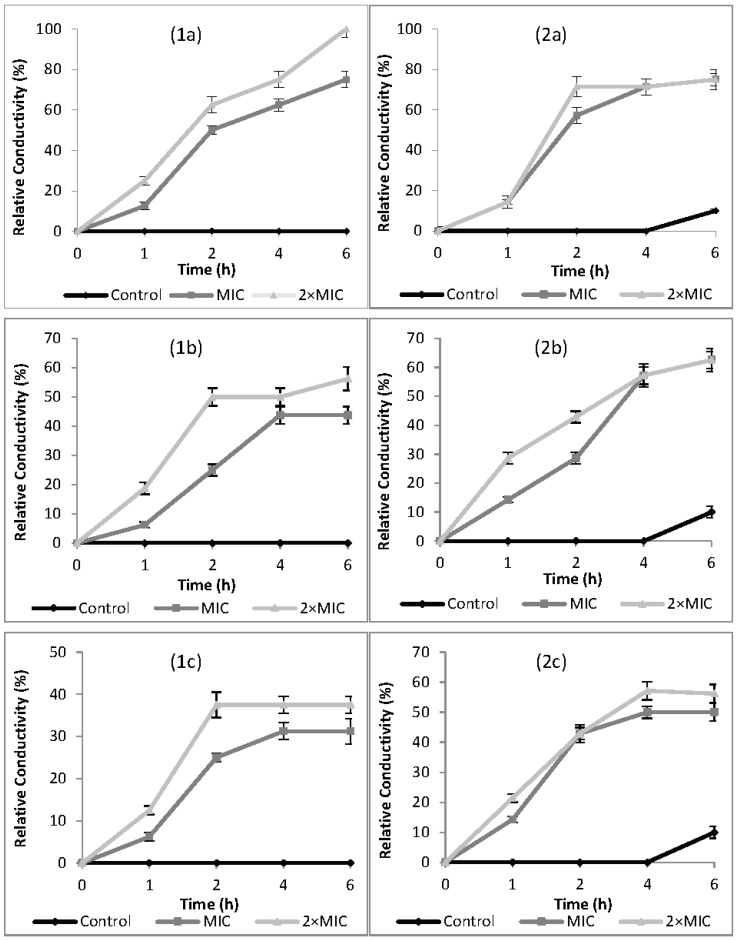
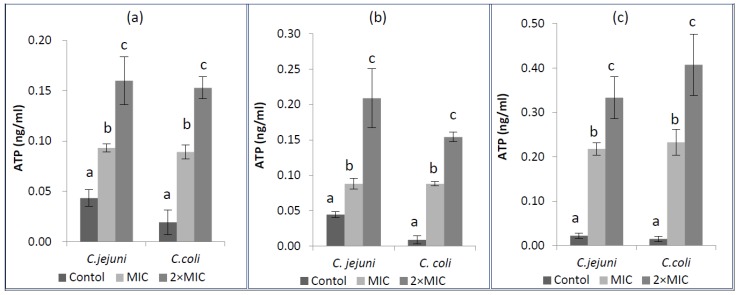
Natural antimicrobials as well as essential oils (EOs) have gained interest to inhibit pathogenic microorganisms and to control food borne diseases. Campylobacter spp. are one of the most common causative agents of gastroenteritis. In this study, cardamom, cumin, and dill weed EOs were evaluated for their antibacterial activities against Campylobacter jejuni and Campylobacter coli by using agar-well diffusion and broth microdilution methods, along with the mechanisms of antimicrobial action. Chemical compositions of EOs were also tested by gas chromatography (GC) and gas chromatography-mass spectrometry (GC-MS). The results showed that cardamom and dill weed EOs possess greater antimicrobial activity than cumin with larger inhibition zones and lower minimum inhibitory concentrations. The permeability of cell membrane and cell membrane integrity were evaluated by determining relative electric conductivity and release of cell constituents into supernatant at 260 nm, respectively. Moreover, effect of EOs on the cell membrane of Campylobacter spp. was also investigated by measuring extracellular ATP concentration. Increase of relative electric conductivity, extracellular ATP concentration, and cell constituents’ release after treatment with EOs demonstrated that tested EOs affected the membrane integrity of Campylobacter spp. The results supported high efficiency of cardamom, cumin, and dill weed EOs to inhibit Campylobacter spp. by impairing the bacterial cell membrane.
Overview
The claims and statistics of this paper haven’t been checked yet.
Run the check — free, no account needed. It reads the open-access text and checks the sources it cites.
Integrity signals
Registry
Cites
Statistics
Figures
Verification
Claims the paper makes
The claims and statistics of this paper haven’t been checked yet.
Run the check — free, no account needed. It reads the open-access text and checks the sources it cites.
Claims other papers make about this one
Each is checked against this paper’s own text: does it say what the citing paper says it does?
In the citing paper
“The current principal constituents of DEO are monoterpenes, notably limonene and carvone, which have potent antibacterial effects [8,61,62].”
From Preservative Potential of Anethum graveolens Essential Oil on Fish Fillet Quality and Shelf Life During Refrigerated Storage (2025) · cites this paper as [61]
Self-check
Percentages, sums and reported differences re-computed from the paper’s own numbers.
The self-check needs the paper’s full text.
Citations
Cites
Wiegand, I., Hilpert, K., & Hancock, R. E. W. (2008) · Nature Protocols · doi:10.1038/nprot.2007.521 · Cited by 6,156
Characterization of the action of selected essential oil components on Gram-negative bacteria
Helander, I. M., Alakomi, H.-L., Latva-Kala, K., Mattila-Sandholm, T., Pol, I., Smid, E. J., Gorris, L. G. M., & von Wright, A. (1998) · Journal of Agricultural and Food Chemistry · doi:10.1021/jf980154m · Cited by 1,664
Ultee, A., Bennik, M. H. J., & Moezelaar, R. (2002) · Applied and Environmental Microbiology · doi:10.1128/aem.68.4.1561-1568.2002 · Cited by 1,602
Carson, C. F., Mee, B. J., & Riley, T. V. (2002) · Antimicrobial Agents and Chemotherapy · doi:10.1128/aac.46.6.1914-1920.2002 · Cited by 975
Research works printed but not linked: 63
- Zilbauer, 2008, Campylobacter jejuni-mediated disease pathogenesis: An update, Trans. R. Soc. Trop. Med. Hyg., 102, 123, 10.1016/j.trstmh.2007.09.019 · DOI
- Havelaar, 2013, Estimating the true incidence of campylobacteriosis and salmonellosis in the European Union, 2009, Epidemiol. Infect., 141, 293, 10.1017/S0950268812000568 · DOI
- Kaakoush, 2015, Global epidemiology of Campylobacter infection, Clin. Microbial. Rev., 28, 687, 10.1128/CMR.00006-15 · DOI
- Dasti, 2010, Campylobacter jejuni: A brief overview on pathogenicity-associated factors and disease-mediating mechanisms, Int. J. Med. Microbiol., 300, 205, 10.1016/j.ijmm.2009.07.002 · DOI
- Omurtag, 2011, Simple media and conditions for inter-laboratory transport of Campylobacter jejuni isolates, Vet. Q., 31, 73, 10.1080/01652176.2011.585797 · DOI
- Kurekci, 2012, Screening of Australian plants for antimicrobial activity against Campylobacter jejuni, Phytother. Res., 26, 186, 10.1002/ptr.3526 · DOI
- Burt, 2004, Essential oils: Their antibacterial properties and potential applications in foods—a review, Int. J. Food Microbiol., 94, 223, 10.1016/j.ijfoodmicro.2004.03.022 · DOI · Paper page
- Baser, 2004, A Comparative Study of the Essential Oils of Wild and Cultivated Satureja hor tensis L., J. Essent. Oil Res., 16, 422, 10.1080/10412905.2004.9698761 · DOI
- Ceylan, 2004, Antimicrobial activity of spices, J. Rapid Methods Autom. Microbiol., 12, 1, 10.1111/j.1745-4581.2004.tb00046.x · DOI
- Lv, 2011, In vitro antimicrobial effects and mechanism of action of selected plant essential oil combinations against four food-related microorganisms, Food Res. Int., 44, 3057, 10.1016/j.foodres.2011.07.030 · DOI
- Bendiabdellah, 2013, Antibacterial activity of Daucus crinitus essential oils along the vegetative life of the plant, J. Chem., 33, 44
- Ozkan, G., Kamiloglu, S., Ozdal, T., Boyacioglu, D., and Capanoglu, E. (2016). Potential use of Turkish medicinal plants in the treatment of various diseases. Molecules, 21. · DOI
- Peter, 2001, Cardamom (small), Handbook of Herbs and Spices, Volume 1, 123
- Peter, 2001, Cumin, Handbook of Herbs and Spices, Volume 1, 164
- Peter, 2001, Dill, Handbook of Herbs and Spices, Volume 1, 173
- Hassanien, 2015, Health-promoting value and food applications of black cumin essential oil: An overview, J. Food Sci. Technol., 52, 6136, 10.1007/s13197-015-1785-4 · DOI · Paper page
- Kumar, 2016, Preservative potential of cumin essential oil for Pisum sativum L. during storage, J. Plant Prot. Res., 56, 203, 10.1515/jppr-2016-0027 · DOI
- 2013, Inhibitory Effect of Cardamom Essential Oil on Aflatoxin B Production by Aspergillus spp. in Arabic Coffee, J. Pure Appl. Microbiol., 7, 1943
- Lazutka, 2001, Genotoxicity of dill (Anethum graveolens L.), peppermint (Mentha×piperita L.) and pine (Pinus sylvestris L.) essential oils in human lymphocytes and Drosophila melanogaster, Food Chem. Toxicol., 39, 485, 10.1016/S0278-6915(00)00157-5 · DOI
- Becerril, 2009, Antimicrobial activity in the vapour phase of a combination of cinnamon and clove essential oils, Food Chem., 116, 982, 10.1016/j.foodchem.2009.03.058 · DOI
- Turgis, 2009, Antimicrobial activity of mustard essential oil against Escherichia coli O157:H7 and Salmonella typhi, Food Control, 20, 1073, 10.1016/j.foodcont.2009.02.001 · DOI · Paper page
- Diao, 2014, Chemical composition, antibacterial activity and mechanism of action of essential oil from seeds of fennel (Foeniculum vulgare Mill.), Food Control, 35, 109, 10.1016/j.foodcont.2013.06.056 · DOI
- Kong, 2008, Antibacterial mechanism of chitosan microspheres in a solid dispersing system against E. coli, Coll. Surf. B Biointerfaces, 65, 197, 10.1016/j.colsurfb.2008.04.003 · DOI
- Tabanca, 2004, Comparison of the Essential Oils of Origanum majorana L. and Origanum x majoricum Cambess, J. Essent. Oil Res., 16, 248, 10.1080/10412905.2004.9698713 · DOI
- Kosar, 2005, Comparison of microwave-assisted hydrodistillation and hydrodistillation methods for the analysis of volatile secondary metabolites, Pharm. Biol., 43, 491, 10.1080/13880200500220136 · DOI
- Wannes, 2009, Variations in essential oil and fatty acid composition during Myrtus communis var. italica fruit maturation, Food Chem., 112, 621, 10.1016/j.foodchem.2008.06.018 · DOI · Paper page
- Kushnarenko, 2016, Investigation of Essential Oils from Three Natural Populations of Lonicera iliensis, Chem. Nat. Compd., 52, 751, 10.1007/s10600-016-1765-6 · DOI
- Sevindik, 2016, Chemical Composition, Antioxidant Capacity, Acetyl-and Butyrylcholinesterase Inhibitory Activities of the Essential Oil of Thymus haussknechtii Velen, Rec. Nat. Prod., 10, 503
- Vitoratos, 2013, Antifungal activity of plant essential oils against Botrytis cinerea, Penicillium italicum and Penicillium digitatum, Not. Bot. Horti Agrobot. Cluj-Napoca, 41, 86, 10.15835/nbha4118931 · DOI
- Moussaoui, 2013, Antibacterial and Antiviral Activities of Essential Oils of Northern Moroccan Plants, Br. Biotechnol. J., 3, 318, 10.9734/BBJ/2013/3596 · DOI
- Bakkali, 2008, Biological effects of essential oils—A review, Food Chem. Toxicol., 46, 446, 10.1016/j.fct.2007.09.106 · DOI · Paper page
- Sobral, 2014, Antitumor activity of monoterpenes found in essential oils, Sci. World J., 2014, 953451, 10.1155/2014/953451 · DOI
- Sumalan, 2013, Assessment of inhibitory potential of essential oils on natural mycoflora and Fusarium mycotoxins production in wheat, Chem. Cent. J., 7, 1, 10.1186/1752-153X-7-32 · DOI
- Gemeda, 2014, Effect of essential oils on Aspergillus spore germination, growth and mycotoxin production: A potential source of botanical food preservative, Asian Pac. J. Trop. Biomed., 4, 373, 10.12980/APJTB.4.2014C857 · DOI
- Pandey, 2014, Chemistry and bioactivities of essential oils of some Ocimum species: An overview, Asian Pac. J. Trop. Biomed., 4, 682, 10.12980/APJTB.4.2014C77 · DOI · Paper page
- Jirovetz, 2005, Composition, quality control and antimicrobial activity of the essential oil of cumin (Cuminum cyminum L.) seeds from Bulgaria that had been stored for up to 36 years, Int. J. Food Sci. Technol., 40, 305, 10.1111/j.1365-2621.2004.00915.x · DOI
- Gochev, 2012, Low temperature extraction of essential oil bearing plants by liquefied gases. 7. Seeds from cardamom (Elettaria cardamomum (L.) Maton), J. BioSci. Biotechnol., 1, 135
- Savan, 2013, Essential oil composition of Elettaria cardamomum Maton, J. Appl. Biol. Sci., 7, 42
- Delaquis, 2002, Antimicrobial activity of individual and mixed fraction of dill, celandra, coriander and eucalyptus essential oil, Int. J. Food Microbiol., 74, 101, 10.1016/S0168-1605(01)00734-6 · DOI
- Bowes, 2004, Influence of seeding date and harvest stage on yields and essential oil composition of three cultivars of dill (Anethum graveolens L.) grown in Nova Scotia, Can. J. Plant Sci., 84, 1155, 10.4141/P03-202 · DOI
- Stewart, 1998, Antimicrobial properties of plant essential oils and essences against five important food-borne pathogens, Lett. Appl. Microbiol., 26, 118, 10.1046/j.1472-765X.1998.00303.x · DOI
- Aslim, 2008, In vitro antimicrobial activity of essential oil from endemic Origanum minutiflorum on ciprofloxacin-resistant Campylobacter spp., Food Chem., 107, 602, 10.1016/j.foodchem.2007.08.048 · DOI
- Friedman, 2002, Bactericidal activities of plant essential oils and some of their isolated constituents against Campylobacter jejuni, Escherichia coli, Listeria monocytogenes, and Salmonella enterica, J. Food Protect., 65, 1545, 10.4315/0362-028X-65.10.1545 · DOI
- Jamali, 2013, Chemical composition, antioxidant and antimicrobial activities of essential oils obtained from wild and cultivated Moroccan Thymus species, Ind. Crops Prod., 43, 450, 10.1016/j.indcrop.2012.07.063 · DOI
- Kalemba, 2003, Antibacterial and antifungal properties of essential oils, Curr. Med. Chem., 10, 813, 10.2174/0929867033457719 · DOI
- Ma, B., Ban, X., Huang, B., He, J., Tian, J., Zeng, H., Chen, Y., and Wang, Y. (2015). Interference and mechanism of dill seed essential oil and contribution of carvone and limonene in preventing Sclerotinia rot of rapeseed. PLoS ONE, 10. · DOI · Paper page
- Mejdi, 2015, Chemical Composition and Antimicrobial Activities of Elettaria Cardamomum L. (Manton) Essential Oil: A High Activity against a Wide Range of Food Borne and Medically Important Bacteria and Fungi, J. Chem. Biol. Phy. Sci. Sec. A, 6, 248
- Iacobellis, 2005, Antibacterial activity of Cuminum cyminum L. and Carum carvi L. essential oils, J. Agric. Food Chem., 53, 57, 10.1021/jf0487351 · DOI
- Sikkema, 1994, Interactions of cyclic hydrocarbons with biological membranes, J. Biol. Chem., 269, 8022, 10.1016/S0021-9258(17)37154-5 · DOI
- Zhang, 2015, Antibacterial activity and mechanism of cinnamon essential oil against Escherichia coli and Staphylococcus aureus, Food Control, 59, 282, 10.1016/j.foodcont.2015.05.032 · DOI
- Li, 2015, Chemical Composition, Antimicrobial Activity and Mechanism of Action of Essential Oil from the Leaves of Macleaya Cordata (Willd.) R. Br, J. Food Saf., 35, 227, 10.1111/jfs.12175 · DOI
- Patra, J.K., and Baek, K.-H. (2016). Antibacterial Activity and Action Mechanism of the Essential Oil from Enteromorpha linza L. against Foodborne Pathogenic Bacteria. Molecules, 21. · DOI
- Shunying, 2005, Chemical composition and antimicrobial activity of the essential oils of Chrysanthemum indicum, J. Ethnopharmacol., 96, 151, 10.1016/j.jep.2004.08.031 · DOI
- 2010, Influence of Origanum vulgare L. essential oil on enterotoxin production, membrane permeability and surface characteristics of Staphylococcus aureus, Int. J. Food Microbiol., 137, 308, 10.1016/j.ijfoodmicro.2009.11.025 · DOI
- Paul, 2011, Trachyspermum ammi (L.) fruit essential oil influencing on membrane permeability and surface characteristics in inhibiting food-borne pathogens, Food Control, 22, 725, 10.1016/j.foodcont.2010.11.003 · DOI · Paper page
- Bennis, 2004, Surface alteration of Saccharomyces cerevisiae induced by thymol and eugenol, Lett. Appl. Microbiol., 38, 454, 10.1111/j.1472-765X.2004.01511.x · DOI
- Bajpai, 2014, Antibacterial mode of action of the essential oil obtained from Chamaecyparis obtusa sawdust on the membrane integrity of selected foodborne pathogens, Food Technol. Biotechnol., 52, 109
- Cui, 2015, Antimicrobial activity and mechanisms of Salvia sclarea essential oil, Bot. Stud., 56, 16, 10.1186/s40529-015-0096-4 · DOI
- Witkowska, 2013, Evaluation of antimicrobial activities of commercial herb and spice extracts against selected food-borne bacteria, J. Food Res., 2, 37, 10.5539/jfr.v2n4p37 · DOI
- Shi, 2016, Antimicrobial activity of syringic acid against Cronobacter sakazakii and its effect on cell membrane, Food Chem., 197, 100, 10.1016/j.foodchem.2015.10.100 · DOI
- Deans, 1987, Antibacterial properties of plant essential oils, Int. J. Food Microbiol., 5, 165, 10.1016/0168-1605(87)90034-1 · DOI
- Rhayour, 2003, The Mechanism of Bactericidal Action of Oregano and Clove Essential Oils and of their Phenolic Major Components on Escherichia coli and Bacillus subtilis, J. Essent. Oil Res., 15, 286, 10.1080/10412905.2003.9712144 · DOI
- Lee, 2002, Antimicrobial synergistic effect of linolenic acid and monoglyceride against Bacillus cereus and Staphylococcus aureus, J. Agric. Food Chem., 50, 2193, 10.1021/jf011175a · DOI
Cited by
Tayel, A., Hassanin, F. S., Edris, S. N., Hamad, A., & Sabeq, I. I. (2025) · Foods · doi:10.3390/foods14091591 · Cited by 7
Metadata
- Authors
- Mutlu-Ingok, A., & Karbancioglu-Guler, F.
- Venue
- Molecules
- Publisher
- MDPI AG
- Published
- 2017-07-15
- Volume
- 22
- Issue
- 7
- Pages
- 1191
- ISSN
- 1420-3049
- PMC
- PMC6152346
- Cited by
- 84
- References
- 4
- Language
- en
- Funders
- Istanbul Technical University, Scientific Research Projects Department (BAP) (38819)
About these checks
Registry, retraction, Cites and statistics results are computed, not judged, with one exception: a printed reference that no index lists is read once by a model before it counts as a citation error. Claims are extracted by a model and kept only when their quote appears verbatim in the text; each cited source is then checked, with a model’s help, for whether it says what the claim relies on. Those verdicts can be wrong — read the claim’s quote and the cited source before relying on one.
Statistics and arithmetic are recomputed, not judged.
Confidence bands are shown only for fields calibrated on our annotated test set. None is calibrated yet, so no band is shown.
What counts as a claim ›How we measure confidence ›How we check this ›
Are you an author, or do you see a problem with this page? Request a review
Data sources
Bibliographic data: Semantic Scholar, OpenAlex, Crossref.
Contains information from the Semantic Scholar Academic Graph Datasets, made available under the ODC Attribution License (ODC-BY 1.0).
Semantic Scholar’s data is described in: Kinney, R., et al. (2023). The Semantic Scholar Open Data Platform. arXiv:2301.10140.
