

Psoromic Acid, a Lichen-Derived Molecule, Inhibits the Replication of HSV-1 and HSV-2, and Inactivates HSV-1 DNA Polymerase: Shedding Light on Antiherpetic Properties
Open accessThe DOI matches its Crossref record; 54 of the 54 references it cites were found in a registry or an index.
Abstract
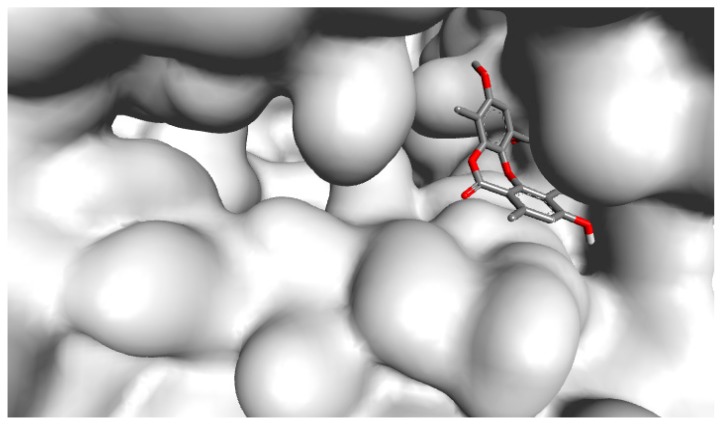
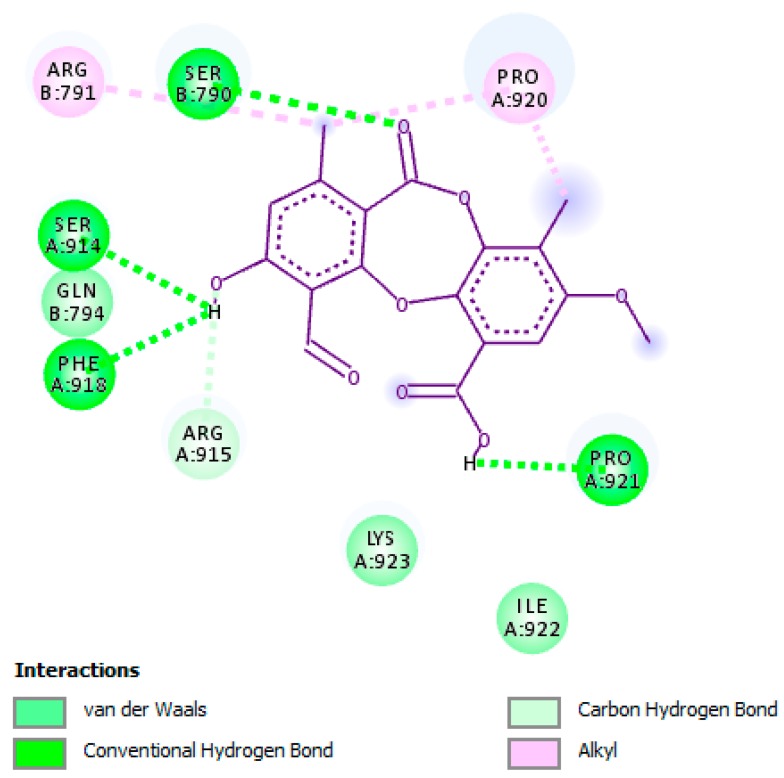
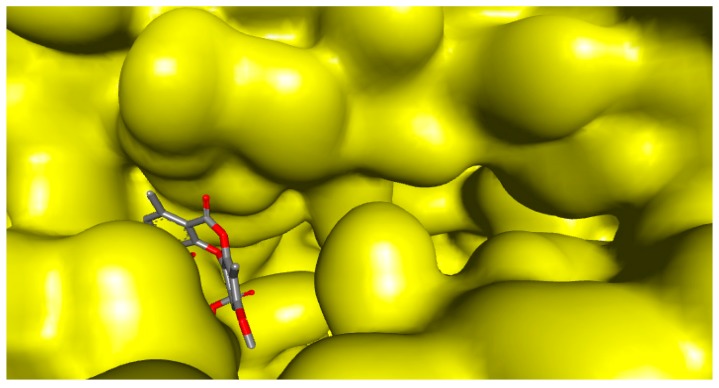
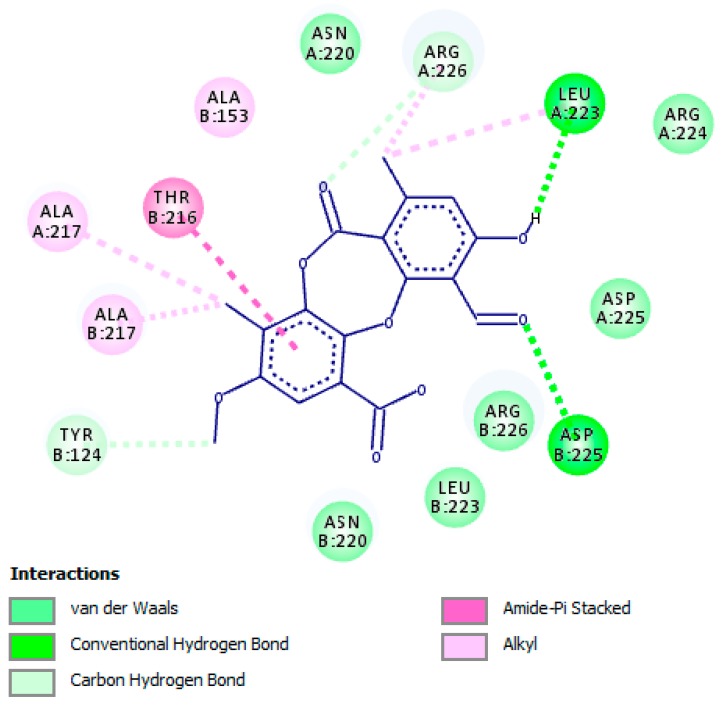
Psoromic acid (PA), a bioactive lichen-derived compound, was investigated for its inhibitory properties against herpes simplex virus type 1 (HSV-1) and type 2 (HSV-2), along with the inhibitory effect on HSV-1 DNA polymerase, which is a key enzyme that plays an essential role in HSV-1 replication cycle. PA was found to notably inhibit HSV-1 replication (50% inhibitory concentration (IC50): 1.9 μM; selectivity index (SI): 163.2) compared with the standard drug acyclovir (ACV) (IC50: 2.6 μM; SI: 119.2). The combination of PA with ACV has led to potent inhibitory activity against HSV-1 replication (IC50: 1.1 µM; SI: 281.8) compared with that of ACV. Moreover, PA displayed equivalent inhibitory action against HSV-2 replication (50% effective concentration (EC50): 2.7 μM; SI: 114.8) compared with that of ACV (EC50: 2.8 μM; SI: 110.7). The inhibition potency of PA in combination with ACV against HSV-2 replication was also detected (EC50: 1.8 µM; SI: 172.2). Further, PA was observed to effectively inhibit HSV-1 DNA polymerase (as a non-nucleoside inhibitor) with respect to dTTP incorporation in a competitive inhibition mode (half maximal inhibitory concentration (IC50): 0.7 μM; inhibition constant (Ki): 0.3 μM) compared with reference drugs aphidicolin (IC50: 0.8 μM; Ki: 0.4 μM) and ACV triphosphate (ACV-TP) (IC50: 0.9 μM; Ki: 0.5 μM). It is noteworthy that the mechanism by which PA-induced anti-HSV-1 activity was related to its inhibitory action against HSV-1 DNA polymerase. Furthermore, the outcomes of in vitro experiments were authenticated using molecular docking analyses, as the molecular interactions of PA with the active sites of HSV-1 DNA polymerase and HSV-2 protease (an essential enzyme required for HSV-2 replication) were revealed. Since this is a first report on the above-mentioned properties, we can conclude that PA might be a future drug for the treatment of HSV infections as well as a promising lead molecule for further anti-HSV drug design.
Overview
The claims and statistics of this paper haven’t been checked yet.
Free: it reads the open-access text and checks the first 5 claims that cite a source we can check. Create a free account to check every claim.
Integrity signals
Registry
Cites
Statistics
Figures
Verification
Claims the paper makes
The claims and statistics of this paper haven’t been checked yet.
Free: it reads the open-access text and checks the first 5 claims that cite a source we can check. Create a free account to check every claim.
Claims other papers make about this one
Each is checked against this paper’s own text: does it say what the citing paper says it does?
The source backs part of the claim, not all of it — or backs it for a different population, condition or comparison.
In the citing paper
“Recently, a promising drug called psoromic acid (a bioactive lichen-derived compound) has been found to inhibit the replication of both HSV-1 and HSV-2 by inhibiting proteases and DNA polymerases, which makes it a possible drug for treating meningitis caused by HSV [104].”
From Viral meningitis: an overview (2021) · cites this paper as [104]
Experimental — accuracy not yet measured
Self-check
Percentages, sums and reported differences re-computed from the paper’s own numbers.
The self-check needs the paper’s full text.
Citations
Cites
Yung-Chi, C., & Prusoff, W. H. (1973) · Biochemical Pharmacology · doi:10.1016/0006-2952(73)90196-2 · Cited by 12,922
Resistance of Herpes Simplex Viruses to Nucleoside Analogues: Mechanisms, Prevalence, and Management
Piret, J., & Boivin, G. (2011) · Antimicrobial Agents and Chemotherapy · doi:10.1128/aac.00615-10 · Cited by 558
(2014) · Handbook of Clinical Neurology · doi:10.1016/b978-0-444-53488-0.00011-0 · Cited by 474
Chromatin control of herpes simplex virus lytic and latent infection
Knipe, D. M., & Cliffe, A. (2008) · Nature Reviews Microbiology · doi:10.1038/nrmicro1794 · Cited by 444
Herpes simplex virus resistance to antiviral drugs
Morfin, F., & Thouvenot, D. (2003) · Journal of Clinical Virology · doi:10.1016/s1386-6532(02)00263-9 · Cited by 438
Styczynski, J., Reusser, P., Einsele, H., de la Camara, R., Cordonnier, C., Ward, K. N., Ljungman, P., Engelhard, D., & Leukemia, F. T. E. C. O. I. I. (2009) · Bone Marrow Transplantation · doi:10.1038/bmt.2008.386 · Cited by 380
Crystal Structure of the Herpes Simplex Virus 1 DNA Polymerase
Liu, S., Knafels, J. D., Chang, J. S., Waszak, G. A., Baldwin, E. T., Deibel, M. R., Thomsen, D. R., Homa, F. L., Wells, P. A., Tory, M. C., et al. (2006) · Journal of Biological Chemistry · doi:10.1074/jbc.m602414200 · Cited by 178
Inhibition of DNA Polymerase from Herpes Simplex Virus-Infected Wi-38 Cells by Phosphonoacetic Acid
Mao, J. C.-H., Robishaw, E. E., & Overby, L. R. (1975) · Journal of Virology · doi:10.1128/jvi.15.5.1281-1283.1975 · Cited by 174
Mohammadi Pour, P., Fakhri, S., Asgary, S., Farzaei, M. H., & Echeverría, J. (2019) · Frontiers in Pharmacology · doi:10.3389/fphar.2019.01207 · Cited by 168
Self-citationAntiherpesvirus drugs: a promising spectrum of new drugs and drug targets
Coen, D. M., & Schaffer, P. A. (2003) · Nature Reviews Drug Discovery · doi:10.1038/nrd1065 · Cited by 165
Vartia, K. O. (1973) · Elsevier eBooks · doi:10.1016/b978-0-12-044950-7.50022-2 · Cited by 160
Knopf, K.-W. (1979) · European Journal of Biochemistry · doi:10.1111/j.1432-1033.1979.tb13181.x · Cited by 157
Viral infectious disease and natural products with antiviral activity.
Kitazato, K., Wang, Y., & Kobayashi, N. (2007) · PubMed · Cited by 141
Bioactive natural products with anti-herpes simplex virus properties
Hassan, S. T. S., Masarčíková, R., & Berchová‐Bímová, K. (2015) · Journal of Pharmacy and Pharmacology · doi:10.1111/jphp.12436 · Cited by 134
Self-citationThe Herpesvirus Proteases as Targets for Antiviral Chemotherapy
Waxman, L., & Darke, P. L. (2000) · Antiviral chemistry & chemotherapy · doi:10.1177/095632020001100101 · Cited by 122
Reusser, P. (1996) · Journal of Hospital Infection · doi:10.1016/s0195-6701(96)90010-9 · Cited by 116
Cytotoxic Evaluation of Phenolic Compounds from Lichens against Melanoma Cells
Brandão, L. F. G., Alcantara, G. B., Matos, M. D. F. C., Bogo, D., Freitas, D. D. S., Oyama, N., & Honda, N. (2012) · Chemical and Pharmaceutical Bulletin · doi:10.1248/cpb.c12-00739 · Cited by 100
Behera, B. C., Mahadik, N. D., & Morey, M. V. (2012) · Pharmaceutical Biology · doi:10.3109/13880209.2012.654396 · Cited by 99
Viral Proteases: Evolution of Diverse Structural Motifs to Optimize Function
Babé, L. M., & Craik, C. S. (1997) · Cell · doi:10.1016/s0092-8674(00)80426-2 · Cited by 95
Sauerbrei, A., Bohn-Wippert, K., Kaspar, M., Krumbholz, A., Karrasch, M., & Zell, R. (2015) · Journal of Antimicrobial Chemotherapy · doi:10.1093/jac/dkv285 · Cited by 89
Brezáni, V., Leláková, V., Hassan, S. T. S., Berchová‐Bímová, K., Nový, P., Klouček, P., Maršík, P., Dall’Acqua, S., Hošek, J., & Šmejkal, K. (2018) · Viruses · doi:10.3390/v10070360 · Cited by 86
Self-citationNatural Products-Derived Chemicals: Breaking Barriers to Novel Anti-HSV Drug Development
Treml, J., Gazdová, M., Šmejkal, K., Šudomová, M., Kubatka, P., & Hassan, S. T. S. (2020) · Viruses · doi:10.3390/v12020154 · Cited by 86
Self-citationHerpesvirus DNA polymerases: Structures, functions and inhibitors
Zarrouk, K., Piret, J., & Boivin, G. (2017) · Virus Research · doi:10.1016/j.virusres.2017.01.019 · Cited by 84
Emsen, B., Aslan, A., Toğar, B., & Türkez, H. (2015) · Pharmaceutical Biology · doi:10.3109/13880209.2015.1126620 · Cited by 76
Zhang, J., Wang, S., Wang, K., & Zheng, C. (2013) · Medical Microbiology and Immunology · doi:10.1007/s00430-013-0295-0 · Cited by 74
Hoog, S. S., Smith, W. W., Qiu, X., Janson, C. A., Hellmig, B. D., McQueney, M. S., O’Donnell, K., O'Shannessy, D. J., DiLella, A. G., Debouck, C. M., et al. (1997) · Biochemistry · doi:10.1021/bi9712697 · Cited by 66
Knopf, K.-W., Kaufman, E. R., & Crumpacker, C. S. (1981) · Journal of Virology · doi:10.1128/jvi.39.3.746-757.1981 · Cited by 59
Non‐nucleoside inhibitors of herpesviruses
Wathen, M. W. (2002) · Reviews in Medical Virology · doi:10.1002/rmv.354 · Cited by 57
Deraeve, C., Guo, Z., Bon, R. S., Blankenfeldt, W., DiLucrezia, R., Wolf, A., Menninger, S., Stigter, E. A., Wetzel, S., Choidas, A., et al. (2012) · Journal of the American Chemical Society · doi:10.1021/ja211305j · Cited by 55
Hassan, S. T. S., Švajdlenka, E., & Berchová‐Bímová, K. (2017) · Molecules · doi:10.3390/molecules22050722 · Cited by 53
Self-citationCao, S., Gan, Y., Dong, X., & Lu, Z. (2014) · Archives of Gynecology and Obstetrics · doi:10.1007/s00404-014-3365-7 · Cited by 51
Latent Versus Productive Infection: the Alpha Herpesvirus Switch
Koyuncu, O. Ö., MacGibeny, M. A., & Enquist, L. W. (2018) · Future Virology · doi:10.2217/fvl-2018-0023 · Cited by 51
Schnute, M. E., Anderson, D. J., Brideau, R. J., Ciske, F. L., Collier, S. A., Cudahy, M. M., Eggen, M., Genin, M. J., Hopkins, T. A., Judge, T. M., et al. (2007) · Bioorganic & Medicinal Chemistry Letters · doi:10.1016/j.bmcl.2007.03.102 · Cited by 48
Hassan, S. T. S., Berchová‐Bímová, K., Petráš, J., & Hassan, K. T. S. (2016) · South African Journal of Botany · doi:10.1016/j.sajb.2016.10.001 · Cited by 45
Self-citationHassan, S. T. S., Berchová‐Bímová, K., Šudomová, M., Malaník, M., Šmejkal, K., & Rengasamy, K. R. R. (2018) · Journal of Clinical Medicine · doi:10.3390/jcm7090283 · Cited by 45
Self-citationHassan, S. T. S., & Švajdlenka, E. (2017) · Molecules · doi:10.3390/molecules22101696 · Cited by 44
Self-citationAkinyi, B., Odhiambo, C. O., Otieno, F., Inzaule, S. C., Oswago, S., Kerubo, E., Ndivo, R., & Zeh, C. E. (2017) · PLoS ONE · doi:10.1371/journal.pone.0178907 · Cited by 40
Sweidan, A., Chollet‐Krugler, M., Sauvager, A., van de Weghe, P., Chokr, A., Bonnaure‐Mallet, M., Tomasi, S., & Bousarghin, L. (2017) · Fitoterapia · doi:10.1016/j.fitote.2017.07.011 · Cited by 40
Development of New Antivirals for Herpesviruses
Eizuru, Y. (2003) · Antiviral chemistry & chemotherapy · doi:10.1177/095632020301400602 · Cited by 35
Inhibition of herpes simplex virus type 1 DNA polymerase by the natural product oosporein.
Terry, B., LIU, W.-C., Cianci, C., Proszynski, E., FERNANDES, P. B., Bush, K., & MEYERS, E. (1992) · The Journal of Antibiotics · doi:10.7164/antibiotics.45.286 · Cited by 32
Memish, Z. A., Almasri, M. M., Chentoufi, A. A., Al‐Tawfiq, J. A., Al-Shangiti, A. M., Al-Kabbani, K. M., Otaibi, B., Assiri, A., & Yezli, S. (2015) · Sexually Transmitted Diseases · doi:10.1097/olq.0000000000000336 · Cited by 30
Broad-spectrum non-nucleoside inhibitors of human herpesviruses
McClain, L. L., Zhi, Y., Cheng, H., Ghosh, A., Piazza, P. A., Yee, M. B., Kumar, S., Milošević, J., Bloom, D. C., Arav‐Boger, R., et al. (2015) · Antiviral Research · doi:10.1016/j.antiviral.2015.06.005 · Cited by 25
Correlation of increased nuclease activity with enhanced virus reactivation
Nishiyama, Y., Maeno, K., & Yoshida, S. (1982) · Experimental Cell Research · doi:10.1016/0014-4827(82)90205-1 · Cited by 24
Hassan, S. T. S. (2020) · Viruses · doi:10.3390/v12040476 · Cited by 24
Self-citationHassan, S. T. S. (2020) · Biomedicines · doi:10.3390/biomedicines8050132 · Cited by 21
Self-citationHassan, S. T. S., Šudomová, M., Berchová‐Bímová, K., Gowrishankar, S., & Rengasamy, K. R. R. (2018) · Journal of Clinical Medicine · doi:10.3390/jcm7080226 · Cited by 18
Self-citationPediatric herpes simplex virus infections: an evidence-based approach to treatment.
Sanders, J. E., & Garcia, S. E. (2014) · PubMed · Cited by 15
Herpes Simplex Virus: Beyond the Basics
Kobty, M. (2015) · Neonatal Network The Journal of Neonatal Nursing · doi:10.1891/0730-0832.34.5.279 · Cited by 13
Shibata, S. (1958) · Springer eBooks · doi:10.1007/978-3-662-26784-4_16 · Cited by 11
Herpes simplex virus type 1 DNA polymerase. Mechanism-based affinity chromatography.
Reardon, J. E. (1990) · Journal of Biological Chemistry · doi:10.1016/s0021-9258(19)39085-4 · Cited by 10
Challenges in the Care of Young Infants With Suspected Neonatal Herpes Simplex Virus
Miller, A. S., & Bennett, J. S. (2015) · Hospital Pediatrics · doi:10.1542/hpeds.2014-0095 · Cited by 10
Antigenotoxicity of Depsidones Isolated from Brazilian Lichens
Guterres, Z. D. R., Honda, N. K., Coelho, R. G., Alcantara, G. B., & Micheletti, A. C. (2017) · Orbital - The Electronic Journal of Chemistry · doi:10.17807/orbital.v9i1.897 · Cited by 10
Mello, J., Botelho, N., de Souza, A. M. T., Oliveira, R. D., de Brito, M. A., Abrahim-Vieira, B. D. A., Sodero, A. C. R., Castro, H. C., Cabral, L., Miceli, L. A., et al. (2015) · Molecules · doi:10.3390/molecules200610689 · Cited by 8
Lawler, J. L., & Coen, D. M. (2018) · Journal of General Virology · doi:10.1099/jgv.0.001138 · Cited by 8
Cited by
Mohammadi Pour, P., Fakhri, S., Asgary, S., Farzaei, M. H., & Echeverría, J. (2019) · Frontiers in Pharmacology · doi:10.3389/fphar.2019.01207 · Cited by 168
Self-citationKohil, A., Jemmieh, S., Smatti, M. K., & Yassine, H. M. (2021) · Archives of Virology · doi:10.1007/s00705-020-04891-1 · Cited by 164
Natural Products-Derived Chemicals: Breaking Barriers to Novel Anti-HSV Drug Development
Treml, J., Gazdová, M., Šmejkal, K., Šudomová, M., Kubatka, P., & Hassan, S. T. S. (2020) · Viruses · doi:10.3390/v12020154 · Cited by 86
“In another study, psoromic acid (45), a bioactive, lichen‐derived molecule, was tested for its inhibitory action against HSV‐1 and HSV‐2 [46].”
BackgroundSelf-citationLichen Depsidones with Biological Interest
Ureña-Vacas, I., González‐Burgos, E., Divakar, P. K., & Gómez-Serranillos, M. P. (2021) · Planta Medica · doi:10.1055/a-1482-6381 · Cited by 63
“Psoromic acid was also of interest as an antiviral agent, as it blocked HSV-1 and HSV-2 replication and DNA synthesis [116].”
BackgroundAntiviral Active Compounds Derived from Natural Sources against Herpes Simplex Viruses
van de Sand, L., Bormann, M., Schmitz, Y., Heilingloh, C. S., Witzke, O., & Krawczyk, A. (2021) · Viruses · doi:10.3390/v13071386 · Cited by 65
“Cytotoxicity was determined with a CC50 (50% cytotoxic concentration) of >310 μM [56].”
BackgroundMethod
Metadata
- Authors
- Hassan, S. T. S., Šudomová, M., Berchová-Bímová, K., Šmejkal, K., & Echeverría, J.
- Affiliations
- University of Veterinary Sciences Brno (CZ)
- Museum of Literature in Moravia, Klášter 1, 664 61 Rajhrad, Czech Republic
- Department of Applied Ecology, Faculty of Environmental Sciences, Czech University of Life Sciences Prague, Kamýcká 129, 165 21, Praha 6-Suchdol, Czech Republic
- Universidad de Santiago de Chile (CL)
- Corresponding author
- Hassan, Sherif T. S.
- Venue
- Molecules
- Publisher
- MDPI AG
- Published
- 2019-08-11
- Volume
- 24
- Issue
- 16
- Pages
- 2912
- ISSN
- 1420-3049 (ISSN-L)
- PMC
- PMC6720901
- OpenAlex
- W2968305480
- Cited by
- 41
- References
- 54
- Citations by year
- 2026: 2 · 2025: 8 · 2024: 4 · 2023: 7 · 2022: 8 · 2021: 7 · 2020: 3 · 2019: 2
- FWCI
- 3.81
- Type
- journal article
- Language
- en
- Open access
- gold
- dx.doi.org
- Licence
- Locations
- Molecules (publishedVersion, cc-by)
- PubMed Central (publishedVersion, cc-by)
- PubMed (publishedVersion)
- DOAJ (DOAJ: Directory of Open Access Journals) (submittedVersion, cc-by-sa)
- Funders
- Internal Grant Agency (IGA) of the Faculty of Environmental Sciences, Czech University of Life Sciences Prague, Czech Republic (20154247/2015)
- Topics
- Health Sciences › Medicine › Infectious Diseases › Herpesvirus Infections and Treatments
- Life Sciences › Agricultural and Biological Sciences › Ecology, Evolution, Behavior and Systematics › Lichen and fungal ecology
- Life Sciences › Agricultural and Biological Sciences › Plant Science › Natural Compound Pharmacology Studies
- Keywords
- psoromic acid, herpes simplex virus type 1, herpes simplex virus type 2, antiviral activity, non-nucleoside polymerase inhibitors, molecular docking, selective toxicity, antiherpetic agents, natural product drug discovery
- MeSH terms
- Animals, Antiviral Agents, Benzoxepins, Carboxylic Acids, Chlorocebus aethiops, DNA-Directed DNA Polymerase, Humans, Lichens, Vero Cells, Viral Proteins, Virus Replication, Herpesvirus 2, Human, Herpesvirus 1, Human, Nucleic Acid Synthesis Inhibitors, Molecular Docking Simulation
About these checks
Registry, retraction, Cites and statistics results are computed, not judged, with one exception: a printed reference that no index lists is read once by a model before it counts as a citation error. Claims are extracted by a model and kept only when their quote appears verbatim in the text; each cited source is then checked, with a model’s help, for whether it says what the claim relies on. Those verdicts can be wrong — read the claim’s quote and the cited source before relying on one.
Statistics and arithmetic are recomputed, not judged.
Confidence bands are shown only for fields calibrated on our annotated test set. None is calibrated yet, so no band is shown.
What counts as a claim ›How we measure confidence ›How we check this ›
Are you an author, or do you see a problem with this page? Request a review
Data sources
Bibliographic data: Semantic Scholar, OpenAlex, Crossref.
Contains information from the Semantic Scholar Academic Graph Datasets, made available under the ODC Attribution License (ODC-BY 1.0).
Semantic Scholar’s data is described in: Kinney, R., et al. (2023). The Semantic Scholar Open Data Platform. arXiv:2301.10140.
