

Design, Synthesis and Antifungal Evaluation of Novel Pyrylium Salt In Vitro and In Vivo
Open accessThe DOI matches its Crossref record; 18 of the 18 references it cites were found in a registry or an index.
Abstract
Nowadays, discovering new skeleton antifungal drugs is the direct way to address clinical fungal infections. Pyrylium salt SM21 was screened from a library containing 50,240 small molecules. Several studies about the antifungal activity and mechanism of SM21 have been reported, but the structure–activity relationship of pyrylium salts was not clear. To explore the chemical space of antifungal pyrylium salt SM21, a series of pyrylium salt derivatives were designed and synthesized. Their antifungal activity and structure-activity relationships (SAR) were investigated. Compared with SM21, most of the synthesized compounds exhibited equivalent or improved antifungal activities against Candida albicans in vitro. The synthesized compounds, such as XY10, XY13, XY14, XY16 and XY17 exhibited comparable antifungal activities against C. albicans with MIC values ranging from 0.47 to 1.0 μM. Fortunately, a compound numbered XY12 showed stronger antifungal activities and lower cytotoxicity was obtained. The MIC of compound XY12 against C. albicans was 0.24 μM, and the cytotoxicity decreased 20-fold as compared to SM21. In addition, XY12 was effective against fluconazole-resistant C. albicans and other pathogenic Candida species. More importantly, XY12 could significantly increase the survival rate of mice with a systemic C. albicans infection, which suggested the good antifungal activities of XY12 in vitro and in vivo. Our results indicated that structural modification of pyrylium salts could lead to the discovery of new antifungal drugs.
Overview
The claims and statistics of this paper haven’t been checked yet.
Free: it reads the open-access text and checks the first 5 claims that cite a source we can check. Create a free account to check every claim.
Integrity signals
Registry
Cites
Statistics
Figures
Verification
Claims the paper makes
The claims and statistics of this paper haven’t been checked yet.
Free: it reads the open-access text and checks the first 5 claims that cite a source we can check. Create a free account to check every claim.
Claims other papers make about this one
Each is checked against this paper’s own text: does it say what the citing paper says it does?
The source backs part of the claim, not all of it — or backs it for a different population, condition or comparison.
In the citing paper
“In our study, based on the structure of SM21, we obtained a new lipophilic pyrylium salt, xy12, which showed improved antifungal activity and reduced cytotoxicity both in vitro and in vivo (17).”
From Combined Transcriptome and Metabolome Analysis Reveals That the Potent Antifungal Pyrylium Salt Inhibits Mitochondrial Complex I in Candida albicans (2023) · cites this paper as [17]
Experimental — accuracy not yet measuredThe cited source says what the claim attributes to it.
In the citing paper
“Based on the modification of the pyrylium salt SM21, a new lead compound, xy12, was synthesized which was effective against Candida species both in vitro and in vivo.”
From Combined Transcriptome and Metabolome Analysis Reveals That the Potent Antifungal Pyrylium Salt Inhibits Mitochondrial Complex I in Candida albicans (2023) · cites this paper as [17]
Self-check
Percentages, sums and reported differences re-computed from the paper’s own numbers.
The self-check needs the paper’s full text.
Citations
Cites
Hidden Killers: Human Fungal Infections
Brown, G. D., Denning, D. W., Gow, N. A. R., Levitz, S. M., Netea, M. G., & White, T. C. (2012) · Science Translational Medicine · doi:10.1126/scitranslmed.3004404 · Cited by 4,284 · cited 1×
“6 million people each year and pose a serious threat to human health, especially among people with HIV infection, cancer, organ transplants and autoimmune diseases [2].”
BackgroundGlobal and Multi-National Prevalence of Fungal Diseases-Estimate Precision
Bongomin, F., Gago, S., Oladele, R., & Denning, D. (2017) · Journal of Fungi · doi:10.3390/jof3040057 · Cited by 2,953 · cited 1×
“Despite advances in antifungal therapy, invasive fungal infection remains the major cause of morbidity and death among immunocompromised patients [7].”
BackgroundKullberg, B. J., & Arendrup, M. C. (2015) · New England Journal of Medicine · doi:10.1056/nejmra1315399 · Cited by 1,315 · cited 1×
“In recent years, systemic Candida infection has risen to fourth place among the nosocomial blood-borne infections [3,4].”
BackgroundDrug resistance and tolerance in fungi.
Berman, J., & Krysan, D. J. (2020) · Nature Reviews Microbiology · doi:10.1038/s41579-019-0322-2 · Cited by 642 · cited 1×
“According to the statistics, the 90-day mortality rate of solid-organ transplant recipients with candidiasis is 22–44% [5].”
Background(2017) · Nature Microbiology · doi:10.1038/nmicrobiol.2017.120 · Cited by 185 · cited 1×
“Candida, Aspergillus and Cryptococcus are the main opportunistic pathogens leading to human fungal infections [1].”
BackgroundAntifungal Resistance: a Concerning Trend for the Present and Future
Hendrickson, J. A., Hu, C., Aitken, S. L., & Beyda, N. (2019) · Current Infectious Disease Reports · doi:10.1007/s11908-019-0702-9 · Cited by 139
In Vitro and In Vivo Activity of a Novel Antifungal Small Molecule against Candida Infections
Wong, S. S. W., Kao, R. Y. T., Yuen, K. Y., Wang, Y., Yang, D., Samaranayake, L. P., & Seneviratne, C. J. (2014) · PLoS ONE · doi:10.1371/journal.pone.0085836 · Cited by 107 · cited 2×
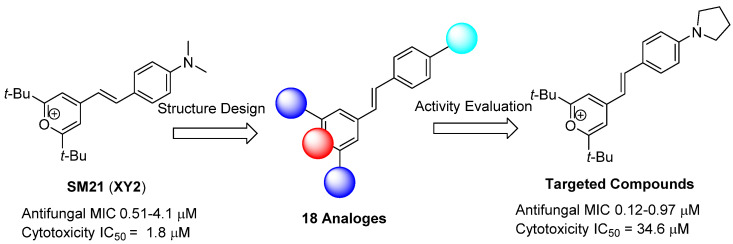
“Among them, lipophilic pyrylium salt SM21 (Figure 1 XY2 in this study) showed good antifu gal activities in vitro and in vivo [11].”
BackgroundSelf-citationChang, W., Liu, J., Zhang, M., Shi, H., Zheng, S., Jin, X., Gao, Y., Wang, S., Ji, A., & Lou, H. (2018) · Nature Communications · doi:10.1038/s41467-018-07633-9 · Cited by 91 · cited 2×
“This result further implied that this lipophilic pyrylium dye shows antifungal activity, probably via targeting mitochondria [12,13,16,17].”
BackgroundExploiting mitochondria as targets for the development of new antifungals
Li, D., & Calderone, R. (2017) · Virulence · doi:10.1080/21505594.2016.1188235 · Cited by 67 · cited 2×
“This result further implied that this lipophilic pyrylium dye shows antifungal activity, probably via targeting mitochondria [12,13,16,17].”
BackgroundLiu, W., Tan, J., Sun, J., Xu, Z., Li, M., Yang, Q., Shao, H., Zhang, L., Liu, W., Wan, Z., et al. (2014) · Journal of Antimicrobial Chemotherapy · doi:10.1093/jac/dkt330 · Cited by 65 · cited 1×
“albicans was significantly lower than that of patients infected with sensitive strains [10].”
BackgroundSelf-citationTolerability profile of the current antifungal armoury
Mourad, A., & Perfect, J. R. (2018) · Journal of Antimicrobial Chemotherapy · doi:10.1093/jac/dkx446 · Cited by 62
Sakagami, T., Kawano, T., Yamashita, K., Yamada, E., Fujino, N., Kaeriyama, M., Fukuda, Y., Nomura, N., Mitsuyama, J., Suematsu, H., et al. (2019) · Journal of Infection and Chemotherapy · doi:10.1016/j.jiac.2018.10.007 · Cited by 43 · cited 1×
“In recent years, systemic Candida infection has risen to fourth place among the nosocomial blood-borne infections [3,4].”
BackgroundLu, R.-Y., Ni, T., Wu, J., Yan, L., Lv, Q., Li, L., Zhang, D., & Jiang, Y. (2019) · Antimicrobial Agents and Chemotherapy · doi:10.1128/aac.01628-19 · Cited by 22 · cited 2×
“After incubation for 24 h, the supernatant was added with 10 µL of CCK-8 agents and cultured at 37 ◦C for 2 h. Finally, cell viability was assessed by measuring OD450 [18].”
MethodSelf-citationCOVID-19 and fungal infection: the need for a strategic approach
White, P. L., Dhillon, R., Hughes, H. C., Wise, M. P., & Backx, M. (2020) · The Lancet Microbe · doi:10.1016/s2666-5247(20)30127-0 · Cited by 19 · cited 1×
“Solving the problem of fungal infections is an important means to improve the recovery rate of patients with immunodeficiencies [6].”
BackgroundUse of Haploid Model of Candida albicans to Uncover Mechanism of Action of a Novel Antifungal Agent
Truong, T., Suriyanarayanan, T., Zeng, G., Le, T. D., Liu, L., Li, J., Tong, C., Wang, Y., & Seneviratne, C. J. (2018) · Frontiers in Cellular and Infection Microbiology · doi:10.3389/fcimb.2018.00164 · Cited by 16
Self-citationTruong, T., Zeng, G., Lim, T. K., Cao, T., Pang, L. M., Lee, Y. M., Lin, Q., Wang, Y., & Seneviratne, C. J. (2019) · PROTEOMICS · doi:10.1002/pmic.201900240 · Cited by 14 · cited 2×
“This result further implied that this lipophilic pyrylium dye shows antifungal activity, probably via targeting mitochondria [12,13,16,17].”
BackgroundSelf-citationBricks, J. L., Stanova, A. V., Ryabitskii, A. B., Yashchuk, V. M. N., & Kachkovsky, O. D. (2012) · Journal of Molecular Structure · doi:10.1016/j.molstruc.2012.08.034 · Cited by 6 · cited 6×
“Pyrylium salt is a kind of cationic dye [14], in which the terminal groups have a dramatic effect on their properties, such as the properties of electron transition and spectral properties.”
BackgroundMethodInfluentialProduct Class 1: Pyrylium Salts
(2003) · Thieme eBooks · doi:10.1055/sos-sd-014-00002 · Cited by 5 · cited 1×
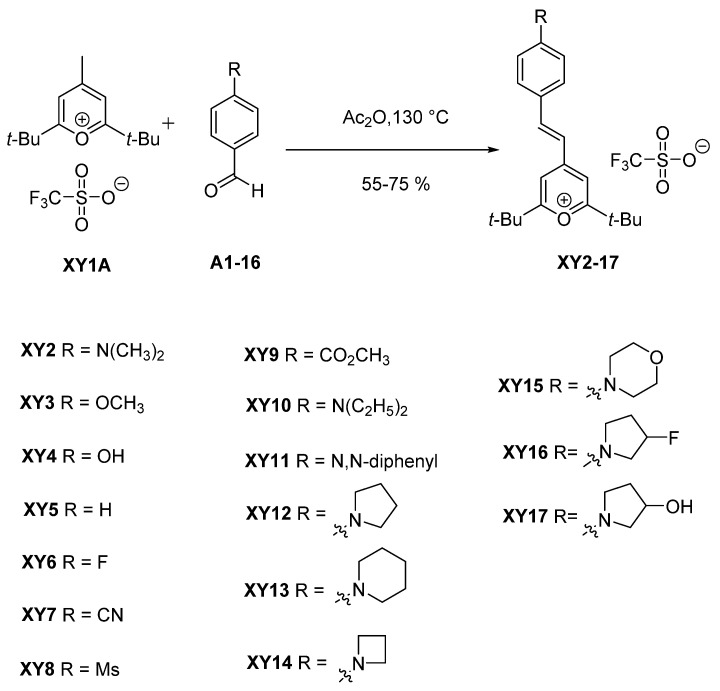
“Pyrylium salts were used as cationic dyes [14] and the methods to prepare these types of compounds were reported [15].”
Method
Cited by
Recent Advances in the Development of Antifungal Agents: Beyond Azoles, Polyenes, and Echinocandins
Saini, V., Safwan, S. M., Mehta, D., Das, E. E., & Bajaj, A. (2025) · ACS Infectious Diseases · doi:10.1021/acsinfecdis.4c00828 · Cited by 25
Lv, Q., Yan, L., Wang, J., Feng, J., Gao, L., Qiu, L., Chao, W., Qin, Y.-L., & Jiang, Y. (2023) · Microbiology Spectrum · doi:10.1128/spectrum.03209-22 · Cited by 12
“In our study, based on the structure of SM21, we obtained a new lipophilic pyrylium salt, xy12, which showed improved antifungal activity and reduced cytotoxicity both in vitro and in vivo (17).”
MethodSelf-citationDesign, Synthesis, and Biological Evaluation of N′-Phenylhydrazides as Potential Antifungal Agents
Zhu, P., Zheng, J., Yan, J., Li, Z., Li, X., & Geng, H. (2023) · International Journal of Molecular Sciences · doi:10.3390/ijms242015120 · Cited by 9
“Fungal infections in humans are mainly caused by Candida , Aspergillus , and Cryptococcus [2].”
Duan, Q., Yuan, M., Ma, X., Zheng, Y., Meng, R., Shi, W., Ni, Y., Zhao, C., Liu, Y., Yu, Z., et al. (2025) · European Journal of Medicinal Chemistry · doi:10.1016/j.ejmech.2025.117387 · Cited by 4
Use of Povidone Iodine Vaginal Swabbing in Treatment of Recurrent Vulvovaginal Candidiasis
Younis, S., Mahmoud, M., & Elshorbagy, A. (2023) · International Journal of Medical Arts · doi:10.21608/ijma.2023.219025.1713 · Cited by 3
“Advanced agents improve tolerability and widen the toxic therapeutic ratio [10, 11] .”
Background
Metadata
- Authors
- Zhang, Y., Li, Q., Chao, W., Qin, Y., Chen, J., Wang, Y., Liu, R., Lv, Q., & Wang, J.
- Affiliations
- Second Military Medical University (CN)
- Fudan University (CN)
- Corresponding author
- Liu, Runhui
- Lv, Quanzhen
- Wang, Jinxin
- Venue
- Molecules
- Publisher
- MDPI AG
- Published
- 2022-07-12
- Volume
- 27
- Issue
- 14
- Pages
- 4450
- ISSN
- 1420-3049 (ISSN-L)
- PMC
- PMC9315806
- OpenAlex
- W4285090619
- Cited by
- 7
- References
- 18
- Citations by year
- 2026: 1 · 2025: 2 · 2023: 4
- FWCI
- 0.73
- Type
- journal article
- Language
- en
- Open access
- gold
- doi.org
- Licence
- Locations
- Molecules (publishedVersion, cc-by)
- PubMed Central (publishedVersion, cc-by)
- PubMed (publishedVersion)
- DOAJ (DOAJ: Directory of Open Access Journals) (submittedVersion)
- Funders
- National Natural Science Foundation of China (82003624, 81902039, 20YF1458700)
- Science and Technology Commission of Shanghai Municipality (82003624, 81902039, 20YF1458700)
- Topics
- Health Sciences › Medicine › Infectious Diseases › Antifungal resistance and susceptibility
- Physical Sciences › Chemistry › Organic Chemistry › Synthesis and Characterization of Heterocyclic Compounds
- Physical Sciences › Chemistry › Organic Chemistry › Synthesis and Biological Evaluation
- Keywords
- pyrylium salts, antifungal agents, Candida albicans, structure-activity relationship, fluconazole resistance, cytotoxicity, systemic candidiasis, fungal infection, chemical space exploration
- MeSH terms
- Animals, Antifungal Agents, Candida, Candida albicans, Microbial Sensitivity Tests, Structure-Activity Relationship, Fluconazole, Mice
About these checks
Registry, retraction, Cites and statistics results are computed, not judged, with one exception: a printed reference that no index lists is read once by a model before it counts as a citation error. Claims are extracted by a model and kept only when their quote appears verbatim in the text; each cited source is then checked, with a model’s help, for whether it says what the claim relies on. Those verdicts can be wrong — read the claim’s quote and the cited source before relying on one.
Statistics and arithmetic are recomputed, not judged.
Confidence bands are shown only for fields calibrated on our annotated test set. None is calibrated yet, so no band is shown.
What counts as a claim ›How we measure confidence ›How we check this ›
Are you an author, or do you see a problem with this page? Request a review
Data sources
Bibliographic data: Semantic Scholar, OpenAlex, Crossref.
Contains information from the Semantic Scholar Academic Graph Datasets, made available under the ODC Attribution License (ODC-BY 1.0).
Semantic Scholar’s data is described in: Kinney, R., et al. (2023). The Semantic Scholar Open Data Platform. arXiv:2301.10140.
