

The DOI matches its Crossref record; 30 of the 30 references it cites were found in a registry or an index.
Natural Deep Eutectic Solvent-Based Microwave-Assisted Extraction of Total Flavonoid Compounds from Spent Sweet Potato (Ipomoea batatas L.) Leaves: Optimization and Antioxidant and Bacteriostatic Activity
Open accessAbstract
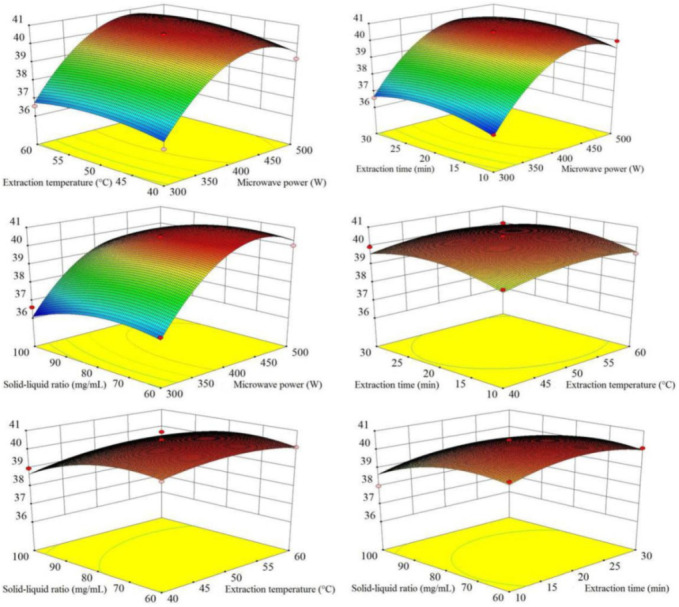
Natural deep eutectic solvents (NADESs) coupled with microwave-assisted extraction (MAE) were applied to extract total flavonoid compounds from spent sweet potato (Ipomoea batatas L.) leaves. In this study, ten different NADESs were successfully synthesized for the MAE. Based on single-factor experiments, the response surface methodology (RSM) was applied, and the microwave power, extraction temperature, extraction time, and solid–liquid ratio were further evaluated in order to optimize the yields of total flavonoid compounds. Besides, the extracts were recovered by macroporous resin for the biological activity detection of flavonoid compounds. As a result, NADES-2, synthesized by choline chloride and malic acid (molar ratio 1:2), exhibited the highest extraction yield. After that, the NADES-2-based MAE process was optimized and the optimal conditions were as follows: microwave power of 470 W, extraction temperature of 54 °C, extraction time of 21 min, and solid–liquid ratio of 70 mg/mL. The extraction yield (40.21 ± 0.23 mg rutin equivalents/g sweet potato leaves) of the model validation experiment was demonstrated to be in accordance with the predicted value (40.49 mg rutin equivalents/g sweet potato leaves). In addition, flavonoid compounds were efficiently recovered from NADES-extracts with a high recovery yield (>85%) using AB-8 macroporous resin. The bioactivity experiments in vitro confirmed that total flavonoid compounds had good DPPH and O2−· radical-scavenging activity, as well as inhibitory effects on E. coli, S. aureus, E. carotovora, and B. subtilis. In conclusion, this study provides a green and efficient method to extract flavonoid compounds from spent sweet potato leaves, providing technical support for the development and utilization of sweet potato leaves’ waste.
Overview
The claims and statistics of this paper haven’t been checked yet.
Free: it reads the open-access text and checks the first 5 claims that cite a source we can check. Create a free account to check every claim.
Integrity signals
Registry
Cites
Statistics
Figures




Verification
Claims the paper makes
The claims and statistics of this paper haven’t been checked yet.
Free: it reads the open-access text and checks the first 5 claims that cite a source we can check. Create a free account to check every claim.
Self-check
Percentages, sums and reported differences re-computed from the paper’s own numbers.
The self-check needs the paper’s full text.
Citations
Cites
Natural deep eutectic solvents as new potential media for green technology
Dai, Y., van Spronsen, J., Witkamp, G.-J., Verpoorte, R., & Choi, Y. H. (2013) · Analytica Chimica Acta · doi:10.1016/j.aca.2012.12.019 · Cited by 2,694 · cited 1×
“In addition, NADES has strong solubilization ability for both non-polar and polar compounds, causing high extraction efficiency for bioactive components [24,25].”
BackgroundChoi, Y. H., van Spronsen, J., Dai, Y., Verberne, M., Hollmann, F., Arends, I. W. C. E., Witkamp, G.-J., & Verpoorte, R. (2011) · Plant Physiology · doi:10.1104/pp.111.178426 · Cited by 1,368 · cited 1×
“In addition, NADES has strong solubilization ability for both non-polar and polar compounds, causing high extraction efficiency for bioactive components [24,25].”
BackgroundBasics and properties of deep eutectic solvents: a review
El Achkar, T., Greige-Gerges, H., & Fourmentin, S. (2021) · Environmental Chemistry Letters · doi:10.1007/s10311-021-01225-8 · Cited by 1,106 · cited 1×
“It has been reported that NADESs replace traditional solvents to extract phenolic secondary metabolites in safflower, total flavonoids in Sophora japonica flowers, alkaloids in Salvia miltiorrhiza, and polyphenols in seabuckthorn seed meal [15,23,26,27], but there is no report that NADES is used to extract flavonoid c…”
BackgroundHydrophobic deep eutectic solvents as water-immiscible extractants
van Osch, D. J. G. P., Zubeir, L. F., van den Bruinhorst, A., Rocha, M. A. A., & Kroon, M. C. (2015) · Green Chemistry · doi:10.1039/c5gc01451d · Cited by 987
Deep eutectic solvents for cathode recycling of Li-ion batteries
Tran, M. K., Rodrigues, M.-T. F., Kato, K., Babu, G., & Ajayan, P. M. (2019) · Nature Energy · doi:10.1038/s41560-019-0368-4 · Cited by 927 · cited 1×
“It has been reported that NADESs replace traditional solvents to extract phenolic secondary metabolites in safflower, total flavonoids in Sophora japonica flowers, alkaloids in Salvia miltiorrhiza, and polyphenols in seabuckthorn seed meal [15,23,26,27], but there is no report that NADES is used to extract flavonoid c…”
BackgroundNew horizons in the extraction of bioactive compounds using deep eutectic solvents: A review
Zainal-Abidin, M. H., Hayyan, M., Hayyan, A., & Jayakumar, N. S. (2017) · Analytica Chimica Acta · doi:10.1016/j.aca.2017.05.012 · Cited by 637 · cited 1×
“It has been reported that NADESs replace traditional solvents to extract phenolic secondary metabolites in safflower, total flavonoids in Sophora japonica flowers, alkaloids in Salvia miltiorrhiza, and polyphenols in seabuckthorn seed meal [15,23,26,27], but there is no report that NADES is used to extract flavonoid c…”
BackgroundGUAN, W., LI, S., YAN, R., TANG, S., & QUAN, C. (2007) · Food Chemistry · doi:10.1016/j.foodchem.2006.04.009 · Cited by 466
Dai, Y., Verpoorte, R., & Choi, Y. H. (2014) · Food Chemistry · doi:10.1016/j.foodchem.2014.02.155 · Cited by 416
Dai, Y., Rozema, E., Verpoorte, R., & Choi, Y. H. (2016) · Journal of Chromatography A · doi:10.1016/j.chroma.2016.01.037 · Cited by 416 · cited 1×
“It has been reported that NADESs replace traditional solvents to extract phenolic secondary metabolites in safflower, total flavonoids in Sophora japonica flowers, alkaloids in Salvia miltiorrhiza, and polyphenols in seabuckthorn seed meal [15,23,26,27], but there is no report that NADES is used to extract flavonoid c…”
BackgroundGolmakani, M.-T., & Rezaei, K. (2008) · Food Chemistry · doi:10.1016/j.foodchem.2007.12.084 · Cited by 365
Cited by
Wawoczny, A., & Gillner, D. (2023) · Journal of Agricultural and Food Chemistry · doi:10.1021/acs.jafc.3c01656 · Cited by 98
Current Challenges in the Sustainable Valorisation of Agri-Food Wastes: A Review
Berenguer, C. V., Andrade, C. F. P., Pereira, J. A. M., Perestrelo, R., & Câmara, J. S. (2022) · Processes · doi:10.3390/pr11010020 · Cited by 98
Research Progress on Extraction and Detection Technologies of Flavonoid Compounds in Foods
Li, W., Zhang, X., Wang, S., Gao, X., & Zhang, X. (2024) · Foods · doi:10.3390/foods13040628 · Cited by 87
Recent Advancements in Microwave-Assisted Extraction of Flavonoids: A Review
Wang, N., Zhu, H., Wang, M., Zhao, S., Sun, G., & Li, Z. (2024) · Food and Bioprocess Technology · doi:10.1007/s11947-024-03574-y · Cited by 69
“In addition, some studies have combined MAE with solvents such as ionic liquids (ILs) (Ahmad et al., 2020; Gu et al., 2016; Rahmi et al., 2020; Zuo et al., 2020), and deep eutectic solvents (DESs) (Du et al., 2023; Shang et al., 2024; Vo et al., 2024; Wang et al., 2019, 2023; Zhang et al., 2022).”
Self-citationAcosta-Vega, L., Cifuentes, A., Ibáñez, E., & Garcia, P. G. (2025) · Molecules · doi:10.3390/molecules30020284 · Cited by 50
“…and 0.751%, respec-Molecules tively) is attributed to the penetration capacity of NADES constituents, which can absorb higher microwave radiation than water and convert it into thermal energy, dissolving cell wall components and extracting soluble substances from the plant material [135–137].”
Influential
Metadata
- Authors
- Zhang, Y., Bian, S., Hu, J., Liu, G., Peng, S., Chen, H., Jiang, Z., Wang, T., Ye, Q., & Zhu, H.
- Affiliations
- Weihai Academy of Agricultural Sciences, Weihai 264200, China
- Anhui Academy of Agricultural Sciences (CN)
- Weihai Comprehensive Agricultural Law Enforcement Detachment, Weihai 264200, China
- Integrated Agricultural Service Center of Xujia Town, Rushan 264500, China
- Corresponding author
- Zhang, Yuqin
- Ye, Quan
- Zhu, Haibo
- Venue
- Molecules
- Publisher
- MDPI AG
- Published
- 2022-09-14
- Volume
- 27
- Issue
- 18
- Pages
- 5985
- ISSN
- 1420-3049 (ISSN-L)
- PMC
- PMC9501105
- OpenAlex
- W4295780112
- Cited by
- 39
- References
- 30
- Citations by year
- 2026: 9 · 2025: 14 · 2024: 8 · 2023: 6 · 2022: 2
- FWCI
- 3.91
- Type
- journal article
- Language
- en
- Open access
- gold
- doi.org
- Licence
- Locations
- Molecules (publishedVersion, cc-by)
- PubMed Central (publishedVersion, cc-by)
- PubMed (publishedVersion)
- DOAJ (DOAJ: Directory of Open Access Journals) (submittedVersion, cc-by-sa)
- Funders
- earmarked fund for CARS-10-Sweetpotato
- Topics
- Health Sciences › Medicine › Biochemistry (medical) › Phytochemicals and Antioxidant Activities
- Physical Sciences › Chemistry › Physical and Theoretical Chemistry › Ionic liquids properties and applications
- Life Sciences › Agricultural and Biological Sciences › Food Science › Agricultural and Biological Research
- Keywords
- natural deep eutectic solvents, microwave-assisted extraction, total flavonoid content, sweet potato leaves, Ipomoea batatas, extraction optimization, antioxidant activity, antibacterial activity, DPPH radical scavenging, superoxide radical scavenging
- MeSH terms
- Deep Eutectic Solvents, Antioxidants, Choline, Escherichia coli, Flavonoids, Microwaves, Plant Extracts, Rutin, Solvents, Staphylococcus aureus, Plant Leaves, Ipomoea batatas
About these checks
Registry, retraction, Cites and statistics results are computed, not judged, with one exception: a printed reference that no index lists is read once by a model before it counts as a citation error. Claims are extracted by a model and kept only when their quote appears verbatim in the text; each cited source is then checked, with a model’s help, for whether it says what the claim relies on. Those verdicts can be wrong — read the claim’s quote and the cited source before relying on one.
Statistics and arithmetic are recomputed, not judged.
Confidence bands are shown only for fields calibrated on our annotated test set. None is calibrated yet, so no band is shown.
What counts as a claim ›How we measure confidence ›How we check this ›
Are you an author, or do you see a problem with this page? Request a review
How to cite
Cite CoChat for the checks on this page, and the paper for its own findings.
- This page
- CoChat. (2026). Citation check: Natural Deep Eutectic Solvent-Based Microwave-Assisted Extraction of Total Flavonoid Compounds from Spent Sweet Potato (Ipomoea batatas L.) Leaves: Optimization and Antioxidant and Bacteriostatic Activity. https://app.cochat.ai/papers/10.3390/molecules27185985
- The paper
- Zhang, Y., Bian, S., Hu, J., Liu, G., Peng, S., Chen, H., Jiang, Z., Wang, T., Ye, Q., & Zhu, H. (2022). Natural Deep Eutectic Solvent-Based Microwave-Assisted Extraction of Total Flavonoid Compounds from Spent Sweet Potato (Ipomoea batatas L.) Leaves: Optimization and Antioxidant and Bacteriostatic Activity. Molecules. https://doi.org/10.3390/molecules27185985
Data sources
Bibliographic data: Semantic Scholar, OpenAlex, Crossref.
Contains information from the Semantic Scholar Academic Graph Datasets, made available under the ODC Attribution License (ODC-BY 1.0).
Semantic Scholar’s data is described in: Kinney, R., et al. (2023). The Semantic Scholar Open Data Platform. arXiv:2301.10140.
