

Optimization of Microalga Chlorella vulgaris Magnetic Harvesting
Open accessThe DOI matches its Crossref record; 54 of the 56 references it cites were found in a registry or an index.
Abstract
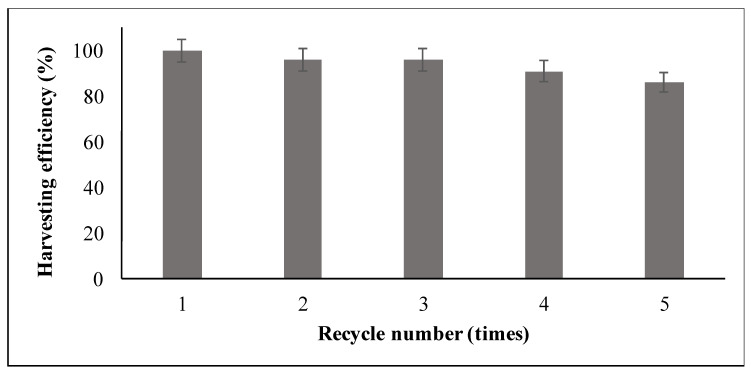
Harvesting of microalgae is a crucial step in microalgae-based mass production of different high value-added products. In the present work, magnetic harvesting of Chlorella vulgaris was investigated using microwave-synthesized naked magnetite (Fe3O4) particles with an average crystallite diameter of 20 nm. Optimization of the most important parameters of the magnetic harvesting process, namely pH, mass ratio (mr) of magnetite particles to biomass (g/g), and agitation speed (rpm) of the C. vulgaris biomass–Fe3O4 particles mixture, was performed using the response surface methodology (RSM) statistical tool. Harvesting efficiencies higher than 99% were obtained for pH 3.0 and mixing speed greater or equal to 350 rpm. Recovery of magnetic particles via detachment was shown to be feasible and the recovery particles could be reused at least five times with high harvesting efficiency. Consequently, the described harvesting approach of C. vulgaris cells leads to an efficient, simple, and quick process, that does not impair the quality of the harvested biomass.
Overview
The claims and statistics of this paper haven’t been checked yet.
Free: it reads the open-access text and checks the first 5 claims that cite a source we can check. Create a free account to check every claim.
Integrity signals
Registry
Cites
Statistics
Figures
Verification
Claims the paper makes
The claims and statistics of this paper haven’t been checked yet.
Free: it reads the open-access text and checks the first 5 claims that cite a source we can check. Create a free account to check every claim.
Claims other papers make about this one
Each is checked against this paper’s own text: does it say what the citing paper says it does?
The cited source says what the claim attributes to it.
In the citing paper
“Importantly, nanoparticles can be recovered after harvesting and subsequently re-used [56].”
From Key Targets for Improving Algal Biofuel Production (2021) · cites this paper as [56]
Self-check
Percentages, sums and reported differences re-computed from the paper’s own numbers.
The self-check needs the paper’s full text.
Citations
Cites
1 retracted
Taghizadeh, S.-M., Berenjian, A., Chew, K. W., Show, P. L., Zaid, H. F. M., Ramezani, H., Ghasemi, Y., Raee, M. J., & Ebrahiminezhad, A. (2020) · Bioengineered · doi:10.1080/21655979.2020.1718477 · Cited by 41 · cited 1×
“The magnetic particles can attach to the cells via electrostatic forces, hydrogen bonds, acid-base interactions or van der Waals forces, forming magnetic particle–cell bonding [23].”
BackgroundRetractedRecovery of microalgal biomass and metabolites: Process options and economics
Molina Grima, E., Belarbi, E.-H., Acién Fernández, F. G., Robles Medina, A., & Chisti, Y. (2003) · Biotechnology Advances · doi:10.1016/s0734-9750(02)00050-2 · Cited by 2,286
Khan, M. I., Shin, J. H., & Kim, J. D. (2018) · Microbial Cell Factories · doi:10.1186/s12934-018-0879-x · Cited by 2,082
Microalgae as a raw material for biofuels production
Gouveia, L., & Oliveira, A. C. (2009) · Journal of Industrial Microbiology & Biotechnology · doi:10.1007/s10295-008-0495-6 · Cited by 1,284 · cited 1×
“In comparison to terrestrial crop plants, microalgae can provide higher productivity and photosynthetic performance, and since they can be cultivated on infertile land, they do not compete with existing food production methods [5,6].”
BackgroundEnvironmental Life Cycle Comparison of Algae to Other Bioenergy Feedstocks
Clarens, A. F., Resurreccion, E. P., White, M. A., & Colosi, L. M. (2010) · Environmental Science & Technology · doi:10.1021/es902838n · Cited by 1,118 · cited 1×
“In comparison to terrestrial crop plants, microalgae can provide higher productivity and photosynthetic performance, and since they can be cultivated on infertile land, they do not compete with existing food production methods [5,6].”
BackgroundA review of the harvesting of micro-algae for biofuel production
Milledge, J. J., & Heaven, S. (2013) · Reviews in Environmental Science and Bio/Technology · doi:10.1007/s11157-012-9301-z · Cited by 678
Microalgal Carotenoids: A Review of Production, Current Markets, Regulations, and Future Direction
Novoveská, L., Ross, M. E., Stanley, M. S., Pradelles, R., Wasiolek, V., & Sassi, J.-F. (2019) · Marine Drugs · doi:10.3390/md17110640 · Cited by 462 · cited 1×
“Bioactive chemicals derived from natural sources present higher biological activity and acceptance by consumers compared to the synthetic alternatives [4].”
BackgroundMagnetic separations: From steel plants to biotechnology
Yavuz, C. T., Prakash, A., Mayo, J. T., & Colvin, V. L. (2009) · Chemical Engineering Science · doi:10.1016/j.ces.2008.11.018 · Cited by 343 · cited 1×
“[3,17,18] has gathered popularity throughout the past decade as a method for harvesting microalgal cells.”
MethodProtein purification using magnetic adsorbent particles
Franzreb, M., Siemann-Herzberg, M., Hobley, T. J., & Thomas, O. R. T. (2006) · Applied Microbiology and Biotechnology · doi:10.1007/s00253-006-0344-3 · Cited by 340 · cited 1×
“, their biocompatibility, reusability, and ease of use, as well as the optimization of the parameters affecting the harvesting efficiency [30].”
BackgroundHarvesting Chlorella minutissima using cell coagulants
Papazi, A., Makridis, P., & Divanach, P. (2010) · Journal of Applied Phycology · doi:10.1007/s10811-009-9465-2 · Cited by 301 · cited 1×
“The reduced lipid levels regarding flocculation, as well as clogging and fouling in filtration, are also considerable disadvantages [12,13].”
Background
Research works printed but not linked: 1
- Rani K. Sandal N. Sahoo P.K. A comprehensive review on chlorella-its composition, health benefits, market and regulatory scenario J. Pharm. Innov. 2018 7 584 589
Cited by
Mass cultivation and harvesting of microalgal biomass: Current trends and future perspectives
Udayan, A., Sirohi, R., Sreekumar, N., Sang, B.-I., & Sim, S. J. (2022) · Bioresource Technology · doi:10.1016/j.biortech.2021.126406 · Cited by 159
A Review of the Harvesting Techniques of Microalgae
Deepa, P., Sowndhararajan, K., & Kim, S. (2023) · Water · doi:10.3390/w15173074 · Cited by 106
“After the treatment, recovered particles could be recycled a minimum of five times without affecting their harvesting effectiveness [114].”
BackgroundMicrobial carotenoid production and their potential applications as antioxidants: A current update
Joshi, K., Kumar, P., & Kataria, R. (2023) · Process Biochemistry · doi:10.1016/j.procbio.2023.02.020 · Cited by 86
New insights into Chlorella vulgaris applications
Al-Hammadi, M. S., & Güngörmüşler, M. (2024) · Biotechnology and Bioengineering · doi:10.1002/bit.28666 · Cited by 79
“However, the detachment process involves chloroform addition (Savvidou et al., 2021), which should be replaced or avoided.”
BackgroundPatel, A. K., Kumar, P., Chen, C., Tambat, V. S., Nguyen, T.-B., Hou, C., Chang, J., Dong, C., & Singhania, R. R. (2022) · Bioresource Technology · doi:10.1016/j.biortech.2022.128009 · Cited by 67
Utilization of nanomaterials in accelerating the production process of sustainable biofuels
Ahmed, S. F., Debnath, J. C., Mehejabin, F., Islam, N., Tripura, R., Mofijur, M., Hoang, A. T., Rasul, M. G., & Vo, D. N. (2022) · Sustainable Energy Technologies and Assessments · doi:10.1016/j.seta.2022.102894 · Cited by 71
Barriers to microalgal mass cultivation
Lane, T. W. (2022) · Current Opinion in Biotechnology · doi:10.1016/j.copbio.2021.09.013 · Cited by 57
Key Targets for Improving Algal Biofuel Production
Griffiths, G., Hossain, A. K., Sharma, V., & Duraisamy, G. (2021) · Clean Technologies · doi:10.3390/cleantechnol3040043 · Cited by 49
Gerulová, K., Kucmanová, A., Sanny, Z., Garaiová, Z., Seiler, E., Čaplovičová, M., Čaplovič, Ľ., & Palcut, M. (2022) · Nanomaterials · doi:10.3390/nano12111786 · Cited by 40
“[86] suggested that Fe3O4 particles can be attached to microalgal cells by hydrogen bonding.”
BackgroundResultInfluentialBio-Nanoparticles Mediated Transesterification of Algal Biomass for Biodiesel Production
Verma, M. L., Dhanya, B. S., Wang, B., Thakur, M., Rani, V., & Kushwaha, R. (2023) · Sustainability · doi:10.3390/su16010295 · Cited by 44
Kumar, P., Patel, A. K., Chen, C., Nguyen, T.-B., Chang, J., Pandey, A., Dong, C., & Singhania, R. R. (2023) · Environmental Technology & Innovation · doi:10.1016/j.eti.2023.103008 · Cited by 26
Kumar, P., Patel, A. K., Singhania, R. R., Chen, C., Bhatia, S. K., & Dong, C. (2023) · Chemical Engineering Journal · doi:10.1016/j.cej.2023.148117 · Cited by 25
Mountourakis, F., Papazi, A., Maragkoudakis, A., Stamatis, N., & Kotzabasis, K. (2023) · Environmental and Experimental Botany · doi:10.1016/j.envexpbot.2023.105543 · Cited by 26
Rajpoot, A. S., Shende, V., Chelladurai, H. M., Dwivedi, G., Verma, T. N., & Choudhary, T. (2025) · Environment Development and Sustainability · doi:10.1007/s10668-025-05984-0 · Cited by 38
Adsorptive recovery of arsenic (III) ions from aqueous solutions using dried Chlamydomonas sp.
Mohamed, M. S., Hozayen, W. G., Alharbi, R. M., & Ibraheem, I. (2022) · Heliyon · doi:10.1016/j.heliyon.2022.e12398 · Cited by 25
“Collectedmeasured information of ZP on the steadiness and charge behavior through detecting the potential of the shear plane of substance particle occurs when it moves in liquid (Savvidou et al., 2021).”
BackgroundPahariya, R., Chauhan, A. P. S., Ranjan, A., Basniwal, R. K., Upadhyay, S., Thakur, S. K., & Jindal, T. (2023) · BioEnergy Research · doi:10.1007/s12155-023-10672-w · Cited by 30
“It has been demonstrated that recovering magnetic particles through detachment is possible and that recovering particles can be utilized at least five further times with high harvesting effectiveness [90].”
Savvidou, M. G., Georgiopoulou, I., Antoniou, N., Tzima, S., Kontou, M., Louli, V., Fatouros, C., Magoulas, K., & Kolisis, F. N. (2023) · Plants · doi:10.3390/plants12020361 · Cited by 20
“The synthesis of these products can be metabolically regulated via micro- macro- nutrients [3,4] and can be enhanced via magnetic immobilization [5–7] while their extraction has recently been improved by magnetic harvesting techniques [8,9].”
BackgroundSelf-citationRana, M. S., & Prajapati, S. K. (2022) · Journal of environmental chemical engineering · doi:10.1016/j.jece.2022.109145 · Cited by 23
Konwar, G., Banik, R., & Geed, S. R. (2025) · Chemical Engineering Journal · doi:10.1016/j.cej.2025.163456 · Cited by 19
Kumar, P., Singhania, R. R., Patel, A. K., Bhatia, S. K., Chen, C., & Dong, C. (2024) · Journal of environmental chemical engineering · doi:10.1016/j.jece.2024.114337 · Cited by 14
Eregie, S. B., Sanusi, I. A., Kana, G. E. B., & Olaniran, A. O. (2023) · Biodegradation · doi:10.1007/s10532-023-10029-2 · Cited by 16
“The cell dry weight was then determined using a standard calibration curve, a correlation dependence of biomass dry weight as a function of optical density (Savvidou et al. 2021).”
Savvidou, M. G., Tsiaka, T., Zoumpoulakis, P. G., Maggiorou, E., Tyrovolas, K., Molino, A., Hristoforou, E. V., & Ferraro, A. (2022) · Magnetochemistry · doi:10.3390/magnetochemistry8080080 · Cited by 10
Self-citationInnovative and high efficiency harvesting process of Chlorella vulgaris by magnetic harvesting
Silva, P. M., Gonçalves, P., Castelo-Grande, T., Augusto, P. A., Barbosa, D., & Simões, M. V. (2025) · Environmental Research · doi:10.1016/j.envres.2025.122249 · Cited by 11
Jijingi, H. E., Yazdi, S. K., Abakr, Y. A., & Satya, A. D. M. (2025) · Cleaner Water · doi:10.1016/j.clwat.2025.100094 · Cited by 9
Jijingi, H. E., Yazdi, S. K., Abakr, Y. A., & Satya, A. D. M. (2025) · Case Studies in Chemical and Environmental Engineering · doi:10.1016/j.cscee.2025.101274 · Cited by 11
Eregie, S. B., Sanusi, I. A., Kana, G. E. B., & Ademola, O. O. (2023) · Bioresource Technology Reports · doi:10.1016/j.biteb.2023.101627 · Cited by 11
Liu, W., Zhou, W., Song, S., Zhao, Y., & Lu, Y. (2023) · Nanomaterials · doi:10.3390/nano13061111 · Cited by 8
“The particle size of Fe3O4 prepared by Aivazoglou [41] was 9 nm.”
MethodBošnjaković, M., Sánta, R., Vučić, A., & Crnac, Z. (2025) · Clean Technologies · doi:10.3390/cleantechnol7030069 · Cited by 8
“Magnetic separation employing magnetite nanoparticles (Fe 3 O 4 ) enables rapid biomass separation, with a 95% utilisation rate [24].”
Xie, F., Zhou, J., Sun, S., Li, H., Xu, C., Liu, H., Yang, Z., Liu, B., Zhang, H., & Li, S. (2025) · Journal of environmental chemical engineering · doi:10.1016/j.jece.2025.118096 · Cited by 8
Microalgae aggregation induced by thermoresponsive polymers
Wang, X., Mafukidze, D. M., & Zheng, Y. (2024) · Bioresource Technology · doi:10.1016/j.biortech.2024.131650 · Cited by 6
Zhao, Y., Wu, X., Chang, W., Che, W., Liu, Y. C., & Li, Y. (2023) · Journal of environmental chemical engineering · doi:10.1016/j.jece.2023.110170 · Cited by 5
Chen, X., Chen, J., Ma, M., Yu, S., Liu, Z., & Zeng, X. (2023) · Nanomaterials · doi:10.3390/nano13131992 · Cited by 5
“The magnetization saturation value of the Fe3O4@ZnS (33 emu/g) was lower than that of the Fe3O4 nanoparticles (63 emu/g) because the introduction of the ZnS enhanced the weight of the nanoparticles [44,45].”
BackgroundMagnetic flocculation of microalgae using magnetite nanoparticles: Progress and challenges
Amo‐Duodu, G., Ennaceri, H., Bahri, P. A., & Moheimani, N. R. (2025) · Algal Research · doi:10.1016/j.algal.2025.104340 · Cited by 5
Zheng, Y., Liu, X., Du, M., Qi, L., Li, Y., Zhou, X., & Wang, D. (2024) · ACS ES&T Water · doi:10.1021/acsestwater.4c00816 · Cited by 5
Magnetite nanoparticles for microalgal biomass dewatering: A study on Chlorella sp.
Amo‐Duodu, G., Ennaceri, H., Bahri, P. A., & Moheimani, N. R. (2025) · Algal Research · doi:10.1016/j.algal.2025.104431 · Cited by 3
Deivayanai, V. C., Saravanan, A., Ragini, Y. P., & Vickram, A. (2026) · Sustainable Chemistry One World · doi:10.1016/j.scowo.2026.100192 · Cited by 3
Fe3O4-based nano-fertilizers for simultaneous nutrient supply and remediation of contaminated soils
Amo‐Duodu, G., Gani, O., Lithi, U. J., Vadiveloo, A., Mobarakpour, S., Tetteh, E. K., Bahri, P. A., Moheimani, N. R., & Ennaceri, H. (2026) · Journal of Environmental Management · doi:10.1016/j.jenvman.2026.130148 · Cited by 3
Rocha, M. F., Magalhães‐Ghiotto, G. A. V., Wernke, G., Ribeiro, A. C., Bergamasco, R., & Gomes, R. G. (2024) · Environmental Nanotechnology Monitoring & Management · doi:10.1016/j.enmm.2024.100981 · Cited by 3
Al-Hammadi, M. S., & Güngörmüşler, M. (2025) · European Journal of Phycology · doi:10.1080/09670262.2025.2484457 · Cited by 3
Kumar, P., Singhania, R. R., Kedves, A., Kónya, Z., & Patel, A. K. (2026) · Environmental Technology & Innovation · doi:10.1016/j.eti.2026.104813 · Cited by 2
Teh, H. Y., Lam, M. K., & Khoo, K. S. (2026) · Separation and Purification Technology · doi:10.1016/j.seppur.2026.137906 · Cited by 2
Díaz‐Quiroz, C., Márquez‐Reyes, J. M., Heya, M. N., Elizondo‐Luévano, J. H., Romero-Soto, I. C., Verdugo-Fuentes, A. A., Díaz-Tenorio, L. M., Nápoles-Armenta, J., Samaniego-Moreno, L., Orozco, C. D. L. M., et al. (2025) · Sustainability · doi:10.3390/su17198679 · Cited by 3
Rapid Treatment of Urban Initial Rainwater Runoff by A/O–Magnetic Flocculation Combined Process
Yan, S., Lv, M., Fang, Y., Li, J., Xu, H., Li, G., Huang, L., Li, Y., & Song, G. (2024) · Water · doi:10.3390/w16233392 · Cited by 1
“A specified quantity of PAC, PAM, and Fe 3 O 4 was then added, and the contents were stirred rapidly at 350 r/min for 2 min to ensure thorough mixing and adsorption of the agents with the colloidal particles in the wastewater [22].”
Karthikeyan, C. S., Ng, F.-L., Sutharsun, S., Syed, A., Bahkali, A. H., Poures, M. V. D., Periasamy, V., Xia, Y., kumar, G. G., & Phang, S. (2025) · ACS Applied Nano Materials · doi:10.1021/acsanm.5c01879 · Cited by 2
Improving microalgae harvesting efficiency: electrochemical techniques and parameter optimization
Yakamercan, E., Guleria, S., Karimi, M., Aygün, A., Bhasin, A., & Şimşek, H. (2025) · Environmental Science Water Research & Technology · doi:10.1039/d5ew00518c · Cited by 7
“17,18 In addition, Savvidou et al. (2021) used microwave-synthesized magnetite to optimize the magnetic harvesting of C. vulgaris .”
Exopolysaccharides as novel cryoprotectants released by Antarctic Chlamydomonas sp. ASYA25
Karsavran, K., Görünmek, M., Çakmak, Z. E., & Çakmak, T. (2025) · International Journal of Biological Macromolecules · doi:10.1016/j.ijbiomac.2025.146454 · Cited by 2
Special Issue “Nanomaterials for Biomedical and Biotechnological Applications”
Ferraro, A. (2022) · Nanomaterials · doi:10.3390/nano12111923 · Cited by 1
“[13] illustrate in their work a biotechnological application of iron oxide nanoparticles.”
BackgroundOptimization of Carbon Capture Rates of Chlorella Vulgaris Using Experimental Testing
Garodia, H., Jain, R., & Kini, S. (2025) · Studies in systems, decision and control · doi:10.1007/978-3-031-84628-1_19
Singh, P., & Singh, R. P. (2025) · Elsevier eBooks · doi:10.1016/b978-0-443-31526-8.00014-5
Çakmak, Z. E. (2026) · Journal of Applied Phycology · doi:10.1007/s10811-026-03787-y
Sreenikethanam, A., Raj, S., Mohan, K., Gobi, M., Sakate, D., Banu, J. R., Jaswal, A. S., Kumar, S., & Bajhaiya, A. K. (2026) · SSRN Electronic Journal · doi:10.2139/ssrn.6249644
Corrêa, P. S., de Moraes, A. P. J., Scheliga, C. G., & Teixeira, C. M. L. L. (2026) · Elsevier eBooks · doi:10.1016/b978-0-443-34082-6.00024-6
Aguilar, L. J. E., Gaona, I. M. S., Vargas, C. A. P., Amaya, J., Vargas, J. E., & Pérez, D. L. (2026) · Condensed Matter · doi:10.3390/condmat11020013
Zamri, N., Yasin, N. H. M., Hamid, A. A., & Nazir, Y. (2026) · Journal of Applied Phycology · doi:10.1007/s10811-026-03990-x
Metadata
- Authors
- Savvidou, M. G., Dardavila, M. M., Georgiopoulou, I., Louli, V., Stamatis, H., Kekos, D., & Voutsas, E.
- Affiliations
- National Technical University of Athens (GR)
- University of Ioannina (GR)
- Corresponding author
- Dardavila, Maria Myrto
- ORCID
- Venue
- Nanomaterials
- Publisher
- MDPI AG
- Published
- 2021-06-20
- Volume
- 11
- Issue
- 6
- Pages
- 1614
- ISSN
- 2079-4991 (ISSN-L)
- PMC
- PMC8234446
- OpenAlex
- W3176123612
- Semantic Scholar
- 0f42d761c07bea95bc94359f34cafd2643f1ab32
- Cited by
- 54
- References
- 56
- Citations by year
- 2026: 9 · 2025: 16 · 2024: 6 · 2023: 13 · 2022: 7 · 2021: 3
- FWCI
- 1.36
- Type
- journal article
- Language
- en
- Open access
- gold
- doi.org
- Licence
- Locations
- Nanomaterials (publishedVersion, cc-by)
- PubMed Central (publishedVersion, cc-by)
- PubMed (publishedVersion)
- DOAJ (DOAJ: Directory of Open Access Journals) (submittedVersion, cc-by-sa)
- Funders
- European Union and Greek national funds through the Operational Program Competitiveness, Entrepreneurship and Innovation, under the call, "Special Actions, Aquaculture-Industrial Materials-Open Innovation in Culture” (T6YBP-00033)
- Topics
- Physical Sciences › Energy › Renewable Energy, Sustainability and the Environment › Algal biology and biofuel production
- Physical Sciences › Environmental Science › Water Science and Technology › Coagulation and Flocculation Studies
- Physical Sciences › Physics and Astronomy › Condensed Matter Physics › Micro and Nano Robotics
- Keywords
- Chlorella vulgaris, Fe3O4 nanoparticles, magnetite, microwave-assisted synthesis, harvesting efficiency, pH optimization, stirring speed, microalgal biomass
About these checks
Registry, retraction, Cites and statistics results are computed, not judged, with one exception: a printed reference that no index lists is read once by a model before it counts as a citation error. Claims are extracted by a model and kept only when their quote appears verbatim in the text; each cited source is then checked, with a model’s help, for whether it says what the claim relies on. Those verdicts can be wrong — read the claim’s quote and the cited source before relying on one.
Statistics and arithmetic are recomputed, not judged.
Confidence bands are shown only for fields calibrated on our annotated test set. None is calibrated yet, so no band is shown.
What counts as a claim ›How we measure confidence ›How we check this ›
Are you an author, or do you see a problem with this page? Request a review
Data sources
Bibliographic data: Semantic Scholar, OpenAlex, Crossref.
Contains information from the Semantic Scholar Academic Graph Datasets, made available under the ODC Attribution License (ODC-BY 1.0).
Semantic Scholar’s data is described in: Kinney, R., et al. (2023). The Semantic Scholar Open Data Platform. arXiv:2301.10140.
