

The DOI matches its Crossref record; 249 of the 251 references it cites were found in a registry or an index.
The Emerging Role of Non-Coding RNAs (ncRNAs) in Plant Growth, Development, and Stress Response Signaling
Open accessAbstract
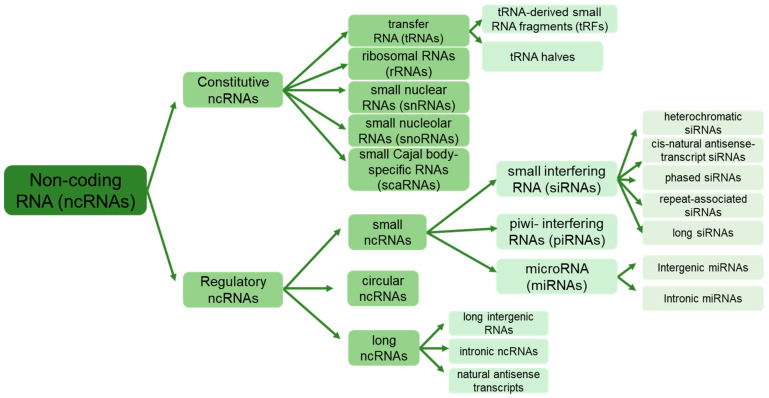
Plant species utilize a variety of regulatory mechanisms to ensure sustainable productivity. Within this intricate framework, numerous non-coding RNAs (ncRNAs) play a crucial regulatory role in plant biology, surpassing the essential functions of RNA molecules as messengers, ribosomal, and transfer RNAs. ncRNAs represent an emerging class of regulators, operating directly in the form of small interfering RNAs (siRNAs), microRNAs (miRNAs), long noncoding RNAs (lncRNAs), and circular RNAs (circRNAs). These ncRNAs exert control at various levels, including transcription, post-transcription, translation, and epigenetic. Furthermore, they interact with each other, contributing to a variety of biological processes and mechanisms associated with stress resilience. This review primarily concentrates on the recent advancements in plant ncRNAs, delineating their functions in growth and development across various organs such as root, leaf, seed/endosperm, and seed nutrient development. Additionally, this review broadens its scope by examining the role of ncRNAs in response to environmental stresses such as drought, salt, flood, heat, and cold in plants. This compilation offers updated information and insights to guide the characterization of the potential functions of ncRNAs in plant growth, development, and stress resilience in future research.
Overview
The claims and statistics of this paper haven’t been checked yet.
Run the check — free, no account needed. It reads the open-access text and checks the sources it cites.
Integrity signals
Registry
Cites
Statistics
Figures
Verification
Claims the paper makes
The claims and statistics of this paper haven’t been checked yet.
Run the check — free, no account needed. It reads the open-access text and checks the sources it cites.
Claims other papers make about this one
Each is checked against this paper’s own text: does it say what the citing paper says it does?
The cited source says what the claim attributes to it.
In the citing paper
“Non-coding RNAs (ncRNAs) are vital for regulating gene expression and stress responses, contributing to sustainable yields under climate change (Yadav et al., 2024).”
From Emerging applications of gene editing technologies for the development of climate-resilient crops (2025) · cites this paper as Yadav et al., 2024
Self-check
Percentages, sums and reported differences re-computed from the paper’s own numbers.
The self-check needs the paper’s full text.
Citations
Cites
Origins and Mechanisms of miRNAs and siRNAs
Carthew, R. W., & Sontheimer, E. J. (2009) · Cell · doi:10.1016/j.cell.2009.01.035 · Cited by 5,161
circRNA biogenesis competes with pre-mRNA splicing
Ashwal-Fluss, R., Meyer, M., Pamudurti, N. R., Ivanov, A., Bartok, O., Hanan, M., Evantal, N., Memczak, S., Rajewsky, N., & Kadener, S. (2014) · Molecular Cell · doi:10.1016/j.molcel.2014.08.019 · Cited by 3,083
Long non-coding RNAs: definitions, functions, challenges and recommendations
Mattick, J. S., Amaral, P., Carninci, P., Carpenter, S. B., Chang, H. Y., Chen, L., Chen, R., Dean, C., Dinger, M. E., Fitzgerald, K. A., et al. (2023) · Nature Reviews Molecular Cell Biology · doi:10.1038/s41580-022-00566-8 · Cited by 2,509
Origin, Biogenesis, and Activity of Plant MicroRNAs
Voinnet, O. (2009) · Cell · doi:10.1016/j.cell.2009.01.046 · Cited by 2,251
Control of leaf morphogenesis by microRNAs
Palatnik, J. F., Allen, E. M., Wu, X., Schommer, C., Schwab, R., Carrington, J. C., & Weigel, D. (2003) · Nature · doi:10.1038/nature01958 · Cited by 1,857
Past, present, and future of circRNAs
Patop, I. L., Wüst, S., & Kadener, S. (2019) · The EMBO Journal · doi:10.15252/embj.2018100836 · Cited by 1,237
Vernalization-Mediated Epigenetic Silencing by a Long Intronic Noncoding RNA
Heo, J. B., & Sung, S. (2010) · Science · doi:10.1126/science.1197349 · Cited by 1,230
Radial Patterning of Arabidopsis Shoots by Class III HD-ZIP and KANADI Genes
Emery, J. F., Floyd, S. K., Alvarez, J., Eshed, Y., Hawker, N. P., Izhaki, A., Baum, S. F., & Bowman, J. L. (2003) · Current Biology · doi:10.1016/j.cub.2003.09.035 · Cited by 1,143
Borsani, O., Zhu, J., Verslues, P. E., Sunkar, R., & Zhu, J. (2005) · Cell · doi:10.1016/j.cell.2005.11.035 · Cited by 1,125
Getting to the Root of miRNA-Mediated Gene Silencing
Eulálio, A., Huntzinger, E., & Izaurralde, E. (2008) · Cell · doi:10.1016/j.cell.2007.12.024 · Cited by 1,071
Research works printed but not linked: 1
- Upadhyay, S.K. (2021). Genome Engineering for Crop Improvement, Wiley. · DOI
Cited by
Sorted by citations
Decoding the functionality of plant transcription factors
Dhatterwal, P., Sharma, N., & Prasad, M. (2024) · Journal of Experimental Botany · doi:10.1093/jxb/erae231 · Cited by 56
Non‐coding RNAs in plant stress responses: molecular insights and agricultural applications
Chen, X., Chen, Z., Watts, R., & Luo, H. (2025) · Plant Biotechnology Journal · doi:10.1111/pbi.70134 · Cited by 47
Emerging applications of gene editing technologies for the development of climate-resilient crops
Chavhan, R. L., Jaybhaye, S. G., Hinge, V. R., Deshmukh, A. S., Shaikh, U. S., Jadhav, P. K., Kadam, U. S., & Hong, J. C. (2025) · Frontiers in Genome Editing · doi:10.3389/fgeed.2025.1524767 · Cited by 55
“Non-coding RNAs (ncRNAs) are vital for regulating gene expression and stress responses, contributing to sustainable yields under climate change (Yadav et al., 2024).”
Wadood, A. A., Bordbar, F., & Zhang, X. (2025) · Frontiers in Animal Science · doi:10.3389/fanim.2025.1551244 · Cited by 43
Sarfraz, Z., Zarlashat, Y., Ambreen, A., Mujahid, M., Iqbal, M. S., Fatima, S. A., Iqbal, M. S., Iqbal, R., & Fiaz, S. (2025) · Plant Breeding · doi:10.1111/pbr.13277 · Cited by 38
Metadata
- Authors
- Yadav, A., Mathan, J., Dubey, A. K., & Singh, A.
- Affiliations
- Michigan State University (US)
- Sashi Bhusan Rath Government Autonomous Women’s College, Brahmapur 760001, India
- University of Nebraska–Lincoln (US)
- Corresponding author
- Singh, Anuradha
- Venue
- Non-Coding RNA
- Publisher
- MDPI AG
- Published
- 2024-02-07
- Volume
- 10
- Issue
- 1
- Pages
- 13
- ISSN
- 2311-553X (ISSN-L)
- PMC
- PMC10893181
- OpenAlex
- W4391603173
- Cited by
- 83
- References
- 251
- Citations by year
- 2026: 29 · 2025: 42 · 2024: 12
- FWCI
- 3.15
- Type
- journal article
- Language
- en
- Open access
- gold
- doi.org
- Licence
- Locations
- Non-Coding RNA (publishedVersion, cc-by)
- PubMed Central (publishedVersion, cc-by)
- PubMed (publishedVersion)
- Lincoln (University of Nebraska) (submittedVersion)
- DOAJ (DOAJ: Directory of Open Access Journals) (submittedVersion)
- Topics
- Life Sciences › Agricultural and Biological Sciences › Plant Science › Plant Molecular Biology Research
- Life Sciences › Biochemistry, Genetics and Molecular Biology › Genetics › Chromosomal and Genetic Variations
- Life Sciences › Biochemistry, Genetics and Molecular Biology › Molecular Biology › Plant Gene Expression Analysis
- Keywords
- non-coding RNA, plant growth and development, plant stress response, siRNA, microRNA, long non-coding RNA, circular RNA, epigenetic regulation, drought stress, salt stress, flooding stress, heat stress, cold stress, root development, seed development, endosperm development, leaf development
About these checks
Registry, retraction, Cites and statistics results are computed, not judged, with one exception: a printed reference that no index lists is read once by a model before it counts as a citation error. Claims are extracted by a model and kept only when their quote appears verbatim in the text; each cited source is then checked, with a model’s help, for whether it says what the claim relies on. Those verdicts can be wrong — read the claim’s quote and the cited source before relying on one.
Statistics and arithmetic are recomputed, not judged.
Confidence bands are shown only for fields calibrated on our annotated test set. None is calibrated yet, so no band is shown.
What counts as a claim ›How we measure confidence ›How we check this ›
Are you an author, or do you see a problem with this page? Request a review
