

The DOI matches its Crossref record; 52 of the 53 references it cites were found in a registry or an index.
Malnutrition as a Strong Predictor of the Onset of Sarcopenia
Open accessAbstract
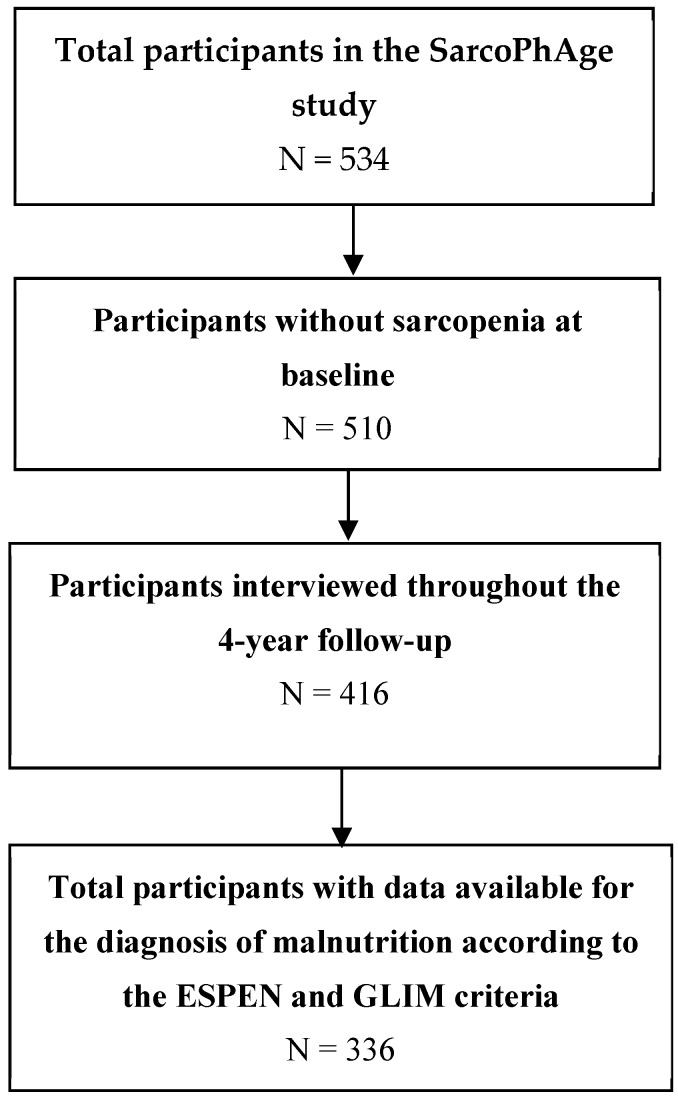
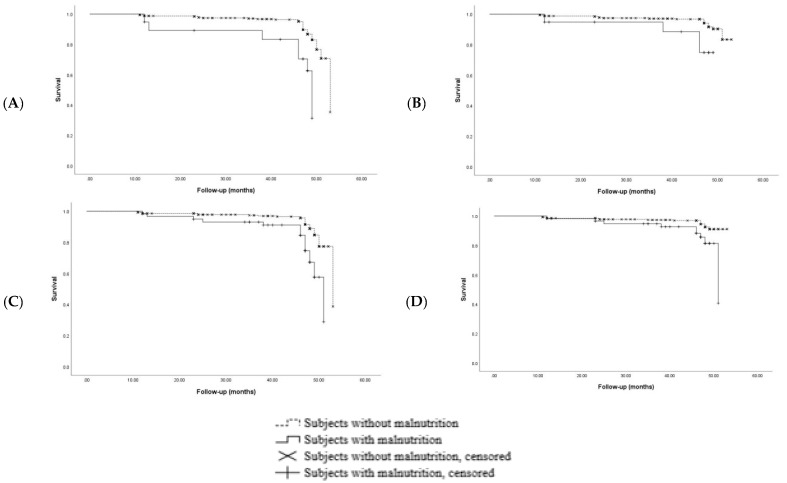
This study aims to explore the association between malnutrition diagnosed according to both the Global Leadership Initiative of Malnutrition (GLIM) and the European Society of Clinical Nutrition and Metabolism (ESPEN) criteria and the onset of sarcopenia/severe sarcopenia, diagnosed according to the European Working Group on Sarcopenia in Older People 2 (EWGSOP2) criterion, in the sarcopenia and physical impairment with advancing age (SarcoPhAge) cohort during a four-year follow-up. Adjusted Cox-regression and Kaplan-Meier curves were performed. Among the 534 community-dwelling participants recruited in the SarcoPhAge study, 510 were free from sarcopenia at baseline, of whom 336 had complete data (186 women and 150 men, mean age of 72.5 ± 5.8 years) to apply the GLIM and ESPEN criteria. A significantly higher risk of developing sarcopenia/severe sarcopenia during the four-year follow-up based on the GLIM [sarcopenia: Adjusted hazard ratio (HR) = 3.23 (95% confidence interval (CI) 1.73–6.05); severe sarcopenia: Adjusted HR = 2.87 (95% CI 1.25–6.56)] and ESPEN [sarcopenia: Adjusted HR = 4.28 (95% CI 1.86–9.86); severe sarcopenia: Adjusted HR = 3.86 (95% CI 1.29–11.54)] criteria was observed. Kaplan-Meier curves confirmed this relationship (log rank p < 0.001 for all). These results highlighted the importance of malnutrition since it has been shown to be associated with an approximately fourfold higher risk of developing sarcopenia/severe sarcopenia during a four-year follow-up.
Overview
The claims and statistics of this paper haven’t been checked yet.
Run the check — free, no account needed. It reads the open-access text and checks the sources it cites.
Integrity signals
Registry
Cites
Statistics
Figures
Verification
Claims the paper makes
The claims and statistics of this paper haven’t been checked yet.
Run the check — free, no account needed. It reads the open-access text and checks the sources it cites.
Claims other papers make about this one
Each is checked against this paper’s own text: does it say what the citing paper says it does?
The source backs part of the claim, not all of it — or backs it for a different population, condition or comparison.
In the citing paper
“Special attention should be paid to malnutrition or the risk of malnutrition in older adults with diabetes given its association with sarcopenia”
From 13. Older Adults: Standards of Care in Diabetes—2026 (2026) · cites this paper as [91]
Experimental — accuracy not yet measured
Self-check
Percentages, sums and reported differences re-computed from the paper’s own numbers.
The self-check needs the paper’s full text.
Citations
Cites
Frailty in Older Adults: Evidence for a Phenotype
Fried, L. P., Tangen, C. M., Walston, J., Newman, A. B., Hirsch, C., Gottdiener, J., Seeman, T., Tracy, R., Kop, W. J., Burke, G., et al. (2001) · The Journals of Gerontology Series A: Biological Sciences and Medical Sciences · doi:10.1093/gerona/56.3.m146 · Cited by 24,907
von Elm, E., Altman, D. G., Egger, M., Pocock, S. J., Gøtzsche, P. C., Vandenbroucke, J. P., & Initiative, F. T. S. (2007) · PLoS Medicine · doi:10.1371/journal.pmed.0040296 · Cited by 23,020
von Elm, E., Altman, D. G., Egger, M., Pocock, S. J., Gøtzsche, P. C., & Vandenbroucke, J. P. (2007) · The Lancet · doi:10.1016/s0140-6736(07)61602-x · Cited by 21,320
Assessment of Older People: Self-Maintaining and Instrumental Activities of Daily Living
Lawton, M. P., & Brody, E. M. (1969) · The Gerontologist · doi:10.1093/geront/9.3_part_1.179 · Cited by 18,540
Assessment of older people: self-maintaining and instrumental activities of daily living.
Lawton, M., & Brody, E. M. (1969) · The gerontologist · doi:10.1097/00006199-197005000-00029 · Cited by 18,276
von Elm, E., Altman, D. G., Egger, M., Pocock, S. J., Gøtzsche, P. C., & Vandenbroucke, J. P. (2008) · Journal of Clinical Epidemiology · doi:10.1016/j.jclinepi.2007.11.008 · Cited by 17,893
von Elm, E., Altman, D. G., Egger, M., Pocock, S. J., Gøtzsche, P. C., Vandenbroucke, J. P., & Initiative, F. T. S. (2007) · Annals of Internal Medicine · doi:10.7326/0003-4819-147-8-200710160-00010 · Cited by 17,796
Sarcopenia: revised European consensus on definition and diagnosis
Cruz-Jentoft, A. J., Bahat, G., Bauer, J., Boirie, Y., Bruyère, O., Cederholm, T., Cooper, C., Landi, F., Rolland, Y., Sayer, A. A., et al. (2019) · Age and Ageing · doi:10.1093/ageing/afy169 · Cited by 13,818
Self-citationThe Mini‐Mental State Examination: A Comprehensive Review
Tombaugh, T. N., & McIntyre, N. J. (1992) · Journal of the American Geriatrics Society · doi:10.1111/j.1532-5415.1992.tb01992.x · Cited by 5,152
Cruz-Jentoft, A. J., & Sayer, A. A. (2019) · The Lancet · doi:10.1016/s0140-6736(19)31138-9 · Cited by 3,905
Cited by
Sorted by citations
Sarcopenia Is Associated with Mortality in Adults: A Systematic Review and Meta-Analysis
Xu, J. J., Wan, C. S., Ktoris, K., Reijnierse, E. M., & Maier, A. B. (2021) · Gerontology · doi:10.1159/000517099 · Cited by 456
A Narrative Review on Sarcopenia in Type 2 Diabetes Mellitus: Prevalence and Associated Factors
Izzo, A. C., Massimino, E., Riccardi, G., & Pepa, G. D. (2021) · Nutrients · doi:10.3390/nu13010183 · Cited by 438
Hu, Y., Peng, W., Ren, R., Wang, Y., & Wang, G. (2022) · Journal of Cachexia Sarcopenia and Muscle · doi:10.1002/jcsm.13081 · Cited by 365
Meza-Valderrama, D., Marco, E., Dávalos‐Yerovi, V., Muns, M. D., Tejero-Sánchez, M., Duarte, E., & Sánchez‐Rodríguez, D. (2021) · Nutrients · doi:10.3390/nu13030761 · Cited by 296
Papadopoulou, S. Κ., Papadimitriou, K., Voulgaridou, G., Georgaki, E., Tsotidou, E., Zantidou, O., & Papandreou, D. (2021) · Nutrients · doi:10.3390/nu13124499 · Cited by 256
Metadata
- Authors
- Beaudart, C., Sanchez-Rodriguez, D., Locquet, M., Reginster, J.-Y., Lengelé, L., & Bruyère, O.
- Affiliations
- University of Liège (BE)
- WHO Collaborating Centre for Public Health Aspects of Musculoskeletal Health and Aging, Division of Public Health, Epidemiology and Health Economics, University of Liège, CHU—Sart Tilman, Quartier Hôpital, Avenue Hippocrate 13 (Bât. B23), 4000 Liège, Belgium
- Corresponding author
- Beaudart, Charlotte
- ORCID
- Venue
- Nutrients
- Publisher
- MDPI AG
- Published
- 2019-11-27
- Volume
- 11
- Issue
- 12
- Pages
- 2883
- ISSN
- 2072-6643 (ISSN-L)
- PMC
- PMC6950107
- OpenAlex
- W2990196144
- Cited by
- 226
- References
- 53
- Citations by year
- 2026: 24 · 2025: 34 · 2024: 29 · 2023: 34 · 2022: 27 · 2021: 57 · 2020: 21
- FWCI
- 18.01
- Type
- journal article
- Language
- en
- Open access
- gold
- dx.doi.org
- Licence
- Locations
- Nutrients (publishedVersion, cc-by)
- PubMed Central (publishedVersion, cc-by)
- PubMed (publishedVersion)
- HAL (submittedVersion)
- ORBi (University of Liège) (submittedVersion, other-oa)
- Repositori digital de la UPF (Universitat Pompeu Fabra) (submittedVersion, cc-by)
- Funders
- Fonds De La Recherche Scientifique - FNRS
- Topics
- Health Sciences › Medicine › Physiology (medical) › Nutrition and Health in Aging
- Health Sciences › Medicine › Geriatrics and Gerontology › Frailty in Older Adults
- Health Sciences › Medicine › Physiology (medical) › Body Composition Measurement Techniques
- Keywords
- malnutrition, sarcopenia, severe sarcopenia, GLIM criteria, ESPEN criteria, EWGSOP2 criteria, older adults, community-dwelling older adults, risk prediction
- MeSH terms
- Aged, Aging, Female, Humans, Male, Prospective Studies, Risk Factors, Cohort Studies, Proportional Hazards Models, Malnutrition, Sarcopenia, Independent Living
About these checks
Registry, retraction, Cites and statistics results are computed, not judged, with one exception: a printed reference that no index lists is read once by a model before it counts as a citation error. Claims are extracted by a model and kept only when their quote appears verbatim in the text; each cited source is then checked, with a model’s help, for whether it says what the claim relies on. Those verdicts can be wrong — read the claim’s quote and the cited source before relying on one.
Statistics and arithmetic are recomputed, not judged.
Confidence bands are shown only for fields calibrated on our annotated test set. None is calibrated yet, so no band is shown.
What counts as a claim ›How we measure confidence ›How we check this ›
Are you an author, or do you see a problem with this page? Request a review
