

Nutrients and Microbiota in Lung Diseases of Prematurity: The Placenta-Gut-Lung Triangle
Open accessThe DOI matches its Crossref record; 162 of the 162 references it cites were found in a registry or an index.
Abstract
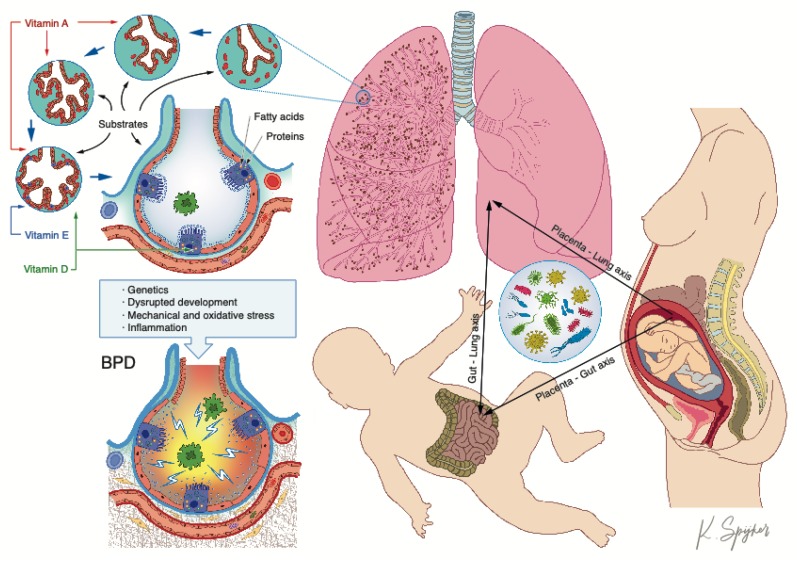
Cardiorespiratory function is not only the foremost determinant of life after premature birth, but also a major factor of long-term outcomes. However, the path from placental disconnection to nutritional autonomy is enduring and challenging for the preterm infant and, at each step, will have profound influences on respiratory physiology and disease. Fluid and energy intake, specific nutrients such as amino-acids, lipids and vitamins, and their ways of administration —parenteral or enteral—have direct implications on lung tissue composition and cellular functions, thus affect lung development and homeostasis and contributing to acute and chronic respiratory disorders. In addition, metabolomic signatures have recently emerged as biomarkers of bronchopulmonary dysplasia and other neonatal diseases, suggesting a profound implication of specific metabolites such as amino-acids, acylcarnitine and fatty acids in lung injury and repair, inflammation and immune modulation. Recent advances have highlighted the profound influence of the microbiome on many short- and long-term outcomes in the preterm infant. Lung and intestinal microbiomes are deeply intricated, and nutrition plays a prominent role in their establishment and regulation. There is an emerging evidence that human milk prevents bronchopulmonary dysplasia in premature infants, potentially through microbiome composition and/or inflammation modulation. Restoring antibiotic therapy-mediated microbiome disruption is another potentially beneficial action of human milk, which can be in part emulated by pre- and probiotics and supplements. This review will explore the many facets of the gut-lung axis and its pathophysiology in acute and chronic respiratory disorders of the prematurely born infant, and explore established and innovative nutritional approaches for prevention and treatment.
Overview
The claims and statistics of this paper haven’t been checked yet.
Free: it reads the open-access text and checks the first 5 claims that cite a source we can check. Create a free account to check every claim.
Integrity signals
Registry
Cites
Statistics
Figures
Verification
Claims the paper makes
The claims and statistics of this paper haven’t been checked yet.
Free: it reads the open-access text and checks the first 5 claims that cite a source we can check. Create a free account to check every claim.
Claims other papers make about this one
Each is checked against this paper’s own text: does it say what the citing paper says it does?
The cited source says what the claim attributes to it.
In the citing paper
“Changes in gut microorganism composition and metabolic function caused by the environment, diet, disease or medical intervention (such as antibiotics) are related to changes in the immune response and airway homeostasis (31,32).”
From The Role of Gut Microbiota in Lung Cancer: From Carcinogenesis to Immunotherapy (2021) · doi:10.3389/fonc.2021.720842 · cites this paper as [32]
Self-check
Percentages, sums and reported differences re-computed from the paper’s own numbers.
The self-check needs the paper’s full text.
Citations
Cites
Dermyshi, E., Wang, Y., Yan, C., Hong, W., Qiu, G., Gong, X., & Zhang, T. (2017) · Neonatology · doi:10.1159/000454668 · Cited by 24,451
Dominguez-Bello, M. G., Costello, E. K., Contreras, M., Magris, M., Hidalgo, G., Fierer, N., & Knight, R. (2010) · Proceedings of the National Academy of Sciences · doi:10.1073/pnas.1002601107 · Cited by 4,774 · cited 1×
“Intuitively, vaginally delivered infants would acquire bacterial communities resembling the microbial vaginal environment (Lactobacillus, Prevotella), whereas C-section infants would acquire mostly skin microbiota (Staphylococcus, Corynebacterium, Propionibacterium) [95].”
BackgroundFormation of short chain fatty acids by the gut microbiota and their impact on human metabolism
Morrison, D. J., & Preston, T. (2016) · Gut Microbes · doi:10.1080/19490976.2015.1134082 · Cited by 3,781 · cited 1×
“SCFAs promote regulatory T-cell generation and function through free fatty acid receptor 2 and 3 (FFAR 2/3) binding and histone deacetylase (HDAc) inhibition [126].”
BackgroundThe Placenta Harbors a Unique Microbiome
Aagaard, K., Ma, J., Antony, K. M., Ganu, R., Petrosino, J., & Versalovic, J. (2014) · Science Translational Medicine · doi:10.1126/scitranslmed.3008599 · Cited by 2,494
The NIH Human Microbiome Project
The NIH HMP Working Group, Peterson, J., Garges, S., Giovanni, M., McInnes, P., Wang, L., Schloss, J. A., Bonazzi, V., McEwen, J. E., Wetterstrand, K. A., et al. (2009) · Genome Research · doi:10.1101/gr.096651.109 · Cited by 2,066 · cited 3×
“The Human Microbiome Project [91] was launched in 2008 by the National Institute of Health with the goal of characterizing the entire bacterial community colonizing the human body.”
MethodInfluentialUnravelling the effects of the environment and host genotype on the gut microbiome
Spor, A., Koren, O., & Ley, R. (2011) · Nature Reviews Microbiology · doi:10.1038/nrmicro2540 · Cited by 1,509 · cited 1×
“Single-gene approaches have identified the role of immune genes (MEFV, MYD88, NOD2, defensin-encoding genes, RELMB, HLA genes, the IgA locus), and metabolic genes (APOA1-encoding apolipoprotein, LEP and LEPR-encoding leptin and its receptor) (for review, see [115]).”
BackgroundAgostoni, C., Buonocore, G., Carnielli, V., De Curtis, M., Darmaun, D., Decsi, T., Domellöf, M., Embleton, N., Fusch, C., Genzel‐Boroviczeny, O., et al. (2010) · Journal of Pediatric Gastroenterology and Nutrition · doi:10.1097/mpg.0b013e3181adaee0 · Cited by 1,489
Ehrenkranz, R. A., Dusick, A. M., Vohr, B. R., Wright, L. L., Wrage, L. A., Poole, W. K., & for the National Institutes of Child Health and Human Development Neonatal Research Network (2006) · Pediatrics · doi:10.1542/peds.2005-1368 · Cited by 1,356 · cited 1×
“In a large cohort study of 600 preterm infants 500–1000 g, a twofold higher incidence of BPD was observed between the first and fourth postnatal weight gain quartile, among other adverse outcomes [30].”
BackgroundPerez-Muñoz, M. E., Arrieta, M.-C., Ramer-Tait, A. E., & Walter, J. (2017) · Microbiome · doi:10.1186/s40168-017-0268-4 · Cited by 1,096 · cited 1×
“However, a recent study based on placenta samples from two large cohorts of complicated and uncomplicated pregnancies showed that most bacterial signatures were acquired during labor and delivery or resulted from technical contamination, with the exception of the pathogen Streptococcus agalactiae, which was observed i…”
BackgroundThébaud, B., Goss, K. N., Laughon, M., Whitsett, J. A., Abman, S. H., Steinhorn, R. H., Aschner, J. L., Davis, P. G., McGrath-Morrow, S. A., Soll, R. F., et al. (2019) · Nature Reviews Disease Primers · doi:10.1038/s41572-019-0127-7 · Cited by 1,070 · cited 1×
“BPD most strongly correlates with lower gestational age [84], and low maternal DHA levels are associated with premature birth [85].”
Background
Cited by
Diagnosis and management of bronchopulmonary dysplasia
Gilfillan, M., Bhandari, A., & Bhandari, V. (2021) · BMJ · doi:10.1136/bmj.n1974 · Cited by 311
“Variations in clinical care, including use of supplemental oxygen, 21 positive pressure, 22 medications, 23 and nutrients, 24 provoke responses modulated by genetic and epigenetic influences.”
BackgroundThe Role of Gut Microbiota in Lung Cancer: From Carcinogenesis to Immunotherapy
(2021) · doi:10.3389/fonc.2021.720842 · Cited by 136
Li, X., Shang, S., Wu, M., Song, Q., & Chen, D. (2024) · Cancer Letters · doi:10.1016/j.canlet.2024.217096 · Cited by 93
Gut Microbiota: the Emerging Link to Lung Homeostasis and Disease
Zhou, A., Lei, Y., Tang, L., Hu, S., Yang, M., Wu, L., Yang, S., & Tang, B. (2020) · Journal of Bacteriology · doi:10.1128/jb.00454-20 · Cited by 89
“In addition, fragments and metabolites of surviving gut microbiota can modulate the lung immune response by translocating across the intestinal barrier and the mesenteric lymphatic system, an essential pathway between the lungs and the gut (15).”
BackgroundHuman Fetal Lungs Harbor a Microbiome Signature
Alam, D. A., Danopoulos, S., Grubbs, B. H., Ali, N. A. B. M., MacAogain, M., Chotirmall, S. H., Warburton, D., Gaggar, A., Ambalavanan, N., & Lal, C. V. (2020) · American Journal of Respiratory and Critical Care Medicine · doi:10.1164/rccm.201911-2127le · Cited by 72
Metadata
- Authors
- Piersigilli, F., Van Grambezen, B., Hocq, C., & Danhaive, O.
- Affiliations
- Cliniques Universitaires Saint-Luc (BE)
- Division of Neonatology, St-Luc University Hospital, Catholic University of Louvain, Brussels 1200, Belgium
- Corresponding author
- Danhaive, Olivier
- Venue
- Nutrients
- Publisher
- MDPI AG
- Published
- 2020-02-13
- Volume
- 12
- Issue
- 2
- Pages
- 469
- ISSN
- 2072-6643 (ISSN-L)
- PMC
- PMC7071142
- OpenAlex
- W3005634747
- Cited by
- 64
- References
- 161
- Citations by year
- 2026: 6 · 2025: 7 · 2024: 8 · 2023: 4 · 2022: 21 · 2021: 12 · 2020: 5
- FWCI
- 1.29
- Type
- journal article
- Language
- en
- Open access
- gold
- doi.org
- Licence
- Locations
- Nutrients (publishedVersion, cc-by)
- PubMed Central (publishedVersion, cc-by)
- PubMed (publishedVersion)
- Digital Access to Libraries (submittedVersion, other-oa)
- DIAL (Catholic University of Leuven) (submittedVersion, other-oa)
- DOAJ (DOAJ: Directory of Open Access Journals) (submittedVersion, cc-by-sa)
- Topics
- Health Sciences › Nursing › Nutrition and Dietetics › Infant Nutrition and Health
- Health Sciences › Medicine › Pulmonary and Respiratory Medicine › Neonatal Respiratory Health Research
- Health Sciences › Medicine › Pediatrics, Perinatology and Child Health › Infant Development and Preterm Care
- Keywords
- preterm infants, bronchopulmonary dysplasia, gut-lung axis, neonatal nutrition, gut microbiota, lung microbiome, breast milk, metabolomics, metabolomic biomarkers, probiotics, prebiotics, inflammation, acylcarnitines, fatty acids, amino acids
- MeSH terms
- Gastrointestinal Microbiome, Nutrients, Female, Humans, Infant Nutritional Physiological Phenomena, Infant, Newborn, Infant, Premature, Infant, Premature, Diseases, Lung, Lung Diseases, Male, Milk, Human, Placenta, Pregnancy, Premature Birth, Microbiota
About these checks
Registry, retraction, Cites and statistics results are computed, not judged, with one exception: a printed reference that no index lists is read once by a model before it counts as a citation error. Claims are extracted by a model and kept only when their quote appears verbatim in the text; each cited source is then checked, with a model’s help, for whether it says what the claim relies on. Those verdicts can be wrong — read the claim’s quote and the cited source before relying on one.
Statistics and arithmetic are recomputed, not judged.
Confidence bands are shown only for fields calibrated on our annotated test set. None is calibrated yet, so no band is shown.
What counts as a claim ›How we measure confidence ›How we check this ›
Are you an author, or do you see a problem with this page? Request a review
Data sources
Bibliographic data: Semantic Scholar, OpenAlex, Crossref.
Contains information from the Semantic Scholar Academic Graph Datasets, made available under the ODC Attribution License (ODC-BY 1.0).
Semantic Scholar’s data is described in: Kinney, R., et al. (2023). The Semantic Scholar Open Data Platform. arXiv:2301.10140.
