

The DOI matches its Crossref record; 90 of the 91 references it cites were found in a registry or an index.
The Gut Microbiome, Aging, and Longevity: A Systematic Review
Open accessAbstract
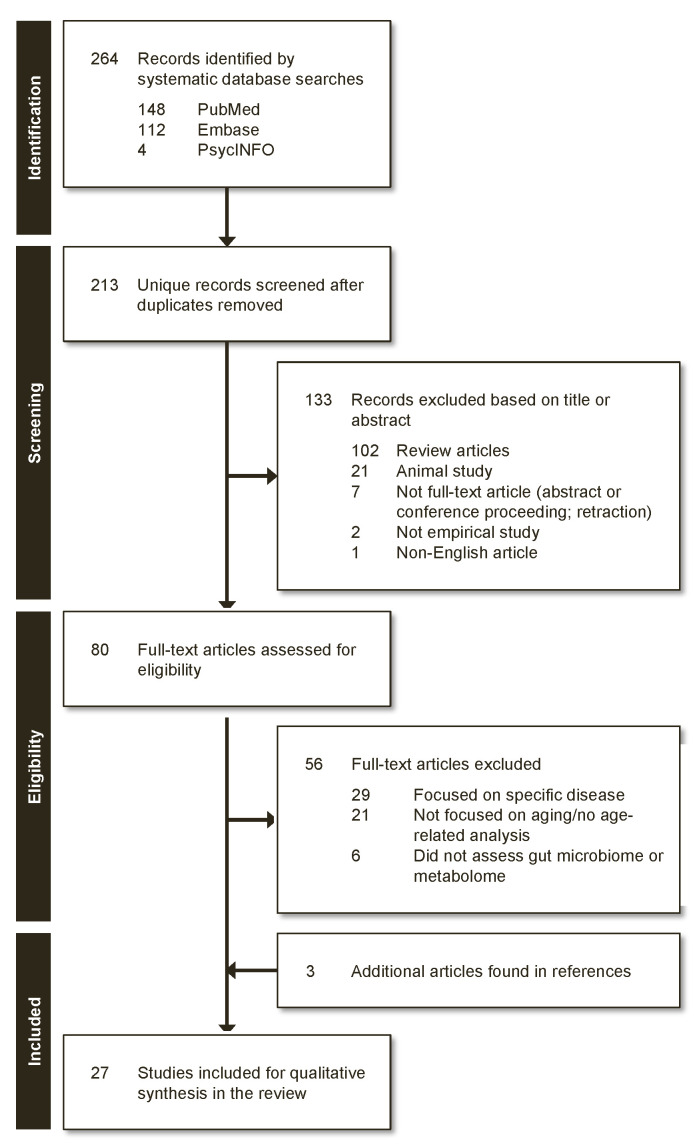
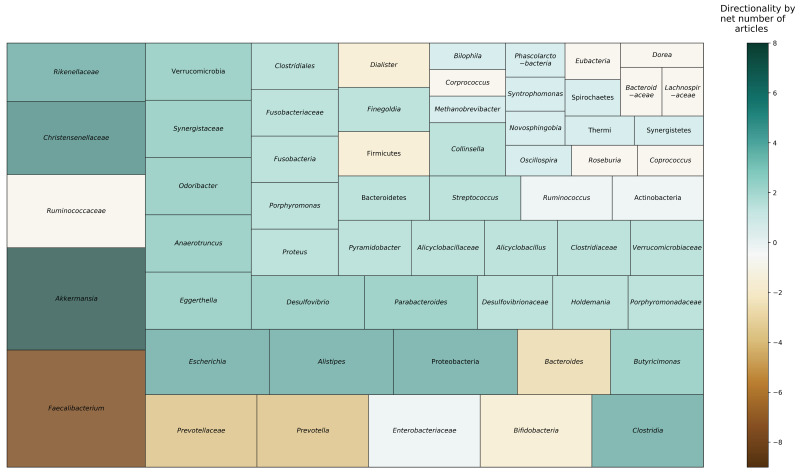
Aging is determined by complex interactions among genetic and environmental factors. Increasing evidence suggests that the gut microbiome lies at the core of many age-associated changes, including immune system dysregulation and susceptibility to diseases. The gut microbiota undergoes extensive changes across the lifespan, and age-related processes may influence the gut microbiota and its related metabolic alterations. The aim of this systematic review was to summarize the current literature on aging-associated alterations in diversity, composition, and functional features of the gut microbiota. We identified 27 empirical human studies of normal and successful aging suitable for inclusion. Alpha diversity of microbial taxa, functional pathways, and metabolites was higher in older adults, particularly among the oldest-old adults, compared to younger individuals. Beta diversity distances significantly differed across various developmental stages and were different even between oldest-old and younger-old adults. Differences in taxonomic composition and functional potential varied across studies, but Akkermansia was most consistently reported to be relatively more abundant with aging, whereas Faecalibacterium, Bacteroidaceae, and Lachnospiraceae were relatively reduced. Older adults have reduced pathways related to carbohydrate metabolism and amino acid synthesis; however, oldest-old adults exhibited functional differences that distinguished their microbiota from that of young-old adults, such as greater potential for short-chain fatty acid production and increased butyrate derivatives. Although a definitive interpretation is limited by the cross-sectional design of published reports, we integrated findings of microbial composition and downstream functional pathways and metabolites, offering possible explanations regarding age-related processes.
Overview
The claims and statistics of this paper haven’t been checked yet.
Run the check — free, no account needed. It reads the open-access text and checks the sources it cites.
Integrity signals
Registry
Cites
Statistics
Figures
Verification
Claims the paper makes
The claims and statistics of this paper haven’t been checked yet.
Run the check — free, no account needed. It reads the open-access text and checks the sources it cites.
Claims other papers make about this one
Each is checked against this paper’s own text: does it say what the citing paper says it does?
In the citing paper
“Studies in the past decade have demonstrated that gut microbiome composition changes with age, that exceptionally long-lived individuals have a different microbiome composition from average older adults131–133, and that certain microorganisms131,134,135 and the metabolites they produce132,134,136 are beneficial to human health.”
From Measuring biological age using omics data (2022) · cites this paper as [131]
Self-check
Percentages, sums and reported differences re-computed from the paper’s own numbers.
The self-check needs the paper’s full text.
Citations
Cites
López-Otín, C., Blasco, M. A., Partridge, L., Serrano, M., & Kroemer, G. (2013) · Cell · doi:10.1016/j.cell.2013.05.039 · Cited by 14,982
An obesity-associated gut microbiome with increased capacity for energy harvest
Turnbaugh, P. J., Ley, R. E., Mahowald, M. A., Magrini, V., Mardis, E. R., & Gordon, J. I. (2006) · Nature · doi:10.1038/nature05414 · Cited by 12,444
Structure, function and diversity of the healthy human microbiome
The Human Microbiome Project Consortium (2012) · Nature · doi:10.1038/nature11234 · Cited by 11,726
Human gut microbiome viewed across age and geography
Yatsunenko, T., Rey, F. E., Manary, M. J., Trehan, I., Dominguez-Bello, M. G., Contreras, M., Magris, M., Hidalgo, G., Baldassano, R. N., Anokhin, A. P., et al. (2012) · Nature · doi:10.1038/nature11053 · Cited by 7,815
Self-citationLinking long-term dietary patterns with gut microbial enterotypes
Wu, G. D., Chen, J., Hoffmann, C., Bittinger, K., Chen, Y.-Y., Keilbaugh, S. A., Bewtra, M., Knights, D., Walters, W. A., Knight, R., et al. (2011) · Science · doi:10.1126/science.1208344 · Cited by 6,513
Self-citationInflamm‐aging: An Evolutionary Perspective on Immunosenescence
FRANCESCHI, C., BONAFÈ, M., VALENSIN, S., OLIVIERI, F., DE LUCA, M., OTTAVIANI, E., & DE BENEDICTIS, G. (2000) · Annals of the New York Academy of Sciences · doi:10.1111/j.1749-6632.2000.tb06651.x · Cited by 5,358
Mind-altering microorganisms: the impact of the gut microbiota on brain and behaviour
Cryan, J. F., & Dinan, T. G. (2012) · Nature Reviews Neuroscience · doi:10.1038/nrn3346 · Cited by 4,572
Cross-talk between Akkermansia muciniphila and intestinal epithelium controls diet-induced obesity
Everard, A., Belzer, C., Geurts, L., Ouwerkerk, J. P., Druart, C., Bindels, L. B., Guiot, Y., Derrien, M., Muccioli, G. G., Delzenne, N. M., et al. (2013) · Proceedings of the National Academy of Sciences · doi:10.1073/pnas.1219451110 · Cited by 4,511
The impact of the gut microbiota on human health: an integrative view
Clemente, J. C., Ursell, L. K., Parfrey, L. W., & Knight, R. (2012) · Cell · doi:10.1016/j.cell.2012.01.035 · Cited by 3,710
Self-citationInflammageing: chronic inflammation in ageing, cardiovascular disease, and frailty
Ferrucci, L., & Fabbri, E. (2018) · Nature Reviews Cardiology · doi:10.1038/s41569-018-0064-2 · Cited by 3,690
Cited by
Sorted by citations
Measuring biological age using omics data
Rutledge, J., Oh, H., & Wyss-Coray, T. (2022) · Nature Reviews Genetics · doi:10.1038/s41576-022-00511-7 · Cited by 570
Chronic inflammation and the hallmarks of aging
Baechle, J. J., Chen, N., Makhijani, P., Winer, S., Furman, D., & Winer, D. A. (2023) · Molecular Metabolism · doi:10.1016/j.molmet.2023.101755 · Cited by 471
The aging gut microbiome and its impact on host immunity
Bosco, N., & Noti, M. (2021) · Genes and Immunity · doi:10.1038/s41435-021-00126-8 · Cited by 435
Short-chain fatty acids as modulators of redox signaling in health and disease
González‐Bosch, C., Boorman, E., Zunszain, P. A., & Mann, G. E. (2021) · Redox Biology · doi:10.1016/j.redox.2021.102165 · Cited by 298
Gut bacterial profiles in Parkinson's disease: A systematic review
Li, Z., Liang, H., Lu, L., Lu, L., Zheng, C., Fan, Y., Wu, B., Zou, T., Luo, X., Xinchun, Z., et al. (2022) · CNS Neuroscience & Therapeutics · doi:10.1111/cns.13990 · Cited by 224
Metadata
- Authors
- Badal, V. D., Vaccariello, E. D., Murray, E. R., Yu, K. E., Knight, R., Jeste, D. V., & Nguyen, T. T.
- Affiliations
- University of California San Diego (US)
- Corresponding author
- Nguyen, Tanya T.
- Venue
- Nutrients
- Publisher
- MDPI AG
- Published
- 2020-12-07
- Volume
- 12
- Issue
- 12
- Pages
- 3759
- ISSN
- 2072-6643 (ISSN-L)
- PMC
- PMC7762384
- OpenAlex
- W3110715890
- Cited by
- 551
- References
- 91
- Citations by year
- 2026: 108 · 2025: 122 · 2024: 122 · 2023: 96 · 2022: 73 · 2021: 29
- FWCI
- 4.76
- Type
- journal article
- Language
- en
- Open access
- gold
- doi.org
- Licence
- Locations
- Nutrients (publishedVersion, cc-by)
- PubMed Central (publishedVersion, cc-by)
- PubMed (publishedVersion)
- eScholarship (California Digital Library) (submittedVersion, cc-by)
- DOAJ (DOAJ: Directory of Open Access Journals) (submittedVersion, cc-by-sa)
- eScholarship (California Digital Library) (submittedVersion)
- Funders
- National Institute of Mental Health (K23 MH118435-01A1, 5T32 MH019934-24)
- Topics
- Life Sciences › Biochemistry, Genetics and Molecular Biology › Molecular Biology › Gut microbiota and health
- Health Sciences › Dentistry › Periodontics › Oral microbiology and periodontitis research
- Life Sciences › Agricultural and Biological Sciences › Food Science › Probiotics and Fermented Foods
- Keywords
- gut microbiota, aging, longevity, oldest old, microbial diversity, Akkermansia, Faecalibacterium, Bacteroidaceae, Lachnospiraceae, short-chain fatty acids, butyrate, carbohydrate metabolism, amino acid synthesis, immune dysregulation
- MeSH terms
- Gastrointestinal Microbiome, Adult, Aged, Aged, 80 and over, Aging, Amino Acids, Cross-Sectional Studies, Feces, Female, Humans, Longevity, Male, Middle Aged, Protein Biosynthesis, Signal Transduction, Carbohydrate Metabolism
About these checks
Registry, retraction, Cites and statistics results are computed, not judged, with one exception: a printed reference that no index lists is read once by a model before it counts as a citation error. Claims are extracted by a model and kept only when their quote appears verbatim in the text; each cited source is then checked, with a model’s help, for whether it says what the claim relies on. Those verdicts can be wrong — read the claim’s quote and the cited source before relying on one.
Statistics and arithmetic are recomputed, not judged.
Confidence bands are shown only for fields calibrated on our annotated test set. None is calibrated yet, so no band is shown.
What counts as a claim ›How we measure confidence ›How we check this ›
Are you an author, or do you see a problem with this page? Request a review
