

The DOI matches its Crossref record; 37 of the 37 references it cites were found in a registry or an index; none of the 7 sources its claims cite is checked for support yet.
Iron Deficiency in Adolescent and Young Adult German Athletes—A Retrospective Study
Open accessAbstract
Background: Iron deficiency is a common phenomenon in sports and may lead to impaired physical performance. The aim of the study was to determine the frequency of iron deficiency in competitive athletes and to discuss the resulting consequences. Methods: The data of 629 athletes (339 male, 290 female) who presented for their annual basic sports medicine examination were investigated. Depending on age (<14 years, 15–17 years, ≥18–30 years), four groups ((I.) normal hemoglobin (Hb) and ferritin level (≥30 ng/mL for adults and 15–18-year-olds; ≥20 ng/mL, respectively, ≥15 ng/mL for adolescents and children), (II.) prelatent iron deficiency (ID) (normal Hb, low ferritin), (III.) latent ID (additionally elevated soluble transferrin receptor or decreased transferrin saturation) and (IV.) manifest anemia) were distinguished. In addition, the iron status and exercise capacity of different types of sports were compared. Results: Overall we found an iron deficiency of 10.9% in male (mainly in adolescence) and 35.9% in female athletes (emphasized in adolescence and young adulthood). There were no significant differences in iron status in regard to the different sport types or in maximum performance for the different groups of iron deficiency. Conclusions: Adolescent and female athletes are more likely to have an iron deficiency. Therapy concepts for athletes therefore should pay attention to iron-rich diets.
Overview
CoChat Summary
TL;DR
In 629 German competitive athletes, iron deficiency was common, especially in female and adolescent athletes, while manifest anemia was rare. Sport type and maximum exercise performance did not differ significantly across iron-status groups.
Key findings
- Overall iron deficiency was found in about 25% of competitive athletes and was about three times more common in women; the abstract reports 10.9% in male and 35.9% in female athletes, mainly in adolescence for males and adolescence/young adulthood for females. Manifest anemia was found in only 1.3%.
- In adult men, only one person had iron deficiency.
- There were no significant differences in iron status across sport types (skill, power, mixed, endurance) (Table 2).
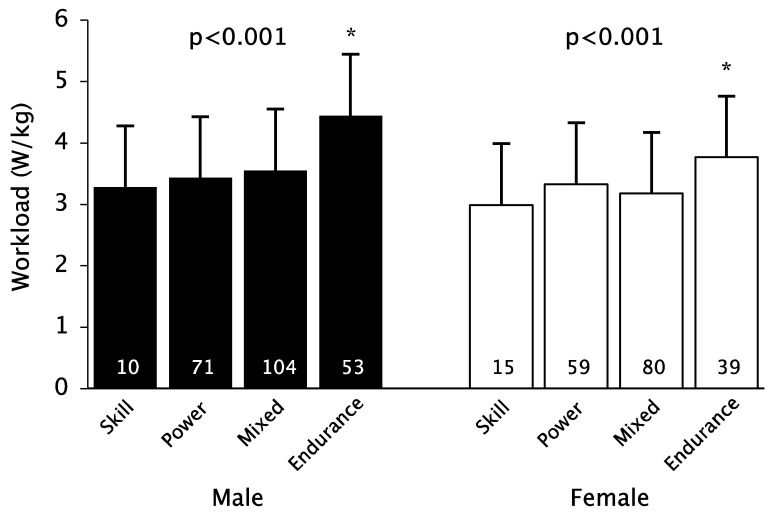
- There was no significant difference in maximum workload/performance among the different iron-deficiency groups; endurance athletes had the highest performance overall (Figure 1, Tables 3 and 4).
Methods
- Retrospective analysis of 629 competitive athletes (339 male, 290 female) who presented at the Lower Saxony Olympic Training Center from May 2021–April 2022 for their annual basic sports medicine examination. Iron status was classified using Clenin criteria into normal, prelatent iron deficiency (normal Hb, low ferritin), latent iron deficiency (additionally sTFR > 4.13 mg/L or transferrin saturation < 16%), and manifest anemia; ferritin cutoffs were age-dependent (≥30 ng/mL for adults and 15–18-year-olds; ≥20 ng/mL and ≥15 ng/mL for adolescents/children). Sports were classified into skill, power, mixed, and endurance disciplines; 431 athletes performed bicycle ergometry.
- Morning blood samples were collected via antecubital vein into EDTA and lithium heparin monovettes. Ferritin values with increased C-reactive protein were excluded; sTFR and transferrin saturation were determined only when ferritin was <35 ng/mL. Anthropometric data included bioimpedance body fat; exercise testing was incremental bicycle ergometry until exhaustion with ECG and lactate monitoring.
- Statistics: mean ± standard deviation, Kolmogorov–Smirnov test, chi-squared test, ANOVA with Bonferroni-corrected post hoc tests, significance level 0.05, SPSS version 27.
Limitations
- Stated in the paper: retrospective design; extent of existing iron substitution was not recorded; no information on diet type or average daily iron intake; part of the study period fell during the peak of the COVID-19 pandemic, so not all athletes could perform the performance test; division into 32 subgroups with partly single or no athletes may have been too small to show significant differences.
- Also stated: all exercise tests used a bicycle ergometer regardless of sport type, so sport-specific testing might have revealed performance differences between iron-deficient groups; the sample was a German population with mainly Caucasian athletes, limiting generalizability to non-western or non-Caucasian populations; sport-type subdivision reflected competition load, not cardiovascular/muscular training load, and training hours per week were not classified.
- Evident from the design/text: as a retrospective observational study, it cannot establish causality between iron status and performance, and the discussion notes that a possible effect of iron substitution over time was not investigated.
Model-written summary. Check it against the paper before relying on it.
Integrity signals
Registry
Cites
Statistics
Figures
Verification
Claims the paper makes
0 Valid · 0 Not valid · 1 Not checked · 22 Own results and interpretations
A result the paper reports from its own data — it cites no other source for it, so there is none to check. The quote shows it is in the paper.
In the paper
“In our collective, iron deficiency is found in about 25% of competitive athletes, with a proportion being three times more common in women (Table 1).”
- Also stated in: § 4. Discussion · plain
“The main finding of our study is that about a quarter of the athletes suffer from iron deficiency, mainly women, consequently, the proportion of anemic athletes is fortunately much lower.”
§ Iron Deficiency in Adolescent and Young Adult German Athletes—A Retrospective Study > 3. Results
plain- Asserted: passes — The authors put it forward as true.
- Checkable: passes — It can be checked against evidence.
- Load-bearing: passes — The paper’s conclusions depend on it.
- Based: passes — The paper gives a reason why it holds.
- Rests on an assumption not shown here.
- Also stated in: § 4. Discussion · plain
A result the paper reports from its own data — it cites no other source for it, so there is none to check. The quote shows it is in the paper.
In the paper
“Manifest anemia was found in only 1.3%.”
- Also stated in: § 4. Discussion · plain
“The main finding of our study is that about a quarter of the athletes suffer from iron deficiency, mainly women, consequently, the proportion of anemic athletes is fortunately much lower.”
§ Iron Deficiency in Adolescent and Young Adult German Athletes—A Retrospective Study > 3. Results
plain- Asserted: passes — The authors put it forward as true.
- Checkable: passes — It can be checked against evidence.
- Load-bearing: unclear — It is unclear whether the paper’s conclusions depend on it.
- Based: passes — The paper gives a reason why it holds.
- Rests on an assumption not shown here.
- Also stated in: § 4. Discussion · plain
A result the paper reports from its own data — it cites no other source for it, so there is none to check. The quote shows it is in the paper.
In the paper
“In our collective, iron deficiency is found in about 25% of competitive athletes, with a proportion being three times more common in women (Table 1).”
- Also stated in: § 4. Discussion · plain
“The main finding of our study is that about a quarter of the athletes suffer from iron deficiency, mainly women, consequently, the proportion of anemic athletes is fortunately much lower.”
§ Iron Deficiency in Adolescent and Young Adult German Athletes—A Retrospective Study > 3. Results
plainstates an association- Asserted: passes — The authors put it forward as true.
- Checkable: passes — It can be checked against evidence.
- Load-bearing: passes — The paper’s conclusions depend on it.
- Based: passes — The paper gives a reason why it holds.
- Rests on an assumption not shown here.
- Also stated in: § 4. Discussion · plain
A result the paper reports from its own data — it cites no other source for it, so there is none to check. The quote shows it is in the paper.
In the paper
“Overall we found an iron deficiency of 10.9% in male (mainly in adolescence) and 35.9% in female athletes (emphasized in adolescence and young adulthood).”
§ Iron Deficiency in Adolescent and Young Adult German Athletes—A Retrospective Study > Abstract
plainstates an association- Asserted: passes — The authors put it forward as true.
- Checkable: passes — It can be checked against evidence.
- Load-bearing: passes — The paper’s conclusions depend on it.
- Based: passes — The paper gives a reason why it holds.
- Rests on an assumption not shown here.
A result the paper reports from its own data — it cites no other source for it, so there is none to check. The quote shows it is in the paper.
In the paper
“In adult men, just one person suffered from iron deficiency.”
§ Iron Deficiency in Adolescent and Young Adult German Athletes—A Retrospective Study > 4. Discussion
plainSingle case- Asserted: passes — The authors put it forward as true.
- Checkable: passes — It can be checked against evidence.
- Load-bearing: unclear — It is unclear whether the paper’s conclusions depend on it.
- Based: passes — The paper gives a reason why it holds.
- Rests on an assumption not shown here.
5 more claims
Create a free account to see all 23 claims and to verify the 7 references still open.
- It may state two separate claims as one. 8
- The quote only partly states this claim. 1
- Probably not a substantial claim. 10
Claims other papers make about this one
Each is checked against this paper’s own text: does it say what the citing paper says it does?
In the citing paper
“Female athletes and those participating in endurance sports are at heightened risk due to factors such as menstrual blood loss, lower dietary iron intake, and increased iron turnover from high training loads [75].”
From Optimizing Performance Nutrition for Adolescent Athletes: A Review of Dietary Needs, Risks, and Practical Strategies (2025) · cites this paper as [75]
In the citing paper
“Competitive adolescent athletes, and among these, especially female athletes, have a higher probability of having an iron deficiency because of growth, menstruation, or vegetarian and vegan diets.”
From Nutrition for Children and Adolescents Who Practice Sport: A Narrative Review (2024) · cites this paper as [52]
In the citing paper
“Hence, in case of iron deficiency or anemia, oral iron supplementation is recommended [52].”
From Nutrition for Children and Adolescents Who Practice Sport: A Narrative Review (2024) · cites this paper as [52]
Citations
Cites
The roles of iron in health and disease
Lieu, P. T., Heiskala, M., Peterson, P. A., & Yang, Y. (2001) · Molecular Aspects of Medicine · doi:10.1016/s0098-2997(00)00006-6 · Cited by 804
Stoffel, N. U., Cercamondi, C. I., Brittenham, G., Zeder, C., Geurts-Moespot, A. J., Swinkels, D. W., Moretti, D., & Zimmermann, M. B. (2017) · The Lancet Haematology · doi:10.1016/s2352-3026(17)30182-5 · Cited by 435
Beard, J., & Tobin, B. (2000) · The American Journal of Clinical Nutrition · doi:10.1093/ajcn/72.2.594s · Cited by 331
Potential benefits and hazards of physical activity and exercise on the gastrointestinal tract
PETERS, H. P. F., DE VRIES, W. R., VANBERGE-HENEGOUWEN, G. P., & AKKERMANS, L. M. A. (2001) · Gut · doi:10.1136/gut.48.3.435 · Cited by 331
Iron considerations for the athlete: a narrative review
Sim, M., Garvican-Lewis, L. A., Cox, G. R., Govus, A., McKay, A. K. A., Stellingwerff, T., & Peeling, P. (2019) · European Journal of Applied Physiology · doi:10.1007/s00421-019-04157-y · Cited by 274
Vegan diets: practical advice for athletes and exercisers
Rogerson, D. (2017) · Journal of the International Society of Sports Nutrition · doi:10.1186/s12970-017-0192-9 · Cited by 270
Iron Requirements in Adolescent Females
Beard, J. L. (2000) · Journal of Nutrition · doi:10.1093/jn/130.2.440s · Cited by 194
Brutsaert, T. D., Hernandez-Cordero, S., Rivera, J., Viola, T., Hughes, G., & Haas, J. D. (2003) · The American Journal of Clinical Nutrition · doi:10.1093/ajcn/77.2.441 · Cited by 175
Iron deficiency in sports-definition, influence on performance and therapy
Clénin, G., Cordes, M., Huber, A., Schumacher, Y. O., Noack, P., Scales, J., & Kriemler, S. (2015) · Swiss Medical Weekly · doi:10.4414/smw.2015.14196 · Cited by 170
Effect of rhEPO administration on serum levels of sTfR and cycling performance
Birkeland, K. R. I., Stray‐Gundersen, J., Hemmersbach, P., N, J. H., Haug, E., & Bahr, R. (2000) · Medicine & Science in Sports & Exercise · doi:10.1097/00005768-200007000-00009 · Cited by 160
Research works printed but not linked: 3
- Mettler, 2004, Ferrum—Ein Mineralstoff im Sport, Schweiz. Z. Für Sportmed. Und Sport., 52, 105
- Friedmann, 2001, Sportleranämie, Dtsch. Z. Sportmed., 52, 262
- Robinson, 2010, Die Hypoferritinämie des Sportlers ist kein sicheres Indiz für Eisenmangel, Dtsch. Z. Sport., 61, 141
Cited by
Iron Homeostasis and Ferroptosis in Human Diseases: Mechanisms and Therapeutic Prospects
Ru, Q., Li, Y., Chen, L., Wu, Y., Min, J., & Wang, F. (2024) · Signal Transduction and Targeted Therapy · doi:10.1038/s41392-024-01969-z · Cited by 724
Nutrition for Children and Adolescents Who Practice Sport: A Narrative Review
Capra, M. E., Stanyevic, B., Giudice, A., Monopoli, D., Decarolis, N. M., Esposito, S., & Biasucci, G. (2024) · Nutrients · doi:10.3390/nu16162803 · Cited by 66
Kowalczyk, A., Nisiewicz, M. K., Bamburowicz‐Klimkowska, M., Kasprzak, A., Ruzycka-Ayoush, M., Koszytkowska‐Stawińska, M., & Nowicka, A. M. (2023) · Biosensors and Bioelectronics · doi:10.1016/j.bios.2023.115212 · Cited by 40
Everett, S. (2025) · Nutrients · doi:10.3390/nu17172792 · Cited by 37
Nutritional Modulation of Hepcidin in the Treatment of Various Anemic States
D’Andrea, P., Giampieri, F., & Battino, M. A. (2023) · Nutrients · doi:10.3390/nu15245081 · Cited by 18
Metadata
- Authors
- Roy, R., Kück, M., Radziwolek, L., & Kerling, A.
- Affiliations
- Medizinische Hochschule Hannover (DE)
- Corresponding author
- Kerling, Arno
- Venue
- Nutrients
- Publisher
- MDPI AG
- Published
- 2022-10-27
- Volume
- 14
- Issue
- 21
- Pages
- 4511
- ISSN
- 2072-6643 (ISSN-L)
- PMC
- PMC9657900
- OpenAlex
- W4307632804
- Semantic Scholar
- 11268c74587878b16a435dab8d85981ec16b7b75
- Cited by
- 41
- References
- 37
- Citations by year
- 2026: 9 · 2025: 13 · 2024: 9 · 2023: 10
- FWCI
- 5.69
- Type
- journal article
- Language
- en
- Open access
- gold
- doi.org
- Licence
- Locations
- Nutrients (publishedVersion, cc-by)
- PubMed (publishedVersion)
- PubMed Central (publishedVersion, cc-by)
- Topics
- Health Sciences › Medicine › Hematology › Iron Metabolism and Disorders
- Health Sciences › Medicine › Physiology (medical) › Exercise and Physiological Responses
- Health Sciences › Medicine › Hematology › Erythropoietin and Anemia Treatment
- Keywords
- iron deficiency, athletes, youth athletes, young adult athletes, female athletes, ferritin, hemoglobin, soluble transferrin receptor, transferrin saturation, iron status, exercise capacity, iron-rich diet
- MeSH terms
- Iron Deficiencies, Adolescent, Adult, Female, Ferritins, Hemoglobins, Humans, Iron, Male, Retrospective Studies, Anemia, Iron-Deficiency, Young Adult, Athletes
About these checks
Registry, retraction, Cites and statistics results are computed, not judged, with one exception: a printed reference that no index lists is read once by a model before it counts as a citation error. Claims are extracted by a model and kept only when their quote appears verbatim in the text; each cited source is then checked, with a model’s help, for whether it says what the claim relies on. Those verdicts can be wrong — read the claim’s quote and the cited source before relying on one.
A language model drew the claims from the paper on 2026-11-14, under version 3 of the claim definition (model deepseek-v4.1-flash, prompt extract-v3).
A second model labelled each claim on 2026-11-14 (model jev-1.13-20260917, definition revision gold-guideline-v0.2).
Statistics and arithmetic are recomputed, not judged.
Confidence bands are shown only for fields calibrated on our annotated test set. None is calibrated yet, so no band is shown.
What counts as a claim ›How we measure confidence ›How we check this ›
Are you an author, or do you see a problem with this page? Request a review
How to cite
Cite CoChat for the checks on this page, and the paper for its own findings.
- This page
- CoChat. (2026). Citation check: Iron Deficiency in Adolescent and Young Adult German Athletes—A Retrospective Study. https://app.cochat.ai/papers/10.3390/nu14214511
- The paper
- Roy, R., Kück, M., Radziwolek, L., & Kerling, A. (2022). Iron Deficiency in Adolescent and Young Adult German Athletes—A Retrospective Study. Nutrients. https://doi.org/10.3390/nu14214511
Data sources
Bibliographic data: Semantic Scholar, OpenAlex, Crossref.
Contains information from the Semantic Scholar Academic Graph Datasets, made available under the ODC Attribution License (ODC-BY 1.0).
Semantic Scholar’s data is described in: Kinney, R., et al. (2023). The Semantic Scholar Open Data Platform. arXiv:2301.10140.
