

The DOI matches its Crossref record; 181 of the 182 references it cites were found in a registry or an index; none of the 122 sources its claims cite is checked for support yet.
Sleep, Nutrition, and Injury Risk in Adolescent Athletes: A Narrative Review
Open accessAbstract
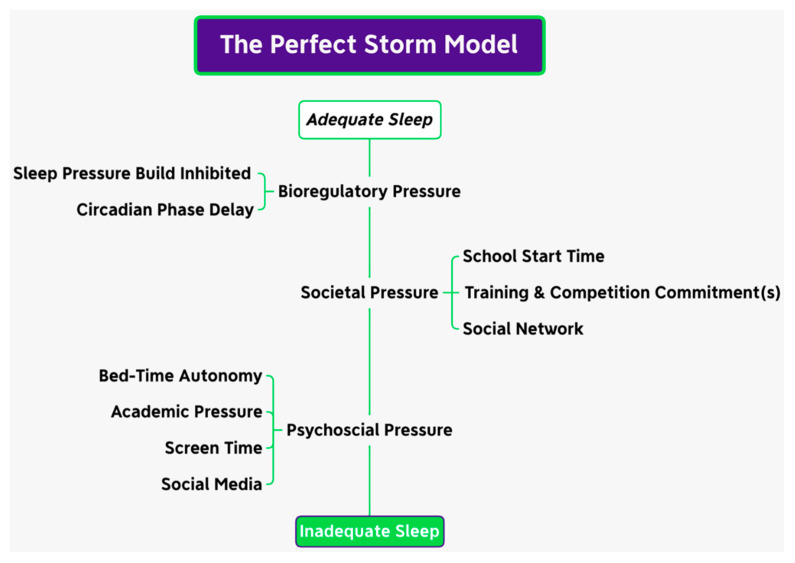
This narrative review explores the impact of sleep and nutrition on injury risk in adolescent athletes. Sleep is viewed as essential to the recuperation process and is distinguished as an active participant in recovery through its involvement in growth, repair, regeneration, and immunity. Furthermore, the literature has shown that the sleep of athletes impacts elements of athletic performance including both physical and cognitive performance, recovery, injury risk, and mental well-being. For sleep to have a restorative effect on the body, it must meet an individual’s sleep needs whilst also lasting for an adequate duration and being of adequate quality, which is age-dependent. The literature has suggested that athletes have increased sleep needs compared to those of the general population and thus the standard recommendations may not be sufficient for athletic populations. Therefore, a more individualised approach accounting for overall sleep health may be more appropriate for addressing sleep needs in individuals including athletes. The literature has demonstrated that adolescent athletes achieve, on average, ~6.3 h of sleep, demonstrating a discrepancy between sleep recommendations (8–10 h) and actual sleep achieved. Sleep–wake cycles undergo development during adolescence whereby adaptation occurs in sleep regulation during this phase. These adaptations increase sleep pressure tolerance and are driven by the maturation of physiological, psychological, and cognitive functioning along with delays in circadian rhythmicity, thus creating an environment for inadequate sleep during adolescence. As such, the adolescent period is a phase of rapid growth and maturation that presents multiple challenges to both sleep and nutrition; consequently, this places a significant burden on an adolescent athletes’ ability to recover, thus increasing the likelihood of injury. Therefore, this article aims to provide a comprehensive review of the available literature on the importance of sleep and nutrition interactions in injury risk in adolescent athletes. Furthermore, it provides foundations for informing further investigations exploring the relation of sleep and nutrition interactions to recovery during adolescence.
Overview
CoChat Summary
TL;DR
This narrative review examines how sleep and nutrition interact with recovery and injury risk in adolescent athletes, noting injury rates of ~1.4–6.4 per 1000 h during training and ~22.4 per 1000 h during competition. It concludes that poor sleep and inadequate diet are associated with higher injury risk, but evidence in adolescent athletes remains limited and largely subjective.
Key findings
- Adolescent athletes achieve, on average, ~6.3 h of sleep, below the 8–10 h recommendation; elite athletes may need ~8.3 h to feel rested.
- Sleep loss is associated with injury: adolescent athletes with <8 h sleep per night were 1.7 times more likely to sustain injury (95% CI 1.0–3.0; p = 0.04); decreasing sleep during high-volume intense training produced a 2.25-fold increase (95% CI 1.46–3.45; p < 0.001); and <8 h specifically gave a 1.31-fold increase (95% CI 0.97–1.78; p = 0.080). Actigraphy found wake after sleep onset predicted previous injury (OR = 1.144), time spent awake predicted injury occurrence (OR = 0.974), and increasing time spent awake by at least 1 min reduced future injury likelihood [F(2.36) = 6.512; p = 0.004].
- In 340 elite adolescent Swedish athletes, meeting recommended nutrition intake decreased injury risk by 64% (OR 0.36; 95% CI 0.14–0.91), and sleeping >8 h per weeknight decreased injury risk by 61% (OR 0.39; 95% CI 0.16–0.99).
- Nutrition knowledge is low in adolescent athletes, with mean scores ranging from 43.8 ± 11.4% to 48.85 ± 12.7%, lower than adult athletes (40.2 ± 12.4% to 70 ± 9%; overall NK% = 55.1 ± 10.7%); a weak positive relationship (r = >0.26) exists between nutrition knowledge and energy balance/dietary quality.
Methods
- Narrative review design, synthesizing available literature on sleep, nutrition, and injury risk in adolescent athletes.
- Data/sample: literature involving adolescent athletes, adult athletes, and general adolescent populations; cited studies include subjective questionnaires, actigraphy, and multiple nutrition knowledge assessment tools, with one analysis involving 340 elite adolescent Swedish athletes.
- Main analysis: narrative synthesis; no primary data collection or meta-analysis is reported, and the text does not describe a systematic search strategy, inclusion/exclusion criteria, or quality appraisal.
Limitations
- Stated limitations: limited research investigates the impact of both sleep and nutrition on injury risk in adolescent athletes; consensus is mainly informed by adult athletes and/or general adolescent populations; objective sleep measures such as actigraphy or polysomnography are scarce in adolescent athletes, so conclusions are inferred from subjective questionnaires and sleep diaries; many studies involve limited sample sizes, case studies, or cross-sectional investigations, limiting conclusions; future longitudinal research using objective sleep measures is warranted.
- Evident limitations: as a narrative review, it lacks a reported systematic search and quality appraisal, so selection and synthesis bias cannot be assessed; the paper also notes that nutrition knowledge research is difficult to infer because of multiple assessment tools.
Model-written summary. Check it against the paper before relying on it.
Integrity signals
Registry
Cites
Statistics
Figures
Verification
Claims the paper makes
0 Valid · 0 Not valid · 32 Not checked · 4 Own results and interpretations
In the paper
“Moreover, solely accounting for a decreased sleep volume resulted in a 1.46-fold (95% CI; 1.10–1.94; p < 0.01) increased risk”
§ Sleep, Nutrition, and Injury Risk in Adolescent Athletes: A Narrative Review > 9. Relationship between Sleep, Nutrition, and Injury Risk in Adolescent Athletes
What the sources say
- Not checked yetcites [163] Frohm, 2017, Multiple Factors Explain Injury Risk in Adolescent Elite Athletes: Applying a Biopsychosocial Perspective, Scand. J. Med. Sci. Sports source
plainstates a cause- Asserted: passes — The authors put it forward as true.
- Checkable: passes — It can be checked against evidence.
- Load-bearing: passes — The paper’s conclusions depend on it.
- Based: passes — The paper gives a reason why it holds.
In the paper
“while adolescent athletes who specifically reported that obtaining < 8 h of sleep resulted in a 1.31-fold (95% CI; 0.97–1.78; p = 0.080) increased injury risk [163].”
§ Sleep, Nutrition, and Injury Risk in Adolescent Athletes: A Narrative Review > 9. Relationship between Sleep, Nutrition, and Injury Risk in Adolescent Athletes
What the sources say
- Not checked yetcites [163] Frohm, 2017, Multiple Factors Explain Injury Risk in Adolescent Elite Athletes: Applying a Biopsychosocial Perspective, Scand. J. Med. Sci. Sports source
plainstates a cause- Asserted: passes — The authors put it forward as true.
- Checkable: passes — It can be checked against evidence.
- Load-bearing: unclear — It is unclear whether the paper’s conclusions depend on it.
- Based: passes — The paper gives a reason why it holds.
In the paper
“Furthermore, the researchers found that athletes who increased TA by at least 1 min reduced their likelihood of sustaining future injury ([F(2.36) = 6.512; p = 0.004]) [186].”
§ Sleep, Nutrition, and Injury Risk in Adolescent Athletes: A Narrative Review > 9. Relationship between Sleep, Nutrition, and Injury Risk in Adolescent Athletes
What the sources say
- Not checked yetcites [186] Viegas, 2022, The Sleep as a Predictor of Musculoskeletal Injuries in Adolescent Athletes, Sleep Sci. source
plainstates a cause- Asserted: passes — The authors put it forward as true.
- Checkable: passes — It can be checked against evidence.
- Load-bearing: unclear — It is unclear whether the paper’s conclusions depend on it.
- Based: passes — The paper gives a reason why it holds.
In the paper
“Furthermore, it was reported that athletes who slept for more than 8 h per weeknight decreased their injury risk by 61% (OR, 0.39; 95% CI, 0.16–0.99) [162].”
§ Sleep, Nutrition, and Injury Risk in Adolescent Athletes: A Narrative Review > 9. Relationship between Sleep, Nutrition, and Injury Risk in Adolescent Athletes
What the sources say
- Not checked yetcites [162] Frohm, 2017, Too Little Sleep and an Unhealthy Diet Could Increase the Risk of Sustaining a New Injury in Adolescent Elite Athletes, Scand. J. Med. Sci. Sports source
plainstates a cause- Asserted: passes — The authors put it forward as true.
- Checkable: passes — It can be checked against evidence.
- Load-bearing: unclear — It is unclear whether the paper’s conclusions depend on it.
- Based: passes — The paper gives a reason why it holds.
In the paper
“Research using subjective questionnaires have purported that adolescent athletes who experience < 8 h of sleep per night are 1.7 times (95% CI; 1.0–3.0; p = 0.04) more likely to sustain an injury [45].”
§ Sleep, Nutrition, and Injury Risk in Adolescent Athletes: A Narrative Review > 9. Relationship between Sleep, Nutrition, and Injury Risk in Adolescent Athletes
What the sources say
- Not checked yetcites [45] Milewski, 2014, Chronic Lack of Sleep Is Associated with Increased Sports Injuries in Adolescent Athletes, J. Pediatr. Orthop. source
hedgedstates an association- Asserted: passes — The authors put it forward as true.
- Checkable: passes — It can be checked against evidence.
- Load-bearing: unclear — It is unclear whether the paper’s conclusions depend on it.
- Based: passes — The paper gives a reason why it holds.
14 more claims
Create a free account to see all 36 claims and to verify the 122 references still open.
- It may state two separate claims as one. 17
- Probably not a substantial claim. 1
Claims other papers make about this one
Each is checked against this paper’s own text: does it say what the citing paper says it does?
In the citing paper
“Several factors may increase the risk of injury in youth and adolescent athletes, including early sports specialisation; high volume training loads; and inadequate dietary intake to support growth, development, sports performance, and recovery [6,7,8].”
From Youth and Adolescent Athlete Musculoskeletal Health: Dietary and Nutritional Strategies to Optimise Injury Prevention and Support Recovery (2024) · cites this paper as [7]
Self-check
Percentages, sums and reported differences re-computed from the paper’s own numbers.
Each contradiction between two passages listed here was confirmed by an independent check.
Rated major: it would touch a result — a value a result rests on, reported and recomputed p-values on opposite sides of the significance level, two passages that conflict with no sign which is right, or a cited work retracted before this paper was published.
In the paper
§ Sleep, Nutrition, and Injury Risk in Adolescent Athletes: A Narrative Review > 11. Conclusions
“compromised sleep (OR, 0.39; 95% CI, 0.16–0.99) and an inadequate diet (OR, 0.36; 95% CI, 0.14–0.91) may increase the likelihood of injury occurrence”
§ Sleep, Nutrition, and Injury Risk in Adolescent Athletes: A Narrative Review > 9. Relationship between Sleep, Nutrition, and Injury Risk in Adolescent Athletes
“athletes who slept for more than 8 h per weeknight decreased their injury risk by 61% (OR, 0.39; 95% CI, 0.16–0.99)”
Rated minor: it would not touch a result — a value no result rests on, a p-value that stays on the same side of the significance level, or a conflict that is clerical, resolved elsewhere in the paper, or outside its own findings.
In the paper
§ Sleep, Nutrition, and Injury Risk in Adolescent Athletes: A Narrative Review > 11. Conclusions
“compromised sleep (OR, 0.39; 95% CI, 0.16–0.99) and an inadequate diet (OR, 0.36; 95% CI, 0.14–0.91) may increase the likelihood of injury occurrence”
§ Sleep, Nutrition, and Injury Risk in Adolescent Athletes: A Narrative Review > 9. Relationship between Sleep, Nutrition, and Injury Risk in Adolescent Athletes
“athletes who reached the recommended nutrition intake decreased their injury risk by 64% (OR, 0.36; 95% CI, 0.14–0.91)”
Citations
Cites
National Sleep Foundation's sleep time duration recommendations: methodology and results summary.
Hirshkowitz, M., Whiton, K., Albert, S. M., Alessi, C., Bruni, O., DonCarlos, L., Hazen, N., Herman, J., Katz, E. S., Kheirandish-Gozal, L., et al. (2015) · Sleep Health · doi:10.1016/j.sleh.2014.12.010 · Cited by 4,404 · cited 3×
“…sleep durations, which includes recommendations The literature has suggested that athletes have increased sleep needs, and thus the general recommendations may not be sufficient for athletic populations [23,63]. for the following: adolescents (8–10 h), adults (7–9 h), and older adults (7–8 h) [46].”
BackgroundTwo-Process Model of Sleep Regulation
(2009) · Encyclopedia of Neuroscience · doi:10.1007/978-3-540-29678-2_6166 · Cited by 3,899
Impact of sleep debt on metabolic and endocrine function
Spiegel, K., Leproult, R., & Van Cauter, E. (1999) · The Lancet · doi:10.1016/s0140-6736(99)01376-8 · Cited by 3,668
Ohayon, M. M., Carskadon, M. A., Guilleminault, C., & Vitiello, M. V. (2004) · Sleep · doi:10.1093/sleep/27.7.1255 · Cited by 3,349
Growth, Maturation, and Physical Activity
Malina, R. M., Bouchard, C., & Bar-Or, O. (2004) · Human Kinetics eBooks · doi:10.5040/9781492596837 · Cited by 3,277
Adolescence: A foundation for future health
Sawyer, S. M., Afifi, R. A., Bearinger, L. H., Blakemore, S.-J., Dick, B., Ezeh, A. C., & Patton, G. C. (2012) · The Lancet · doi:10.1016/s0140-6736(12)60072-5 · Cited by 2,635
Sleep Health: Can We Define It? Does It Matter?
Buysse, D. J. (2014) · Sleep · doi:10.5665/sleep.3298 · Cited by 2,536
Spiegel, K., Tasali, E., Penev, P., & Cauter, E. V. (2004) · Annals of Internal Medicine · doi:10.7326/0003-4819-141-11-200412070-00008 · Cited by 2,459
Adverse metabolic and cardiovascular consequences of circadian misalignment
Scheer, F. A. J. L., Hilton, M. F., Mantzoros, C. S., & Shea, S. A. (2009) · Proceedings of the National Academy of Sciences · doi:10.1073/pnas.0808180106 · Cited by 2,351
Sleep-dependent memory consolidation
Stickgold, R. (2005) · Nature · doi:10.1038/nature04286 · Cited by 1,857 · cited 1×
“REM sleep facilitates neurological regeneration, learning, memory, and emotional regulation [27,29,30].”
Background
Research works printed but not linked: 6
- Kryger, M.H., Roth, T., and Dement, W.C. (2005). Principles and Practice of Sleep Medicine, W.B. Saunders. [4th ed.].
- Kryger, M.H., Roth, T., and Dement, W.C. (2017). Principles and Practice of Sleep Medicine, Elsevier. [6th ed.].
- Hannon, M.P., Unnithan, V., Morton, J.P., and Close, G.L. (2019). Strength and Conditioning for Young Athletes, Routledge.
- Coutts, A., Crowcroft, S., and Kempton, T. (2017). Sport, Recovery and Performance: Interdisciplinary Insights, Routledge.
- Selye, H. (1956). The Stress of Life, McGraw-Hill.
- Read, M., Rietveld, R., Deigan, D., Birnie, M., Mason, L., and Centofanti, A. (2022). Peak Performance for Soccer, Routledge.
Cited by
Alcock, R., Hislop, M., Vidgen, H. A., & Desbrow, B. (2024) · Journal of Functional Morphology and Kinesiology · doi:10.3390/jfmk9040221 · Cited by 33
Real-Time Athlete Fatigue Monitoring Using Fuzzy Decision Support Systems
Li, A. (2025) · International Journal of Computational Intelligence Systems · doi:10.1007/s44196-025-00732-8 · Cited by 22
The Sleep, Recovery, and Nutrition Characteristics of Elite Adolescent Athletes
Mason, L., Connolly, J., Devenney, L. E., Lacey, K., O’Donovan, J., Faulkner, M., & Doherty, R. (2025) · Sports · doi:10.3390/sports13020050 · Cited by 17
Self-citationMechanism of Action and Beneficial Effects of Probiotics in Amateur and Professional Athletes
Nami, Y., Barghi, A., Shahgolzari, M., Salehian, M., & Haghshenas, B. (2024) · Food Science & Nutrition · doi:10.1002/fsn3.4658 · Cited by 16
Xu, Z., Sun, W., Qian, H., & Yao, M. (2025) · BMC Medical Informatics and Decision Making · doi:10.1186/s12911-025-03331-x · Cited by 14
The Impact of Sleep on Athletes Performance and Injury Risk: A Narrative Review
Rygielski, A., Melnyk, B., Latour, E. E., Latour, M., Judek, R., Kowalczyk, Z., Stanek, A., & Płudowska, K. (2024) · Quality in Sport · doi:10.12775/qs.2024.19.54333 · Cited by 12
Hu, S., Li, W., Chen, Y., Li, N., Lou, S., Shao, Y., Guo, Y., Sun, Q., Ni, Z., Dong, L., et al. (2025) · BMC Psychiatry · doi:10.1186/s12888-025-06839-8 · Cited by 10
Gao, Y., & Wang, L. (2024) · Frontiers in Nutrition · doi:10.3389/fnut.2024.1382068 · Cited by 8
Relationship Between Poor Sleep and Depressive Symptoms in Korean Elite Youth Athletes
Choi, Y., Kim, S., Park, S. H., Kim, K. T., Kim, R. K., Kwak, H., & Cho, J. (2025) · Journal of Clinical Medicine · doi:10.3390/jcm14020479 · Cited by 8
Finnegan, E., Daly, E., & Ryan, L. (2025) · Current Developments in Nutrition · doi:10.1016/j.cdnut.2025.107507 · Cited by 7
Souabni, M. J., Souabni, M., Hammouda, O., & Driss, T. (2024) · Children · doi:10.3390/children11091044 · Cited by 7
Cheng, F., Al-Hashimy, H. N. H., & Yao, J. (2025) · Scientific Reports · doi:10.1038/s41598-025-30359-w · Cited by 5
Afonso, P., Forte, P. M., Branquinho, L., Ferraz, R. M. P., Garrido, N. D., & Teixeira, J. E. (2025) · Healthcare · doi:10.3390/healthcare13243301 · Cited by 5
Ye, Y., & Wang, Y. (2025) · Frontiers in Pediatrics · doi:10.3389/fped.2025.1650588 · Cited by 5
Johnson, D. M., Eisenmann, J. C., Lawson, R., Stables, R. G., Williams, S., Cumming, S. P., & Lloyd, R. S. (2025) · Strength and conditioning journal · doi:10.1519/ssc.0000000000000920 · Cited by 4
Chen, J., Deng, B., He, T., He, J., Li, D., Lu, M., & Sun, J. (2025) · PeerJ · doi:10.7717/peerj.19928 · Cited by 4
Abrahamson, J., Sandstedt, E., Sansone, M., & Lindman, I. (2025) · BMJ Open Sport & Exercise Medicine · doi:10.1136/bmjsem-2025-002699 · Cited by 4
Prevalence and injury profiles for recreational padel players: A cross-sectional survey-based study
Declève, P., Nourissat, G., Neyens, D., Cools, A. M. J., & Borms, D. (2025) · Physical Therapy in Sport · doi:10.1016/j.ptsp.2025.07.002 · Cited by 4
Hofmann, H. S., Kramer, C., Schmidt, N. M., Lachmann, J., Trillmich, L., Sand, M., Froböse, I., & Biallas, B. (2025) · BMC Sports Science Medicine and Rehabilitation · doi:10.1186/s13102-025-01367-0 · Cited by 3
Sleep and lucid dreaming in adolescent athletes and non-athletes
Bonamino, C., Watling, C. N., & Polman, R. C. J. (2024) · Journal of Sports Sciences · doi:10.1080/02640414.2024.2401687 · Cited by 2
“It’s never just one thing”: understanding risk factors for sports injuries in track and field
Weerasinghe, K., Jayawardena, R., Nanayakkara, I., & Hills, A. P. (2026) · BMC Sports Science Medicine and Rehabilitation · doi:10.1186/s13102-026-01719-4 · Cited by 2
The importance of recovery and nutrition for the healthy development of a young athlete
Pastucha, D., Skalská, M., & Střítecká, H. (2025) · Pediatrie pro praxi · doi:10.36290/ped.2025.008 · Cited by 1
Salsabila, R., Sopiah, P., & Rosyda, R. (2025) · Jurnal Keperawatan · doi:10.22219/jk.v16i1.38750 · Cited by 1
A field experiment of sleep extension and precision performance in young archers
Prasetyo, R. A. B., Amanda, & Falahi, H. H. (2026) · International Journal of Adolescence and Youth · doi:10.1080/02673843.2026.2683718 · Cited by 1
Kaczmarek, F., Matecka, M., Bartkowiak-Wieczorek, J., Kmiecik, M., Kaczmarek, K., Gajniak, P., Fiutak, M., Stężycka, J., Krupa, K. K., Marchwiak, S., et al. (2026) · Journal of Clinical Medicine · doi:10.3390/jcm15176582 · Cited by 1
Sleep, Dietary Patterns, and Energy Availability Status in Adolescent Female Artistic Gymnasts
K. Eberhardt, H., J. Ormsbee, M., & G. Saracino, P. (2026) · International Journal of Exercise Science · doi:10.70252/ijes2026218
Upplevelser av aktivitetsbalans hos elever på gymnasieskola med idrottsinriktning
Karlsson, L., & Edinge, R. (2025) · Lund University Publications Student Papers (Lund University)
Kunnari, J., & Portin, J. (2024) · Theseus (Ammattikorkeakoulujen)
THE IMPORTANCE OF SLEEP AND THE CONSEQUENCES OF SLEEP DEPRIVATION
Walczak, D., Kruk, A., Białoń, A., Nowak, W. E., Harbut, P., Jurczenko, L., Gawłowski, I., Dorosz, A., Jakubowska, K., & Miśta, A. (2025) · International Journal of Innovative Technologies in Social Science · doi:10.31435/ijitss.4(48).2025.4375
Narrative Review of Overuse Injuries, Risk Factors, and Monitoring Tools in Youth SwimmersPreprint
Paruchuri, S. (2026) · doi:10.58445/rars.3573
Relationship between sleep quality, nutrition habits and body composition: A study on young athletes
Asan, S., Karababa, B., Canyurt, F., Toprak, H., Özdemir, E., & Belošević, D. (2026) · Journal of Physical Education and Sport · doi:10.7752/jpes.2026.01018
Vlahoyiannis, A., Tsouloupas, C. N., Stavrinou, P. S., Andreou, P., Lysandrou, P., Shiantonas, S., & Giannaki, C. D. (2026) · International Journal of Sports Science & Coaching · doi:10.1177/17479541261421009
Herbella, J. M., Gigena, S., & Mattei, B. (2026) · Argentinian Journal of Respiratory & Physical Therapy · doi:10.58172/ajrpt.v8i1.403
Mason, L., Connolly, J., Devenney, L. E., Lacey, K., Faulkner, M., & Doherty, R. (2026) · Biology of Sport · doi:10.5114/biolsport.2026.158301
Self-citationBeneficial effect of napping on mood and cognitive performance in adolescent athletes
Souabni, M. J., Souabni, M., Hammouda, O., & Driss, T. (2026) · Journal of Sports Sciences · doi:10.1080/02640414.2026.2640330
Souabni, M. J., Souabni, M., Hammouda, O., Nédélec, M., Ammar, A., & Driss, T. (2026) · Biology of Sport · doi:10.5114/biolsport.2026.159567
Impact of Sports Science-Based Training Programs on Athletic Performance and Injury Prevention
Khan, D. S., Awais, D. M., Baig, M. A., & Jan, A. (2026) · Social science review archives. · doi:10.70670/sra.v4i1.1955
Mar‘atusalihat, S., Ghrahani, R., & Tarigan, R. (2026) · Pediatric Rheumatology · doi:10.1186/s12969-026-01216-5
La santé physique et le sommeil : un duo essentiel
Nagaishi, M., Fottorino, Z., & Spruyt, K. (2026) · Cahiers de la Puéricultrice · doi:10.1016/j.cahpu.2026.03.012
Value-Based Care for Pediatric Female Athletes
Elliott, K., & McCambridge, T. M. (2026) · Springer eBooks · doi:10.1007/978-3-032-19570-8_22
Polvikipuinen nuori urheilija : video-opas harjoitteluun
Pöntiö, K., & Löytty, S. (2026) · Theseus (Ammattikorkeakoulujen)
Sillanpää, N., & Vehmanen, S. (2026) · Jyväskylä University Digital Archive (University of Jyväskylä)
Baranowski, S., Lewańska, J., Bogdański, K., Kruszyńska, Z., Aleshchyk, A., Adamczak, M., Majewski, M., Libura, B., Lazar, M., & Szkaradowski, Ł. (2026) · Quality in Sport · doi:10.12775/qs.2026.67.74336
A Narrative Review of Overuse Injuries, Risk Factors, and Monitoring Tools in Youth Swimmers
Paruchuri, S. (2026) · American journal of student research. · doi:10.70251/hyjr2348.45178188
Effects of Multi-Day Gobi Endurance Trekking on Foot Morphology in Male AdolescentsPreprint
Wang, J., Jia, S., Xian, T., Wei, J., Shi, T., Liu, H., Liu, Z., Zhu, J., & Ren, S. (2026) · Research Square · doi:10.21203/rs.3.rs-10675511/v1
Sleep Disturbances and Sports Injury Risk: A Narrative Review
Kiełbasa, B., Kowalczyk, O., Pagacz, K., Kolasa, W., Lis, M., Stadnik, A., Jędryka, M., Gatniejewska, J., & Kaczorek, M. (2026) · Quality in Sport · doi:10.12775/qs.2026.71.75024
Marrouh, A., Haddouchi, A. E., Kartti, S., Fahime, E. E., Boutayeb, S., Chagar, Y., Baudot, C., Belyamani, L., Dakka, T., & Eljaoudi, R. (2026) · Frontiers in Systems Biology · doi:10.3389/fsysb.2026.1858521
Harries, S. L., Clayton, D. J., Johnson, M. A., & Varley, I. (2026) · Exercise Sport and Movement · doi:10.1249/esm.0000000000000072
How Insufficient Sleep May Increase the Risk of Injury in Athletes
Ali, S. (2026) · Theoretical and Natural Science · doi:10.54254/2753-8818/2026.38526
Metadata
- Authors
- Mason, L., Connolly, J., Devenney, L. E., Lacey, K., O’Donovan, J., & Doherty, R.
- Affiliations
- Atlantic Technological University (IE)
- The Open University (GB)
- Dublin City University (IE)
- Corresponding author
- Mason, Lorcán
- Venue
- Nutrients
- Publisher
- MDPI AG
- Published
- 2023-12-13
- Volume
- 15
- Issue
- 24
- Pages
- 5101
- ISSN
- 2072-6643 (ISSN-L)
- PMC
- PMC10745648
- OpenAlex
- W4389670054
- Cited by
- 50
- References
- 182
- Citations by year
- 2026: 25 · 2025: 18 · 2024: 7
- FWCI
- 2.29
- Type
- journal article
- Language
- en
- Open access
- gold
- doi.org
- Licence
- Locations
- Nutrients (publishedVersion, cc-by)
- PubMed Central (publishedVersion, cc-by)
- PubMed (publishedVersion)
- Ulster University Research Portal (Ulster University) (publishedVersion, cc-by)
- Open Research Online (The Open University) (acceptedVersion)
- Funders
- the Atlantic Technological University of Donegal President’s Research Bursary
- Topics
- Health Sciences › Medicine › Orthopedics and Sports Medicine › Sports injuries and prevention
- Social Sciences › Psychology › Experimental and Cognitive Psychology › Sleep and related disorders
- Health Sciences › Medicine › Orthopedics and Sports Medicine › Sports Performance and Training
- Keywords
- sleep, nutrition, injury risk, youth athletes, sleep need, circadian rhythm, sleep regulation, recovery, athletic performance, psychological well-being
- MeSH terms
- Adolescent, Circadian Rhythm, Humans, Nutritional Status, Sleep, Athletic Performance, Athletes
About these checks
Registry, retraction, Cites and statistics results are computed, not judged, with one exception: a printed reference that no index lists is read once by a model before it counts as a citation error. Claims are extracted by a model and kept only when their quote appears verbatim in the text; each cited source is then checked, with a model’s help, for whether it says what the claim relies on. Those verdicts can be wrong — read the claim’s quote and the cited source before relying on one.
A language model drew the claims from the paper on 2026-11-14, under version 3 of the claim definition (model deepseek-v4.1-flash, prompt extract-v3).
A second model labelled each claim on 2026-11-14 (model jev-1.13-20260917, definition revision gold-guideline-v0.2).
Statistics and arithmetic are recomputed, not judged.
Confidence bands are shown only for fields calibrated on our annotated test set. None is calibrated yet, so no band is shown.
What counts as a claim ›How we measure confidence ›How we check this ›
Are you an author, or do you see a problem with this page? Request a review
Data sources
Bibliographic data: Semantic Scholar, OpenAlex, Crossref.
Contains information from the Semantic Scholar Academic Graph Datasets, made available under the ODC Attribution License (ODC-BY 1.0).
Semantic Scholar’s data is described in: Kinney, R., et al. (2023). The Semantic Scholar Open Data Platform. arXiv:2301.10140.
