

The DOI matches its Crossref record; 43 of the 43 references it cites were found in a registry or an index; none of the 29 sources its claims cite is checked for support yet.
Curcumin Supplementation Improves Gastrointestinal Symptoms in Women with Severe Obesity: A Double-Blind, Randomized, Placebo-Controlled Trial—A Pilot Study
Open accessAbstract
Gastrointestinal symptoms, including reflux, bloating, dyspepsia, stomach pain, and altered bowel patterns, are commonly reported in individuals with severe obesity and may significantly impact quality of life. Background/Objectives: Curcumin, a bioactive compound found in turmeric (Curcuma longa L.), possesses anti-inflammatory and antioxidant properties and has been investigated for its potential role in gastrointestinal health. However, its effects in individuals with severe obesity remain unclear. Methods: This double-blind, placebo-controlled clinical trial aimed to evaluate the effect of curcumin supplementation on gastrointestinal symptoms in women with severe obesity. Thirty-one women with a body mass index (BMI) ≥ 40 kg/m2 undergoing bariatric surgery were randomized to receive either 1500 mg of curcumin (98.75%) or a placebo (1500 mg corn starch) daily for 13 weeks. Gastrointestinal symptoms were assessed using the Gastrointestinal Symptom Rating Scale (GSRS), and stool consistency was assessed using the Bristol Stool Scale. Anthropometric measurements were also collected. Results: Participants had an average age of 33.1 ± 8 years and a BMI of 45.6 ± 3.31 kg/m2. No differences were observed between groups at baseline. At the end of the study, the curcumin group showed a significant reduction in the GSRS’s total score compared to the placebo group (p = 0.002), with improvements in eructation (p = 0.011) and constipation (p = 0.007). Additionally, the curcumin group showed reduced BMI (p = 0.019) and neck circumference (p = 0.042). Conclusions: These findings suggest that curcumin supplementation may alleviate some gastrointestinal symptoms and improve anthropometric measures in women with severe obesity, providing a potential dietary strategy.
Overview
CoChat Summary
TL;DR
In a 13-week double-blind pilot RCT, curcumin supplementation (1500 mg/day) improved total gastrointestinal symptoms and some anthropometric measures in women with severe obesity compared with placebo. The authors conclude curcumin may be a promising adjunctive strategy, but the small pilot sample limits interpretation.
Key findings
- The curcumin group showed a significant reduction in total GSRS score versus placebo (p = 0.002); within-group total GSRS decreased by 7.36 points (p = 0.003; d = −1.17).
- Specific improvements were reported for eructation (p = 0.011; d = −0.858) and constipation (p = 0.007; d = 0.562), while stool consistency on the Bristol Stool Scale did not significantly change in either group.
- Curcumin supplementation was associated with reduced BMI (−4.0 kg/m²; p = 0.019; d = 0.017) and neck circumference (p = 0.042; d = 0.440); no significant changes were observed in the placebo group.
- No significant between-group differences in dietary intake were detected at baseline or post-intervention, although the placebo group increased protein intake (p = 0.002) and reduced carbohydrate intake (p = 0.002) from baseline.
Methods
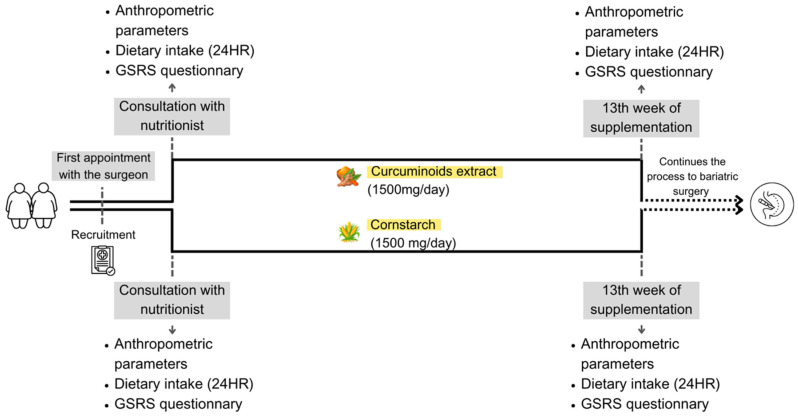
- Double-blind, randomized, placebo-controlled pilot trial in women with severe obesity (BMI ≥ 40 kg/m²) undergoing bariatric surgery; participants received either 1500 mg/day curcumin or 1500 mg/day corn starch placebo for 13 weeks.
- Thirty-one women were randomized; average age was 33.1 ± 8 years and BMI 45.6 ± 3.31 kg/m². Gastrointestinal symptoms were assessed with the GSRS, stool consistency with the Bristol Stool Scale, and anthropometric measurements were collected.
- Analyses used delta values, independent t-tests or Mann–Whitney U tests, paired t-tests or Wilcoxon signed-rank tests, and ANCOVA adjusting for BMI, protein intake, and carbohydrate intake; significance was set at p < 0.05. Post hoc power was 1 − β = 0.64.
Limitations
- The paper states that curcumin’s poor bioavailability may have limited effects, gut microbiota composition, intestinal biomarkers, and microbial metabolites were not measured, participants were engaged in multidisciplinary preoperative care, and the small sample size means conclusions should be interpreted cautiously as a pilot study.
- The paper also states that participants were not recruited based on gastrointestinal symptoms because this was a sub-study of a broader trial focused on adipose tissue outcomes.
- Evident from the text: the achieved post hoc power was 0.64, and the 13-week duration may be insufficient to detect changes in symptoms with more complex pathophysiological mechanisms; GSRS outcomes were self-reported.
Model-written summary. Check it against the paper before relying on it.
Integrity signals
Registry
Cites
Statistics
Figures
Verification
Claims the paper makes
0 Valid · 0 Not valid · 24 Not checked · 35 Own results and interpretations
A result the paper reports from its own data — it cites no other source for it, so there is none to check. The quote shows it is in the paper.
In the paper
“Regarding anthropometric outcomes, a significant reduction in BMI (−4.0 kg/m2; p = 0.019; d = 0.017) and neck circumference (p = 0.042; d = 0.440) were observed in the curcumin group.”
§ Curcumin Supplementation Improves Gastrointestinal Symptoms in Women with Severe Obesity: A Double-Blind, Randomized, Placebo-Controlled Trial—A Pilot Study > 3. Results > Sample Description
plainstates a cause- Asserted: passes — The authors put it forward as true.
- Checkable: passes — It can be checked against evidence.
- Load-bearing: unclear — It is unclear whether the paper’s conclusions depend on it.
- Based: passes — The paper gives a reason why it holds.
- Rests on an assumption not shown here.
A result the paper reports from its own data — it cites no other source for it, so there is none to check. The quote shows it is in the paper.
In the paper
“These changes were not observed in the placebo group (Table 1).”
§ Curcumin Supplementation Improves Gastrointestinal Symptoms in Women with Severe Obesity: A Double-Blind, Randomized, Placebo-Controlled Trial—A Pilot Study > 3. Results > Sample Description
plain- Asserted: passes — The authors put it forward as true.
- Checkable: passes — It can be checked against evidence.
- Load-bearing: unclear — It is unclear whether the paper’s conclusions depend on it.
- Based: passes — The paper gives a reason why it holds.
A result the paper reports from its own data — it cites no other source for it, so there is none to check. The quote shows it is in the paper.
In the paper
“No significant changes in gastrointestinal symptoms were observed in the placebo group.”
§ Curcumin Supplementation Improves Gastrointestinal Symptoms in Women with Severe Obesity: A Double-Blind, Randomized, Placebo-Controlled Trial—A Pilot Study > 3. Results > Sample Description
plain- Asserted: passes — The authors put it forward as true.
- Checkable: passes — It can be checked against evidence.
- Load-bearing: passes — The paper’s conclusions depend on it.
- Based: passes — The paper gives a reason why it holds.
A result the paper reports from its own data — it cites no other source for it, so there is none to check. The quote shows it is in the paper.
In the paper
“At the end of the study, the curcumin group showed a significant reduction in the GSRS’s total score compared to the placebo group (p = 0.002)”
§ Curcumin Supplementation Improves Gastrointestinal Symptoms in Women with Severe Obesity: A Double-Blind, Randomized, Placebo-Controlled Trial—A Pilot Study > Abstract
plainstates a cause- Asserted: passes — The authors put it forward as true.
- Checkable: passes — It can be checked against evidence.
- Load-bearing: passes — The paper’s conclusions depend on it.
- Based: passes — The paper gives a reason why it holds.
- Rests on an assumption not shown here.
A result the paper reports from its own data — it cites no other source for it, so there is none to check. The quote shows it is in the paper.
In the paper
“Specific symptoms that improved included eructation (p = 0.011; d = −0.858) and constipation (p = 0.007; d = 0.562) (Table 2).”
§ Curcumin Supplementation Improves Gastrointestinal Symptoms in Women with Severe Obesity: A Double-Blind, Randomized, Placebo-Controlled Trial—A Pilot Study > 3. Results > Sample Description
plainstates a cause- Asserted: passes — The authors put it forward as true.
- Checkable: passes — It can be checked against evidence.
- Load-bearing: passes — The paper’s conclusions depend on it.
- Based: passes — The paper gives a reason why it holds.
- Rests on an assumption not shown here.
17 more claims
Create a free account to see all 59 claims and to verify the 29 references still open.
- Probably not a substantial claim. 26
- It may state two separate claims as one. 19
Self-check
Percentages, sums and reported differences re-computed from the paper’s own numbers.
Each contradiction between two passages listed here was confirmed by an independent check.
Rated minor: it would not touch a result — a value no result rests on, a p-value that stays on the same side of the significance level, or a conflict that is clerical, resolved elsewhere in the paper, or outside its own findings.
In the paper
§ Curcumin Supplementation Improves Gastrointestinal Symptoms in Women with Severe Obesity: A Double-Blind, Randomized, Placebo-Controlled Trial—A Pilot Study > 3. Results > Sample Description
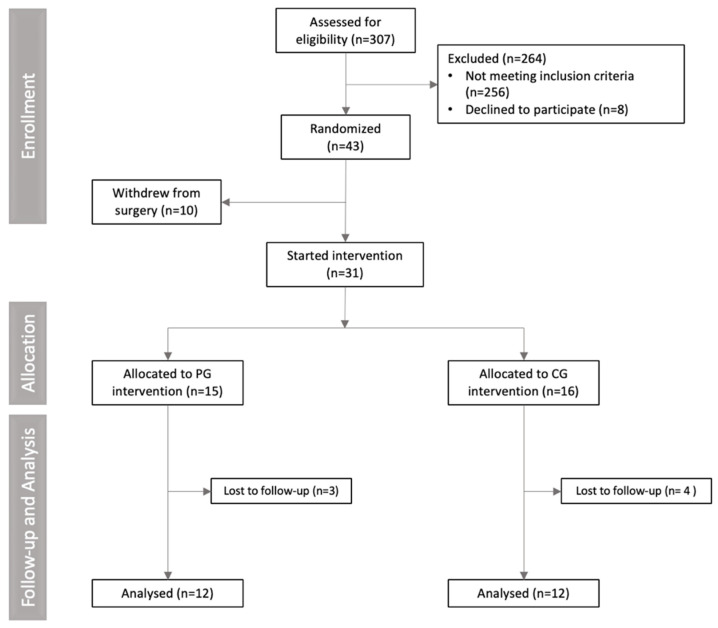
“Consequently, 31 participants were randomized into the curcumin or placebo groups and completed the study.”
§ Curcumin Supplementation Improves Gastrointestinal Symptoms in Women with Severe Obesity: A Double-Blind, Randomized, Placebo-Controlled Trial—A Pilot Study > 3. Results > Sample Description
“A total of seven participants withdrew from the study.”
Rated minor: it would not touch a result — a value no result rests on, a p-value that stays on the same side of the significance level, or a conflict that is clerical, resolved elsewhere in the paper, or outside its own findings.
In the paper
§ Curcumin Supplementation Improves Gastrointestinal Symptoms in Women with Severe Obesity: A Double-Blind, Randomized, Placebo-Controlled Trial—A Pilot Study > Abstract
“1500 mg of curcumin (98.75%)”
§ Curcumin Supplementation Improves Gastrointestinal Symptoms in Women with Severe Obesity: A Double-Blind, Randomized, Placebo-Controlled Trial—A Pilot Study > 2. Materials and Methods > 2.2. Experimental Design and Randomization
“capsules containing curcumin (97.85%)”
Rated minor: it would not touch a result — a value no result rests on, a p-value that stays on the same side of the significance level, or a conflict that is clerical, resolved elsewhere in the paper, or outside its own findings.
In the paper
“A total of 307 volunteers were assessed for eligibility. Of these, 274 were excluded for not meeting the inclusion criteria (n = 256), declining to participate (n = 8), or withdrawing from surgery (n = 10). Consequently, 31 participants were randomized into the curcumin or placebo groups and completed the study.”
§ Curcumin Supplementation Improves Gastrointestinal Symptoms in Women with Severe Obesity: A Double-Blind, Randomized, Placebo-Controlled Trial—A Pilot Study > 3. Results > Sample Description
Reported 31 · recomputed 33
Citations
Cites
Definition and diagnostic criteria of clinical obesity
Rubino, F., Cummings, D. E., Eckel, R. H., Cohen, R. V., Wilding, J. P. H., Brown, W. A., Stanford, F. C., Batterham, R. L., Farooqi, I. S., Farpour-Lambert, N. J., et al. (2025) · The Lancet Diabetes & Endocrinology · doi:10.1016/s2213-8587(24)00316-4 · Cited by 1,811
Conway, J. M., Ingwersen, L. A., Vinyard, B. T., & Moshfegh, A. J. (2003) · The American Journal of Clinical Nutrition · doi:10.1093/ajcn/77.5.1171 · Cited by 820
Stephen, A. M., Champ, M. M.-J., Cloran, S. J., Fleith, M., van Lieshout, L., Mejborn, H., & Burley, V. J. (2017) · Nutrition Research Reviews · doi:10.1017/s095442241700004x · Cited by 798
Polyphenol-Mediated Gut Microbiota Modulation: Toward Prebiotics and Further
Rodríguez-Daza, M. C., Pulido-Mateos, E. C., Lupien-Meilleur, J., Guyonnet, D., Desjardins, Y., & Roy, D. (2021) · Frontiers in Nutrition · doi:10.3389/fnut.2021.689456 · Cited by 474
Comparative Absorption of a Standardized Curcuminoid Mixture and Its Lecithin Formulation
Cuomo, J., Appendino, G., Dern, A. S., Schneider, E., McKinnon, T. P., Brown, M. J., Togni, S., & Dixon, B. M. (2011) · Journal of Natural Products · doi:10.1021/np1007262 · Cited by 339
Mohammadi, A., Sahebkar, A., Iranshahi, M., Amini, M., Khojasteh, R., Ghayour‐Mobarhan, M., & Ferns, G. A. (2013) · Phytotherapy Research · doi:10.1002/ptr.4715 · Cited by 277
Jazayeri-Tehrani, S. A., Rezayat, S. M., Mansouri, S., Qorbani, M., Alavian, S. M., Daneshi‐Maskooni, M., & Hosseinzadeh‐Attar, M. J. (2019) · Nutrition & Metabolism · doi:10.1186/s12986-019-0331-1 · Cited by 212
Esmaily, H., Sahebkar, A., Iranshahi, M., Ganjali, S., Mohammadi, A., Ferns, G. A., & Ghayour‐Mobarhan, M. (2015) · Chinese Journal of Integrative Medicine · doi:10.1007/s11655-015-2160-z · Cited by 206
Adipose tissue derived bacteria are associated with inflammation in obesity and type 2 diabetes
Massier, L., Chakaroun, R., Tabei, S., Crane, A., Didt, K. D., Fallmann, J., von Bergen, M., Haange, S.-B., Heyne, H., Stumvoll, M., et al. (2020) · Gut · doi:10.1136/gutjnl-2019-320118 · Cited by 194 · cited 1×
“Individuals with obesity also exhibit increased intestinal permeability to bacterial products such as lipopolysaccharide, which contribute to systemic inflammation [4].”
Therapeutic potential of curcumin in digestive diseases
Dulbecco, P. (2013) · World Journal of Gastroenterology · doi:10.3748/wjg.v19.i48.9256 · Cited by 139
Cited by
Mahdi, L., Graziani, A., Baffy, G., Mitten, E. K., Portincasa, P., & Khalil, M. (2025) · Nutrients · doi:10.3390/nu17172793 · Cited by 112
Vanishing ethnomedicinal wisdom: A survey of indigenous plant-based healing in Rangamati, Bangladesh
Ope, M. S., Rafin, M. R., Bussmann, R. W., & Ashrafuzzaman, M. (2025) · Ethnobotany Research and Applications · doi:10.32859/era.33.40.1-19 · Cited by 1
Hu, J., Fan, D., Xiao, C., Kang, C., Shi, J., Li, Y., Liu, J., Shen, L., & Lin, N. (2026) · Nutrition Journal · doi:10.1186/s12937-026-01343-5 · Cited by 1
The Role of Curcumin in Obesity: Mechanisms and Metabolic Implications
Baran, J., Wojciechowska, K., Niczyporuk, P., Martowska, J., Choroszewska, E., Bullmann, A. I., Warych, W., Niezgoda, J., Skłodowski, T., & Woroniecka, K. (2026) · Quality in Sport · doi:10.12775/qs.2026.50.68173
Ferraz, L. R. D. M., Ernesto, F. A., Santos, V. D. S. D., Melo, A. F. V. D., SALES, A. N. D. S., Fernandes, M. G. D. S., Araújo, I. J. D. S., & dos Santos, M. M. D. (2026) · Revista Multidisciplinar do Nordeste Mineiro · doi:10.66104/eb67fx72
Ottou, P. B. M., Bayengue, S. S. B., Guimfack, M. N., Tiekwe, J. E., Enyegue, E. L. E., Nanfah, M. D. M., Landry, K. B., Mansuri, R., Mogtomo, M. L. K., & Foko, L. P. K. (2026) · Journal of Ethnopharmacology · doi:10.1016/j.jep.2026.122399
Metadata
- Authors
- Kattah, F. M., Figueiredo, N., Bezerra, K. K., Oliveira, E. S., Melo, C. C. D., Lima, G. B., Cavalcante, J. P. R., Benetti, B. B. D. C., Lima, G. C., Mota, J. F., & Corgosinho, F. C.
- Affiliations
- Universidade Federal de Goiás (BR)
- Faculty of Medicine, Federal University of Goiás, Goiânia 74605-080, Brazil
- Faculty of Nutrition, Federal University of Goiás, Goiânia 74605-080, Brazil
- Corresponding author
- Mota, João Felipe
- Corgosinho, Flávia Campos
- ORCID
- Venue
- Nutrients
- Publisher
- MDPI AG
- Published
- 2025-06-20
- Volume
- 17
- Issue
- 13
- Pages
- 2064
- ISSN
- 2072-6643 (ISSN-L)
- PMC
- PMC12250708
- OpenAlex
- W4411485716
- Cited by
- 6
- References
- 43
- Citations by year
- 2026: 4 · 2025: 2
- FWCI
- 1.94
- Type
- journal article
- Language
- en
- Open access
- gold
- doi.org
- Licence
- Locations
- Nutrients (publishedVersion, cc-by)
- PubMed (publishedVersion)
- PubMed Central (publishedVersion, cc-by)
- Funders
- Conselho Nacional de Desenvolvimento Científico e Tecnológico (434159/2018-2, n.01/2022)
- Fundação de Apoio à Pesquisa (FUNAPE/UFG) (434159/2018-2, n.01/2022)
- Fundação de Amparo à Pesquisa do Estado de Goiás (434159/2018-2, n.01/2022)
- Fundação Coordenação de Aperfeiçoamento de Pessoal de Nível Superior (434159/2018-2, n.01/2022)
- Topics
- Life Sciences › Biochemistry, Genetics and Molecular Biology › Molecular Medicine › Curcumin's Biomedical Applications
- Health Sciences › Medicine › Gastroenterology › Gastrointestinal motility and disorders
- Life Sciences › Biochemistry, Genetics and Molecular Biology › Molecular Biology › Gut microbiota and health
- Keywords
- curcumin, dietary supplementation, gastrointestinal symptoms, morbid obesity, women, bariatric surgery, reflux, bloating, dyspepsia, constipation, stool consistency, body mass index, neck circumference, Gastrointestinal Symptom Rating Scale, anti-inflammatory agents
- MeSH terms
- Adult, Curcumin, Double-Blind Method, Female, Gastrointestinal Diseases, Humans, Middle Aged, Obesity, Morbid, Pilot Projects, Body Mass Index, Treatment Outcome, Dietary Supplements, Bariatric Surgery
About these checks
Registry, retraction, Cites and statistics results are computed, not judged, with one exception: a printed reference that no index lists is read once by a model before it counts as a citation error. Claims are extracted by a model and kept only when their quote appears verbatim in the text; each cited source is then checked, with a model’s help, for whether it says what the claim relies on. Those verdicts can be wrong — read the claim’s quote and the cited source before relying on one.
A language model drew the claims from the paper on 2026-11-14, under version 3 of the claim definition (model deepseek-v4.1-flash, prompt extract-v3).
A second model labelled each claim on 2026-11-14 (model jev-1.13-20260917, definition revision gold-guideline-v0.2).
Statistics and arithmetic are recomputed, not judged.
Confidence bands are shown only for fields calibrated on our annotated test set. None is calibrated yet, so no band is shown.
What counts as a claim ›How we measure confidence ›How we check this ›
Are you an author, or do you see a problem with this page? Request a review
Data sources
Bibliographic data: Semantic Scholar, OpenAlex, Crossref.
Contains information from the Semantic Scholar Academic Graph Datasets, made available under the ODC Attribution License (ODC-BY 1.0).
Semantic Scholar’s data is described in: Kinney, R., et al. (2023). The Semantic Scholar Open Data Platform. arXiv:2301.10140.
