

Does Protein Ingestion Timing Affect Exercise-Induced Adaptations? A Systematic Review with Meta-Analysis
Open accessThe DOI matches its Crossref record; 32 of the 32 references it cites were found in a registry or an index; none of the 30 sources its claims cite is checked for support yet.
Abstract
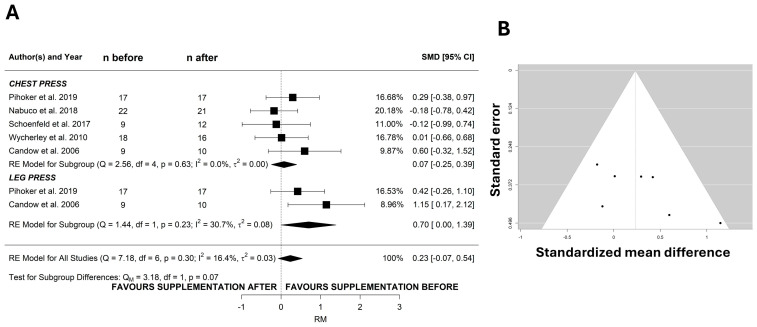
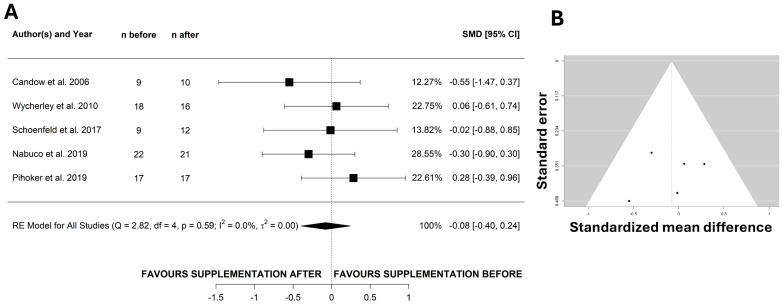
Background/Objectives: Muscle strength and mass are key determinants of exercise performance and a hallmark of health span. Recently, several meta-analyses have concluded that protein supplementation timing does not alter muscle strength and mass gains. However, these meta-analyses did not directly compare several supplementation timings within the same study, thus limiting their conclusions. The objective of this study was to conduct a meta-analysis including only studies directly comparing protein intake before and after exercise. Methods: Three databases (PubMed (n = 748), Web of Science (n = 1458), and Scopus (n = 1105)) and reference lists were searched from inception to January 15, 2024 to identify studies where subjects were randomized to consume protein before or after each training session for at least 4 weeks. Risk of bias was evaluated using the critical appraisal checklist for RCT. A meta-analysis was performed using random-effect models. The outcomes were strength and lean body mass. Results: Of 3311 records identified, 6 reports (5 studies) were eligible and all were considered of sufficient quality to be included in the meta-analysis. For the chest press exercise, there was no effect of protein timing on repeated maximum (RM) (SMD: 0.07; 95% CI: −0.248 to 0.395; I2 = 0%, p = 0.653). For the leg press exercise, consuming protein before training increased the RM more than after training (SMD: 0.70; 95% CI: 0.005 to 1.388; I2 = 31%, p = 0.048). However, subgroup analysis did not reveal a significant effect difference (p = 0.07) for leg press and chest press. Lean body mass was not differently modulated by protein supplementation timing (SMD: −0.08; 95% CI: −0.398 to 0.244; I2 = 0%, p = 0.641). Conclusions: Protein timing does not importantly modify exercise-induced changes in lean body mass. While upper and lower limbs strength may respond differently, more investigation is needed to reach a more robust conclusion. The present review was registered in PROSPERO (CRD42023464503).
Overview
CoChat Summary
TL;DR
This systematic review and meta-analysis of 6 reports (5 studies) directly comparing protein intake before versus after exercise found no important effect of timing on lean body mass or chest press strength, but pre-exercise protein increased leg press RM more than post-exercise in a two-study analysis. Certainty of evidence was low to very low.
Key findings
- Chest press RM showed no effect of protein timing (SMD: 0.07; 95% CI: −0.248 to 0.395; I² = 0%, p = 0.653; n = 5 studies).
- Leg press RM increased more with protein before training than after training (SMD: 0.70; 95% CI: 0.005 to 1.388; I² = 31%, p = 0.048; n = 2 studies), but subgroup analysis did not reveal a significant effect difference between leg press and chest press (p = 0.07).
- Lean body mass was not differently modulated by protein timing (SMD: −0.08; 95% CI: −0.398 to 0.244; I² = 0%, p = 0.641; n = 5 studies); fat mass showed a similar lack of effect, and bicep, vastus lateralis, and triceps thickness were not influenced by timing.
- GRADE certainty was low for chest press, lean mass, and fat mass, and very low for leg press, bicep thickness, triceps thickness, and vastus lateralis thickness.
Methods
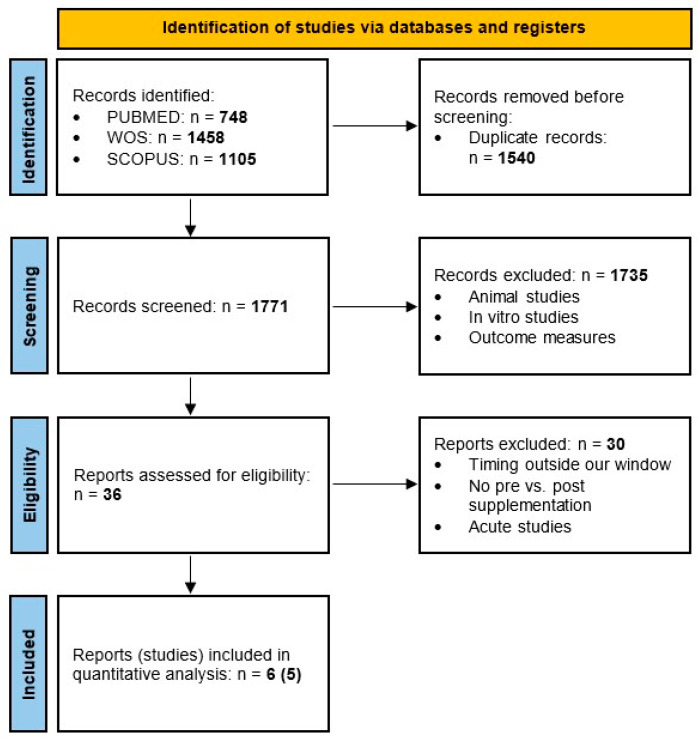
- Systematic review and meta-analysis (PROSPERO CRD42023464503; PRISMA 2020) searched PubMed (n = 748), Web of Science (n = 1458), and Scopus (n = 1105) from inception to 15 January 2024 plus reference lists; 3311 records were identified, 1771 screened after duplicates, and 6 reports (5 studies) were included.
- Eligible studies were randomized controlled trials or crossover studies with ≥4 weeks washout, adults >18 years, protein/BCAA supplementation from 4 h pre- to 4 h post-exercise, training ≥2×/week for ≥4 consecutive weeks, and direct comparison of protein before versus after each training session. Risk of bias was assessed with the critical appraisal checklist for RCT.
- Random-effects meta-analyses (DerSimonian–Laird) were performed in R metafor; outcomes were strength and lean body mass; effect sizes were standardized mean differences with 95% CIs; heterogeneity was reported as I²; leave-one-out sensitivity, funnel plots/Egger’s tests, and GRADE certainty were also used.
Limitations
- The paper states that only two included studies received a “good” risk-of-bias rating, some meta-analyses were based on only two observations, meta-regressions for age, training status, training length, or supplementation dose could not be performed, and GRADE certainty was low to very low.
- The text makes evident that the leg press finding came from only two studies involving 53 subjects, the subgroup comparison for leg press versus chest press was only a statistical trend, and the limited number of included studies restricts the robustness of conclusions.
Model-written summary. Check it against the paper before relying on it.
Integrity signals
Registry
Cites
Statistics
Figures
Verification
Claims the paper makes
0 Valid · 0 Not valid · 21 Not checked · 35 Own results and interpretations
A result the paper reports from its own data — it cites no other source for it, so there is none to check. The quote shows it is in the paper.
In the paper
“For the leg press exercise, consuming protein before training increased the RM more than after training (SMD: 0.70; 95% CI: 0.005 to 1.388; I2 = 31%, p = 0.048).”
- Also stated in: § 3. Results · plain
“On the other hand, consuming protein before training induced a higher leg press RM gain than consuming protein after training (SMD: 0.70; 95% CI: 0.005 to 1.388; I2 = 31%, p = 0.048, n = 2 studies).”
§ Does Protein Ingestion Timing Affect Exercise-Induced Adaptations? A Systematic Review with Meta-Analysis > Abstract
plainstates a causen = 2 ·- Asserted: passes — The authors put it forward as true.
- Checkable: passes — It can be checked against evidence.
- Load-bearing: passes — The paper’s conclusions depend on it.
- Based: passes — The paper gives a reason why it holds.
- Rests on 2 assumptions not shown here.
- Also stated in: § 3. Results · plain
A result the paper reports from its own data — it cites no other source for it, so there is none to check. The quote shows it is in the paper.
In the paper
“First, only two of the included studies received a “good” rating in the risk of bias assessment, indicating that the methodological quality of most of the studies analyzed is limited.”
§ Does Protein Ingestion Timing Affect Exercise-Induced Adaptations? A Systematic Review with Meta-Analysis > 4. Discussion
plain- Asserted: passes — The authors put it forward as true.
- Checkable: passes — It can be checked against evidence.
- Load-bearing: passes — The paper’s conclusions depend on it.
- Based: passes — The paper gives a reason why it holds.
A result the paper reports from its own data — it cites no other source for it, so there is none to check. The quote shows it is in the paper.
In the paper
“Finally, bicep (SMD: −0.197; 95% CI: −0.826 to 0.432; I2 = 0%, p = 0.540, n = 2 studies), vastus lateralis (SMD: 0.128; 95% CI: −0.658 to 0.914; I2 = 36%, p = 0.749, n = 2 studies), and triceps (SMD: 0.314; 95% CI: −0.371 to 0.999; I2 = 15%, p = 0.369, n = 2 studies) thickness were not influenced by protein timing (Supplementary Figure S2).”
§ Does Protein Ingestion Timing Affect Exercise-Induced Adaptations? A Systematic Review with Meta-Analysis > 3. Results
plainn = 2- Asserted: passes — The authors put it forward as true.
- Checkable: passes — It can be checked against evidence.
- Load-bearing: passes — The paper’s conclusions depend on it.
- Based: passes — The paper gives a reason why it holds.
- Rests on 3 assumptions not shown here.
A result the paper reports from its own data — it cites no other source for it, so there is none to check. The quote shows it is in the paper.
In the paper
“For the chest press exercise, there was no effect of protein timing on repeated maximum (RM) (SMD: 0.07; 95% CI: −0.248 to 0.395; I2 = 0%, p = 0.653).”
- Also stated in: § 3. Results · plain
“The overall effect for chest press showed no effect of protein timing (SMD: 0.07; 95% CI: −0.248 to 0.395; I2 = 0%, p = 0.653, n = 5 studies).”
§ Does Protein Ingestion Timing Affect Exercise-Induced Adaptations? A Systematic Review with Meta-Analysis > Abstract
plainn = 5- Asserted: passes — The authors put it forward as true.
- Checkable: passes — It can be checked against evidence.
- Load-bearing: passes — The paper’s conclusions depend on it.
- Based: passes — The paper gives a reason why it holds.
- Rests on 3 assumptions not shown here.
- Also stated in: § 3. Results · plain
A result the paper reports from its own data — it cites no other source for it, so there is none to check. The quote shows it is in the paper.
In the paper
“Second, some of the meta-analyses conducted in the present study were based on only two observations, which, combined with the aforementioned issue, further restricts the strength of the conclusions.”
§ Does Protein Ingestion Timing Affect Exercise-Induced Adaptations? A Systematic Review with Meta-Analysis > 4. Discussion
plain- Asserted: passes — The authors put it forward as true.
- Checkable: passes — It can be checked against evidence.
- Load-bearing: unclear — It is unclear whether the paper’s conclusions depend on it.
- Based: passes — The paper gives a reason why it holds.
21 more claims
Create a free account to see all 56 claims and to verify the 30 references still open.
- It may state two separate claims as one. 16
- Probably not a substantial claim. 19
Self-check
Percentages, sums and reported differences re-computed from the paper’s own numbers.
Each contradiction between two passages listed here was confirmed by an independent check.
Rated minor: it would not touch a result — a value no result rests on, a p-value that stays on the same side of the significance level, or a conflict that is clerical, resolved elsewhere in the paper, or outside its own findings.
In the paper
§ Does Protein Ingestion Timing Affect Exercise-Induced Adaptations? A Systematic Review with Meta-Analysis > 3. Results
“two others [27,28] older, untrained women.”
§ Does Protein Ingestion Timing Affect Exercise-Induced Adaptations? A Systematic Review with Meta-Analysis > 3. Results
“One study [27] involved older, overweight or obese men and women with type 2 diabetes.”
Rated minor: it would not touch a result — a value no result rests on, a p-value that stays on the same side of the significance level, or a conflict that is clerical, resolved elsewhere in the paper, or outside its own findings.
In the paper
§ Does Protein Ingestion Timing Affect Exercise-Induced Adaptations? A Systematic Review with Meta-Analysis > 3. Results
“In addition, two studies [25,26] measured leg press 1RM”
§ Does Protein Ingestion Timing Affect Exercise-Induced Adaptations? A Systematic Review with Meta-Analysis > 4. Discussion
“Leg press assessment was only performed in two studies [24,25] involving 53 subjects.”
Citations
Cites
The PRISMA 2020 statement: An updated guideline for reporting systematic reviews
Page, M. J., McKenzie, J. E., Bossuyt, P. M., Boutron, I., Hoffmann, T. C., Mulrow, C. D., Shamseer, L., Tetzlaff, J. M., Akl, E. A., Brennan, S. E., et al. (2021) · BMJ · doi:10.1136/bmj.n71 · Cited by 108,283
Conducting Meta-Analyses in R with the metafor Package
Viechtbauer, W. (2010) · Journal of Statistical Software · doi:10.18637/jss.v036.i03 · Cited by 20,464
Morton, R. W., Murphy, K. T., McKellar, S. R., Schoenfeld, B. J., Henselmans, M., Helms, E., Aragon, A. A., Devries, M. C., Banfield, L., Krieger, J. W., et al. (2018) · British Journal of Sports Medicine · doi:10.1136/bjsports-2017-097608 · Cited by 1,269 · cited 1×
“Supplementation is an effective method to ensure the intake of sufficient protein for enhancing skeletal muscle strength and mass in healthy adults and older people [6,7].”
Barker, T. H., Stone, J. C., Sears, K., Klugar, M., Tufanaru, C., Leonardi-Bee, J., Aromataris, E., & Munn, Z. (2023) · JBI Evidence Synthesis · doi:10.11124/jbies-22-00430 · Cited by 1,225 · cited 1×
“The two researchers independently evaluated risk of bias using the critical appraisal checklist for RCT of the Faculty of Health and Medical Sciences at the University of Adelaide, South Australia [20].”
Tang, J. E., Moore, D. R., Kujbida, G. W., Tarnopolsky, M. A., & Phillips, S. M. (2009) · Journal of Applied Physiology · doi:10.1152/japplphysiol.00076.2009 · Cited by 998
International Society of Sports Nutrition Position Stand: protein and exercise
Jäger, R., Kerksick, C. M., Campbell, B. I., Cribb, P. J., Wells, S. D., Skwiat, T. M., Purpura, M., Ziegenfuss, T. N., Ferrando, A. A., Arent, S. M., et al. (2017) · Journal of the International Society of Sports Nutrition · doi:10.1186/s12970-017-0177-8 · Cited by 873
International society of sports nutrition position stand: nutrient timing
Kerksick, C. M., Arent, S., Schoenfeld, B. J., Stout, J. R., Campbell, B., Wilborn, C. D., Taylor, L., Kalman, D., Smith-Ryan, A. E., Kreider, R. B., et al. (2017) · Journal of the International Society of Sports Nutrition · doi:10.1186/s12970-017-0189-4 · Cited by 622 · cited 1×
“It has been suggested that the ingestion of protein either before and/or after exercise can be an effective strategy to support increases in strength and improvements in body composition [12], but this effect likely diminishes as more time passes after the exercise session [13].”
Tipton, K. D., Rasmussen, B. B., Miller, S. L., Wolf, S. E., Owens-Stovall, S. K., Petrini, B. E., & Wolfe, R. R. (2001) · American Journal of Physiology-Endocrinology and Metabolism · doi:10.1152/ajpendo.2001.281.2.e197 · Cited by 526 · cited 1×
“In humans, ingesting branched-chain amino acids (BCAA) immediately before intense leg exercise increases the anabolic response compared to the consumption of these amino acids immediately after [11].”
Protein "requirements" beyond the RDA: implications for optimizing health
Phillips, S. M., Chevalier, S., & Leidy, H. J. (2016) · Applied Physiology, Nutrition, and Metabolism · doi:10.1139/apnm-2015-0550 · Cited by 396 · cited 1×
“Current protein intake recommendations suggest 0.8 g/kg of body weight for young healthy subjects, which can be increased to approximately 1.2 g/kg of body weight in older subjects and to approximately 1.6–1.8 g/ kg in athletes [3–5].”
InfluentialGoldspink, D. F., & Kelly, F. J. (1984) · Biochemical Journal · doi:10.1042/bj2170507 · Cited by 228
Research works printed but not linked: 1
- Schünemann H.J. Higgins J.P.T. Vist G.E. Glasziou P. Akl E.A. Skoetz N. Guyatt G.H. Chapter 14: Completing ‘Summary of findings’ tables and grading the certainty of the evidence [last updated May 2025] Cochrane Handbook for Systematic Reviews of Interventions Version 6.5.1 Higgins J.P.T. Thomas J. Chandler J. Cumpston M. Li T. Page M.J. Welch V.A. Cochrane London, UK 2024 Available online: https://www.cochrane.org/handbook (accessed on 25 September 2024)
Cited by
Plant-Based Nutrition and Supplements for Optimal Athletic Performance
Rosenfeld, R. M., Zinman, S., & Bonnet, J. P. (2025) · American Journal of Lifestyle Medicine · doi:10.1177/15598276251393663 · Cited by 5
Callegari, I. O. M., Silva, G. M., & Oliveira, A. G. (2026) · Journal of the International Society of Sports Nutrition · doi:10.1080/15502783.2026.2752317
Performance Optimization in Streetlifting: The Combined Role of Nutrition, Lean Mass, and Sleep
Stranieri, C., Bulbarelli, A., Lonati, E., Palestini, P., & Cazzaniga, E. (2025) · Nutrients · doi:10.3390/nu18010105
Mohammadi, A., Tek, T., Jalali, P., Asadi, B., Franjko, I., Sporiš, G., Gutenberger, K., & Nobarı, H. (2026) · Journal of Human Sport and Exercise · doi:10.55860/2etc7v20
Metadata
- Authors
- Casuso, R. A., & Goossens, L.
- Affiliations
- Universidad Loyola Andalucía (ES)
- Corresponding author
- Casuso, Rafael A.
- Venue
- Nutrients
- Publisher
- MDPI AG
- Published
- 2025-06-21
- Volume
- 17
- Issue
- 13
- Pages
- 2070
- ISSN
- 2072-6643 (ISSN-L)
- PMC
- PMC12250900
- OpenAlex
- W4411570670
- Cited by
- 5
- References
- 32
- Citations by year
- 2026: 3 · 2025: 2
- FWCI
- 0.42
- Type
- journal article
- Language
- en
- Open access
- gold
- doi.org
- Licence
- Locations
- Nutrients (publishedVersion, cc-by)
- PubMed Central (publishedVersion, cc-by)
- PubMed (publishedVersion)
- Topics
- Health Sciences › Nursing › Nutrition and Dietetics › Muscle metabolism and nutrition
- Health Sciences › Medicine › Orthopedics and Sports Medicine › Sports Performance and Training
- Health Sciences › Medicine › Physiology (medical) › Cardiovascular and exercise physiology
- Keywords
- exercise-induced adaptations, muscle strength, lean body mass, chest press, leg press, resistance training
- MeSH terms
- Adaptation, Physiological, Dietary Proteins, Female, Humans, Male, Time Factors, Exercise, Muscle, Skeletal, Dietary Supplements, Muscle Strength
About these checks
Registry, retraction, Cites and statistics results are computed, not judged, with one exception: a printed reference that no index lists is read once by a model before it counts as a citation error. Claims are extracted by a model and kept only when their quote appears verbatim in the text; each cited source is then checked, with a model’s help, for whether it says what the claim relies on. Those verdicts can be wrong — read the claim’s quote and the cited source before relying on one.
A language model drew the claims from the paper on 2026-11-23, under version 3 of the claim definition (model deepseek-v4.1-flash, prompt extract-v3).
A second model labelled each claim on 2026-11-23 (model jev-1.13-20260917, definition revision gold-guideline-v0.2).
Statistics and arithmetic are recomputed, not judged.
Confidence bands are shown only for fields calibrated on our annotated test set. None is calibrated yet, so no band is shown.
What counts as a claim ›How we measure confidence ›How we check this ›
Are you an author, or do you see a problem with this page? Request a review
Data sources
Bibliographic data: Semantic Scholar, OpenAlex, Crossref.
Contains information from the Semantic Scholar Academic Graph Datasets, made available under the ODC Attribution License (ODC-BY 1.0).
Semantic Scholar’s data is described in: Kinney, R., et al. (2023). The Semantic Scholar Open Data Platform. arXiv:2301.10140.
