

The DOI matches its Crossref record; 62 of the 62 references it cites were found in a registry or an index; none of the 11 sources its claims cite is checked for support yet.
Effectiveness of a Nutrition Education Programme on Nutritional Knowledge in Young Football Players: A Pilot Study
Open accessAbstract
Background: Adequate nutrition is fundamental to the health and performance of young athletes. However, many fail to meet nutritional recommendations. Nutrition education programmes are promising, cost-effective strategies for improving dietary habits. However, research gaps persist, coupled with notable variability amongst the intervention programmes targeting youth athletes. The aim of this study was to assess the nutritional knowledge of Portuguese youth athletes and to evaluate the effectiveness of a nutrition education programme in improving football players’ understanding of a healthy diet. Methods: Participants were recruited from a local football club through public announcement. Male youth football players aged 13 to 18 years, training at least 3 times per week and competing regularly over the past six months, were eligible. The baseline assessment included anthropometric measurements, an assessment of the adherence to the Mediterranean diet using the KIDMED questionnaire, and an assessment of general and sports nutrition knowledge via a structured questionnaire. Following the intervention—comprising three face-to-face educational sessions and two digital infographics—the KIDMED and nutrition knowledge questionnaires were re-administered. Results: A sample of 38 male footballers were eligible for this study. Most participants exhibited a healthy body weight, with a corresponding adequate body composition. The mean KIDMED score indicated moderate adherence to the Mediterranean diet with no statistically significant difference between the baseline and post-intervention (6.79 ± 1.52 versus 6.97 ± 2.01, p > 0.05). There was a significant enhancement in overall nutrition knowledge, accompanied by notable improvements in the comprehension of macro- and micronutrient sources and sports nutrition principles. Conclusions: This pilot programme proved effective in enhancing young football players’ knowledge of nutrient sources and sports nutrition.
Overview
CoChat Summary
TL;DR
This pilot quasi-experimental study assessed nutritional knowledge and Mediterranean diet adherence in 38 male Portuguese youth football players and tested a nutrition education programme. It found significant improvements in overall nutrition knowledge and most PGENSK domains, but no significant change in KIDMED adherence.
Key findings
- In 38 male footballers, mean KIDMED score was in the moderate adherence interval and did not change significantly pre- vs post-intervention (6.79 ± 1.52 versus 6.97 ± 2.01, p > 0.05); 18 participants (47.34%) increased their KIDMED score, and 12 had high adherence before the intervention.
- PGENSK scores improved significantly overall and in macro- and micronutrient sources, sports nutrition, and global score (p < 0.001); food label was the only domain without a significant improvement. Observed power for the significant increases was greater than 95%.
- Anthropometry: mean BMI was 20.8 ± 2.2 kg/m²; 81.58% were of normal weight; one player was overweight; there were no obese footballers. Of participants who underwent body composition assessment, 78.9% had normal body fat of 10–20%, while eight had high body fat values.
Methods
- Community trial, quasi-experimental, during the 2024/2025 football season. Participants were recruited from a local football club through a public announcement. Eligible participants were male youth football players aged 13–18, training at least 3 times per week and competing regularly over the past six months. From 130 male youth soccer players, 44 met eligibility criteria at baseline; 38 male footballers were included.
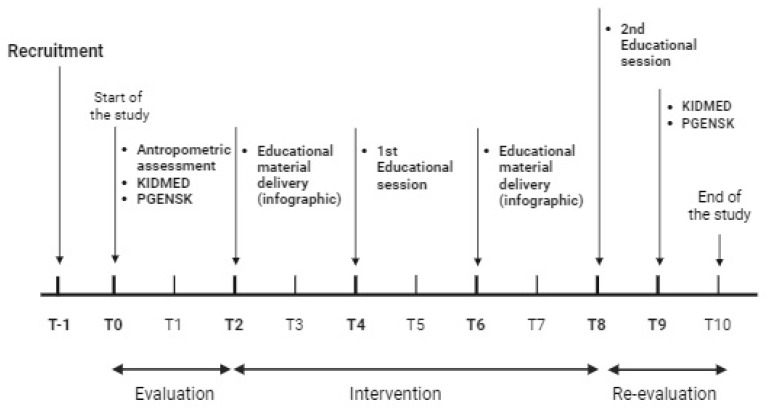
- Baseline assessment included anthropometric measurements, KIDMED for Mediterranean diet adherence, and an adapted PGENSK general and sports nutrition knowledge questionnaire (43 questions; maximum score 47). The abstract reports three face-to-face educational sessions and two digital infographics, while the methods/results report two in-person sessions and two infographics. KIDMED and PGENSK were re-administered after the intervention.
- Analysis used descriptive statistics and a one-way repeated measures MANOVA on four PGENSK variables (Macro and micronutrients, Food label, Sports nutrition, Global score) across two timepoints, using SPSS version 30.0 and a 5% significance level.
Limitations
- Stated: this is a pilot study and should be extended to include a larger sample and all age groups within adolescence. Time restrictions for the teams made several interventions challenging. Female footballers were not permitted to attend the same training sessions where assessments and interventions took place, so this pilot included only male players although YANEI is intended for young female and male athletes.
- Stated: further studies are needed to evaluate the impact on actual dietary behaviours, and long-term follow-up should be considered.
- Evident from the text: no control group is described, and the discrepancy between the abstract’s “three face-to-face educational sessions” and the methods/results’ “two in-person sessions” is not reconciled. The study assessed nutrition knowledge and KIDMED adherence rather than dietary intake or behaviour.
Model-written summary. Check it against the paper before relying on it.
Integrity signals
Registry
Cites
Statistics
Figures
Verification
Claims the paper makes
0 Valid · 0 Not valid · 7 Not checked · 15 Own results and interpretations
A result the paper reports from its own data — it cites no other source for it, so there is none to check. The quote shows it is in the paper.
In the paper
“Although it increased slightly after the interventions, there were no significant differences (p > 0.05) in the average KIDMED score before and after the interventions, as presented in Table 2.”
- Also stated in: § Abstract · plain
“The mean KIDMED score indicated moderate adherence to the Mediterranean diet with no statistically significant difference between the baseline and post-intervention (6.79 ± 1.52 versus 6.97 ± 2.01, p > 0.05).”
§ Effectiveness of a Nutrition Education Programme on Nutritional Knowledge in Young Football Players: A Pilot Study > 3. Results > 3.2. Adherence to Mediterranean Diet Before and After Interventions
plain- Asserted: passes — The authors put it forward as true.
- Checkable: passes — It can be checked against evidence.
- Load-bearing: unclear — It is unclear whether the paper’s conclusions depend on it.
- Based: passes — The paper gives a reason why it holds.
- Also stated in: § Abstract · plain
A result the paper reports from its own data — it cites no other source for it, so there is none to check. The quote shows it is in the paper.
In the paper
“The mean KIDMED score was in the moderate adherence interval (4–7).”
- Also stated in: § Abstract · hedged
“The mean KIDMED score indicated moderate adherence to the Mediterranean diet with no statistically significant difference between the baseline and post-intervention (6.79 ± 1.52 versus 6.97 ± 2.01, p > 0.05).”
§ Effectiveness of a Nutrition Education Programme on Nutritional Knowledge in Young Football Players: A Pilot Study > 3. Results > 3.2. Adherence to Mediterranean Diet Before and After Interventions
plain- Asserted: passes — The authors put it forward as true.
- Checkable: passes — It can be checked against evidence.
- Load-bearing: unclear — It is unclear whether the paper’s conclusions depend on it.
- Based: passes — The paper gives a reason why it holds.
- Also stated in: § Abstract · hedged
A result the paper reports from its own data — it cites no other source for it, so there is none to check. The quote shows it is in the paper.
In the paper
“The multivariate tests based on Pillai’s trace statistics showed that there was a difference in the four combined variables over time, that is, between the pre- and post-intervention (p < 0.001).”
§ Effectiveness of a Nutrition Education Programme on Nutritional Knowledge in Young Football Players: A Pilot Study > 3. Results > 3.3. The Impact of Interventions in Knowledge About Nutrition and Sports Nutrition
plain- Asserted: passes — The authors put it forward as true.
- Checkable: passes — It can be checked against evidence.
- Load-bearing: passes — The paper’s conclusions depend on it.
- Based: passes — The paper gives a reason why it holds.
In the paper
“In fact, of the studies included in this systematic review, 27 out of 32 found that nutrition education interventions improved nutrition knowledge.”
§ Effectiveness of a Nutrition Education Programme on Nutritional Knowledge in Young Football Players: A Pilot Study > 1. Introduction
What the sources say
- Not checked yetcites [19] Tam, 2019, Effectiveness of Education Interventions Designed to Improve Nutrition Knowledge in Athletes: A Systematic Review, Sports Med. source
plainstates a cause- Asserted: passes — The authors put it forward as true.
- Checkable: passes — It can be checked against evidence.
- Load-bearing: passes — The paper’s conclusions depend on it.
- Based: passes — The paper gives a reason why it holds.
None of the sources cited for this claim have been checked yet.
In the paper
“In fact, evidence has shown that most football players do not meet nutritional recommendations [3,4].”
§ Effectiveness of a Nutrition Education Programme on Nutritional Knowledge in Young Football Players: A Pilot Study > 1. Introduction
What the sources say
- Not checked yetcites [3] Danielik, K., Książek, A., Zagrodna, A., and Słowińska-Lisowska, M. (2022). How Do Male Football Players Meet Dietary Recommendations? A Systematic Literature Review. Int. J. Environ. Res. Public Health, 19. source
- Not checked yetcites [4] Chryssanthopoulos, C., Souglis, A., Tsalouhidou, S., Hulton, A.T., Bogdanis, G.C., Petridou, A., Philippou, A., Maridaki, M., and Theos, A. (2024). Dietary Intake of Soccer Players before, during and after an Official Game: Influence of Competition Level and Playing Position. Nutrients, 16. source
boosted- Asserted: passes — The authors put it forward as true.
- Checkable: passes — It can be checked against evidence.
- Load-bearing: passes — The paper’s conclusions depend on it.
- Based: passes — The paper gives a reason why it holds.
6 more claims
Create a free account to see all 22 claims and to verify the 11 references still open.
- It may state two separate claims as one. 11
- Probably not a substantial claim. 4
Claims other papers make about this one
Each is checked against this paper’s own text: does it say what the citing paper says it does?
In the citing paper
“Twenty-seven unique studies (7, 8, 11, 13–24, 28–39) were included.”
In the citing paper
“Soccer/football was most represented (11, 13–15, 17, 19, 20, 29, 32–34, 38), followed by volleyball (31, 35, 36), basketball (39), handball (23, 37), baseball (16), hockey (28), American football (7, 8, 22), and mixed-sport youth settings (18, 21, 24, 30).”
In the citing paper
“Some studies used posters or web-apps (11, 12), short face-to-face or digital education (13, 14), team-based life-skills programs, practical guidance, or dietary feedback (15–17), controlled dietary modification (18), and multicomponent sport-based education (19).”
In the citing paper
“but Mediterranean diet adherence did not significantly change”
In the citing paper
“Vicente et al. (14) improved nutrition knowledge in young football players”
9 more claims about this paper
Create a free account to see every claim other papers make about this one.
Self-check
Percentages, sums and reported differences re-computed from the paper’s own numbers.
Each contradiction between two passages listed here was confirmed by an independent check.
Rated major: it would touch a result — a value a result rests on, reported and recomputed p-values on opposite sides of the significance level, two passages that conflict with no sign which is right, or a cited work retracted before this paper was published.
In the paper
§ Effectiveness of a Nutrition Education Programme on Nutritional Knowledge in Young Football Players: A Pilot Study > Abstract
“Following the intervention—comprising three face-to-face educational sessions and two digital infographics—the KIDMED and nutrition knowledge questionnaires were re-administered.”
§ Effectiveness of a Nutrition Education Programme on Nutritional Knowledge in Young Football Players: A Pilot Study > 2. Materials and Methods > 2.4. Educative Interventions
“Following the initial assessment phase, the young athletes attended two in-person nutrition education sessions and received two infographics.”
Citations
Cites
Sawyer, S. M., Azzopardi, P. S., Wickremarathne, D., & Patton, G. C. (2018) · The Lancet Child & Adolescent Health · doi:10.1016/s2352-4642(18)30022-1 · Cited by 3,666
Nutrition and Athletic Performance
(2016) · Medicine & Science in Sports & Exercise · doi:10.1249/mss.0000000000000852 · Cited by 1,305 · cited 2×
“Nutrition is recognised as playing a role in sports performance, in spite of intake not always being aligned with guidelines [1,2].”
Dinu, M., Pagliai, G., Casini, A., & Sofi, F. (2018) · European Journal of Clinical Nutrition · doi:10.1038/ejcn.2017.58 · Cited by 1,016
An updated systematic review and meta-analysis on adherence to mediterranean diet and risk of cancer
Morze, J., Danielewicz, A., Przybyłowicz, K., Zeng, H., Hoffmann, G., & Schwingshackl, L. (2021) · European Journal of Nutrition · doi:10.1007/s00394-020-02346-6 · Cited by 352
Connecting with Generation Z: Approaches in Nursing Education
Chicca, J., & Shellenbarger, T. (2018) · Teaching and Learning in Nursing · doi:10.1016/j.teln.2018.03.008 · Cited by 329
Becerra-Tomás, N., Blanco Mejía, S., Viguiliouk, E., Khan, T., Kendall, C. W. C., Kahleova, H., Rahelić, D., Sievenpiper, J. L., & Salas-Salvadó, J. (2020) · Critical Reviews in Food Science and Nutrition · doi:10.1080/10408398.2019.1565281 · Cited by 300
Do Lessons in Nature Boost Subsequent Classroom Engagement? Refueling Students in Flight
Kuo, M., Browning, M. H. E. M., & Penner, M. L. (2018) · Frontiers in Psychology · doi:10.3389/fpsyg.2017.02253 · Cited by 195
Sports dietitians Australia position statement: sports nutrition for the adolescent athlete
Desbrow, B., McCormack, J., Burke, L. M., Cox, G. R., Fallon, K., Hislop, M., Logan, R., Marino, N., Sawyer, S. M., Shaw, G., et al. (2014) · International Journal of Sport Nutrition and Exercise Metabolism · doi:10.1123/ijsnem.2014-0031 · Cited by 165
Brown, O. N., O’Connor, L. E., & Savaiano, D. A. (2014) · Journal of American College Health · doi:10.1080/07448481.2014.899233 · Cited by 142
Özdamlı, F., & Özdal, H. (2018) · Eurasia Journal of Mathematics Science and Technology Education · doi:10.29333/ejmste/81868 · Cited by 132
Research works printed but not linked: 1
- Hawk, M. (2014). Assessing Sports Nutrition Knowledge of Adolescent Athletes and Their Parents: An Intervention Approach. [Master’s Thesis, Georgia Southern University].
Cited by
Arreguín, A., & Hernández-Reyes, A. (2026) · BMC Nutrition · doi:10.1186/s40795-026-01319-y · Cited by 3
Victoria-Montesinos, D., García-Muñoz, A. M., Mercader-Ros, M. T., Jaraba-Salinero, Y., & Figueroa-Morales, F. (2026) · Frontiers in Nutrition · doi:10.3389/fnut.2026.1939289 · Cited by 1
Veloso-Pulgar, M., & Farran-Codina, A. (2026) · Frontiers in Nutrition · doi:10.3389/fnut.2026.1821345 · Cited by 1
Hernández, A. Q., Pablos, A., & Drehmer, E. (2026) · Frontiers in Nutrition · doi:10.3389/fnut.2026.1767162 · Cited by 1
Abdulai, K., Hayford, F. E. A., Axame, W. K., Alhassan, A. R., & Brown, C. (2026) · African Journal of Sports and Physical Sciences · doi:10.62154/ajsps.2025.06.01012 · Cited by 1
Dietary practices of college athletes as a result of nutrition studies
Azad, S. K., & Pandey, R. K. (2025) · International Journal of Physical Education & Sports Sciences · doi:10.29070/ny1c4g78
UÇBAĞLAR, Ö., & Önal, H. Y. (2026) · Revista Española de Nutrición Humana y Dietética · doi:10.14306/renhyd.30.3.2707
Fueling the Future: Advances in Sports Nutrition for Young Athletes
Vicente, F. (2026) · Nutrients · doi:10.3390/nu18142327
Self-citationAnthropometric assessment of nutritional status among young football athletes
Hartanto, B. A., Matadi, G. E. P., Annas, M. R., & Zulkarnain, W. D. (2026) · Journal of Pedagogy in Sport and Physical Activity · doi:10.68701/jpspa.v1i1.15
Nieve-Medina, F. E., & Oyarvide, R. M. O. (2026) · RICEAFS Revista de Investigación en Ciencias de la Educación Actividad Física y Salud · doi:10.64905/riceafs.eei.e91
Metadata
- Authors
- Vicente, F., Anastácio, L., Monteiro, A., Brito, J., Ramalho, R., & Pereira, P.
- Affiliations
- Escola Superior de Saúde Egas Moniz (PT)
- NUTRIWIN, Praceta Manuel Gouveia 1, 2725-372 Algueirão-Mem Martins, Portugal
- Corresponding author
- Vicente, Filipa
- Venue
- Nutrients
- Publisher
- MDPI AG
- Published
- 2025-07-23
- Volume
- 17
- Issue
- 15
- Pages
- 2404
- ISSN
- 2072-6643 (ISSN-L)
- PMC
- PMC12348160
- OpenAlex
- W4412594315
- Cited by
- 10
- References
- 62
- Citations by year
- 2026: 9 · 2025: 1
- FWCI
- 5.09
- Type
- journal article
- Language
- en
- Open access
- gold
- doi.org
- Licence
- Locations
- Nutrients (publishedVersion, cc-by)
- PubMed (publishedVersion)
- PubMed Central (publishedVersion, cc-by)
- Repositório Comum (Repositório Científico de Acesso Aberto de Portugal) (submittedVersion, cc-by)
- Funders
- FCT/MCTES (10.54499/UIDB/04585/2020)
- Topics
- Health Sciences › Nursing › Nutrition and Dietetics › Nutrition, Health and Food Behavior
- Health Sciences › Medicine › Public Health, Environmental and Occupational Health › Nutritional Studies and Diet
- Health Sciences › Nursing › Nutrition and Dietetics › Dietetics, Nutrition, and Education
- Keywords
- nutrition education, youth football players, sports nutrition knowledge, Mediterranean diet adherence, KIDMED questionnaire, dietary habits, adolescent boys, body composition, micronutrients, digital infographics
- MeSH terms
- Diet, Healthy, Adolescent, Health Education, Humans, Health Knowledge, Attitudes, Practice, Male, Nutritional Status, Pilot Projects, Portugal, Surveys and Questionnaires, Soccer, Diet, Mediterranean, Athletes, Sports Nutritional Sciences, Sports Nutritional Physiological Phenomena
About these checks
Registry, retraction, Cites and statistics results are computed, not judged, with one exception: a printed reference that no index lists is read once by a model before it counts as a citation error. Claims are extracted by a model and kept only when their quote appears verbatim in the text; each cited source is then checked, with a model’s help, for whether it says what the claim relies on. Those verdicts can be wrong — read the claim’s quote and the cited source before relying on one.
A language model drew the claims from the paper on 2026-11-14, under version 3 of the claim definition (model deepseek-v4.1-flash, prompt extract-v3).
A second model labelled each claim on 2026-11-14 (model jev-1.13-20260917, definition revision gold-guideline-v0.2).
Statistics and arithmetic are recomputed, not judged.
Confidence bands are shown only for fields calibrated on our annotated test set. None is calibrated yet, so no band is shown.
What counts as a claim ›How we measure confidence ›How we check this ›
Are you an author, or do you see a problem with this page? Request a review
Data sources
Bibliographic data: Semantic Scholar, OpenAlex, Crossref.
Contains information from the Semantic Scholar Academic Graph Datasets, made available under the ODC Attribution License (ODC-BY 1.0).
Semantic Scholar’s data is described in: Kinney, R., et al. (2023). The Semantic Scholar Open Data Platform. arXiv:2301.10140.
