

Protein-Pacing and Multi-Component Exercise Training Improves Physical Performance Outcomes in Exercise-Trained Women: The PRISE 3 Study
Open accessThe DOI matches its Crossref record; 43 of the 44 references it cites were found in a registry or an index.
Abstract
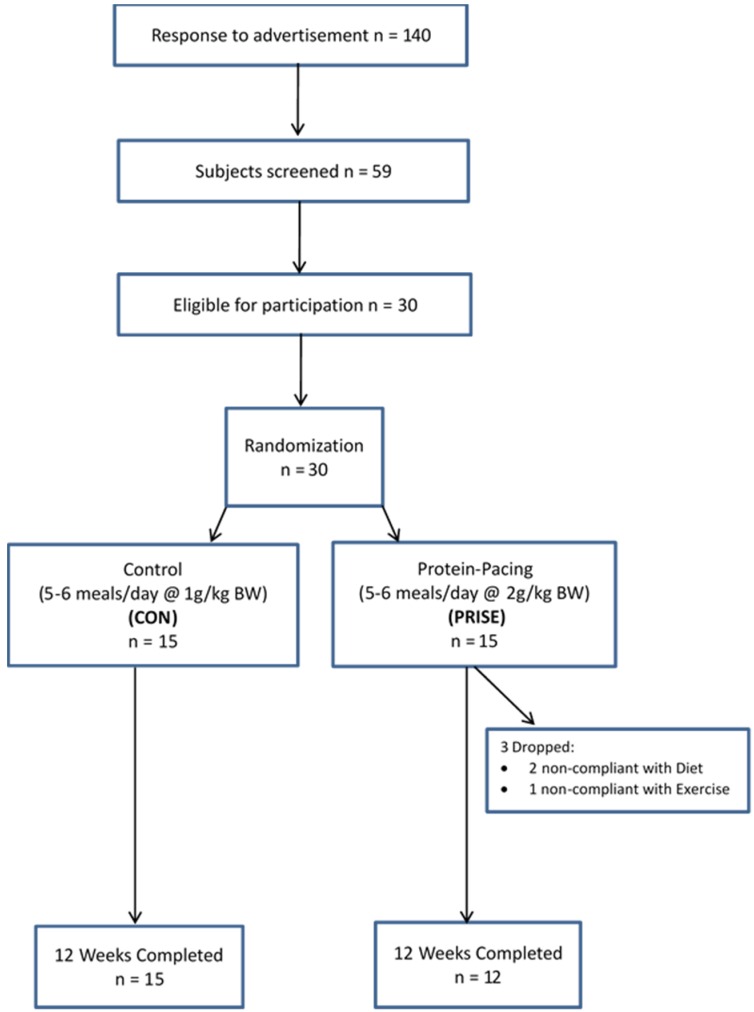
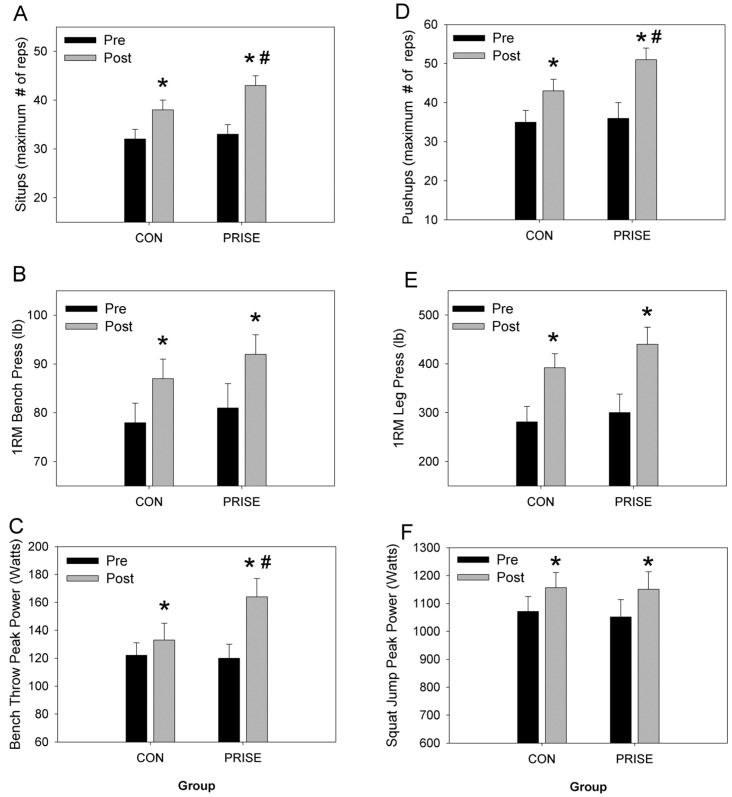
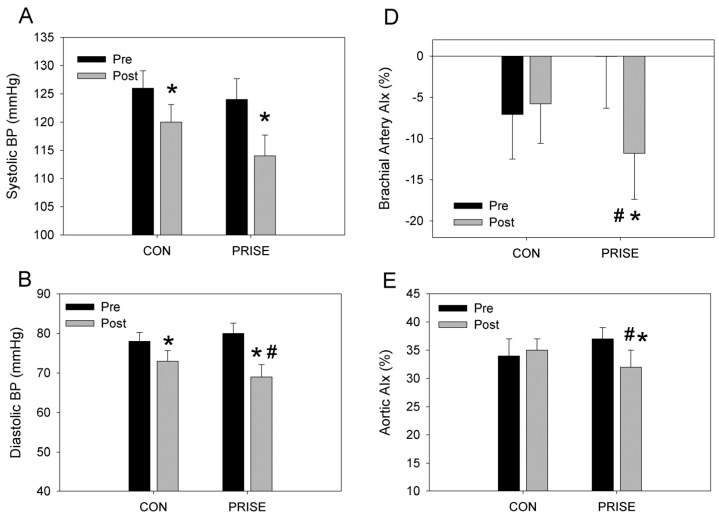
The beneficial cardiometabolic and body composition effects of combined protein-pacing (P; 5–6 meals/day at 2.0 g/kg BW/day) and multi-mode exercise (resistance, interval, stretching, endurance; RISE) training (PRISE) in obese adults has previously been established. The current study examines PRISE on physical performance (endurance, strength and power) outcomes in healthy, physically active women. Thirty exercise-trained women (>4 days exercise/week) were randomized to either PRISE (n = 15) or a control (CON, 5–6 meals/day at 1.0 g/kg BW/day; n = 15) for 12 weeks. Muscular strength (1-RM bench press, 1-RM BP) endurance (sit-ups, SUs; push-ups, PUs), power (bench throws, BTs), blood pressure (BP), augmentation index, (AIx), and abdominal fat mass were assessed at Weeks 0 (pre) and 13 (post). At baseline, no differences existed between groups. Following the 12-week intervention, PRISE had greater gains (p < 0.05) in SUs, PUs (6 ± 7 vs. 10 ± 7, 40%; 8 ± 13 vs. 14 ± 12, 43% ∆reps, respectively), BTs (11 ± 35 vs. 44 ± 34, 75% ∆watts), AIx (1 ± 9 vs. −5 ± 11, 120%), and DBP (−5 ± 9 vs. −11 ± 11, 55% ∆mmHg). These findings suggest that combined protein-pacing (P; 5–6 meals/day at 2.0 g/kg BW/day) diet and multi-component exercise (RISE) training (PRISE) enhances muscular endurance, strength, power, and cardiovascular health in exercise-trained, active women.
Overview
The claims and statistics of this paper haven’t been checked yet.
Free: it reads the open-access text and checks the first 5 claims that cite a source we can check. Create a free account to check every claim.
Integrity signals
Registry
Cites
Statistics
Figures
Verification
Claims the paper makes
The claims and statistics of this paper haven’t been checked yet.
Free: it reads the open-access text and checks the first 5 claims that cite a source we can check. Create a free account to check every claim.
Claims other papers make about this one
Each is checked against this paper’s own text: does it say what the citing paper says it does?
The source backs part of the claim, not all of it — or backs it for a different population, condition or comparison.
In the citing paper
“their results consistently demonstrate positive changes in body composition [116, 142] and physical performance outcomes in both lean [143, 144] and overweight/obese populations [142, 143, 145].”
From International Society of Sports Nutrition Position Stand: protein and exercise (2017) · cites this paper as [143]
Experimental — accuracy not yet measuredThe source backs part of the claim, not all of it — or backs it for a different population, condition or comparison.
In the citing paper
“Arciero and colleagues [129, 130] have most recently demonstrated increased muscular strength and power in exercise-trained physically fit men and women using protein pacing compared to ingestion of similar sized meals at similar times but different protein contents, both of which included the same multi-component exercise training during a 12-week intervention.”
From International society of sports nutrition position stand: nutrient timing (2017) · cites this paper as [129]
Experimental — accuracy not yet measured
Self-check
Percentages, sums and reported differences re-computed from the paper’s own numbers.
The self-check needs the paper’s full text.
Citations
Cites
Law, M. R., Morris, J. K., & Wald, N. J. (2009) · BMJ · doi:10.1136/bmj.b1665 · Cited by 2,775 · cited 1×
“Such changes are known to significantly reduce risk of coronary heart disease events and stroke, by approximately 25% and 36%, respectively [32].”
BackgroundArterial stiffness, wave reflections, and the risk of coronary artery disease
Weber, T., Auer, J., O’Rourke, M. F., Kvas, E., Lassnig, E., Berent, R., & Eber, B. (2004) · Circulation · doi:10.1161/01.cir.0000105767.94169.e3 · Cited by 1,081 · cited 1×
“Augmentation index (AIx), but not pulse wave velocity, corroborates the blood pressure findings, indicating a significant reduction with training, which was enhanced in the PRISE group (Figure 3) and likely translates into a reduction in CV risk [33].”
ResultBell, G. J., Syrotuik, D., Martin, T. P., Burnham, R., & Quinney, H. A. (2000) · European Journal of Applied Physiology · doi:10.1007/s004210050063 · Cited by 411 · cited 1×
“Research on concurrent strength and endurance training has revealed that either endurance capacity [8] or muscle strength [9] may be compromised due to conflicting physiological mechanisms or perhaps the reallocation of training volume or overtraining.”
BackgroundRakobowchuk, M., Tanguay, S., Burgomaster, K. A., Howarth, K. R., Gibala, M. J., & MacDonald, M. J. (2008) · American Journal of Physiology-Regulatory, Integrative and Comparative Physiology · doi:10.1152/ajpregu.00069.2008 · Cited by 337 · cited 2×
“Previous investigations of training on vascular health have revealed positive responses to either resistance, interval [25], flexibility (e.”
BackgroundA Brief Review of Critical Processes in Exercise-Induced Muscular Hypertrophy
Phillips, S. M. (2014) · Sports Medicine · doi:10.1007/s40279-014-0152-3 · Cited by 281
Effects of resistance training on arterial stiffness: a meta-analysis
Miyachi, M. (2013) · British Journal of Sports Medicine · doi:10.1136/bjsports-2012-090488 · Cited by 260 · cited 1×
“In light of previous investigations that suggest resistance training elevates vascular stiffness [34], the current study highlights that, using a multimodal training protocol, central pulse wave velocity was not altered, and, in fact, augmentation index was reduced.”
BackgroundNutritional interventions to augment resistance training-induced skeletal muscle hypertrophy
Morton, R. W., McGlory, C., & Phillips, S. M. (2015) · Frontiers in Physiology · doi:10.3389/fphys.2015.00245 · Cited by 234
Effects of Resistance, Endurance, and Concurrent Exercise on Training Outcomes in Men
GLOWACKI, S. P., MARTIN, S. E., MAURER, A., BAEK, W., GREEN, J. S., & CROUSE, S. F. (2004) · Medicine & Science in Sports & Exercise · doi:10.1249/01.mss.0000147629.74832.52 · Cited by 205 · cited 1×
“Research on concurrent strength and endurance training has revealed that either endurance capacity [8] or muscle strength [9] may be compromised due to conflicting physiological mechanisms or perhaps the reallocation of training volume or overtraining.”
BackgroundWhey protein supplementation during resistance training augments lean body mass
Volek, J. S., Volk, B. M., Gómez, A. L., Kunces, L. J., Kupchak, B. R., Freidenreich, D. J., Aristizabal, J. C., Saenz, C., Dunn-Lewis, C., Ballard, K. D., et al. (2013) · Journal of the American College of Nutrition · doi:10.1080/07315724.2013.793580 · Cited by 181 · cited 2×
“In support of this, our findings are in agreement with those of others showing a training-induced improvement in performance outcomes [4,5,20], and we extend these findings to demonstrate this in recreationally active healthy women.”
BackgroundResultDietary Protein to Support Anabolism with Resistance Exercise in Young Men
Phillips, S. M., Hartman, J. W., & Wilkinson, S. B. (2005) · Journal of the American College of Nutrition · doi:10.1080/07315724.2005.10719454 · Cited by 171
Cited by
International Society of Sports Nutrition Position Stand: protein and exercise
Jäger, R., Kerksick, C. M., Campbell, B. I., Cribb, P. J., Wells, S. D., Skwiat, T. M., Purpura, M., Ziegenfuss, T. N., Ferrando, A. A., Arent, S. M., et al. (2017) · Journal of the International Society of Sports Nutrition · doi:10.1186/s12970-017-0177-8 · Cited by 873
“Using this approach, their results consistently demonstrate positive changes in body composition [116, 142] and physical performance outcomes in both lean [143, 144] and overweight/obese populations [142, 143, 145].”
ResultSelf-citationInternational society of sports nutrition position stand: nutrient timing
Kerksick, C. M., Arent, S., Schoenfeld, B. J., Stout, J. R., Campbell, B., Wilborn, C. D., Taylor, L., Kalman, D., Smith-Ryan, A. E., Kreider, R. B., et al. (2017) · Journal of the International Society of Sports Nutrition · doi:10.1186/s12970-017-0189-4 · Cited by 622
“As a starting point, it is important to highlight that most of the available research on this topic has largely used nonathletic, untrained populations except two recent publications using trained men and women [129, 130].”
BackgroundSelf-citationEffects of Protein Supplementation on Performance and Recovery in Resistance and Endurance Training
Cintineo, H. P., Arent, M. A., Antonio, J., & Arent, S. M. (2018) · Frontiers in Nutrition · doi:10.3389/fnut.2018.00083 · Cited by 88
“(64) demonstrated the combination of resistance training and consumption of 4–6 meals per day containing 20–40 g of protein per meal resulted in positive changes in body composition and physical performance.”
BackgroundWirth, J., Hillesheim, E., & Brennan, L. (2020) · The Journal of Nutrition · doi:10.1093/jn/nxaa049 · Cited by 87
Arciero, P. J., Ives, S. J., Mohr, A. E., Robinson, N., Escudero, D., Robinson, J., Rose, K., Minicucci, O., O’Brien, G., Curran, K., et al. (2022) · Frontiers in Physiology · doi:10.3389/fphys.2022.893783 · Cited by 71
“Total mood disturbance (TMD) was also calculated using the following formula: TMD (tension + depression + anger + fatigue + confusion) − vigor Feelings of hunger, satiation, and desire-to-eat were assessed with visual analog scales (VAS, 0–100 mm) at baseline (week 0) and week 13 to evaluate the impact of the lifestyl…”
BackgroundMethodInfluentialSelf-citation
Metadata
- Authors
- Arciero, P., Ives, S., Norton, C., Escudero, D., Minicucci, O., O’Brien, G., Paul, M., Ormsbee, M., Miller, V., Sheridan, C., & He, F.
- Affiliations
- Skidmore College (US)
- Florida State University (US)
- Corresponding author
- Arciero, Paul
- Venue
- Nutrients
- Publisher
- MDPI AG
- Published
- 2016-06-01
- Volume
- 8
- Issue
- 6
- Pages
- 332
- ISSN
- 2072-6643 (ISSN-L)
- PMC
- PMC4924173
- OpenAlex
- W2409978738
- Cited by
- 26
- References
- 44
- Citations by year
- 2025: 1 · 2024: 4 · 2023: 5 · 2022: 4 · 2021: 2 · 2020: 2 · 2019: 2 · 2018: 2 · 2017: 3 · 2016: 1
- FWCI
- 1.83
- Type
- journal article
- Language
- en
- Open access
- gold
- doi.org
- Licence
- Locations
- Nutrients (publishedVersion, cc-by)
- PubMed Central (publishedVersion, cc-by)
- PubMed (publishedVersion)
- Creative Matter (Skidmore College) (submittedVersion)
- DOAJ (DOAJ: Directory of Open Access Journals) (submittedVersion, cc-by-sa)
- Funders
- Isagenix International LLC (043014)
- Topics
- Health Sciences › Nursing › Nutrition and Dietetics › Muscle metabolism and nutrition
- Health Sciences › Medicine › Orthopedics and Sports Medicine › Sports Performance and Training
- Health Sciences › Medicine › Physiology (medical) › Cardiovascular and exercise physiology
- Keywords
- physical performance, muscular endurance, muscle strength, output power, cardiovascular health, augmentation index, blood pressure, abdominal fat mass, resistance training, interval training, stretching, endurance training
- MeSH terms
- Adult, Body Composition, Diet, Dietary Proteins, Female, Humans, Hunger, Middle Aged, Physical Fitness, Satiety Response, Dietary Supplements, Physical Conditioning, Human
About these checks
Registry, retraction, Cites and statistics results are computed, not judged, with one exception: a printed reference that no index lists is read once by a model before it counts as a citation error. Claims are extracted by a model and kept only when their quote appears verbatim in the text; each cited source is then checked, with a model’s help, for whether it says what the claim relies on. Those verdicts can be wrong — read the claim’s quote and the cited source before relying on one.
Statistics and arithmetic are recomputed, not judged.
Confidence bands are shown only for fields calibrated on our annotated test set. None is calibrated yet, so no band is shown.
What counts as a claim ›How we measure confidence ›How we check this ›
Are you an author, or do you see a problem with this page? Request a review
How to cite
Cite CoChat for the checks on this page, and the paper for its own findings.
- This page
- CoChat. (2026). Citation check: Protein-Pacing and Multi-Component Exercise Training Improves Physical Performance Outcomes in Exercise-Trained Women: The PRISE 3 Study. https://app.cochat.ai/papers/10.3390/nu8060332
- The paper
- Arciero, P., Ives, S., Norton, C., Escudero, D., Minicucci, O., O’Brien, G., Paul, M., Ormsbee, M., Miller, V., Sheridan, C., & He, F. (2016). Protein-Pacing and Multi-Component Exercise Training Improves Physical Performance Outcomes in Exercise-Trained Women: The PRISE 3 Study. Nutrients. https://doi.org/10.3390/nu8060332
Data sources
Bibliographic data: Semantic Scholar, OpenAlex, Crossref.
Contains information from the Semantic Scholar Academic Graph Datasets, made available under the ODC Attribution License (ODC-BY 1.0).
Semantic Scholar’s data is described in: Kinney, R., et al. (2023). The Semantic Scholar Open Data Platform. arXiv:2301.10140.
