

The DOI matches its Crossref record; 141 of the 142 references it cites were found in a registry or an index.
The Role of Mammalian Target of Rapamycin (mTOR) in Insulin Signaling
Open accessAbstract
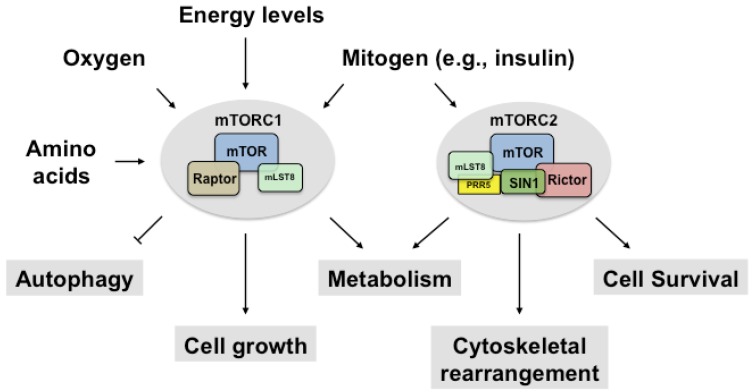
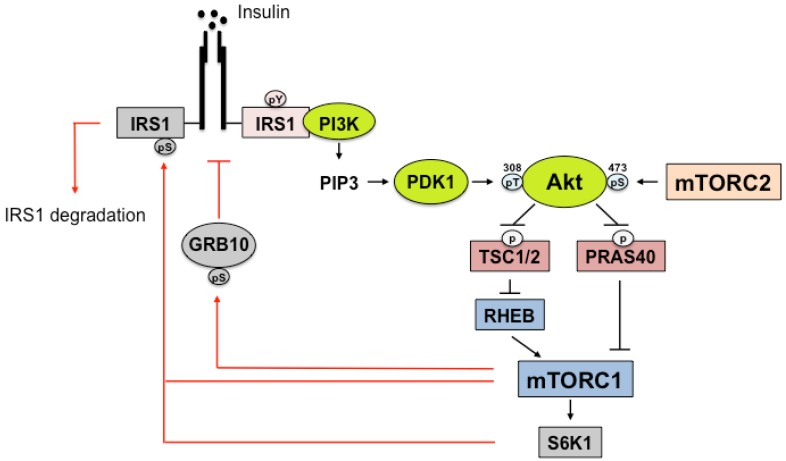
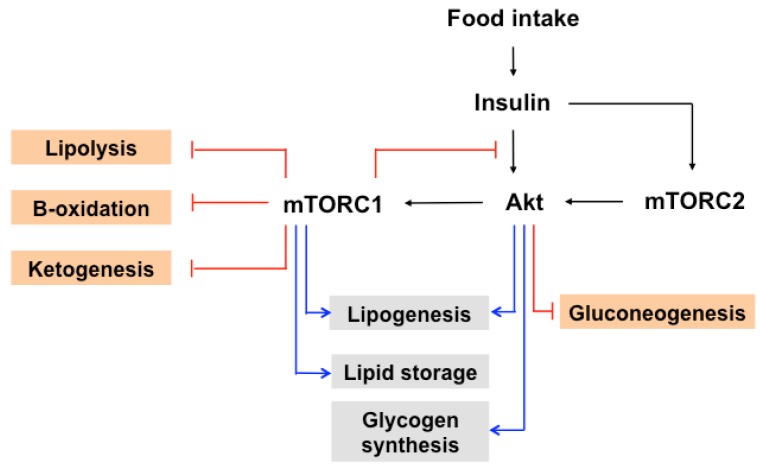
The mammalian target of rapamycin (mTOR) is a serine/threonine kinase that controls a wide spectrum of cellular processes, including cell growth, differentiation, and metabolism. mTOR forms two distinct multiprotein complexes known as mTOR complex 1 (mTORC1) and mTOR complex 2 (mTORC2), which are characterized by the presence of raptor and rictor, respectively. mTOR controls insulin signaling by regulating several downstream components such as growth factor receptor-bound protein 10 (Grb10), insulin receptor substrate (IRS-1), F-box/WD repeat-containing protein 8 (Fbw8), and insulin like growth factor 1 receptor/insulin receptor (IGF-IR/IR). In addition, mTORC1 and mTORC2 regulate each other through a feedback loop to control cell growth. This review outlines the current understanding of mTOR regulation in insulin signaling in the context of whole body metabolism.
Overview
The claims and statistics of this paper haven’t been checked yet.
Run the check — free, no account needed. It reads the open-access text and checks the sources it cites.
Integrity signals
Registry
Cites
Statistics
Figures
Verification
Claims the paper makes
The claims and statistics of this paper haven’t been checked yet.
Run the check — free, no account needed. It reads the open-access text and checks the sources it cites.
Claims other papers make about this one
Each is checked against this paper’s own text: does it say what the citing paper says it does?
The cited source says what the claim attributes to it.
In the citing paper
“mTORC1 can be further activated by mTORC2 via phosphorylation of Akt. 10”
Self-check
Percentages, sums and reported differences re-computed from the paper’s own numbers.
The self-check needs the paper’s full text.
Citations
Cites
Repertoires of Autophagy in the Pathogenesis of Ocular Diseases
Li, Y., Jiang, Q. L., Cao, G.-F., Yao, J., & Yan, B. (2015) · Cellular Physiology and Biochemistry · doi:10.1159/000373980 · Cited by 16,351
mTOR Signaling in Growth Control and Disease
Laplante, M., & Sabatini, D. M. (2012) · Cell · doi:10.1016/j.cell.2012.03.017 · Cited by 8,509
mTOR Signaling in Growth, Metabolism, and Disease
Saxton, R. A., & Sabatini, D. M. (2017) · Cell · doi:10.1016/j.cell.2017.02.004 · Cited by 7,555
AMPK and mTOR regulate autophagy through direct phosphorylation of Ulk1
Kim, J., Kundu, M., Viollet, B., & Guan, K.-L. (2011) · Nature Cell Biology · doi:10.1038/ncb2152 · Cited by 7,227
AKT/PKB signaling: navigating downstream
Manning, B. D., & Cantley, L. C. (2007) · Cell · doi:10.1016/j.cell.2007.06.009 · Cited by 6,115
Signal transduction by receptors with tyrosine kinase activity
Ullrich, A., & Schlessinger, J. (1990) · Cell · doi:10.1016/0092-8674(90)90801-k · Cited by 5,435
Insulin signalling and the regulation of glucose and lipid metabolism
Saltiel, A. R., & Kahn, C. R. (2001) · Nature · doi:10.1038/414799a · Cited by 5,326
Watterson, K. R., Bestow, D., Gallagher, J. R., Hamilton, D. L., Ashford, F. B., Meakin, P. J., & Ashford, M. L. J. (2012) · Neurosignals · doi:10.1159/000334144 · Cited by 3,395
Newgard, C. B., An, J., Bain, J. R., Muehlbauer, M. J., Stevens, R. D., Lien, L. F., Haqq, A. M., Shah, S. H., Arlotto, M., Slentz, C. A., et al. (2009) · Cell Metabolism · doi:10.1016/j.cmet.2009.02.002 · Cited by 3,165
The Rag GTPases Bind Raptor and Mediate Amino Acid Signaling to mTORC1
Sancak, Y., Peterson, T. R., Shaul, Y. D., Lindquist, R. A., Thoreen, C. C., Bar-Peled, L., & Sabatini, D. M. (2008) · Science · doi:10.1126/science.1157535 · Cited by 2,773
Cited by
Sorted by citations
Cai, Y., Song, W., Li, J., Jing, Y., Liang, C., Zhang, L., Zhang, X., Zhang, W., Liu, B., An, Y., et al. (2022) · Science China Life Sciences · doi:10.1007/s11427-022-2161-3 · Cited by 450
Gestational Diabetes Mellitus: A Harbinger of the Vicious Cycle of Diabetes
Alejandro, E. U., Mamerto, T. P., Chung, G., Villavieja, A., Gaus, N. L., Morgan, E., & Pineda-Cortel, M. R. B. (2020) · International Journal of Molecular Sciences · doi:10.3390/ijms21145003 · Cited by 353
Alzheimer's disease and type 2 diabetes: a critical assessment of the shared pathological traits
Chatterjee, S., & Mudher, A. (2018) · Frontiers in Neuroscience · doi:10.3389/fnins.2018.00383 · Cited by 270
Mann, G., Mora, S., Madu, G., & Adegoke, O. A. J. (2021) · Frontiers in Physiology · doi:10.3389/fphys.2021.702826 · Cited by 283
Causal roles of mitochondrial dynamics in longevity and healthy aging
Sharma, A., Smith, H. J., Yao, P., & Mair, W. B. (2019) · EMBO Reports · doi:10.15252/embr.201948395 · Cited by 222
Metadata
- Authors
- Yoon, M.-S.
- Affiliations
- Gachon University (KR)
- Corresponding author
- Yoon, Mee-Sup
- ORCID
- Yoon, Mee-Sup
- Venue
- Nutrients
- Publisher
- MDPI AG
- Published
- 2017-10-27
- Volume
- 9
- Issue
- 11
- Pages
- 1176
- ISSN
- 2072-6643 (ISSN-L)
- PMC
- PMC5707648
- OpenAlex
- W2766921609
- Cited by
- 300
- References
- 142
- Citations by year
- 2026: 17 · 2025: 33 · 2024: 28 · 2023: 30 · 2022: 47 · 2021: 46 · 2020: 43 · 2019: 34 · 2018: 20
- FWCI
- 2.48
- Type
- journal article
- Language
- en
- Open access
- gold
- doi.org
- Licence
- Locations
- Nutrients (publishedVersion, cc-by)
- Europe PMC (PubMed Central) (publishedVersion, cc-by)
- PubMed Central (publishedVersion, cc-by)
- PubMed (publishedVersion)
- DOAJ (DOAJ: Directory of Open Access Journals) (submittedVersion, cc-by-sa)
- Funders
- the Basic Science Research Program through the National Research Foundation of Korea (NRF) funded by the Ministry of Education (NRF-2015R1D1A1A01058313)
- the Korea Health Technology R&D Project through the Korea Health Industry Development Institute (KHIDI), funded by the Ministry of Health & Welfare (HI17C0426)
- the Gachon University Gil Medical Center (2015-15)
- Topics
- Life Sciences › Biochemistry, Genetics and Molecular Biology › Molecular Biology › PI3K/AKT/mTOR signaling in cancer
- Life Sciences › Biochemistry, Genetics and Molecular Biology › Molecular Biology › Metabolism, Diabetes, and Cancer
- Health Sciences › Nursing › Nutrition and Dietetics › Muscle metabolism and nutrition
- Keywords
- mTOR, insulin signaling, mTORC1, mTORC2, raptors, Rictor, Grb10, IRS-1, IGF-1 receptor, insulin receptor, cell growth regulation, whole-body metabolism, feedback loops
- MeSH terms
- Mechanistic Target of Rapamycin Complex 1, Regulatory-Associated Protein of mTOR, Mechanistic Target of Rapamycin Complex 2, Rapamycin-Insensitive Companion of mTOR Protein, Animals, Humans, Insulin, Receptor, Insulin, Signal Transduction, Receptor, IGF Type 1, F-Box Proteins, Cell Proliferation, GRB10 Adaptor Protein, Insulin Receptor Substrate Proteins, TOR Serine-Threonine Kinases
About these checks
Registry, retraction, Cites and statistics results are computed, not judged, with one exception: a printed reference that no index lists is read once by a model before it counts as a citation error. Claims are extracted by a model and kept only when their quote appears verbatim in the text; each cited source is then checked, with a model’s help, for whether it says what the claim relies on. Those verdicts can be wrong — read the claim’s quote and the cited source before relying on one.
Statistics and arithmetic are recomputed, not judged.
Confidence bands are shown only for fields calibrated on our annotated test set. None is calibrated yet, so no band is shown.
What counts as a claim ›How we measure confidence ›How we check this ›
Are you an author, or do you see a problem with this page? Request a review
