

Candida albicans Interactions with Mucosal Surfaces during Health and Disease
Open accessThe DOI matches its Crossref record; 200 of the 202 references it cites were found in a registry or an index.
Abstract
Flexible adaptation to the host environment is a critical trait that underpins the success of numerous microbes. The polymorphic fungus Candida albicans has evolved to persist in the numerous challenging niches of the human body. The interaction of C. albicans with a mucosal surface is an essential prerequisite for fungal colonisation and epitomises the complex interface between microbe and host. C. albicans exhibits numerous adaptations to a healthy host that permit commensal colonisation of mucosal surfaces without provoking an overt immune response that may lead to clearance. Conversely, fungal adaptation to impaired immune fitness at mucosal surfaces enables pathogenic infiltration into underlying tissues, often with devastating consequences. This review will summarise our current understanding of the complex interactions that occur between C. albicans and the mucosal surfaces of the human body.
Overview
The claims and statistics of this paper haven’t been checked yet.
Free: it reads the open-access text and checks the first 5 claims that cite a source we can check. Create a free account to check every claim.
Integrity signals
Registry
Cites
Statistics
Figures
Verification
Claims the paper makes
The claims and statistics of this paper haven’t been checked yet.
Free: it reads the open-access text and checks the first 5 claims that cite a source we can check. Create a free account to check every claim.
Claims other papers make about this one
Each is checked against this paper’s own text: does it say what the citing paper says it does?
The cited source says what the claim attributes to it.
In the citing paper
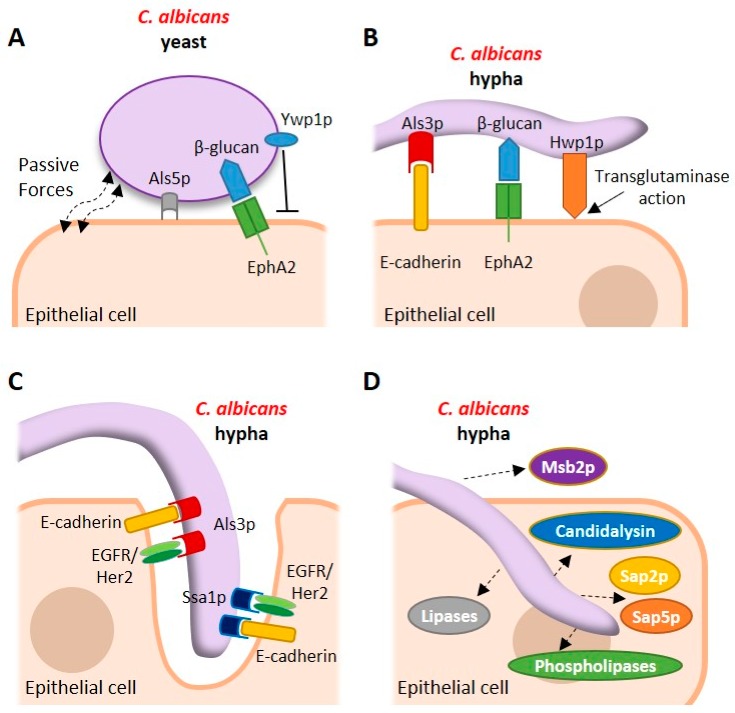
“These include a number of proteins from the Als family, particularly Als3, as well as hyphal wall protein 1 (Hwp1) [2, 195–198].”
From Mechanisms of fungal dissemination (2021) · cites this paper as [195]
The cited source says what the claim attributes to it.
In the citing paper
“C. albicans invasins include Als3 and the heat shock protein Ssa1 [195, 199, 200].”
From Mechanisms of fungal dissemination (2021) · cites this paper as [195]
In the citing paper
“In addition, yeast β-glucan is also recognized by the nonclassical pattern recognition receptor EphA2 [195].”
From Mechanisms of fungal dissemination (2021) · cites this paper as [195]
In the citing paper
“In the case of yeast, adherence is due to passive forces such as hydrophobic and/or electrostatic interactions as well as agglutinin-like sequence (Als) 5 [2, 195].”
From Mechanisms of fungal dissemination (2021) · cites this paper as [195]
Self-check
Percentages, sums and reported differences re-computed from the paper’s own numbers.
The self-check needs the paper’s full text.
Citations
Cites
Ozinsky, A., Underhill, D. M., Fontenot, J. D., Hajjar, A. M., Smith, K. D., Wilson, C. B., Schroeder, L., & Aderem, A. (2000) · Proceedings of the National Academy of Sciences · doi:10.1073/pnas.250476497 · Cited by 2,085
Pappas, P. G., Lionakis, M. S., Arendrup, M. C., Ostrosky-Zeichner, L., & Kullberg, B. J. (2018) · Nature Reviews Disease Primers · doi:10.1038/nrdp.2018.26 · Cited by 1,636 · cited 1×
“The cells that comprise mucosal barriers express pattern recognition receptors (PRRs) that recognise pathogen-associated molecular patterns (PAMPs) such as fungal cell wall components present on yeast and hyphal cells [79].”
BackgroundBrown, G. D., & Gordon, S. (2001) · Nature · doi:10.1038/35092620 · Cited by 1,579 · cited 1×
“Aryl hydrocarbon receptor IFN-γ and L-kynurenine [68] Dectin-1 β-glucan [90] EGFR/Her2 Als3p/Ssa1p [28,29] EphA2 β-glucan [93]”
Virulence factors of Candida albicans
Calderone, R. A., & Fonzi, W. A. (2001) · Trends in Microbiology · doi:10.1016/s0966-842x(01)02094-7 · Cited by 1,331 · cited 1×
“albicans to a mucosal surface is an essential requirement for persistence in the host, whether it be as a commensal or a pathogen [3,4].”
BackgroundCandida albicans Secreted Aspartyl Proteinases in Virulence and Pathogenesis
Naglik, J. R., Challacombe, S. J., & Hube, B. (2003) · Microbiology and Molecular Biology Reviews · doi:10.1128/mmbr.67.3.400-428.2003 · Cited by 1,179 · cited 3×
“Sap1–8p are secreted into the extracellular milieu, while Sap9p and Sap10p remain anchored on the cell membrane [141].”
BackgroundSelf-citationDectin-1 is required for β-glucan recognition and control of fungal infection
Taylor, P. R., Tsoni, S. V., Willment, J. A., Dennehy, K. M., Rosas, M., Findon, H., Haynes, K., Steele, C., Botto, M., Gordon, S., et al. (2007) · Nature Immunology · doi:10.1038/ni1408 · Cited by 1,161
Chronic Mucocutaneous Candidiasis in Humans with Inborn Errors of Interleukin-17 Immunity
Puel, A., Cypowyj, S., Bustamante, J., Wright, J. F., Liu, L., Lim, H. K., Migaud, M., Israel, L., Chrabieh, M., Audry, M., et al. (2011) · Science · doi:10.1126/science.1200439 · Cited by 1,056
Conti, H. R., Shen, F., Nayyar, N., Stocum, E., Sun, J. N., Lindemann, M. J., Ho, A. W., Hai, J. H., Yu, J. J., Jung, J. W., et al. (2009) · Journal of Experimental Medicine · doi:10.1084/jem.20081463 · Cited by 1,024 · cited 4×
“These isoforms trigger the release of the neutrophil activating chemokine G-CSF and β-defensin-1 and -3 from epithelial cells in oral tissue and the release of histatins from the salivary glands during OPC [112,133].”
BackgroundInfluentialCandidalysin is a fungal peptide toxin critical for mucosal infection
Moyes, D. L., Wilson, D., Richardson, J. P., Mogavero, S., Tang, S. X., Wernecke, J., Höfs, S., Gratacap, R. L., Robbins, J., Runglall, M., et al. (2016) · Nature · doi:10.1038/nature17625 · Cited by 942
Self-citationBacterial Iron Sources: From Siderophores to Hemophores
Wandersman, C., & Delepelaire, P. (2004) · Annual Review of Microbiology · doi:10.1146/annurev.micro.58.030603.123811 · Cited by 930
Cited by
d'Enfert, C., Kaune, A.-K., Alaban, L.-R., Chakraborty, S., Cole, N., Delavy, M., Kosmala, D., Marsaux, B., Fróis-Martins, R., Morelli, M., et al. (2021) · FEMS Microbiology Reviews · doi:10.1093/femsre/fuaa060 · Cited by 347
Lass-Flörl, C., Kanj, S. S., Govender, N. P., Thompson, G. R., Ostrosky- Zeichner, L., & Govrins, M. A. (2024) · Nature Reviews Disease Primers · doi:10.1038/s41572-024-00503-3 · Cited by 298
Oral microbiome: a review of its impact on oral and systemic health
Rajasekaran, J. J., Krishnamurthy, H. K., Bosco, J., Jayaraman, V., Krishna, K., Wang, T., & Bei, K. (2024) · Microorganisms · doi:10.3390/microorganisms12091797 · Cited by 272
Oral Cavity and Candida albicans: Colonisation to the Development of Infection
Patel, M. (2022) · Pathogens · doi:10.3390/pathogens11030335 · Cited by 170
Mechanisms of fungal dissemination
Strickland, A. B., & Shi, M. (2021) · Cellular and Molecular Life Sciences · doi:10.1007/s00018-020-03736-z · Cited by 127
Metadata
- Authors
- Nikou, S.-A., Kichik, N., Brown, R., Ponde, N., Ho, J., Naglik, J., & Richardson, J.
- Affiliations
- The Francis Crick Institute (GB)
- King's College London (GB)
- Corresponding author
- Richardson, Jonathan
- ORCID
- Venue
- Pathogens
- Publisher
- MDPI AG
- Published
- 2019-04-22
- Volume
- 8
- Issue
- 2
- Pages
- 53
- ISSN
- 2076-0817 (ISSN-L)
- PMC
- PMC6631630
- OpenAlex
- W2936696147
- Cited by
- 103
- References
- 202
- Citations by year
- 2026: 9 · 2025: 16 · 2024: 20 · 2023: 14 · 2022: 16 · 2021: 12 · 2020: 14 · 2019: 1
- FWCI
- 1.51
- Type
- journal article
- Language
- en
- Open access
- gold
- dx.doi.org
- Licence
- Locations
- Pathogens (publishedVersion, cc-by)
- PubMed Central (publishedVersion, cc-by)
- PubMed (publishedVersion)
- Research Portal (King's College London) (publishedVersion, cc-by)
- DOAJ (DOAJ: Directory of Open Access Journals) (submittedVersion, cc-by-sa)
- Figshare (submittedVersion, cc-by)
- Funders
- Biotechnology & Biological Sciences Research Council (BB/N014677/1)
- National Institutes of Health (R37-DE022550)
- King’s Health Partners Challenge Fund (R170501)
- The Rosetrees Trust (M680)
- The NIH Research at Guys and St. Thomas’s NHS Foundation Trust and the King’s College London Biomedical Research Centre (IS-BRC-1215-20006)
- Topics
- Health Sciences › Medicine › Infectious Diseases › Antifungal resistance and susceptibility
- Life Sciences › Biochemistry, Genetics and Molecular Biology › Molecular Biology › Fungal and yeast genetics research
- Health Sciences › Medicine › Infectious Diseases › Fungal Infections and Studies
- Keywords
- Candida albicans, mucosal surfaces, host-microbe interactions, fungal colonization, commensalism, fungal pathogenicity, immune evasion, mucosal immunity, fungal adaptation
About these checks
Registry, retraction, Cites and statistics results are computed, not judged, with one exception: a printed reference that no index lists is read once by a model before it counts as a citation error. Claims are extracted by a model and kept only when their quote appears verbatim in the text; each cited source is then checked, with a model’s help, for whether it says what the claim relies on. Those verdicts can be wrong — read the claim’s quote and the cited source before relying on one.
Statistics and arithmetic are recomputed, not judged.
Confidence bands are shown only for fields calibrated on our annotated test set. None is calibrated yet, so no band is shown.
What counts as a claim ›How we measure confidence ›How we check this ›
Are you an author, or do you see a problem with this page? Request a review
How to cite
Cite CoChat for the checks on this page, and the paper for its own findings.
- This page
- CoChat. (2026). Citation check: Candida albicans Interactions with Mucosal Surfaces during Health and Disease. https://app.cochat.ai/papers/10.3390/pathogens8020053
- The paper
- Nikou, S.-A., Kichik, N., Brown, R., Ponde, N., Ho, J., Naglik, J., & Richardson, J. (2019). Candida albicans Interactions with Mucosal Surfaces during Health and Disease. Pathogens. https://doi.org/10.3390/pathogens8020053
Data sources
Bibliographic data: Semantic Scholar, OpenAlex, Crossref.
Contains information from the Semantic Scholar Academic Graph Datasets, made available under the ODC Attribution License (ODC-BY 1.0).
Semantic Scholar’s data is described in: Kinney, R., et al. (2023). The Semantic Scholar Open Data Platform. arXiv:2301.10140.
