

Peripheral Wavefront Sensor with Fixation Target Made by Optical Simulation for Measuring Human Eye Regardless of Spectacle
Open accessThe DOI matches its Crossref record; 51 of the 51 references it cites were found in a registry or an index.
Abstract
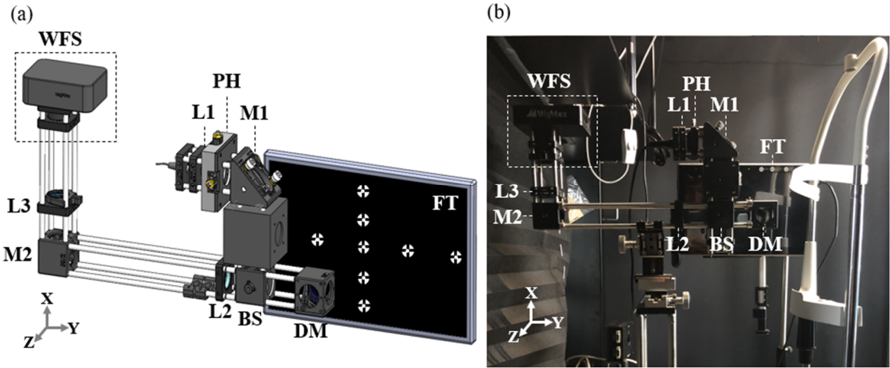
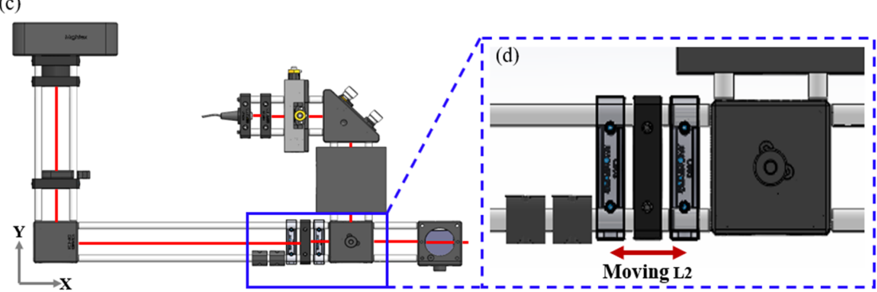
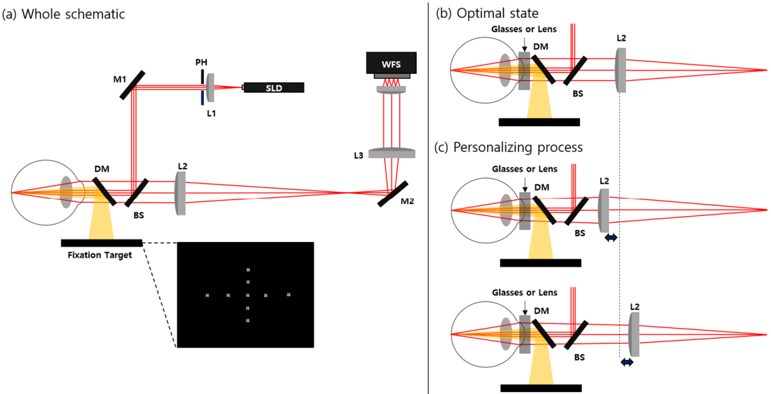
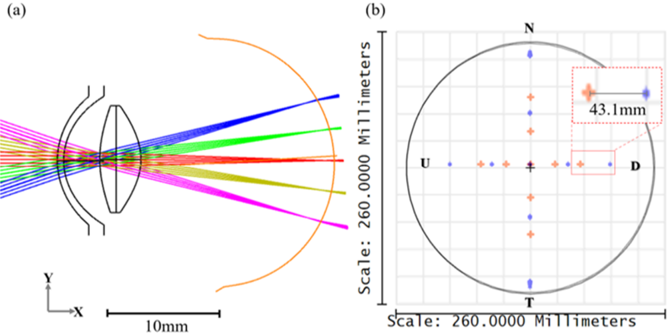
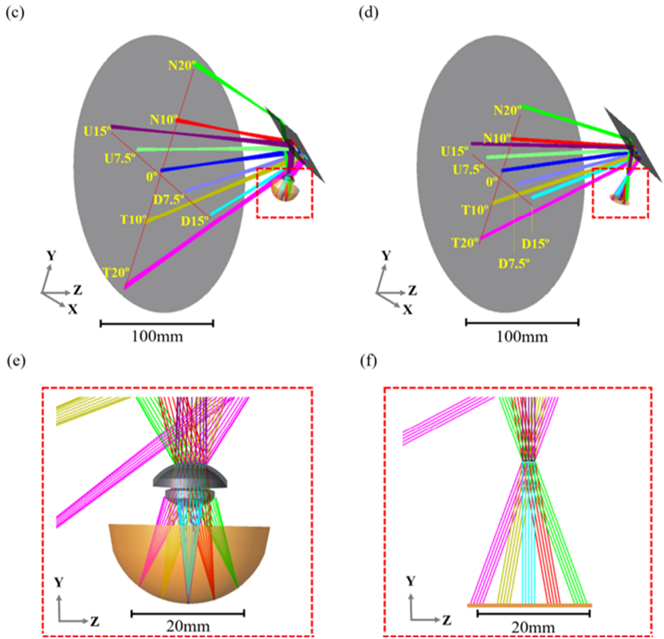
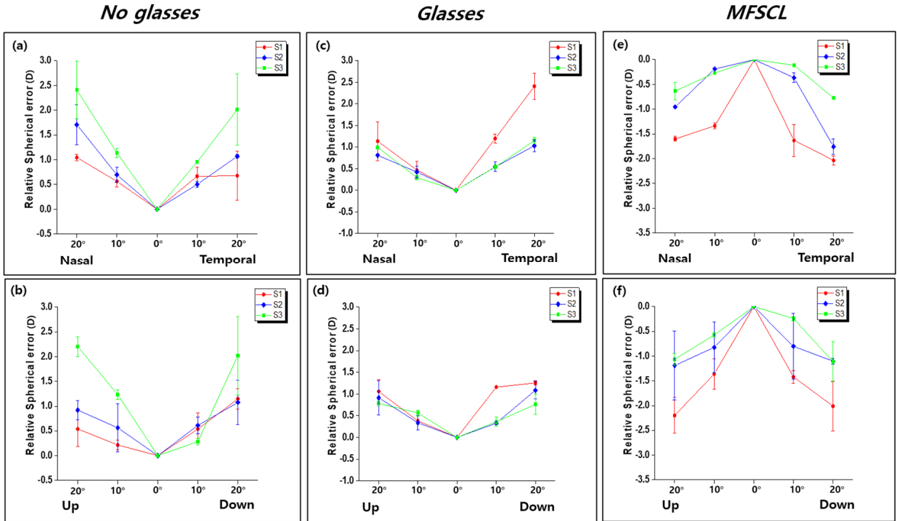
This study proposes a custom-built aberrometer that measures peripheral defocus to evaluate myopia progression in the human eye. This advanced device can measure visual fields in both horizontal (up to 40°) and vertical (up to 30°) orientations. It incorporates a novel fixation target that is meticulously designed using an optical simulation software. Notably, each angular point of this novel fixation target differs considerably from the conventional fixation target. To mitigate the effects of the optical variations introduced by spectacles and the subject’s vision, we incorporated a position-variable lens positioned in front of the eye. This lens compensates for these variations, enhancing the precision of the measurements. To evaluate the performance of the proposed aberrometer, we conducted experiments under three distinct conditions: first, with the naked eye; second, while wearing spectacles; and third, while wearing a multifocal lens.
Overview
The claims and statistics of this paper haven’t been checked yet.
Free: it reads the open-access text and checks the first 5 claims that cite a source we can check. Create a free account to check every claim.
Integrity signals
Registry
Cites
Statistics
Figures
Verification
Claims the paper makes
The claims and statistics of this paper haven’t been checked yet.
Free: it reads the open-access text and checks the first 5 claims that cite a source we can check. Create a free account to check every claim.
Claims other papers make about this one
Each is checked against this paper’s own text: does it say what the citing paper says it does?
The check wasn’t confident either way, so it gives no verdict — never disputed.
In the citing paper
“Also, reduced HOAs from FFLs have been shown to be more effective in reducing peripheral coma, trefoil, and spherical aberration because of their ability to customize the correction for specific ray paths through the lens-eye system [26,38,39].”
From Freeform vs. Aspheric Spectacle Lenses: A Comprehensive Review of Optical Performance, Clinical Outcomes, and Patient Considerations (2026) · cites this paper as [38]
Experimental — accuracy not yet measured
Self-check
Percentages, sums and reported differences re-computed from the paper’s own numbers.
The self-check needs the paper’s full text.
Citations
Cites
Global Prevalence of Myopia and High Myopia and Temporal Trends from 2000 through 2050
Holden, B. A., Fricke, T. R., Wilson, D. A., Jong, M., Naidoo, K. S., Sankaridurg, P., Wong, T. Y., Naduvilath, T. J., & Resnikoff, S. (2016) · Ophthalmology · doi:10.1016/j.ophtha.2016.01.006 · Cited by 5,500
Confocal Imaging–Guided Laser Ablation of Basal Cell Carcinomas: An Ex Vivo Study
Sierra, H., Cordova, M., Chen, C.-S. J., & Rajadhyaksha, M. (2015) · Journal of Investigative Dermatology · doi:10.1038/jid.2014.371 · Cited by 1,703
Thibos, L. N., WHEELER, W., & Horner, D. G. (1997) · Optometry and Vision Science · doi:10.1002/j.1538-9235.1997.tb04707.x · Cited by 1,238
Liang, J., Grimm, B., Goelz, S., & Bille, J. F. (1994) · Journal of the Optical Society of America A · doi:10.1364/josaa.11.001949 · Cited by 1,195
Baird, P. N., Saw, S.-M., Lanca, C., Guggenheim, J. A., Smith III, E. L., Zhou, X., Matsui, K.-O., Wu, P.-C., Sankaridurg, P., Chia, A., et al. (2020) · Nature Reviews Disease Primers · doi:10.1038/s41572-020-00231-4 · Cited by 838
Prevalence of Myopia in Taiwanese Schoolchildren: 1983 to 2000
Lin, L., Shih, Y., Hsiao, C., & Chen, C. (2004) · Annals of the Academy of Medicine, Singapore · doi:10.47102/annals-acadmedsg.v33n1p27 · Cited by 837
Cho, P., Cheung, S. W., & Edwards, M. (2005) · Current Eye Research · doi:10.1080/02713680590907256 · Cited by 596
Prevalence of Refractive Error in the United States, 1999-2004
Vitale, S. (2008) · Archives of Ophthalmology · doi:10.1001/archopht.126.8.1111 · Cited by 512
Hiraoka, T., Kakita, T., Okamoto, F., Takahashi, H., & Oshika, T. (2012) · Investigative Opthalmology & Visual Science · doi:10.1167/iovs.11-8453 · Cited by 488
(2002) · PubMed · Cited by 474
Cited by
Ladopoulos, K., Pateras, E., & Ninos, G. (2026) · Cureus · doi:10.7759/cureus.104008
“Also, reduced HOAs from FFLs have been shown to be more effective in reducing peripheral coma, trefoil, and spherical aberration because of their ability to customize the correction for specific ray paths through the lens-eye system [26,38,39].”
Metadata
- Authors
- Oh, S.-K., Kim, J.-M., Yoon, G.-Y., Yoo, Y.-S., & Kim, D. Y.
- Affiliations
- Inha University (KR)
- Department of Electrical and Computer Engineering, Inha University, Incheon 22212, Republic of Korea
- College of Optometry, University of Houston, Houston, TX 77004, USA
- The Catholic University of Korea Uijeongbu St. Mary's Hospital (KR)
- Corresponding author
- Yoo, Young-Sik
- Kim, Dae Yu
- Venue
- Photonics
- Publisher
- MDPI AG
- Published
- 2024-04-02
- Volume
- 11
- Issue
- 4
- Pages
- 332
- ISSN
- 2304-6732 (ISSN-L)
- OpenAlex
- W4393558562
- Cited by
- 1
- References
- 51
- Citations by year
- 2026: 1
- FWCI
- 0.31
- Type
- journal article
- Language
- en
- Open access
- gold
- dx.doi.org
- Licence
- Locations
- Photonics (publishedVersion, cc-by)
- DOAJ (DOAJ: Directory of Open Access Journals) (submittedVersion, cc-by-sa)
- Funders
- National Research Foundation of Korea (2021R1I1A1A01056094, 2018R1A6A1A03025523, 2023R1A2C1004330, KMDF_PR_ 20200901_0026)
- Korean government (2021R1I1A1A01056094, 2018R1A6A1A03025523, 2023R1A2C1004330, KMDF_PR_ 20200901_0026)
- Topics
- Health Sciences › Medicine › Ophthalmology › Ophthalmology and Visual Impairment Studies
- Physical Sciences › Physics and Astronomy › Atomic and Molecular Physics, and Optics › Adaptive optics and wavefront sensing
- Physical Sciences › Computer Science › Computer Vision and Pattern Recognition › Optical measurement and interference techniques
- Keywords
- wavefront sensor, fixation target, peripheral defocus, myopia progression, optical simulation, multifocal lens, visual field testing, aberrometry
About these checks
Registry, retraction, Cites and statistics results are computed, not judged, with one exception: a printed reference that no index lists is read once by a model before it counts as a citation error. Claims are extracted by a model and kept only when their quote appears verbatim in the text; each cited source is then checked, with a model’s help, for whether it says what the claim relies on. Those verdicts can be wrong — read the claim’s quote and the cited source before relying on one.
Statistics and arithmetic are recomputed, not judged.
Confidence bands are shown only for fields calibrated on our annotated test set. None is calibrated yet, so no band is shown.
What counts as a claim ›How we measure confidence ›How we check this ›
Are you an author, or do you see a problem with this page? Request a review
How to cite
Cite CoChat for the checks on this page, and the paper for its own findings.
- This page
- CoChat. (2026). Citation check: Peripheral Wavefront Sensor with Fixation Target Made by Optical Simulation for Measuring Human Eye Regardless of Spectacle. https://app.cochat.ai/papers/10.3390/photonics11040332
- The paper
- Oh, S.-K., Kim, J.-M., Yoon, G.-Y., Yoo, Y.-S., & Kim, D. Y. (2024). Peripheral Wavefront Sensor with Fixation Target Made by Optical Simulation for Measuring Human Eye Regardless of Spectacle. Photonics. https://doi.org/10.3390/photonics11040332
Data sources
Bibliographic data: Semantic Scholar, OpenAlex, Crossref.
Contains information from the Semantic Scholar Academic Graph Datasets, made available under the ODC Attribution License (ODC-BY 1.0).
Semantic Scholar’s data is described in: Kinney, R., et al. (2023). The Semantic Scholar Open Data Platform. arXiv:2301.10140.
