

β-Ionone: Its Occurrence and Biological Function and Metabolic Engineering
Open accessThe DOI matches its Crossref record; 106 of the 106 references it cites were found in a registry or an index.
Abstract
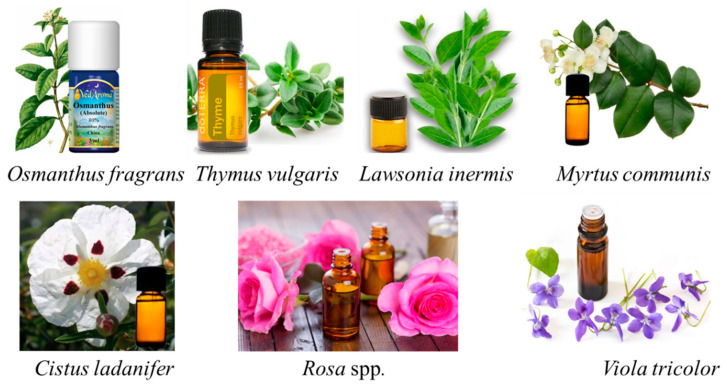
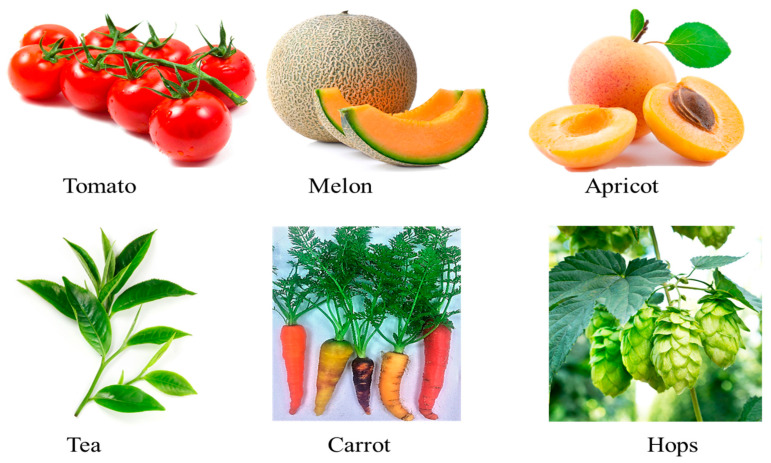
β-Ionone is a natural plant volatile compound, and it is the 9,10 and 9′,10′ cleavage product of β-carotene by the carotenoid cleavage dioxygenase. β-Ionone is widely distributed in flowers, fruits, and vegetables. β-Ionone and other apocarotenoids comprise flavors, aromas, pigments, growth regulators, and defense compounds; serve as ecological cues; have roles as insect attractants or repellants, and have antibacterial and fungicidal properties. In recent years, β-ionone has also received increased attention from the biomedical community for its potential as an anticancer treatment and for other human health benefits. However, β-ionone is typically produced at relatively low levels in plants. Thus, expressing plant biosynthetic pathway genes in microbial hosts and engineering the metabolic pathway/host to increase metabolite production is an appealing alternative. In the present review, we discuss β-ionone occurrence, the biological activities of β-ionone, emphasizing insect attractant/repellant activities, and the current strategies and achievements used to reconstruct enzyme pathways in microorganisms in an effort to to attain higher amounts of the desired β-ionone.
Overview
The claims and statistics of this paper haven’t been checked yet.
Free: it reads the open-access text and checks the first 5 claims that cite a source we can check. Create a free account to check every claim.
Integrity signals
Registry
Cites
Statistics
Figures



Verification
Claims the paper makes
The claims and statistics of this paper haven’t been checked yet.
Free: it reads the open-access text and checks the first 5 claims that cite a source we can check. Create a free account to check every claim.
Claims other papers make about this one
Each is checked against this paper’s own text: does it say what the citing paper says it does?
The cited source says what the claim attributes to it.
In the citing paper
“However, due to the prolonged time for the plant growth cycle and high dilution, the direct plant extraction of beta-ionone is limited [50].”
From Innovative Approaches to an Eco-Friendly Cosmetic Industry: A Review of Sustainable Ingredients (2024) · cites this paper as [50]
Self-check
Percentages, sums and reported differences re-computed from the paper’s own numbers.
The self-check needs the paper’s full text.
Citations
Cites
Plant Volatiles: Recent Advances and Future Perspectives
Dudareva, N., Negre, F., Nagegowda, D. A., & Orlova, I. (2006) · Critical Reviews in Plant Sciences · doi:10.1080/07352680600899973 · Cited by 1,395
The formation and function of plant volatiles: perfumes for pollinator attraction and defense
Pichersky, E., & Gershenzon, J. (2002) · Current Opinion in Plant Biology · doi:10.1016/s1369-5266(02)00251-0 · Cited by 1,190
Biochemistry of Plant Volatiles
Dudareva, N., Pichersky, E., & Gershenzon, J. (2004) · Plant Physiology · doi:10.1104/pp.104.049981 · Cited by 1,128
Plant Volatile Compounds: Sensory Cues for Health and Nutritional Value?
Goff, S. A., & Klee, H. J. (2006) · Science · doi:10.1126/science.1112614 · Cited by 710
Carotenoids and their cleavage products: Biosynthesis and functions
Walter, M. H., & Strack, D. (2011) · Natural Product Reports · doi:10.1039/c0np00036a · Cited by 580 · cited 2×
“The name “ionone” is derived from “iona” (Greek for violet), which refers to the violet odor, and “ketone,” which refers to the structure of the ionone [11,12].”
BackgroundCarotenoid oxidation products as stress signals in plants
Havaux, M. (2014) · The Plant Journal · doi:10.1111/tpj.12386 · Cited by 569
Plant carotenoid cleavage oxygenases and their apocarotenoid products
Auldridge, M. E., McCarty, D. R., & Klee, H. J. (2006) · Current Opinion in Plant Biology · doi:10.1016/j.pbi.2006.03.005 · Cited by 540
Ko, Y.-S., Kim, J. W., Lee, J. A., Han, T., Kim, G. B., Park, J. E., & Lee, S. Y. (2020) · Chemical Society Reviews · doi:10.1039/d0cs00155d · Cited by 476
Simkin, A. J., Schwartz, S. H., Auldridge, M., Taylor, M. G., & Klee, H. J. (2004) · The Plant Journal · doi:10.1111/j.1365-313x.2004.02263.x · Cited by 474
Plant Secondary Metabolite Diversity and Species Interactions
Kessler, A., & Kalske, A. (2018) · Annual Review of Ecology, Evolution, and Systematics · doi:10.1146/annurev-ecolsys-110617-062406 · Cited by 465
Research works printed but not linked: 1
- Basu S. Zandi P. Cetzal-Ix W. Sengupta R. The genus Rosa: An aristocrat from the plant family with class, color and fragrance IRSEN 2015 1 9 Available online: https://www.academia.edu/download/38410616/Basu_et_al_Roses_2015.pdf (accessed on 15 March 2021)
Cited by
Floral Scents and Fruit Aromas: Functions, Compositions, Biosynthesis, and Regulation
Mostafa, S., Wang, Y., Zeng, W., & Jin, B. (2022) · Frontiers in Plant Science · doi:10.3389/fpls.2022.860157 · Cited by 220
Innovative Approaches to an Eco-Friendly Cosmetic Industry: A Review of Sustainable Ingredients
Sasounian, R., Martinez, R. M., Lopes, A. M., Giarolla, J., Rosado, C., Magalhães, W. V., Velasco, M. V. R., & Baby, A. R. (2024) · Clean Technologies · doi:10.3390/cleantechnol6010011 · Cited by 96
Baky, M. H., Shamma, S. N., Xiao, J., & Farag, M. A. (2022) · Food Chemistry · doi:10.1016/j.foodchem.2022.132374 · Cited by 69
Analyzing Volatile Compounds of Young and Mature Docynia delavayi Fruit by HS-SPME-GC-MS and rOAV
Wang, Y., He, Y., Liu, Y., & Wang, D. (2022) · Foods · doi:10.3390/foods12010059 · Cited by 59
Metadata
- Authors
- Paparella, A., Shaltiel-Harpaza, L., & Ibdah, M.
- Affiliations
- University of Teramo (IT)
- Migal Galilee Research Institute, P.O. Box 831, Kiryat Shmona 11016, Israel
- Agricultural Research Organization (IL)
- Corresponding author
- Ibdah, Mwafaq
- Venue
- Plants
- Publisher
- MDPI AG
- Published
- 2021-04-12
- Volume
- 10
- Issue
- 4
- Pages
- 754
- ISSN
- 2223-7747 (ISSN-L)
- PMC
- PMC8069406
- OpenAlex
- W3153408627
- Cited by
- 155
- References
- 106
- Citations by year
- 2026: 36 · 2025: 40 · 2024: 30 · 2023: 19 · 2022: 23 · 2021: 7
- FWCI
- 2.07
- Type
- journal article
- Language
- en
- Open access
- gold
- doi.org
- Licence
- Locations
- Plants (publishedVersion, cc-by)
- PubMed Central (publishedVersion, cc-by)
- PubMed (publishedVersion)
- DOAJ (DOAJ: Directory of Open Access Journals) (submittedVersion, cc-by-sa)
- UniTERAMO Research Catalog (University of Teramo) (submittedVersion)
- Topics
- Life Sciences › Biochemistry, Genetics and Molecular Biology › Molecular Biology › Plant biochemistry and biosynthesis
- Life Sciences › Biochemistry, Genetics and Molecular Biology › Molecular Biology › Microbial Metabolic Engineering and Bioproduction
- Life Sciences › Biochemistry, Genetics and Molecular Biology › Biotechnology › Biochemical and biochemical processes
- Keywords
- β-ionone, apocarotenoids, carotenoid cleavage dioxygenase, beta-carotene cleavage, plant volatiles, insect attractants, insect repellents, anticancer potential, metabolic engineering, biosynthetic pathway reconstruction, plant secondary metabolites
About these checks
Registry, retraction, Cites and statistics results are computed, not judged, with one exception: a printed reference that no index lists is read once by a model before it counts as a citation error. Claims are extracted by a model and kept only when their quote appears verbatim in the text; each cited source is then checked, with a model’s help, for whether it says what the claim relies on. Those verdicts can be wrong — read the claim’s quote and the cited source before relying on one.
Statistics and arithmetic are recomputed, not judged.
Confidence bands are shown only for fields calibrated on our annotated test set. None is calibrated yet, so no band is shown.
What counts as a claim ›How we measure confidence ›How we check this ›
Are you an author, or do you see a problem with this page? Request a review
How to cite
Cite CoChat for the checks on this page, and the paper for its own findings.
- This page
- CoChat. (2026). Citation check: β-Ionone: Its Occurrence and Biological Function and Metabolic Engineering. https://app.cochat.ai/papers/10.3390/plants10040754
- The paper
- Paparella, A., Shaltiel-Harpaza, L., & Ibdah, M. (2021). β-Ionone: Its Occurrence and Biological Function and Metabolic Engineering. Plants. https://doi.org/10.3390/plants10040754
Data sources
Bibliographic data: Semantic Scholar, OpenAlex, Crossref.
Contains information from the Semantic Scholar Academic Graph Datasets, made available under the ODC Attribution License (ODC-BY 1.0).
Semantic Scholar’s data is described in: Kinney, R., et al. (2023). The Semantic Scholar Open Data Platform. arXiv:2301.10140.
