

The DOI matches its Crossref record; 270 of the 270 references it cites were found in a registry or an index.
Regulation of Reactive Oxygen Species during Salt Stress in Plants and Their Crosstalk with Other Signaling Molecules—Current Perspectives and Future Directions
Open accessAbstract
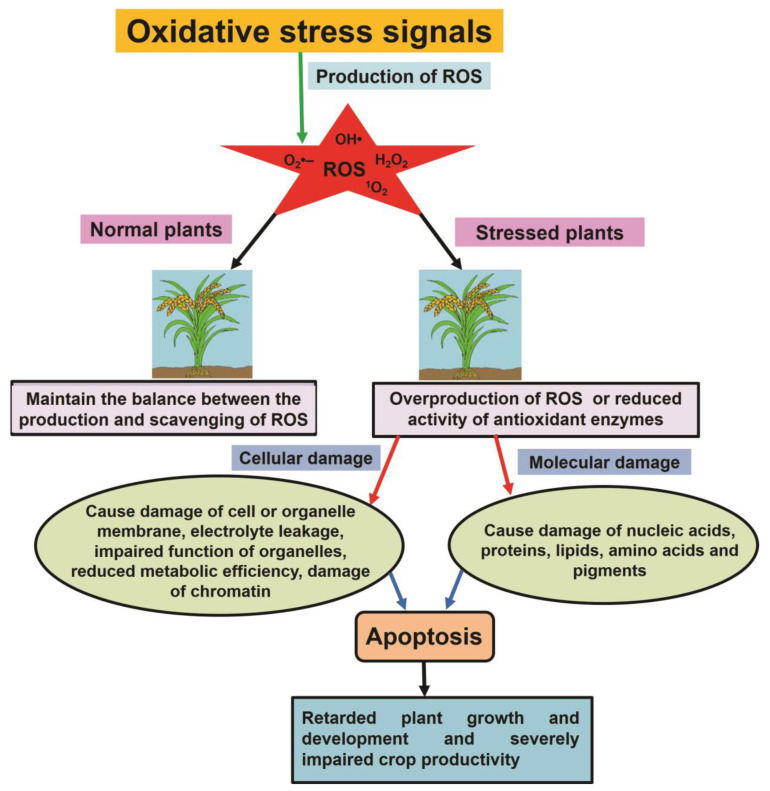
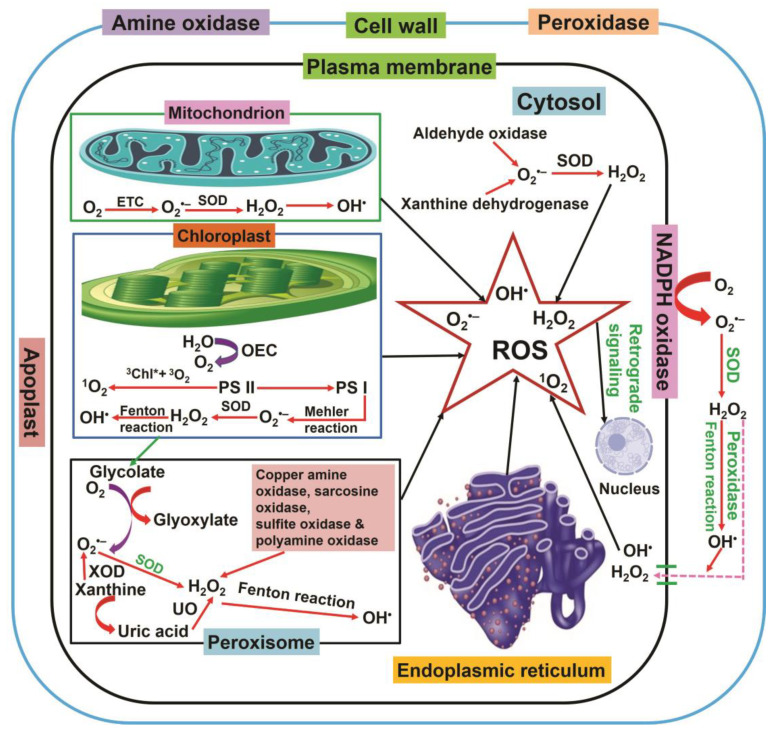
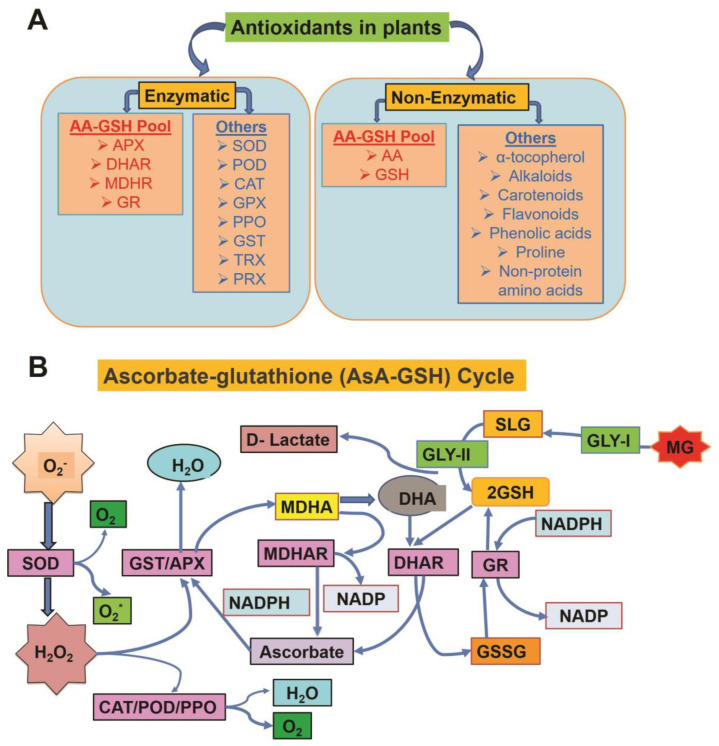
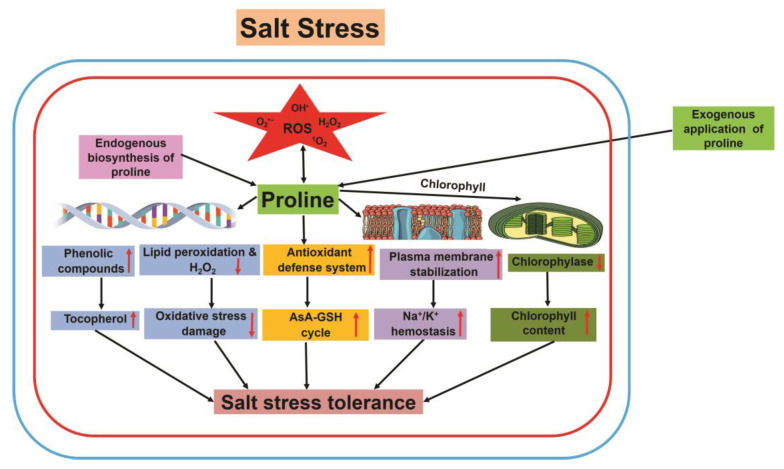
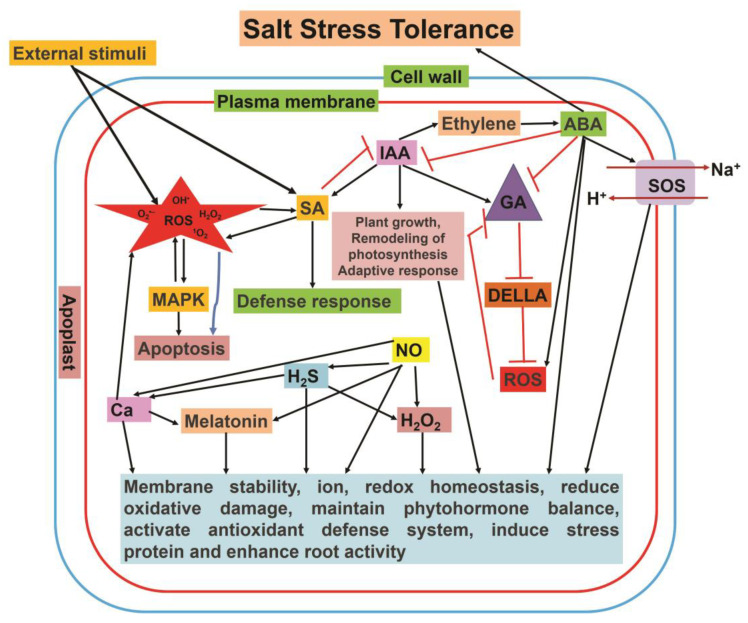
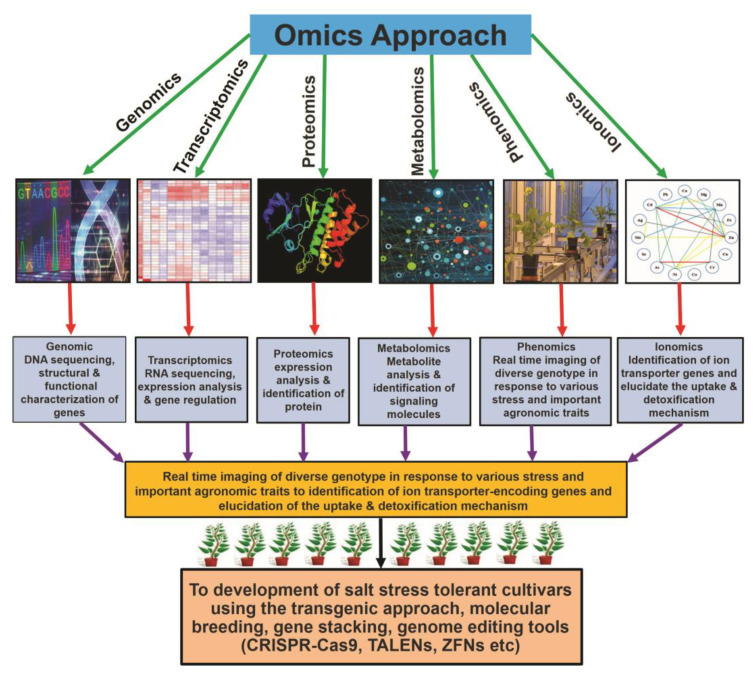
Salt stress is a severe type of environmental stress. It adversely affects agricultural production worldwide. The overproduction of reactive oxygen species (ROS) is the most frequent phenomenon during salt stress. ROS are extremely reactive and, in high amounts, noxious, leading to destructive processes and causing cellular damage. However, at lower concentrations, ROS function as secondary messengers, playing a critical role as signaling molecules, ensuring regulation of growth and adjustment to multifactorial stresses. Plants contain several enzymatic and non-enzymatic antioxidants that can detoxify ROS. The production of ROS and their scavenging are important aspects of the plant’s normal response to adverse conditions. Recently, this field has attracted immense attention from plant scientists; however, ROS-induced signaling pathways during salt stress remain largely unknown. In this review, we will discuss the critical role of different antioxidants in salt stress tolerance. We also summarize the recent advances on the detrimental effects of ROS, on the antioxidant machinery scavenging ROS under salt stress, and on the crosstalk between ROS and other various signaling molecules, including nitric oxide, hydrogen sulfide, calcium, and phytohormones. Moreover, the utilization of “-omic” approaches to improve the ROS-regulating antioxidant system during the adaptation process to salt stress is also described.
Overview
The claims and statistics of this paper haven’t been checked yet.
Run the check — free, no account needed. It reads the open-access text and checks the sources it cites.
Integrity signals
Registry
Cites
Statistics
Figures
Verification
Claims the paper makes
The claims and statistics of this paper haven’t been checked yet.
Run the check — free, no account needed. It reads the open-access text and checks the sources it cites.
Claims other papers make about this one
Each is checked against this paper’s own text: does it say what the citing paper says it does?
The source backs part of the claim, not all of it — or backs it for a different population, condition or comparison.
In the citing paper
“Furthermore, increased salinity levels promote the formation of reactive oxygen species (ROS), which can degrade chlorophyll and damage the photosynthetic machinery46.”
From Cold plasma technology as a pre-treatment for seed priming enhances germination and reduces salinity stress in Prosopis Koelziana (2025) · cites this paper as [46]
Experimental — accuracy not yet measured
Self-check
Percentages, sums and reported differences re-computed from the paper’s own numbers.
The self-check needs the paper’s full text.
Citations
Cites
Mechanisms of Salinity Tolerance
Munns, R., & Tester, M. (2008) · Annual Review of Plant Biology · doi:10.1146/annurev.arplant.59.032607.092911 · Cited by 13,792
Reactive oxygen species and antioxidant machinery in abiotic stress tolerance in crop plants
Gill, S. S., & Tuteja, N. (2010) · Plant Physiology and Biochemistry · doi:10.1016/j.plaphy.2010.08.016 · Cited by 11,734
Hydrogen Peroxide is Scavenged by Ascorbate-specific Peroxidase in Spinach Chloroplasts
Nakano, Y., & Asada, K. (1981) · Plant and Cell Physiology · doi:10.1093/oxfordjournals.pcp.a076232 · Cited by 10,809
Oxidative stress, antioxidants and stress tolerance
Mittler, R. (2002) · Trends in Plant Science · doi:10.1016/s1360-1385(02)02312-9 · Cited by 10,790
Sharma, P., Jha, A. B., Dubey, R. S., & Pessarakli, M. (2012) · Journal of Botany · doi:10.1155/2012/217037 · Cited by 5,723
ASCORBATE AND GLUTATHIONE: Keeping Active Oxygen Under Control
Noctor, G., & Foyer, C. H. (1998) · Annual Review of Plant Physiology and Plant Molecular Biology · doi:10.1146/annurev.arplant.49.1.249 · Cited by 5,722
Proline: a multifunctional amino acid
Szabados, L., & Savouré, A. (2009) · Trends in Plant Science · doi:10.1016/j.tplants.2009.11.009 · Cited by 4,351
Asada, K. (1999) · Annual Review of Plant Physiology and Plant Molecular Biology · doi:10.1146/annurev.arplant.50.1.601 · Cited by 4,038
Polyphenols: Chemistry, dietary sources, metabolism, and nutritional significance
Bravo, L. (2009) · Nutrition Reviews · doi:10.1111/j.1753-4887.1998.tb01670.x · Cited by 4,030
Antioxidants, Oxidative Damage and Oxygen Deprivation Stress: a Review
Blokhina, O. B. (2002) · Annals of Botany · doi:10.1093/aob/mcf118 · Cited by 4,018
Research works printed but not linked: 15
- Mehla, N., Sindhi, V., Josula, D., Bisht, P., and Wani, S.H. (2017). Reactive Oxygen Species and Antioxidant Systems in Plants: Role and Regulation under Abiotic Stress, Springer.
- Hasanuzzaman, M., Hossain, M.A., Silva, J.A., and Fujita, M. (2012). Crop Stress and Its Management: Perspectives and Strategies, Springer.
- Maurya, A.K. (2020). Agronomic Crops, Springer.
- Loewen, 2000, Catalase—An “old” enzyme that continues to surprise us, ASM News, 66, 76
- Scandalios, J.G. (2019). Causes of Photooxidative Stress and Amelioration of Defense Systems in Plants, CRC Press.
- Sharma, I., and Ahmad, P. (2014). Oxidative Damage to Plants, Elsevier.
- Rao, A., and Reddy, A.R. (2008). Sulfur Assimilation and Abiotic Stress in Plants, Springer.
- Kubo, 1993, Primary structure and properties of glutathione reductase from Arabidopsis thaliana, Plant Cell Physiol., 34, 1259
- Yousuf, P.Y., Hakeem, K.U.R., Chandna, R., and Ahmad, P. (2012). Abiotic Stress Responses in Plants, Springer.
- Castro, D., Contreras, L.M., Kurz, L., and Wilkesman, J. (2017). Zymography, Springer.
- Barnes, J., Zheng, Y., and Lyons, T. (2002). Air Pollution and Plant Biotechnology, Springer.
- Abdelaal, 2021, Salt tolerance activation in faba bean plants using proline and salicylic acid associated with physio-biochemical and yield characters improvement, Fresenius Environ. Bull., 30, 3175
- Kesawat, M.S., Das, B.K., Kumar, M., and Bhaganagare, G.R. (2015). Biological Nitrogen Fixation, Wiley Online Library.
- Iqbal, N., Masood, A., and Khan, N.A. (2012). Phytohormones and Abiotic Stress Tolerance in Plants, Springer.
- Yang, D.-Y., Zhuang, K.-Y., and Ma, N.-N. (2022). Protoplasma, Springer.
Cited by
Sorted by citations
Mariyam, S., Bhardwaj, R., Khan, N. A., Sahi, S. V., & Seth, C. S. (2023) · Plant Science · doi:10.1016/j.plantsci.2023.111835 · Cited by 118
Reactive oxygen species (ROS): plant perspectives on oxidative signalling and biotic stress response
Sood, M. (2025) · Discover Plants. · doi:10.1007/s44372-025-00275-4 · Cited by 109
Niekerk, L., Gokul, A., Basson, G., Badiwe, M., Nkomo, M. A., Klein, A., & Keyster, M. (2024) · Plant Cell & Environment · doi:10.1111/pce.14926 · Cited by 93
Ali, S., Akhtar, M. S., Siraj, M., & Zaman, W. (2024) · International Journal of Molecular Sciences · doi:10.3390/ijms252212424 · Cited by 90
Waheed, A., Zhuo, L., Wang, M., Hailiang, X., Tong, Z., Wang, C., & Aili, A. (2024) · Plant Stress · doi:10.1016/j.stress.2024.100652 · Cited by 80
Metadata
- Authors
- Kesawat, M. S., Satheesh, N., Kherawat, B. S., Kumar, A., Kim, H.-U., Chung, S.-M., & Kumar, M.
- Affiliations
- Sri Sri University (IN)
- Swami Keshwanand Rajasthan Agricultural University (IN)
- Banaras Hindu University (IN)
- Sejong University (KR)
- Dongguk University (KR)
- Corresponding author
- Kumar, Manu
- ORCID
- Venue
- Plants
- Publisher
- MDPI AG
- Published
- 2023-02-14
- Volume
- 12
- Issue
- 4
- Pages
- 864
- ISSN
- 2223-7747 (ISSN-L)
- PMC
- PMC9964777
- OpenAlex
- W4320917863
- Cited by
- 407
- References
- 270
- Citations by year
- 2026: 132 · 2025: 139 · 2024: 113 · 2023: 22
- FWCI
- 9.70
- Type
- journal article
- Language
- en
- Open access
- gold
- doi.org
- Licence
- Locations
- Plants (publishedVersion, cc-by)
- PubMed Central (publishedVersion, cc-by)
- PubMed (publishedVersion)
- DOAJ (DOAJ: Directory of Open Access Journals) (submittedVersion, cc-by-sa)
- Funders
- National Research Foundation of Korea (NRF-2020R1A2C2008175)
- Dongguk University Research Fund of 2020–2023 (NRF-2020R1A2C2008175)
- Topics
- Life Sciences › Agricultural and Biological Sciences › Plant Science › Plant Stress Responses and Tolerance
- Life Sciences › Biochemistry, Genetics and Molecular Biology › Molecular Biology › Redox biology and oxidative stress
- Life Sciences › Agricultural and Biological Sciences › Plant Science › Plant-Microbe Interactions and Immunity
- Keywords
- reactive oxygen species, salt stress, salt tolerance, antioxidant enzymes, non-enzymatic antioxidants, ROS signaling, nitric oxide, hydrogen sulfide, calcium signaling, plant hormones, oxidative stress, plant stress response, omics approaches
About these checks
Registry, retraction, Cites and statistics results are computed, not judged, with one exception: a printed reference that no index lists is read once by a model before it counts as a citation error. Claims are extracted by a model and kept only when their quote appears verbatim in the text; each cited source is then checked, with a model’s help, for whether it says what the claim relies on. Those verdicts can be wrong — read the claim’s quote and the cited source before relying on one.
Statistics and arithmetic are recomputed, not judged.
Confidence bands are shown only for fields calibrated on our annotated test set. None is calibrated yet, so no band is shown.
What counts as a claim ›How we measure confidence ›How we check this ›
Are you an author, or do you see a problem with this page? Request a review
