

The DOI matches its Crossref record.
Implementation of Circular Economy Principles in the Synthesis of Polyurethane Foams
Abstract
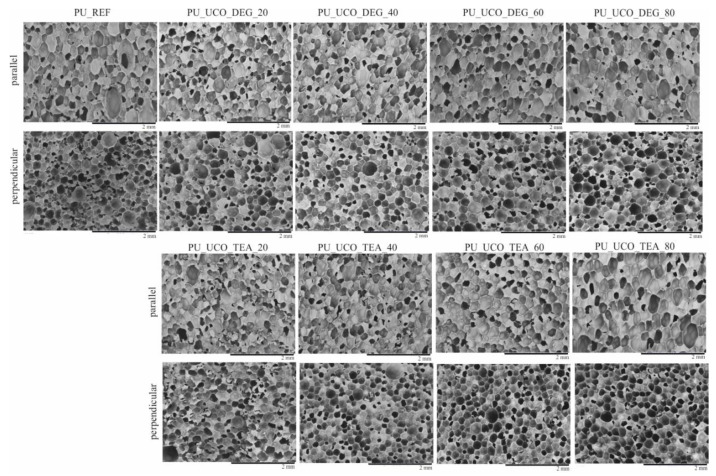
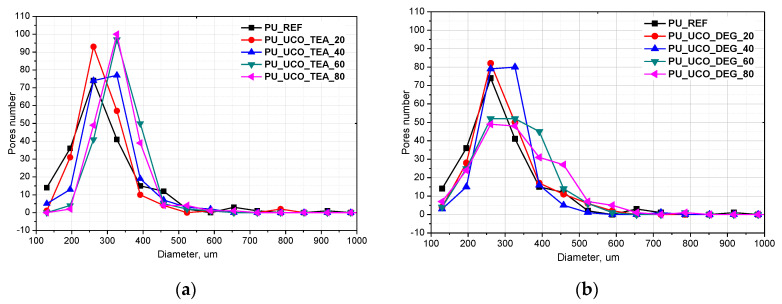
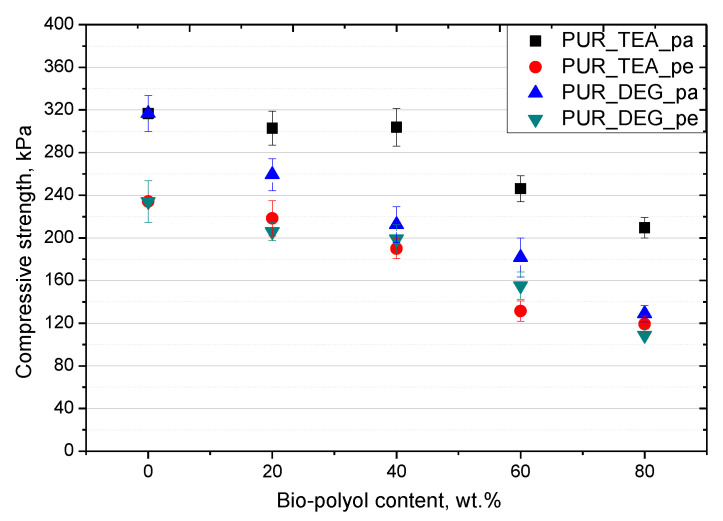
The main strategy of the European Commission in the field of the building industry assumes a reduction of greenhouse gas emissions by up to 20% by 2020 and by up to 80% by 2050. In order to meet these conditions, it is necessary to develop not only efficient thermal insulation materials, but also more environmentally friendly ones. This paper describes an experiment in which two types of bio-polyols were obtained using transesterification of used cooking oil with triethanolamine (UCO_TEA) and diethylene glycol (UCO_DEG). The bio-polyols were next used to prepare low-density rigid polyurethane (PUR) foams. It was found that the bio-polyols increased the reactivity of the PUR systems, regardless of their chemical structures. The reactivity of the system modified with 60% of the diethylene glycol-based bio-polyol was higher than in the case of the reference system. The bio-foams exhibited apparent densities of 41–45 kg/m3, homogeneous cellular structures and advantageous values of the coefficient of thermal conductivity. It was observed that the higher functionality of bio-polyol UCO_TEA compared with UCO_DEG had a beneficial effect on the mechanical and thermal properties of the bio-foams. The most promising results were obtained in the case of the foams modified in 60% with the bio-polyol based on triethanoloamine. In conclusion, this approach, utilizing used cooking oil in the synthesis of high-value thermal insulating materials, provides a sustainable municipal waste recycling solution.
Overview
The claims and statistics of this paper haven’t been checked yet.
Run the check — free, no account needed. It reads the open-access text and checks the sources it cites.
Integrity signals
Registry
Cites
Statistics
Figures
Verification
Claims the paper makes
The claims and statistics of this paper haven’t been checked yet.
Run the check — free, no account needed. It reads the open-access text and checks the sources it cites.
Claims other papers make about this one
Each is checked against this paper’s own text: does it say what the citing paper says it does?
In the citing paper
“fossilbased PURs can be (i) reduced by replacing polyols with bio-oils (Kura nska et al., 2020)”
From Stakeholder governance to facilitate collaboration for a systemic circular economy transition: A qualitative study in the European chemicals and plastics industry (2024) · cites this paper as Kurańska et al., 2020
Self-check
Percentages, sums and reported differences re-computed from the paper’s own numbers.
The self-check needs the paper’s full text.
Citations
Cites
No references could be resolved yet.
Research works printed but not linked: 21
- Liszkowska, J., Borowicz, M., and Paciorek-Sadowska, J. (2019). Assessment of Photodegradation and Biodegradation of RPU/PIR Foams Modified by Natural Compounds of Plant Origin. Polymers, 12. · DOI
- Zhang, G., Wu, Y., Chen, W., Han, D., Lin, X., and Xu, G. (2019). Open-Cell Rigid Polyurethane Foams from Peanut Shell-Derived Polyols Prepared under Di ff erent Post-Processing Conditions. Polymers, 11. · DOI
- Paciorek-Sadowska, J., Borowicz, M., Isbrandt, M., Czupryński, B., and Apiecionek, Ł. (2019). The Use of Waste from the Production of Rapeseed Oil for Obtaining of New Polyurethane Composites. Polymers, 11. · DOI
- Barczewski, 2019, Basalt waste management in the production of highly effective porous polyurethane composites for thermal insulating applications, Polym. Test., 76, 90, 10.1016/j.polymertesting.2019.02.008 · DOI
- Barczewski, 2019, Rigid polyurethane foams modified with thermoset polyester-glass fiber composite waste, Polym. Test., 81, 106190, 10.1016/j.polymertesting.2019.106190 · DOI
- Zieleniewska, 2016, Development and applicational evaluation of the rigid polyurethane foam composites with egg shell waste, Polym. Degrad. Stab., 132, 78, 10.1016/j.polymdegradstab.2016.02.030 · DOI
- Paberza, 2014, Wheat straw lignin as filler for rigid polyurethane foams on the basis of tall oil amide, Polimery, 6, 477, 10.14314/polimery.2014.477 · DOI
- Formela, 2017, Structural, thermal and physico-mechanical properties of polyurethane/brewers’ spent grain composite foams modified with ground tire rubber, Ind. Crop. Prod., 108, 844, 10.1016/j.indcrop.2017.07.047 · DOI
- Bertino, 2018, Rigid polyurethane foams reinforced with solid waste generated in leather industry, Polym. Test., 69, 225, 10.1016/j.polymertesting.2018.05.013 · DOI · Paper page
- Benes, 2019, Effect of homogeneous catalysts on ring opening reactions of epoxidized cooking oils, J. Clean. Prod., 230, 162, 10.1016/j.jclepro.2019.05.096 · DOI
- Fridrihsone, 2020, Life Cycle Assessment of vegetable oil based polyols for polyurethane production, J. Clean. Prod., 266, 121403, 10.1016/j.jclepro.2020.121403 · DOI
- Polaczek, 2019, Evaluation of application potential of used cooking oils in the synthesis of polyol compounds, Environ. Chem. Eng., 7, 103506, 10.1016/j.jece.2019.103506 · DOI
- Zhang, 2020, Influence of NCO/OH ratio on preparation of four agricultural wastes liquefied polyols based polyurethane foams, Polym. Degrad. Stab., 179, 109256, 10.1016/j.polymdegradstab.2020.109256 · DOI
- Borowicz, M., Paciorek-Sadowska, J., Isbrandt, M., Grzybowski, Ł., and Czupryński, B. (2019). Glycerolysis of Poly(lactic acid) as a Way to Extend the “Life Cycle” of This Material. Polymers, 11. · DOI
- Cateto, 2009, Optimization Study of Lignin Oxypropylation in View of the Preparation of Polyurethane Rigid Foams, Ind. Eng. Chem. Res., 48, 2583, 10.1021/ie801251r · DOI
- Pinto, 2020, Synthesis of thermal insulating polyurethane foams from lignin and rapeseed based polyols: A comparative study, Ind. Crop. Prod., 143, 111882, 10.1016/j.indcrop.2019.111882 · DOI
- Hejna, 2017, The influence of crude glycerol and castor oil-based polyol on the structure and performance of rigid polyurethane-polyisocyanurate foams, Ind. Crop. Prod., 95, 113, 10.1016/j.indcrop.2016.10.023 · DOI
- Paruzel, 2017, Rigid Polyurethane Foam Fabrication Using Medium Chain Glycerides of Coconut Oil and Plastics from End-of-Life Vehicles, ACS Sustain. Chem. Eng., 5, 6237, 10.1021/acssuschemeng.7b01197 · DOI
- Ji, 2015, Polyurethane rigid foams formed from different soy-based polyols by the ring opening of epoxidised soybean oil with methanol, phenol, and cyclohexanol, Ind. Crop. Prod., 74, 76, 10.1016/j.indcrop.2015.04.041 · DOI
- Jiao, 2013, Thermal degradation characteristics of rigid polyurethane foam and the volatile products analysis with TG-FTIR-MS, Polym. Degrad. Stab., 98, 2687, 10.1016/j.polymdegradstab.2013.09.032 · DOI
- Zieleniewska, 2016, Modification of flexible polyurethane foams by the addition of natural origin fillers, Polym. Degrad. Stab., 132, 32, 10.1016/j.polymdegradstab.2016.05.002 · DOI
Cited by
Sorted by citations
Rahla, K. M., Mateus, R., & Bragança, L. (2021) · Infrastructures · doi:10.3390/infrastructures6040049 · Cited by 99
Schultz, F. C., Valentinov, V., Kirchherr, J., Reinhardt, R. J., & Pies, I. (2024) · Business Strategy and the Environment · doi:10.1002/bse.3592 · Cited by 82
Metadata
- Authors
- Kurańska, M., Leszczyńska, M., Malewska, E., Prociak, A., & Ryszkowska, J.
- Affiliations
- Department of Chemistry and Technology of Polymers, Cracow University of Technology, Warszawska 24, 31-155 Kraków, Poland
- Faculty of Materials Science and Engineering, Warsaw University of Technology, Wołoska 141, 0-507 Warsaw, Poland
- ORCID
- Ryszkowska, Joanna
- Venue
- Polymers
- Publisher
- MDPI AG
- Published
- 2020-09-12
- Volume
- 12
- Issue
- 9
- Pages
- 2068
- ISSN
- 2073-4360
- PMC
- PMC7569902
- Cited by
- 30
- References
- 0
- Language
- en
- Funders
- National Center for Research and Development in Poland (LIDER/28/0167/L-8/16/NCBR/2017)
About these checks
Registry, retraction, Cites and statistics results are computed, not judged, with one exception: a printed reference that no index lists is read once by a model before it counts as a citation error. Claims are extracted by a model and kept only when their quote appears verbatim in the text; each cited source is then checked, with a model’s help, for whether it says what the claim relies on. Those verdicts can be wrong — read the claim’s quote and the cited source before relying on one.
Statistics and arithmetic are recomputed, not judged.
Confidence bands are shown only for fields calibrated on our annotated test set. None is calibrated yet, so no band is shown.
What counts as a claim ›How we measure confidence ›How we check this ›
Are you an author, or do you see a problem with this page? Request a review
How to cite
Cite CoChat for the checks on this page, and the paper for its own findings.
- This page
- CoChat. (2026). Citation check: Implementation of Circular Economy Principles in the Synthesis of Polyurethane Foams. https://app.cochat.ai/papers/10.3390/polym12092068
- The paper
- Kurańska, M., Leszczyńska, M., Malewska, E., Prociak, A., & Ryszkowska, J. (2020). Implementation of Circular Economy Principles in the Synthesis of Polyurethane Foams. Polymers. https://doi.org/10.3390/polym12092068
