

The DOI matches its Crossref record; 1 of the 1 references it cites were found in a registry or an index.
Optimization and Kinetic Modelling of Hydroxycinnamic Acid Extraction from Anethum graveolens Leaves
Abstract
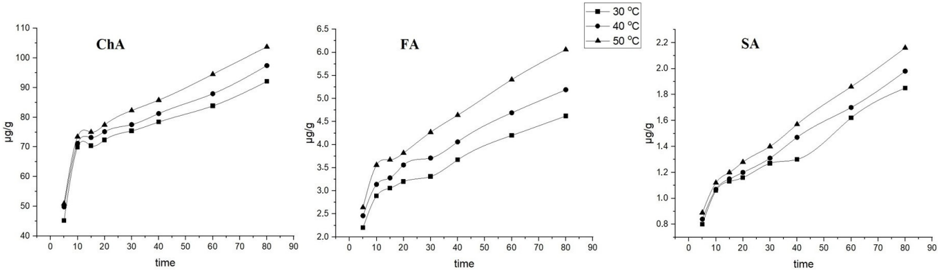
This study focused on optimizing key extraction parameters (ethanol concentration, temperature, and time) to enhance the extraction of hydroxycinnamic acids from A. graveolens leaves, applying a replicated 23 full factorial design. The experimental results demonstrated that extraction conditions significantly influenced the yield of hydroxycinnamic acids. The optimum conditions were 50% ethanol for 80 min at 50 °C, yielding 103.75 µg/g of chlorogenic acid (ChA), 6.05 µg/g of ferulic acid (FA), and 2.19 µg/g of sinapic acid (SA). Therefore, the extract obtained with 50% ethanol showed the highest levels of polyphenols, flavonoids, and antioxidant potential, highlighting its suitability for use in both food-related products and pharmaceutical formulations. Additionally, the applicability of different mathematical models (unsteady-state diffusion, parabolic diffusion, and power law models, as well as Ponomaryov’s and Elovich’s equations) to describe and better understand the kinetics of hydroxycinnamic acid extraction from dill leaves was evaluated. The fit of each kinetic model to the experimental data was assessed using the root mean square error and the coefficient of determination. Among the five kinetic models, the unsteady-state diffusion model and Ponomaryov’s equation provided the best fit, exhibiting the highest accuracy. The activation energy for the extraction process was determined to be 5.85, 6.46, and 7.59 kJ/mol for ChA, FA, and SA, respectively. The extraction of hydroxycinnamic acids from dill leaves was found to be endothermic, irreversible, and spontaneous.
Overview
The claims and statistics of this paper haven’t been checked yet.
Run the check — free, no account needed. It reads the open-access text and checks the sources it cites.
Integrity signals
Registry
Cites
Statistics
Figures
Verification
Claims the paper makes
The claims and statistics of this paper haven’t been checked yet.
Run the check — free, no account needed. It reads the open-access text and checks the sources it cites.
Claims other papers make about this one
Each is checked against this paper’s own text: does it say what the citing paper says it does?
In the citing paper
“Jevtovic et al. [19] proved that the recovery of sinapic, ferulic and chlorogenic acids was strongly influenced by ethanol concentration and the applied extraction method.”
From Maceration, Soxhlet Extraction, and Steam Hydrodistillation of Anethum graveolens Seeds: Phytochemical Profiles and Cytotoxic Effects (2026) · cites this paper as [19]
In the citing paper
“Jevtovic et al. [19] reported chlorogenic, ferulic and sinapic acid concentrations of approximately 103.75, 6.05 and 2.19 μg/g plant material, respectively, following the optimised extraction of A. graveolens leaves with 50% ethanol.”
From Maceration, Soxhlet Extraction, and Steam Hydrodistillation of Anethum graveolens Seeds: Phytochemical Profiles and Cytotoxic Effects (2026) · cites this paper as [19]
Self-check
Percentages, sums and reported differences re-computed from the paper’s own numbers.
The self-check needs the paper’s full text.
Citations
Cites
Pressurized liquid extraction as a green approach in food and herbal plants extraction: A review
Mustafa, A., & Turner, C. (2011) · Analytica Chimica Acta · doi:10.1016/j.aca.2011.07.018 · Cited by 1,104
Research works printed but not linked: 43
- Regueiro, 2015, Characterization of the phenolic and antioxidant profiles of selected culinary herbs and spices: Caraway, turmeric, dill, marjoram and nutmeg, Food Sci. Technol., 35, 189, 10.1590/1678-457X.6580 · DOI
- Kulig, 2019, Scrining of polyphenolic compounds from traditional medicinal herbs, J. Microbiol. Biotechnol. Food Sci., 9, 487, 10.15414/jmbfs.2019.9.special.487-491 · DOI
- Akhtar, 2018, Phytochemical analysis and comprehensive evaluation of antimicrobial and antioxidant properties of 61 medicinal plant species, Arab. J. Chem., 11, 1223, 10.1016/j.arabjc.2015.01.013 · DOI
- Isbilir, 2011, Antioxidant Potential of Different Dill (Anethum graveolens L.) Leaf Extracts, Int. J. Food Prop., 14, 894, 10.1080/10942910903474401 · DOI · Paper page
- Swieca, 2008, Influence of thermal processing on phenolics compounds level and antiradical activity of dill (Anethum graveolens L.), Herba Pol., 54, 59
- Teixeira, J., Gaspar, S., Garrido, E.G., Garrido, J., and Borges, F. (2013). Hydroxycinnamic Acid Antioxidants: An Electrochemical Overview. BioMed Res. Int., 2013. · DOI
- Laina, K.T., Drosou, C., Stergiopoulos, C., Eleni, P.M., and Krokida, M. (2024). Optimization of Combined Ultrasound and Microwave-Assisted Extraction for Enhanced Bioactive Compounds Recovery from Four Medicinal Plants: Oregano, Rosemary, Hypericum, and Chamomile. Molecules, 29. · DOI
- Hobbi, P., Okoro, O.V., Delporte, C., Alimoradi, H., Podstawczyk, D., Nie, L., Bernaerts, K.V., and Shavandi, A. (2021). Kinetic modelling of the solid–liquid extraction process of polyphenolic compounds from apple pomace: Influence of solvent composition and temperature. Bioresour. Bioprocess., 8. · DOI
- Kaderides, 2019, Microwave-assisted extraction of phenolics from pomegranate peels: Optimization, kinetics, and comparison with ultrasounds extraction, Chem. Eng. Process., 137, 1, 10.1016/j.cep.2019.01.006 · DOI
- Menkiti, 2015, Extraction of oil from Terminalia catappa L.: Process parameter impacts, kinetics, and thermodynamics, Ind. Crops Prod., 77, 713, 10.1016/j.indcrop.2015.08.019 · DOI
- Singleton, 1965, Colorometry of total phenolics with phosphomolybdic-phosphotungstic acid reagents, Am. J. Enol. Vitic., 16, 144, 10.5344/ajev.1965.16.3.144 · DOI · Paper page
- Brighente, 2007, Antioxidant activity and total phenolic content of some Brazilian species, Pharm. Biol., 45, 156, 10.1080/13880200601113131 · DOI
- Baliyan, S., Mukherjee, R., Priyadarshini, A., Vibhuti, A., Gupta, A., Pandey, R.P., and Chang, C.-M. (2022). Determination of Antioxidants by DPPH Radical Scavenging Activity and Quantitative Phytochemical Analysis of Ficus religiosa. Molecules, 27. · DOI · Paper page
- Dias, 2024, Enhancing the Extraction of Phenolic Antioxidants from Amazonian Assai (Euterpe oleracea Martius) Fruit Waste through Response Surface Methodology Optimization, Biomass, 4, 402, 10.3390/biomass4020019 · DOI
- Suresh, M., and Mohammed Saleh, A.A. (2019). In Vitro Antioxidant and Bactericidal Efficacy of 15 Common Spices: Novel Therapeutics for Urinary Tract Infections?. Medicina, 55. · DOI
- Apak, 2008, Cupric ion reducing antioxidant capacity assay for food antioxidants: Vitamins, polyphenolics, and flavonoids in food extracts, Methods Mol. Biol., 477, 163, 10.1007/978-1-60327-517-0_14 · DOI
- Galgano, F., Tolve, R., Scarpa, T., Caruso, M.C., Lucini, L., Senizza, B., and Condelli, N. (2021). Extraction Kinetics of Total Polyphenols, Flavonoids, and Condensed Tannins of Lentil Seed Coat: Comparison of Solvent and Extraction Methods. Foods, 10. · DOI
- 2006, Kinetics of ultrasonic extraction of extractive substances from garden (Salvia officinalis L.) and glutinous (Salvia glutinosa L.) sage, Ultrason. Sonochem., 13, 150, 10.1016/j.ultsonch.2005.02.002 · DOI
- 2014, The kinetic and thermodynamic analysis of ultrasound-extraction of minerals from aerial parts of white lady’s bedstraw (Galium mollugo L.), Chem. Eng. Res. Des., 92, 1399, 10.1016/j.cherd.2013.10.024 · DOI
- Nour, 2017, Bioactive compounds, antioxidant activity and nutritional quality of different culinary aromatic herbs, Not. Bot. Horti. Agrobot., 45, 179, 10.15835/nbha45110678 · DOI
- Shan, 2005, Antioxidant capacity of 26 spice extracts and characterization of their phenolic constituents, J. Agric. Food Chem., 53, 7749, 10.1021/jf051513y · DOI · Paper page
- Jiang, 2021, Optimization of the Extraction Technology and Assessment of Antioxidant Activity of Chlorogenic Acid-Rich Extracts From Eucommia ulmoides Leaves, Nat. Prod. Commun., 16, 1
- Zeng, G., Ran, Y., Huang, X., Li, Y., Zhang, M., Ding, H., Ma, Y., Ma, H., Jin, L., and Sun, D. (2022). Optimization of Ultrasonic-Assisted Extraction of Chlorogenic Acid from Tobacco Waste. Int. J. Environ. Res. Public Health, 19. · DOI
- Nayak, 2015, Comparison of microwave, ultrasound and accelerated-assisted solvent extraction for recovery of polyphenols from Citrus sinensis peels, Food Chem., 187, 507, 10.1016/j.foodchem.2015.04.081 · DOI
- Michiels, 2012, Extraction conditions can greatly influence antioxidant capacity assays in plant food matrices, Food Chem., 130, 986, 10.1016/j.foodchem.2011.07.117 · DOI
- Dent, 2013, The Effect of Extraction Solvents, Temperature and Time on the Composition and Mass Fraction of Polyphenols in Dalmatian Wild Sage (Salvia officinalis L.) Extracts, Food Technol. Biotechnol., 51, 84
- Patil, 2021, Study of Extraction Kinetics of Total Polyphenols from Curry Leaves, Int. J. Chem. Eng., 2021, 9988684, 10.1155/2021/9988684 · DOI
- Torres, 2012, Effects of Temperature and Time on Polyphenolic Content and Antioxidant Activity in the Pressurized Hot Water Extraction of Deodorized Thyme (Thymus vulgaris), J. Agric. Food Chem., 60, 10920, 10.1021/jf3027759 · DOI
- Uma, 2010, Optimization of Extraction Parameters of Total Phenolic Compounds from Henna (Lawsonia inermis) Leaves, Sains Malays., 39, 119
- Costa, 2012, Thymus lotocephalus wild plants and in vitro cultures produce different profiles of phenolic compounds with antioxidant activity, Food Chem., 135, 1253, 10.1016/j.foodchem.2012.05.072 · DOI
- Bugarski, 2017, Optimization of the extraction process of polyphenols from Thymus serpyllum L. herb using maceration, heat-and ultrasound-assisted techniques, Sep. Purif. Technol., 179, 369, 10.1016/j.seppur.2017.01.055 · DOI
- Aklilu, 2021, Artificial neural network and response surface methodology for modeling and optimization of activation of lactoperoxidase system, S. Afr. J. Chem. Eng., 37, 12
- Balyan, 2017, Aqueous extraction kinetics of phenolic compounds from jamun (Syzygium cumini L.) seeds, Int. J. Food Prop., 20, 372, 10.1080/10942912.2016.1163266 · DOI
- Ickovski, 2020, Kinetic models of the extraction of vanillic acid from pumpkin seeds, Open Chem., 18, 22, 10.1515/chem-2020-0001 · DOI
- Anbalagana, 2019, Prelusive scale extraction of mangiferin from Mangifera indica leaves: Assessing solvent competency, process optimization, kinetic study and diffusion modelling, Ind. Crops Prod., 140, 111703, 10.1016/j.indcrop.2019.111703 · DOI
- 2008, Empirical kinetic models for the resinoid extraction from aerial parts of St. Jon’s wort (Hypericum perforatum L.), Biochem. Eng. J., 41, 1, 10.1016/j.bej.2008.02.010 · DOI
- Morina, 2015, An improved HPLC-DAD method for simultaneously measuring phenolics in the leaves of Tilia platyphyllos and Ailanthus altissima, Bot. Serb., 39, 177
- Tomas, 2007, Study of solid-liquid extraction kinetics of total polyphenols from grape seeds, J. Food Eng., 81, 236, 10.1016/j.jfoodeng.2006.10.027 · DOI
- 2020, Optimization, kinetics and thermodynamika of the solid-liquid extraction process of flavonoids from rosemary (Rosemarinus officinalis), Stud. UBB Chem., 65, 111, 10.24193/subbchem.2020.1.09 · DOI
- Balyan, 2018, Analysis of flux decline using sequential fouling mechanisms during concentration of Syzygium cumini (L.) leaf extract, Chem. Eng. Res. Des., 130, 167, 10.1016/j.cherd.2017.12.015 · DOI
- Krishnan, 2017, Influence of microwave irradiation on kinetics and thermodynamics of extraction of flavonoids from Phyllanthus emblica, Braz. J. Chem. Eng., 34, 885, 10.1590/0104-6632.20170343s20150628 · DOI
- 2015, Kinetics of the solid-liquid extraction process of phenolic antioxidants and antioxidant capacity from hop (Humulus lupulus L.), Sep. Sci. Technol., 50, 1658, 10.1080/01496395.2014.978019 · DOI
- 2014, The kinetics and thermodynamics of hempseed oil extraction by n-hexane, Ind. Crops Prod., 52, 679, 10.1016/j.indcrop.2013.11.045 · DOI
Cited by
Goldiș, C., Racoviceanu, R., Negrea-Ghiulai, R., Mioc, A., Prodea, A., Atyim, E., Maksimovic, T., Lukinich-Gruia, A. T., Pricop, M.-A., & Șoica, C. (2026) · Molecules · doi:10.3390/molecules31183337
Metadata
- Authors
- Jevtovic, V., Alabbosh, K. F. S., Alyami, R. A., Alreshidi, M. A., Alshammari, M. R., Alshammari, B., Mitić, J., & Mitić, M.
- Venue
- Processes
- Publisher
- MDPI AG
- Published
- 2025-04-24
- Volume
- 13
- Issue
- 5
- Pages
- 1297
- ISSN
- 2227-9717
- Cited by
- 3
- References
- 1
- Language
- en
- Funders
- University of Ha’il, Kingdom of Saudi Arabia (RG-24159)
- Scientific Research Deanship at University of Ha’il—Saudi Arabia (RG-24159)
About these checks
Registry, retraction, Cites and statistics results are computed, not judged, with one exception: a printed reference that no index lists is read once by a model before it counts as a citation error. Claims are extracted by a model and kept only when their quote appears verbatim in the text; each cited source is then checked, with a model’s help, for whether it says what the claim relies on. Those verdicts can be wrong — read the claim’s quote and the cited source before relying on one.
Statistics and arithmetic are recomputed, not judged.
Confidence bands are shown only for fields calibrated on our annotated test set. None is calibrated yet, so no band is shown.
What counts as a claim ›How we measure confidence ›How we check this ›
Are you an author, or do you see a problem with this page? Request a review
Data sources
Bibliographic data: Semantic Scholar, OpenAlex, Crossref.
Contains information from the Semantic Scholar Academic Graph Datasets, made available under the ODC Attribution License (ODC-BY 1.0).
Semantic Scholar’s data is described in: Kinney, R., et al. (2023). The Semantic Scholar Open Data Platform. arXiv:2301.10140.
