

SegMarsViT: Lightweight Mars Terrain Segmentation Network for Autonomous Driving in Planetary Exploration
Open accessThe DOI matches its Crossref record; 67 of the 67 references it cites were found in a registry or an index; 1 of the 4 sources its claims cite were checked for support.
Abstract
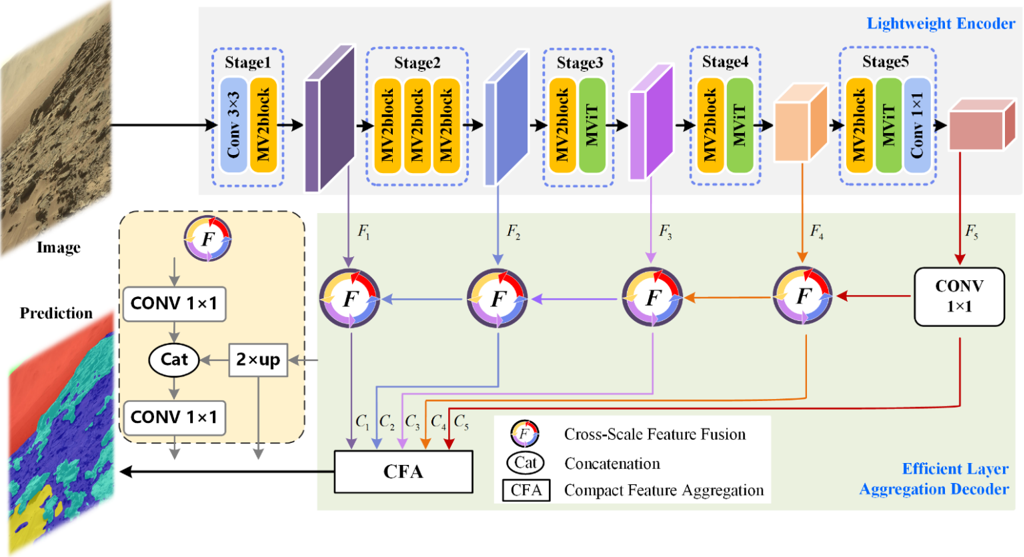
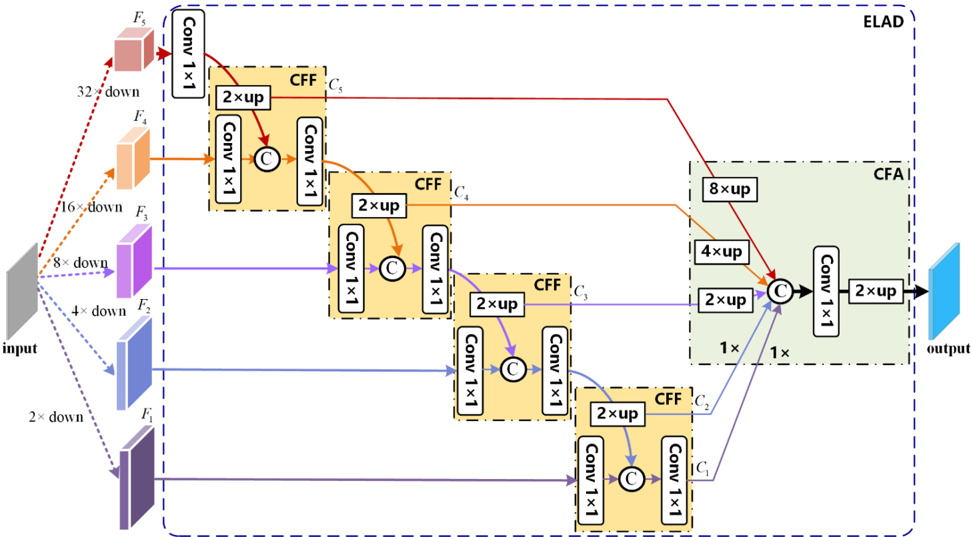
Planetary rover systems need to perform terrain segmentation to identify feasible driving areas and surround obstacles, which falls into the research area of semantic segmentation. Recently, deep learning (DL)-based methods were proposed and achieved great performance for semantic segmentation. However, due to the on-board processor platform’s strict comstraints on computational complexity and power consumption, existing DL approaches are almost impossible to be deployed on satellites under the burden of extensive computation and large model size. To fill this gap, this paper targeted studying effective and efficient Martian terrain segmentation solutions that are suitable for on-board satellites. In this article, we propose a lightweight ViT-based terrain segmentation method, namely, SegMarsViT. In the encoder part, the mobile vision transformer (MViT) block in the backbone extracts local–global spatial and captures multiscale contextual information concurrently. In the decoder part, the cross-scale feature fusion modules (CFF) further integrate hierarchical context information and the compact feature aggregation module (CFA) combines multi-level feature representation. Moreover, we evaluate the proposed method on three public datasets: AI4Mars, MSL-Seg, and S5Mars. Extensive experiments demonstrate that the proposed SegMarsViT was able to achieve 68.4%, 78.22%, and 67.28% mIoU on the AI4Mars-MSL, MSL-Seg, and S5Mars, respectively, under the speed of 69.52 FPS.
Overview
CoChat Summary
TL;DR
SegMarsViT is a lightweight ViT-based encoder-decoder for Martian terrain segmentation, combining a MobileViT backbone with an efficient layer aggregation decoder using cross-scale feature fusion and compact feature aggregation. It reports 68.4% mIoU on AI4Mars-MSL, 78.22% on S5 Mars, and 67.28% on MSL-Seg, at 69.52 FPS.
Key findings
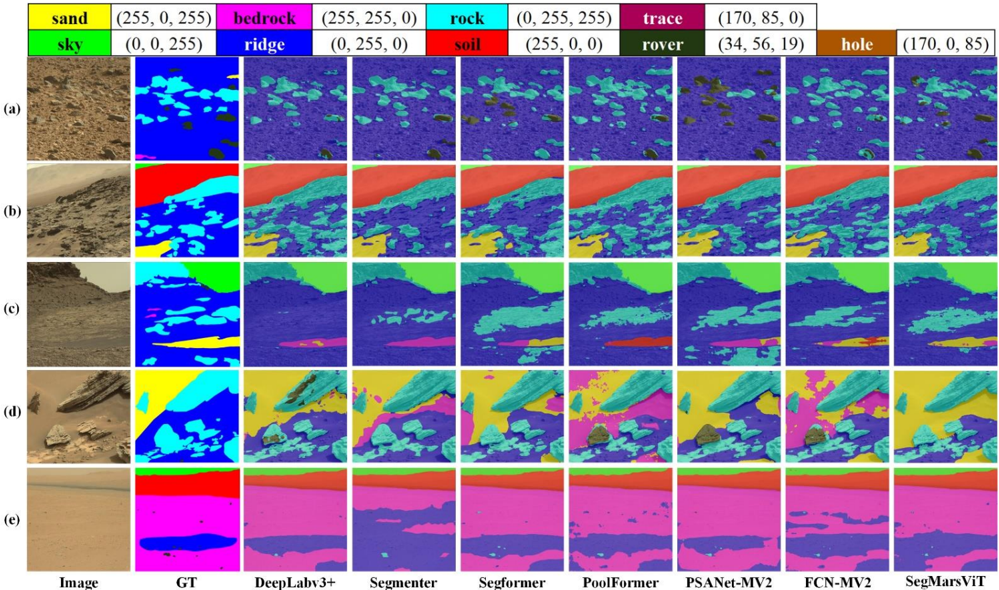
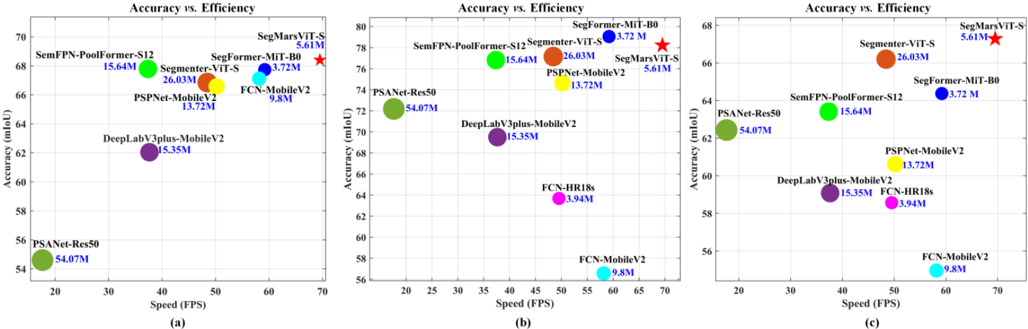
- On AI4Mars-MSL, SegMarsViT (MobileViT-s) reaches 68.4% mIoU and 92.46% pixelACC with 5.61 M parameters and 8.54 G FLOPs; compared with SegFormer (MIT-B0), it keeps 0.66% better mIoU.
- On S5 Mars, it reaches 78.22% mIoU, 92.15% pixelACC, 84.74 mFscore, and 85.86 mPrecision at 69.52 FPS with 5.61 M parameters and 8.54 G FLOPs.
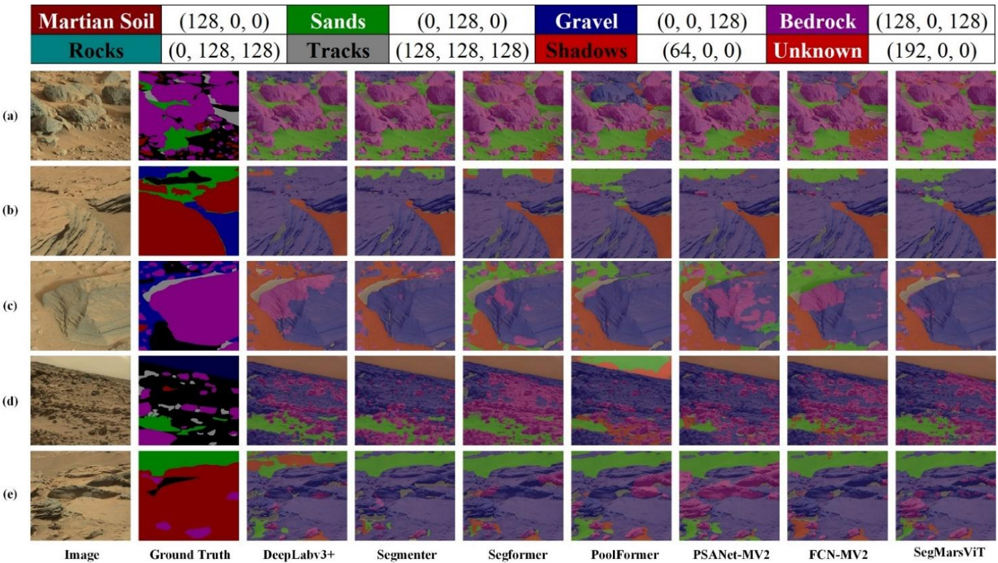
- On MSL-Seg, it reaches 67.28% mIoU, 86.05% pixelACC, 78.69 mFscore, and 78.75 mPrecision at 69.52 FPS; the paper reports improvements of 2.96% pixelACC and 5.17% mIoU over other latest methods.
- Ablation on MSL-Seg shows adding CFF and CFA improves mIoU and pixelACC by 4.06% and 2.62% over the baseline; ELAD gives 67.28 mIoU at 8.54 G FLOPs versus AMD at 66.69 mIoU/13.14 G FLOPs and UNetD at 66.83 mIoU/12.85 G FLOPs.
Methods
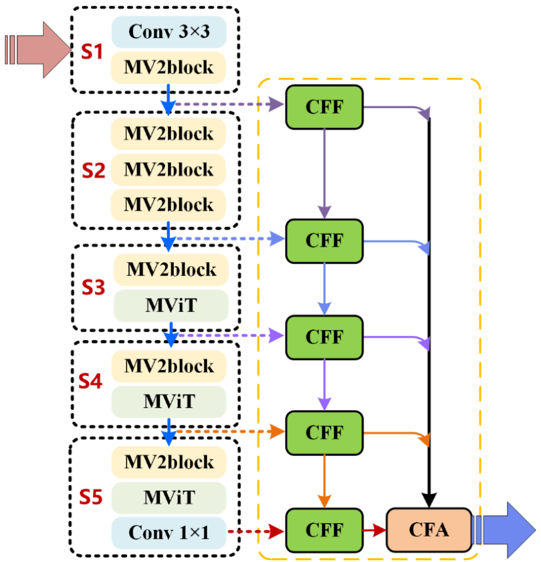
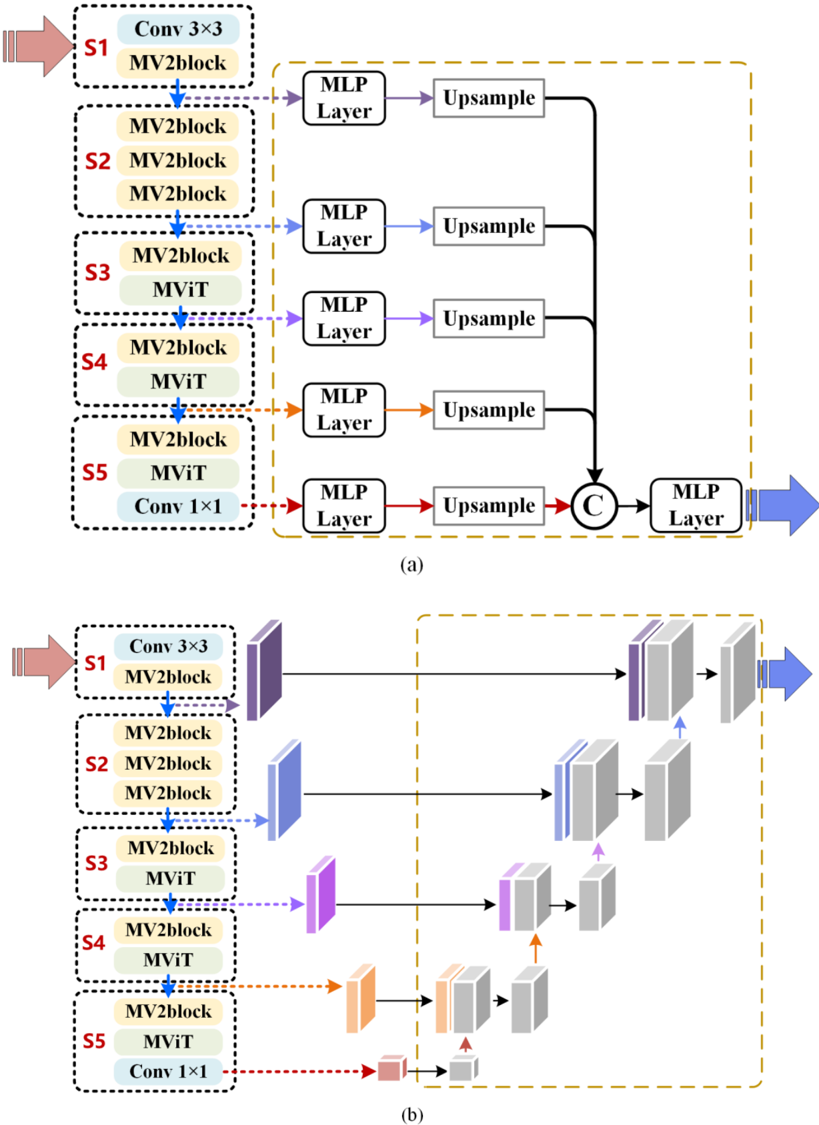
- The model uses a MobileViT backbone as encoder, with the last pooling and fully connected layers removed, and an efficient layer aggregation decoder (ELAD) containing cross-scale feature fusion (CFF) and compact feature aggregation (CFA) modules; the loss combines weighted IoU loss and weighted BCE loss.
- Evaluation uses three public datasets: AI4Mars-MSL (17,030 images, 4 classes, 1024 × 1024), MSL-Seg (4155 images, 8 classes, 560 × 500), and S5 Mars (6000 images, 9 classes, 1200 × 1200).
- Training uses MMSegmentation and PyTorch, 400 epochs, mini-batch size 16 over 4 RTX2080Ti GPUs, SGD with initial LR 1e-2 and polynomial LR policy, random crop to 512 × 512, and augmentation; metrics are mIoU, pixelACC, mFscore, and mPrecision, with comparison against eight SOTA methods.
Limitations
- Stated: there is an enormous gap between high-end GPU and a low-memory spacecraft device; future work will test on realistic hardware and focus on energy consumption and practical performance.
- Stated: missed detections and error detections remain, and segmentation accuracy needs further improvement; some MSL-Seg classes have low IoU (e.g., Martian soil and bedrock) because their notions are ambiguous and their pixel counts in training data are low.
- Evident from the text: evaluation is performed on GPUs (RTX2080Ti for training, NVIDIA 3070Ti for FPS) rather than actual on-board satellite hardware; also, the text reports “8.54 M parameters and 5.6 G FLOPs” while the tables list 5.61 M parameters and 8.54 G FLOPs, indicating a reporting inconsistency.
Model-written summary. Check it against the paper before relying on it.
Integrity signals
Registry
Cites
Statistics
Figures
Verification
Claims the paper makes
1 Valid · 1 Not valid · 2 Not checked · 67 Own results and interpretations
The cited sources support only part of this claim — read each source’s verdict below.
In the paper
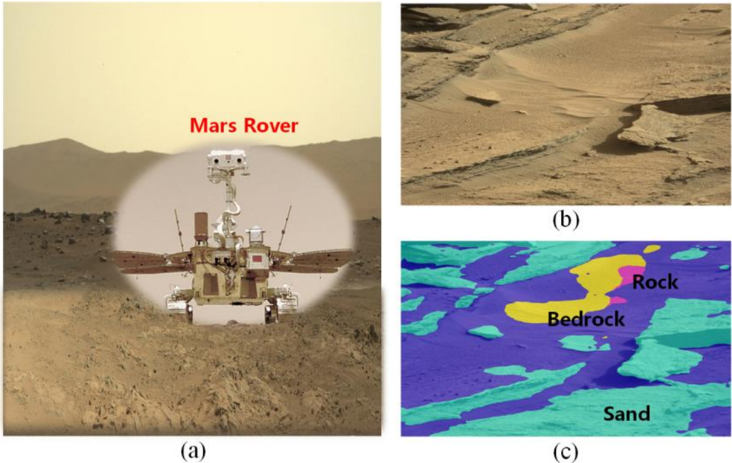
“Objects on the surface of Mars exhibit unstructured characteristics with rich textures, ambiguous boundaries and diverse sizes, such as rocks and gravel [21].”
What the sources say
- Partly supportedcites [21] 21. Dai, Y.; Xue, C.; Zhou, L. Visual Saliency Guided Perceptual Adaptive Quantization Based on HEVC Intra-Coding for Planetary Images. PLoS ONE 2022 , 19 , e0263729. [CrossRef] sourceExperimental — accuracy not yet measured
Section 5.2 describes rocks, gravel and other targets on Mars as having rich textures and diverse sizes, and describes a cluttered setting where foreground and background can look similar. It does not characterize the objects as unstructured or their boundaries as ambiguous; its labeling rules instead prefer objects with definite shaped boundaries. No page number is available in our copy. (LLM, conf=0.87)
plain- Asserted: passes — The authors put it forward as true.
- Checkable: passes — It can be checked against evidence.
- Load-bearing: passes — The paper’s conclusions depend on it.
- Based: passes — The paper gives a reason why it holds.
- Partly supported
A result the paper reports from its own data — it cites no other source for it, so there is none to check. The quote shows it is in the paper.
In the paper
“Extensive experiments demonstrate that the proposed SegMarsViT was able to achieve 68.4%, 78.22%, and 67.28% mIoU on the AI4Mars-MSL, MSL-Seg, and S 5 Mars, respectively, under the speed of 69.52 FPS.”
boosted- Asserted: passes — The authors put it forward as true.
- Checkable: passes — It can be checked against evidence.
- Load-bearing: passes — The paper’s conclusions depend on it.
- Based: passes — The paper gives a reason why it holds.
A result the paper reports from its own data — it cites no other source for it, so there is none to check. The quote shows it is in the paper.
In the paper
“Extensive experiments demonstrate that the proposed SegMarsViT was able to achieve 68.4%, 78.22%, and 67.28% mIoU on the AI4Mars-MSL, MSL-Seg, and S 5 Mars, respectively, under the speed of 69.52 FPS.”
- Also stated in: § 1. Introduction · plain
“The results validate the effectiveness and efficiency of the proposed model, which can obtain competitive performance with 68.4%, 78.22%, and 67.28% mIoU, respectively.”
boosted- Asserted: passes — The authors put it forward as true.
- Checkable: passes — It can be checked against evidence.
- Load-bearing: passes — The paper’s conclusions depend on it.
- Based: passes — The paper gives a reason why it holds.
- Also stated in: § 1. Introduction · plain
36 more claims
Create a free account to see all 71 claims and to verify the 2 references still open.
- It may state two separate claims as one. 12
- The quote only partly states this claim. 3
- Probably not a substantial claim. 18
Self-check
Percentages, sums and reported differences re-computed from the paper’s own numbers.
Each contradiction between two passages listed here was confirmed by an independent check.
Rated major: it would touch a result — a value a result rests on, reported and recomputed p-values on opposite sides of the significance level, two passages that conflict with no sign which is right, or a cited work retracted before this paper was published.
In the paper
§ 4.2.3. Results on MSL-Seg
“the proposed SegMarsViT has the fewest parameters among all the models.”
§ 4.2.2. Results on S 5 Mars
“| SegFormer-MIT-B0 | 91.99 | 79.05 | 85.74 | 85.61 | 6.39 | 3.72 | 59.21 |”
Rated major: it would touch a result — a value a result rests on, reported and recomputed p-values on opposite sides of the significance level, two passages that conflict with no sign which is right, or a cited work retracted before this paper was published.
In the paper
“| AI4Mars-MSL | 4 | 17,030 | 1024 × 1024 | 16,064:322:322 |”
Reported 17030 · recomputed 16708
Rated major: it would touch a result — a value a result rests on, reported and recomputed p-values on opposite sides of the significance level, two passages that conflict with no sign which is right, or a cited work retracted before this paper was published.
In the paper
§ 4.2.1. Results on AI4Mars-MSL
“SegMarsViT yields 68.4% mIoU using only 8.54 M parameters and 5.6 G FLOPs”
§ 4.2.1. Results on AI4Mars-MSL
“| SegMarsViT (Ours) | MobileViT-s | 92.46 | 68.4 | 8.54 | 5.61 |”
Rated major: it would touch a result — a value a result rests on, reported and recomputed p-values on opposite sides of the significance level, two passages that conflict with no sign which is right, or a cited work retracted before this paper was published.
In the paper
§ SegMarsViT: Lightweight Mars Terrain Segmentation Network for Autonomous Driving in Planetary Exploration
“68.4%, 78.22%, and 67.28% mIoU on the AI4Mars-MSL, MSL-Seg, and S 5 Mars, respectively”
§ 4.3. Ablation Studies 4.3.1. Effect of Backbone
“| MobileViT-s | 8.54G | 5.61M | 69.5 | 92.46 | 68.4 | 92.15 | 78.22 | 86.05 | 67.28 |”
Rated major: it would touch a result — a value a result rests on, reported and recomputed p-values on opposite sides of the significance level, two passages that conflict with no sign which is right, or a cited work retracted before this paper was published.
In the paper
§ 4.3.2. Effect of ELAD
“(1) Baseline: MobileViT-s + ELAD (Without CFA).”
§ 4.3.2. Effect of ELAD
“| Baseline | - | ✓ | 83.43 | 63.22 | 7.54 | 5.0 |”
Citations
Cites
U-Net: Convolutional Networks for Biomedical Image SegmentationPreprint
Ronneberger, O., Fischer, P., & Brox, T. (2015) · International Conference on Medical Image Computing and Computer-Assisted Intervention · doi:10.48550/arxiv.1505.04597 · Cited by 105,781
U-Net: Convolutional Networks for Biomedical Image Segmentation
Ronneberger, O., Fischer, P., & Brox, T. (2015) · Lecture notes in computer science · doi:10.1007/978-3-319-24574-4_28 · Cited by 99,404
An Image is Worth 16x16 Words: Transformers for Image Recognition at Scale
Dosovitskiy, A., Beyer, L., Kolesnikov, A., Weissenborn, D., Zhai, X., Unterthiner, T., Dehghani, M., Minderer, M., Heigold, G., Gelly, S., et al. (2020) · arXiv · doi:10.48550/arxiv.2010.11929 · Cited by 47,472
Fully convolutional networks for semantic segmentation
Long, J., Shelhamer, E., & Darrell, T. (2015) · 2015 IEEE Conference on Computer Vision and Pattern Recognition (CVPR) · doi:10.1109/cvpr.2015.7298965 · Cited by 38,834
Swin Transformer: Hierarchical Vision Transformer using Shifted Windows
Liu, Z., Lin, Y., Cao, Y., Hu, H., Wei, Y., Zhang, Z., Lin, S., & Guo, B. (2021) · 2021 IEEE/CVF International Conference on Computer Vision (ICCV) · doi:10.1109/iccv48922.2021.00986 · Cited by 35,534
PyTorch: An Imperative Style, High-Performance Deep Learning Library
Paszke, A., Gross, S., Massa, F., Lerer, A., Bradbury, J., Chanan, G., Killeen, T., Lin, Z., Gimelshein, N., Antiga, L., et al. (2019) · arXiv · doi:10.48550/arxiv.1912.01703 · Cited by 31,473
MobileNetV2: Inverted Residuals and Linear Bottlenecks
Sandler, M., Howard, A., Zhu, M., Zhmoginov, A., & Chen, L.-C. (2018) · 2018 IEEE/CVF Conference on Computer Vision and Pattern Recognition · doi:10.1109/cvpr.2018.00474 · Cited by 28,755 · cited 4×
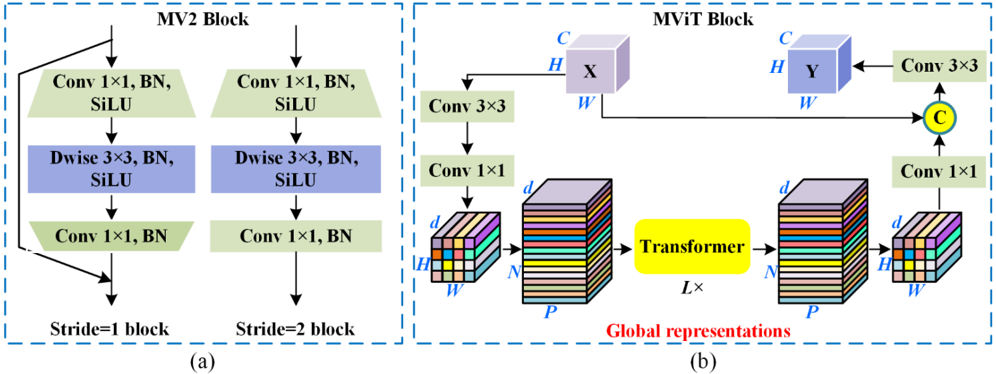
“The MV2 blocks (Figure 3a) come from MobileNetv2 [43] and are mainly responsible for down-sampling in the backbone.”
BackgroundInfluentialEncoder-Decoder with Atrous Separable Convolution for Semantic Image Segmentation
Chen, L.-C., Zhu, Y., Papandreou, G., Schroff, F., & Adam, H. (2018) · Lecture Notes in Computer Science · doi:10.1007/978-3-030-01234-2_49 · Cited by 20,054
Zhao, H., Shi, J., Qi, X., Wang, X., & Jia, J. (2017) · 2017 IEEE Conference on Computer Vision and Pattern Recognition (CVPR) · doi:10.1109/cvpr.2017.660 · Cited by 16,438
Deformable DETR: Deformable Transformers for End-to-End Object Detection
Zhu, X., Su, W., Lu, L., Li, B., Wang, X., & Dai, J. (2020) · arXiv · doi:10.48550/arxiv.2010.04159 · Cited by 6,027
Cited by
Transformers for Remote Sensing: A Systematic Review and Analysis
Wang, R. Z., Ma, L., He, G., Johnson, B. A., Yan, Z., Chang, M., & Liang, Y. (2024) · Sensors · doi:10.3390/s24113495 · Cited by 142
Lightweight medical image segmentation network with multi-scale feature-guided fusion
Zhu, Z., Yu, K., Qi, G., Cong, B., Li, Y., Li, Z., & Gao, X. (2024) · Computers in Biology and Medicine · doi:10.1016/j.compbiomed.2024.109204 · Cited by 77
Xiong, Y., Xiao, X., Yao, M., Cui, H., & Fu, Y. (2024) · ISPRS Journal of Photogrammetry and Remote Sensing · doi:10.1016/j.isprsjprs.2024.06.008 · Cited by 76
Fan, L., Yuan, J., Niu, X., Zha, K., & Ma, W. (2023) · Remote Sensing · doi:10.3390/rs15163935 · Cited by 20
Evaluation Method of Potato Storage External Defects Based on Improved U-Net
Zhang, K., Wang, S., Hu, Y., et al. (2023) · Agronomy · doi:10.3390/agronomy13102503 · Cited by 15
Surveying image segmentation approaches in astronomy
Xu, D., & Zhu, Y. (2024) · Astronomy and Computing · doi:10.1016/j.ascom.2024.100838 · Cited by 16
MarsSeg: Mars Surface Semantic Segmentation With Multilevel Extractor and Connector
Li, J., Chen, K., Tian, G., Li, L., & Shi, Z. (2025) · IEEE Transactions on Geoscience and Remote Sensing · doi:10.1109/tgrs.2025.3526630 · Cited by 23
TerSeg: A dual-branch semantic segmentation network for Mars terrain and autonomous path planning
Fan, L., Yuan, J., & Zha, K. (2025) · Expert Systems with Applications · doi:10.1016/j.eswa.2025.126397 · Cited by 12
Deep Learning based Terrain Classification of Mars Raw Images using UNet and FCN Models
Samhitha, D. S., & Ashwini, K. (2024) · International Conference on Computing for Sustainable Global Development · doi:10.23919/indiacom61295.2024.10498424 · Cited by 6
LisseMars: A Lightweight Semantic Segmentation Model for Mars Helicopter
Lin, B., Wang, F., Li, Q., Zheng, B., Yao, M., Xiao, X., Qi, Y., Cui, H., & Huang, X. (2025) · Aerospace · doi:10.3390/aerospace12121049 · Cited by 10
NNPP: A learning-based heuristic model for accelerating optimal path planning on uneven terrain
Ji, Y., Liu, Y., Xie, G., Ma, B., Xie, Z., & Cao, B. (2025) · Robotics and Autonomous Systems · doi:10.1016/j.robot.2025.105084 · Cited by 9
CLOVER: Contrastive Learning for Onboard Vision-Enabled Robotics
Vincent, G., Ward, I. R., Moore, C., Chen, J., Pak, K., Yepremyan, A., Wilson, B. D., & Goh, E. Y. (2023) · Journal of Spacecraft and Rockets · doi:10.2514/1.a35767 · Cited by 6
Deep Learning based Semantic Segmentation for Mars Rover Terrain Classification
Mohammad, F., Gao, Y., Kay, S., Field, R., Benedetti, M. D., & Ntagiou, E. (2024) · International Conference on Space Robotics (iSpaRo) · doi:10.1109/isparo60631.2024.10687827 · Cited by 11
Multi-Pooling Context Network for Image Semantic Segmentation
Liu, Q., Dong, Y., Jiang, Z., Pei, Y., Zheng, B., Zheng, L., & Fu, Z. (2023) · Remote Sensing · doi:10.3390/rs15112800 · Cited by 5
Ma, Y., Li, Z., Wu, B., & Duan, R. (2025) · Earth and Space Science · doi:10.1029/2024ea003812 · Cited by 6
Texture-based segmentation for sand and rock in Mars images
Alkawi, O., Qahwaji, R., Smith, C. L., & Mnasri, Z. (2025) · Advances in Space Research · doi:10.1016/j.asr.2025.05.034 · Cited by 5
LBNet: A Lightweight Bilateral Network for Semantic Segmentation of Martian Rock
Wei, P., Sun, Z., & He, T. (2024) · IEEE Access · doi:10.1109/access.2024.3511084 · Cited by 3
A progressive segmentation network for navigable areas with semantic–spatial information flow
Li, W., Liao, M., & Zou, W. (2024) · Expert Systems with Applications · doi:10.1016/j.eswa.2024.125465 · Cited by 4
Mapping “Brain Terrain” Regions on Mars Using Deep Learning
Pearson, K. A., Noe, E., Zhao, D., Altınok, A., & Morgan, A. M. (2024) · The Planetary Science Journal · doi:10.3847/psj/ad5673 · Cited by 6
Xiao, T., Wang, Q., Atkinson, P. M., & Tong, X. (2025) · IEEE Transactions on Geoscience and Remote Sensing · doi:10.1109/tgrs.2025.3605989 · Cited by 2
Liu, W., Wan, G., Liu, J., & Cong, D. (2025) · IEEE Access · doi:10.1109/access.2025.3585918 · Cited by 2
Wang, R., Sun, J., Zhou, K., JinLin, W. A. N. G., Bi, J., Zhang, Q., Wang, W., Qu, G., Li, C., & Qiu, H. (2025) · Remote Sensing · doi:10.3390/rs18010035 · Cited by 3
Xu, X., Cheng, T., Chen, Q., Feng, Y., Xie, H., Wang, C., Jin, Y., & Tong, X. (2025) · IEEE Journal of Selected Topics in Applied Earth Observations and Remote Sensing · doi:10.1109/jstars.2025.3648935 · Cited by 1
Edge-Centric Real-Time Segmentation for Autonomous Underwater Cave Exploration
Mohammadi, M., Abdullah, A., Juneja, A., Rekleitis, I. M., Islam, M. J., & Zand, R. (2024) · International Conference on Machine Learning and Applications · doi:10.1109/icmla61862.2024.00218 · Cited by 7
Li, W., Liao, M., & Zou, W. (2025) · IEEE Transactions on Intelligent Transportation Systems · doi:10.1109/tits.2025.3562867 · Cited by 1
LESFormer: a lightweight parallel heterogeneous network for extraterrestrial terrain segmentation
Xu, A., Jiang, S., Xu, X., Cao, Z., Huang, B., Feng, Y., Xie, H. E., Wang, C., & Tong, X. (2026) · Advances in Space Research · doi:10.1016/j.asr.2026.07.124
TSCA-Net: Mars terrain segmentation based on category attention
Huang, G. M., Li, Y., & Zhang, H. (2023) · International Conference on Algorithms, High Performance Computing and Artificial Intelligence (AHPCAI) · doi:10.1117/12.3011483
SOUL: A weakly supervised framework for Martian rock segmentation using scribble labels
Xiao, T., Wang, Q., & Tong, X. (2025) · International Journal of Applied Earth Observation and Geoinformation · doi:10.1016/j.jag.2025.104998 · Cited by 1
Safety-Aware Reinforcement Learning for Lunar Rover Navigation Using Orbital DEMs
Potharaju, A., Ravi, S., Sindoli, M. T., Bellur, P., Rangaswamy, S., & Purohit, M. V. (2026) · IEEE Access · doi:10.1109/access.2026.3717682 · Cited by 1
Deep Learning Based Mars Terrain Classification with Edge Detection for Planetary Rovers
N., S., Jegathesan, V., Jamunasri, N., & Chekuri, S. T. V. (2025) · IEEE Space, Aerospace and Defence Conference (SPACE) · doi:10.1109/space65882.2025.11170510 · Cited by 2
Computer vision for mars exploration: a review of orbital remote sensing and in situ perception
Jie, C. H. E. N., Liao, X., Jiang, M., Yutong, X. I. A. O., & Yu-Yan Sara, Z. H. A. O. (2026) · Planet · doi:10.15302/planet.2026.26015
Tani, M. R., Shawon, N. J., Rashid, M., Rashid, R., & Karim, S. (2026) · Lecture notes in networks and systems · doi:10.1007/978-3-032-15764-5_32
Metadata
- Authors
- Dai, Y., Zheng, T., Xue, C., & Zhou, L.
- Affiliations
- Chinese Academy of Sciences (CN)
- Corresponding author
- Xue, Changbin
- Venue
- Remote Sensing
- Publisher
- MDPI AG
- Published
- 2022-12-12
- Volume
- 14
- Issue
- 24
- Pages
- 6297
- ISSN
- 2072-4292 (ISSN-L)
- OpenAlex
- W4311375979
- Semantic Scholar
- b50bd6cd7952cc14fb1dc50eaa01212a2d8e54cc
- Cited by
- 35
- References
- 52
- Citations by year
- 2026: 4 · 2025: 15 · 2024: 11 · 2023: 5
- FWCI
- 3.91
- Type
- journal article
- Language
- en
- Open access
- gold
- doi.org
- Licence
- Locations
- Remote Sensing (publishedVersion, cc-by)
- DOAJ (DOAJ: Directory of Open Access Journals) (submittedVersion, cc-by-sa)
- Funders
- Chinese Academy of Sciences Project (CXJJ-20S017)
- Topics
- Physical Sciences › Earth and Planetary Sciences › Space and Planetary Science › Planetary Science and Exploration
- Physical Sciences › Computer Science › Computer Vision and Pattern Recognition › Advanced Neural Network Applications
- Physical Sciences › Computer Science › Computer Vision and Pattern Recognition › Robotics and Sensor-Based Localization
- Keywords
- lightweight vision transformer, cross-scale feature fusion, Mars 2020 Perseverance rover
About these checks
Registry, retraction, Cites and statistics results are computed, not judged, with one exception: a printed reference that no index lists is read once by a model before it counts as a citation error. Claims are extracted by a model and kept only when their quote appears verbatim in the text; each cited source is then checked, with a model’s help, for whether it says what the claim relies on. Those verdicts can be wrong — read the claim’s quote and the cited source before relying on one.
The claim verdicts this report counts are experimental: their accuracy is not yet measured.
A language model drew the claims from the paper on 2026-10-10, under version 3 of the claim definition (model deepseek-v4.1-flash, prompt extract-v3).
A second model labelled each claim on 2026-10-10 (model jev-1.13-20260917, definition revision gold-guideline-v0.2).
Cited sources are checked with a language model’s help (gpt-6-sol).
Statistics and arithmetic are recomputed, not judged.
Confidence bands are shown only for fields calibrated on our annotated test set. None is calibrated yet, so no band is shown.
What counts as a claim ›How we measure confidence ›How we check this ›
Are you an author, or do you see a problem with this page? Request a review
Data sources
Bibliographic data: Semantic Scholar, OpenAlex, Crossref.
Contains information from the Semantic Scholar Academic Graph Datasets, made available under the ODC Attribution License (ODC-BY 1.0).
Semantic Scholar’s data is described in: Kinney, R., et al. (2023). The Semantic Scholar Open Data Platform. arXiv:2301.10140.
