

The DOI matches its Crossref record; 67 of the 67 references it cites were found in a registry or an index; 1 of the 4 sources its claims cite were checked for support.
SegMarsViT: Lightweight Mars Terrain Segmentation Network for Autonomous Driving in Planetary Exploration
Open accessAbstract
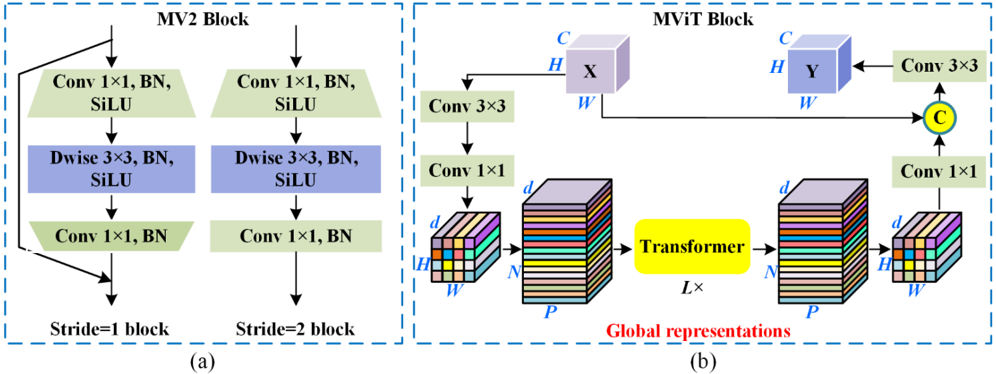
Planetary rover systems need to perform terrain segmentation to identify feasible driving areas and surround obstacles, which falls into the research area of semantic segmentation. Recently, deep learning (DL)-based methods were proposed and achieved great performance for semantic segmentation. However, due to the on-board processor platform’s strict comstraints on computational complexity and power consumption, existing DL approaches are almost impossible to be deployed on satellites under the burden of extensive computation and large model size. To fill this gap, this paper targeted studying effective and efficient Martian terrain segmentation solutions that are suitable for on-board satellites. In this article, we propose a lightweight ViT-based terrain segmentation method, namely, SegMarsViT. In the encoder part, the mobile vision transformer (MViT) block in the backbone extracts local–global spatial and captures multiscale contextual information concurrently. In the decoder part, the cross-scale feature fusion modules (CFF) further integrate hierarchical context information and the compact feature aggregation module (CFA) combines multi-level feature representation. Moreover, we evaluate the proposed method on three public datasets: AI4Mars, MSL-Seg, and S5Mars. Extensive experiments demonstrate that the proposed SegMarsViT was able to achieve 68.4%, 78.22%, and 67.28% mIoU on the AI4Mars-MSL, MSL-Seg, and S5Mars, respectively, under the speed of 69.52 FPS.
Overview
CoChat Summary
TL;DR
SegMarsViT is a lightweight ViT-based encoder-decoder for Martian terrain segmentation, combining a MobileViT backbone with an efficient layer aggregation decoder using cross-scale feature fusion and compact feature aggregation. It reports 68.4% mIoU on AI4Mars-MSL, 78.22% on S5 Mars, and 67.28% on MSL-Seg, at 69.52 FPS.
Key findings
- On AI4Mars-MSL, SegMarsViT (MobileViT-s) reaches 68.4% mIoU and 92.46% pixelACC with 5.61 M parameters and 8.54 G FLOPs; compared with SegFormer (MIT-B0), it keeps 0.66% better mIoU.
- On S5 Mars, it reaches 78.22% mIoU, 92.15% pixelACC, 84.74 mFscore, and 85.86 mPrecision at 69.52 FPS with 5.61 M parameters and 8.54 G FLOPs.
- On MSL-Seg, it reaches 67.28% mIoU, 86.05% pixelACC, 78.69 mFscore, and 78.75 mPrecision at 69.52 FPS; the paper reports improvements of 2.96% pixelACC and 5.17% mIoU over other latest methods.
- Ablation on MSL-Seg shows adding CFF and CFA improves mIoU and pixelACC by 4.06% and 2.62% over the baseline; ELAD gives 67.28 mIoU at 8.54 G FLOPs versus AMD at 66.69 mIoU/13.14 G FLOPs and UNetD at 66.83 mIoU/12.85 G FLOPs.
Methods
- The model uses a MobileViT backbone as encoder, with the last pooling and fully connected layers removed, and an efficient layer aggregation decoder (ELAD) containing cross-scale feature fusion (CFF) and compact feature aggregation (CFA) modules; the loss combines weighted IoU loss and weighted BCE loss.
- Evaluation uses three public datasets: AI4Mars-MSL (17,030 images, 4 classes, 1024 × 1024), MSL-Seg (4155 images, 8 classes, 560 × 500), and S5 Mars (6000 images, 9 classes, 1200 × 1200).
- Training uses MMSegmentation and PyTorch, 400 epochs, mini-batch size 16 over 4 RTX2080Ti GPUs, SGD with initial LR 1e-2 and polynomial LR policy, random crop to 512 × 512, and augmentation; metrics are mIoU, pixelACC, mFscore, and mPrecision, with comparison against eight SOTA methods.
Limitations
- Stated: there is an enormous gap between high-end GPU and a low-memory spacecraft device; future work will test on realistic hardware and focus on energy consumption and practical performance.
- Stated: missed detections and error detections remain, and segmentation accuracy needs further improvement; some MSL-Seg classes have low IoU (e.g., Martian soil and bedrock) because their notions are ambiguous and their pixel counts in training data are low.
- Evident from the text: evaluation is performed on GPUs (RTX2080Ti for training, NVIDIA 3070Ti for FPS) rather than actual on-board satellite hardware; also, the text reports “8.54 M parameters and 5.6 G FLOPs” while the tables list 5.61 M parameters and 8.54 G FLOPs, indicating a reporting inconsistency.
Model-written summary. Check it against the paper before relying on it.
Integrity signals
Registry
Cites
Statistics
Figures




Verification
Claims the paper makes
1 Valid · 1 Not valid · 2 Not checked · 67 Own results and interpretations
The cited sources support only part of this claim — read each source’s verdict below.
In the paper
“Objects on the surface of Mars exhibit unstructured characteristics with rich textures, ambiguous boundaries and diverse sizes, such as rocks and gravel [21].”
What the sources say
- Partly supportedcites [21] Dai, Y., Xue, C., and Zhou, L. (2022). Visual Saliency Guided Perceptual Adaptive Quantization Based on HEVC Intra-Coding for Planetary Images. PLoS ONE, 19. sourceExperimental — accuracy not yet measured
Section 5.2 describes rocks, gravel and other targets on Mars as having rich textures and diverse sizes, and describes a cluttered setting where foreground and background can look similar. It does not characterize the objects as unstructured or their boundaries as ambiguous; its labeling rules instead prefer objects with definite shaped boundaries. No page number is available in our copy. (LLM, conf=0.87)
plain- Asserted: passes — The authors put it forward as true.
- Checkable: passes — It can be checked against evidence.
- Load-bearing: passes — The paper’s conclusions depend on it.
- Based: passes — The paper gives a reason why it holds.
- Partly supported
A result the paper reports from its own data — it cites no other source for it, so there is none to check. The quote shows it is in the paper.
In the paper
“Extensive experiments demonstrate that the proposed SegMarsViT was able to achieve 68.4%, 78.22%, and 67.28% mIoU on the AI4Mars-MSL, MSL-Seg, and S 5 Mars, respectively, under the speed of 69.52 FPS.”
boosted- Asserted: passes — The authors put it forward as true.
- Checkable: passes — It can be checked against evidence.
- Load-bearing: passes — The paper’s conclusions depend on it.
- Based: passes — The paper gives a reason why it holds.
A result the paper reports from its own data — it cites no other source for it, so there is none to check. The quote shows it is in the paper.
In the paper
“Extensive experiments demonstrate that the proposed SegMarsViT was able to achieve 68.4%, 78.22%, and 67.28% mIoU on the AI4Mars-MSL, MSL-Seg, and S 5 Mars, respectively, under the speed of 69.52 FPS.”
- Also stated in: § 1. Introduction · plain
“The results validate the effectiveness and efficiency of the proposed model, which can obtain competitive performance with 68.4%, 78.22%, and 67.28% mIoU, respectively.”
boosted- Asserted: passes — The authors put it forward as true.
- Checkable: passes — It can be checked against evidence.
- Load-bearing: passes — The paper’s conclusions depend on it.
- Based: passes — The paper gives a reason why it holds.
- Also stated in: § 1. Introduction · plain
A result the paper reports from its own data — it cites no other source for it, so there is none to check. The quote shows it is in the paper.
In the paper
“Extensive experiments demonstrate that the proposed SegMarsViT was able to achieve 68.4%, 78.22%, and 67.28% mIoU on the AI4Mars-MSL, MSL-Seg, and S 5 Mars, respectively, under the speed of 69.52 FPS.”
- Also stated in: § 1. Introduction · plain
“The results validate the effectiveness and efficiency of the proposed model, which can obtain competitive performance with 68.4%, 78.22%, and 67.28% mIoU, respectively.”
boosted- Asserted: passes — The authors put it forward as true.
- Checkable: passes — It can be checked against evidence.
- Load-bearing: passes — The paper’s conclusions depend on it.
- Based: passes — The paper gives a reason why it holds.
- Also stated in: § 1. Introduction · plain
A result the paper reports from its own data — it cites no other source for it, so there is none to check. The quote shows it is in the paper.
In the paper
“Extensive experiments demonstrate that the proposed SegMarsViT was able to achieve 68.4%, 78.22%, and 67.28% mIoU on the AI4Mars-MSL, MSL-Seg, and S 5 Mars, respectively, under the speed of 69.52 FPS.”
- Also stated in: § 1. Introduction · plain
“The results validate the effectiveness and efficiency of the proposed model, which can obtain competitive performance with 68.4%, 78.22%, and 67.28% mIoU, respectively.”
boosted- Asserted: passes — The authors put it forward as true.
- Checkable: passes — It can be checked against evidence.
- Load-bearing: passes — The paper’s conclusions depend on it.
- Based: passes — The paper gives a reason why it holds.
- Also stated in: § 1. Introduction · plain
36 more claims
Create a free account to see all 71 claims and to verify the 2 references still open.
- It may state two separate claims as one. 12
- The quote only partly states this claim. 3
- Probably not a substantial claim. 18
Self-check
Percentages, sums and reported differences re-computed from the paper’s own numbers.
Each contradiction between two passages listed here was confirmed by an independent check.
Rated major: it would touch a result — a value a result rests on, reported and recomputed p-values on opposite sides of the significance level, two passages that conflict with no sign which is right, or a cited work retracted before this paper was published.
In the paper
§ 4.2.3. Results on MSL-Seg
“the proposed SegMarsViT has the fewest parameters among all the models.”
§ 4.2.2. Results on S 5 Mars
“| SegFormer-MIT-B0 | 91.99 | 79.05 | 85.74 | 85.61 | 6.39 | 3.72 | 59.21 |”
Rated major: it would touch a result — a value a result rests on, reported and recomputed p-values on opposite sides of the significance level, two passages that conflict with no sign which is right, or a cited work retracted before this paper was published.
In the paper
“| AI4Mars-MSL | 4 | 17,030 | 1024 × 1024 | 16,064:322:322 |”
Reported 17030 · recomputed 16708
Rated major: it would touch a result — a value a result rests on, reported and recomputed p-values on opposite sides of the significance level, two passages that conflict with no sign which is right, or a cited work retracted before this paper was published.
In the paper
§ 4.2.1. Results on AI4Mars-MSL
“SegMarsViT yields 68.4% mIoU using only 8.54 M parameters and 5.6 G FLOPs”
§ 4.2.1. Results on AI4Mars-MSL
“| SegMarsViT (Ours) | MobileViT-s | 92.46 | 68.4 | 8.54 | 5.61 |”
Rated major: it would touch a result — a value a result rests on, reported and recomputed p-values on opposite sides of the significance level, two passages that conflict with no sign which is right, or a cited work retracted before this paper was published.
In the paper
§ SegMarsViT: Lightweight Mars Terrain Segmentation Network for Autonomous Driving in Planetary Exploration
“68.4%, 78.22%, and 67.28% mIoU on the AI4Mars-MSL, MSL-Seg, and S 5 Mars, respectively”
§ 4.3. Ablation Studies 4.3.1. Effect of Backbone
“| MobileViT-s | 8.54G | 5.61M | 69.5 | 92.46 | 68.4 | 92.15 | 78.22 | 86.05 | 67.28 |”
Rated major: it would touch a result — a value a result rests on, reported and recomputed p-values on opposite sides of the significance level, two passages that conflict with no sign which is right, or a cited work retracted before this paper was published.
In the paper
§ 4.3.2. Effect of ELAD
“(1) Baseline: MobileViT-s + ELAD (Without CFA).”
§ 4.3.2. Effect of ELAD
“| Baseline | - | ✓ | 83.43 | 63.22 | 7.54 | 5.0 |”
Citations
Cites
U-Net: Convolutional Networks for Biomedical Image Segmentation
Ronneberger, O., Fischer, P., & Brox, T. (2015) · Lecture notes in computer science · doi:10.1007/978-3-319-24574-4_28 · Cited by 99,404
An Image is Worth 16x16 Words: Transformers for Image Recognition at Scale
Dosovitskiy, A., Beyer, L., Kolesnikov, A., Weissenborn, D., Zhai, X., Unterthiner, T., Dehghani, M., Minderer, M., Heigold, G., Gelly, S., et al. (2020) · arXiv · doi:10.48550/arxiv.2010.11929 · Cited by 47,472
Fully convolutional networks for semantic segmentation
Long, J., Shelhamer, E., & Darrell, T. (2015) · 2015 IEEE Conference on Computer Vision and Pattern Recognition (CVPR) · doi:10.1109/cvpr.2015.7298965 · Cited by 38,834
Swin Transformer: Hierarchical Vision Transformer using Shifted Windows
Liu, Z., Lin, Y., Cao, Y., Hu, H., Wei, Y., Zhang, Z., Lin, S., & Guo, B. (2021) · 2021 IEEE/CVF International Conference on Computer Vision (ICCV) · doi:10.1109/iccv48922.2021.00986 · Cited by 35,534
PyTorch: An Imperative Style, High-Performance Deep Learning Library
Paszke, A., Gross, S., Massa, F., Lerer, A., Bradbury, J., Chanan, G., Killeen, T., Lin, Z., Gimelshein, N., Antiga, L., et al. (2019) · arXiv · doi:10.48550/arxiv.1912.01703 · Cited by 31,473
MobileNetV2: Inverted Residuals and Linear Bottlenecks
Sandler, M., Howard, A., Zhu, M., Zhmoginov, A., & Chen, L.-C. (2018) · 2018 IEEE/CVF Conference on Computer Vision and Pattern Recognition · doi:10.1109/cvpr.2018.00474 · Cited by 28,755
Encoder-Decoder with Atrous Separable Convolution for Semantic Image Segmentation
Chen, L.-C., Zhu, Y., Papandreou, G., Schroff, F., & Adam, H. (2018) · Lecture Notes in Computer Science · doi:10.1007/978-3-030-01234-2_49 · Cited by 20,054
Zhao, H., Shi, J., Qi, X., Wang, X., & Jia, J. (2017) · 2017 IEEE Conference on Computer Vision and Pattern Recognition (CVPR) · doi:10.1109/cvpr.2017.660 · Cited by 16,438
Deformable DETR: Deformable Transformers for End-to-End Object Detection
Zhu, X., Su, W., Lu, L., Li, B., Wang, X., & Dai, J. (2020) · arXiv · doi:10.48550/arxiv.2010.04159 · Cited by 6,027
U-Net: Convolutional Networks for Biomedical Image SegmentationPreprint
Ronneberger, O., Fischer, P., & Brox, T. (2015) · arXiv (Cornell University) · doi:10.48550/arxiv.1505.04597 · Cited by 5,282
Pyramid Vision Transformer: A Versatile Backbone for Dense Prediction without Convolutions
Wang, W., Xie, E., Li, X., Fan, D.-P., Song, K., Liang, D., Lu, T., Luo, P., & Shao, L. (2021) · 2021 IEEE/CVF International Conference on Computer Vision (ICCV) · doi:10.1109/iccv48922.2021.00061 · Cited by 5,259 · cited 1×
“[33] proposed PVT, a pyramid vision transformer for dense prediction tasks, which is a natural extension of ViT with pyramid structures.”
BackgroundSegFormer: Simple and Efficient Design for Semantic Segmentation with Transformers
Xie, E., Wang, W., Yu, Z., Anandkumar, A., Alvarez, J. M., & Luo, P. (2021) · arXiv · doi:10.48550/arxiv.2105.15203 · Cited by 5,090
Rethinking Semantic Segmentation from a Sequence-to-Sequence Perspective with Transformers
Zheng, S., Lu, J., Zhao, H., Zhu, X., Luo, Z., Wang, Y., Fu, Y., Feng, J., Xiang, T., Torr, P. H. S., et al. (2021) · 2021 IEEE/CVF Conference on Computer Vision and Pattern Recognition (CVPR) · doi:10.1109/cvpr46437.2021.00681 · Cited by 4,008 · cited 1×
“[34] proposed SETR, which is a hierarchical transformer from a sequence-to-sequence learning perspective, and it shows that good results can still be obtained without relying on the convolution operation.”
BackgroundRethinking Semantic Segmentation from a Sequence-to-Sequence Perspective with Transformers
Zheng, S., Lu, J., Zhao, H., Zhu, X., Luo, Z., Wang, Y., Fu, Y., Feng, J., Xiang, T., Torr, P. H. S., et al. (2020) · arXiv · doi:10.48550/arxiv.2012.15840 · Cited by 4,004
UNETR: Transformers for 3D Medical Image Segmentation
Hatamizadeh, A., Tang, Y., Nath, V., Yang, D., Myronenko, A., Landman, B., Roth, H. R., & Xu, D. (2022) · 2022 IEEE/CVF Winter Conference on Applications of Computer Vision (WACV) · doi:10.1109/wacv51458.2022.00181 · Cited by 3,586 · cited 1×
“Similarly, there are UNETR [41] and nnFormer [42] in the same vein.”
BackgroundUNETR: Transformers for 3D Medical Image Segmentation
Hatamizadeh, A., Tang, Y., Nath, V., Yang, D., Myronenko, A., Landman, B., Roth, H., & Xu, D. (2021) · arXiv · doi:10.48550/arxiv.2103.10504 · Cited by 3,580
BiSeNet: Bilateral Segmentation Network for Real-Time Semantic Segmentation
Yu, C., Wang, J., Peng, C., Gao, C., Yu, G., & Sang, N. (2018) · Lecture Notes in Computer Science · doi:10.1007/978-3-030-01261-8_20 · Cited by 2,968
Fully Convolutional Networks for Semantic Segmentation
Long, J., Shelhamer, E., & Darrell, T. J. (2014) · arXiv (Cornell University) · doi:10.48550/arxiv.1411.4038 · Cited by 2,489
Liu, Z., Ning, J., Cao, Y., Wei, Y., Zhang, Z., Lin, S., & Hu, H. (2022) · 2022 IEEE/CVF Conference on Computer Vision and Pattern Recognition (CVPR) · doi:10.1109/cvpr52688.2022.00320 · Cited by 2,294
Liu, Z., Ning, J., Cao, Y., Wei, Y., Zhang, Z., Lin, S., & Hu, H. (2021) · arXiv · doi:10.48550/arxiv.2106.13230 · Cited by 2,294
Segmenter: Transformer for Semantic Segmentation
Strudel, R., Garcia, R., Laptev, I., & Schmid, C. (2021) · 2021 IEEE/CVF International Conference on Computer Vision (ICCV) · doi:10.1109/iccv48922.2021.00717 · Cited by 2,051
BiSeNet V2: Bilateral Network with Guided Aggregation for Real-Time Semantic Segmentation
Yu, C., Gao, C., Wang, J., Yu, G., Shen, C., & Sang, N. (2021) · International Journal of Computer Vision · doi:10.1007/s11263-021-01515-2 · Cited by 1,813
A survey on deep learning techniques for image and video semantic segmentation
Garcia-Garcia, A., Orts-Escolano, S., Oprea, S., Villena-Martinez, V., Martinez-Gonzalez, P., & Garcia-Rodriguez, J. (2018) · Applied Soft Computing · doi:10.1016/j.asoc.2018.05.018 · Cited by 1,490
Wang, L., Li, R., Zhang, C., Fang, S., Duan, C., Meng, X., & Atkinson, P. M. (2022) · ISPRS Journal of Photogrammetry and Remote Sensing · doi:10.1016/j.isprsjprs.2022.06.008 · Cited by 1,349
MetaFormer is Actually What You Need for Vision
Yu, W., Luo, M., Zhou, P., Si, C., Zhou, Y., Wang, X., Feng, J., & Yan, S. (2022) · 2022 IEEE/CVF Conference on Computer Vision and Pattern Recognition (CVPR) · doi:10.1109/cvpr52688.2022.01055 · Cited by 1,255
PSANet: Point-wise Spatial Attention Network for Scene Parsing
Zhao, H., Zhang, Y., Liu, S., Shi, J., Loy, C. C., Lin, D., & Jia, J. (2018) · Lecture Notes in Computer Science · doi:10.1007/978-3-030-01240-3_17 · Cited by 1,192
ESPNet: Efficient Spatial Pyramid of Dilated Convolutions for Semantic Segmentation
Mehta, S., Rastegari, M., Caspi, A., Shapiro, L., & Hajishirzi, H. (2018) · Lecture Notes in Computer Science · doi:10.1007/978-3-030-01249-6_34 · Cited by 1,029
A Review on Deep Learning Techniques Applied to Semantic Segmentation
García-García, A., Orts‐Escolano, S., Oprea, S., Villena-Martínez, V., & García‐Rodríguez, J. (2017) · arXiv (Cornell University) · doi:10.48550/arxiv.1704.06857 · Cited by 991
ESPNet: Efficient Spatial Pyramid of Dilated Convolutions for Semantic Segmentation
Mehta, S., Rastegari, M., Caspi, A., Shapiro, L., & Hajishirzi, H. (2018) · European Conference on Computer Vision · doi:10.48550/arxiv.1803.06815 · Cited by 917
Cross-Modal Self-Attention Network for Referring Image Segmentation
Ye, L., Rochan, M., Liu, Z., & Wang, Y. (2019) · 2019 IEEE/CVF Conference on Computer Vision and Pattern Recognition (CVPR) · doi:10.1109/cvpr.2019.01075 · Cited by 532
Pyramid Vision Transformer: A Versatile Backbone for Dense Prediction without ConvolutionsPreprint
Wang, W., Xie, E., Li, X., Fan, D.-P., Song, K., Liang, D., Lü, T., Luo, P., & Shao, L. (2021) · arXiv (Cornell University) · doi:10.48550/arxiv.2102.12122 · Cited by 417
EDN: Salient Object Detection via Extremely-Downsampled Network
Wu, Y.-H., Liu, Y., Zhang, L., Cheng, M.-M., & Ren, B. (2022) · IEEE Transactions on Image Processing · doi:10.1109/tip.2022.3164550 · Cited by 282
nnFormer: Interleaved Transformer for Volumetric Segmentation
Zhou, H.-Y., Guo, J., Zhang, Y., Yu, L., Wang, L., & Yu, Y. (2021) · arXiv (Cornell University) · doi:10.48550/arxiv.2109.03201 · Cited by 256
Zhao, H., Shi, J., Qi, X., Wang, X., & Jia, J. (2016) · arXiv (Cornell University) · doi:10.48550/arxiv.1612.01105 · Cited by 255
BiSeNet: Bilateral Segmentation Network for Real-time Semantic SegmentationPreprint
Yu, C., Wang, J., Peng, C., Gao, C., Yu, G., & Sang, N. (2018) · arXiv (Cornell University) · doi:10.48550/arxiv.1808.00897 · Cited by 179
MobileSal: Extremely Efficient RGB-D Salient Object Detection
Wu, Y.-H., Liu, Y., Xu, J., Bian, J.-W., Gu, Y.-C., & Cheng, M.-M. (2022) · IEEE Transactions on Pattern Analysis and Machine Intelligence · doi:10.1109/tpami.2021.3134684 · Cited by 176
DABNet: Depth-wise Asymmetric Bottleneck for Real-time Semantic Segmentation
Li, G., Yun, I., Kim, J., & Kim, J. (2019) · arXiv (Cornell University) · doi:10.48550/arxiv.1907.11357 · Cited by 171
SPOC: Deep Learning-based Terrain Classification for Mars Rover Missions
Rothrock, B., Kennedy, R., Cunningham, C., Papon, J., Heverly, M., & Ono, M. (2016) · AIAA SPACE 2016 · doi:10.2514/6.2016-5539 · Cited by 161
Huang, H., Xie, S., Lin, L., Iwamoto, Y., Han, X., Chen, Y., & Tong, R. (2022) · International Joint Conference on Artificial Intelligence · doi:10.24963/ijcai.2022/135 · Cited by 157
Liu, R., Tao, F., Liu, X., Na, J., Leng, H., Wu, J., & Zhou, T. (2022) · Remote Sensing · doi:10.3390/rs14133109 · Cited by 155
Polynomial Learning Rate Policy with Warm Restart for Deep Neural Network
Mishra, P., & Sarawadekar, K. P. (2019) · IEEE Region 10 Conference (TENCON) · doi:10.1109/tencon.2019.8929465 · Cited by 123
RTSeg: Real-Time Semantic Segmentation Comparative Study
Siam, M., Gamal, M., Abdel-Razek, M., Yogamani, S., & Jagersand, M. (2018) · 2018 25th IEEE International Conference on Image Processing (ICIP) · doi:10.1109/icip.2018.8451495 · Cited by 112
AI4MARS: A Dataset for Terrain-Aware Autonomous Driving on Mars
Swan, R. M., Atha, D., Leopold, H. A., Gildner, M., Oij, S., Chiu, C., & Ono, M. (2021) · 2021 IEEE/CVF Conference on Computer Vision and Pattern Recognition Workshops (CVPRW) · doi:10.1109/cvprw53098.2021.00226 · Cited by 104 · cited 1×
“[20] built the first large-scale dataset, AI4Mars, for the task of Mars terrain classification and traversability assessment, of which labels were obtained through a crowdsourcing approach and consisted four classes: soil, bedrock, sand, and big rock.”
SSformer: A Lightweight Transformer for Semantic Segmentation
Shi, W., Xu, J. L., & Gao, P. (2022) · IEEE International Workshop on Multimedia Signal Processing (MMSP) · doi:10.1109/mmsp55362.2022.9949177 · Cited by 89
A hybrid attention semantic segmentation network for unstructured terrain on Mars
Liu, H., Yao, M., Xiao, X., & Cui, H. (2022) · Acta Astronautica · doi:10.1016/j.actaastro.2022.08.002 · Cited by 71
Sea-Land Segmentation With Res-UNet And Fully Connected CRF
Chu, Z., Tian, T., Feng, R., et al. (2019) · IEEE International Geoscience and Remote Sensing Symposium (IGARSS) · doi:10.1109/igarss.2019.8900625 · Cited by 68
Li, J., Zi, S., Song, R., Li, Y., Hu, Y., & Du, Q. (2022) · IEEE Transactions on Geoscience and Remote Sensing · doi:10.1109/tgrs.2022.3152587 · Cited by 64
McGlinchy, J., Johnson, B., Muller, B., Joseph, M. B., & Diaz, J. (2019) · IEEE International Geoscience and Remote Sensing Symposium (IGARSS) · doi:10.1109/igarss.2019.8900453 · Cited by 61
A Simple High Performance Approach to Semantic Segmentation
Csurka, G., & Perronnin, F. (2008) · British Machine Vision Conference (BMVC) · doi:10.5244/c.22.22 · Cited by 57
Transformers Meet Visual Learning Understanding: A Comprehensive ReviewPreprint
Yang, Y., Jiao, L., Liu, X., Liu, F., Yang, S., Feng, Z., & Tang, X. (2022) · arXiv (Cornell University) · doi:10.48550/arxiv.2203.12944 · Cited by 49
EACNet: Enhanced Asymmetric Convolution for Real-Time Semantic Segmentation
Li, Y., Li, X., Xiao, C., Li, H., & Zhang, W. (2021) · IEEE Signal Processing Letters · doi:10.1109/lsp.2021.3051845 · Cited by 46
Cross-Modal Self-Attention Network for Referring Image SegmentationPreprint
Ye, L., Rochan, M., Liu, Z., et al. (2019) · arXiv (Cornell University) · doi:10.48550/arxiv.1904.04745 · Cited by 46
Mars Terrain Segmentation with Less Labels
Goh, E. Y., Chen, J., & Wilson, B. D. (2022) · IEEE Aerospace Conference (AERO) · doi:10.1109/aero53065.2022.9843245 · Cited by 44
On Efficient Real-Time Semantic Segmentation: A SurveyPreprint
Holder, C. J., & Shafique, M. (2022) · arXiv (Cornell University) · doi:10.48550/arxiv.2206.08605 · Cited by 43
Iwashita, Y., Nakashima, K., Stoica, A., & Kurazume, R. (2019) · IEEE International Conference on Multimedia Information Processing and Retrieval (MIPR) · doi:10.1109/mipr.2019.00057 · Cited by 28
Tian, Y., Chen, F., Wang, H., & Zhang, S. (2020) · International Conference on Control, Robotics and Cybernetics (CRC) · doi:10.1109/crc51253.2020.9253492 · Cited by 20
Graph-shifts: Natural image labeling by dynamic hierarchical computing
Corso, J. J., Yuille, A., & Zhuowen Tu, A. (2008) · IEEE Computer Society Conference on Computer Vision and Pattern Recognition/Proceedings - IEEE Computer Society Conference on Computer Vision and Pattern Recognition/Proceedings · doi:10.1109/cvpr.2008.4587490 · Cited by 19
Semi-Supervised Learning for Mars Imagery Classification
Wang, W., Lin, L., Fan, Z., & Liu, J. (2021) · Proceedings - International Conference on Image Processing · doi:10.1109/icip42928.2021.9506533 · Cited by 17
Bi-Unet: A Dual Stream Network for Real-Time Highway Surface Segmentation
Sun, J., Shen, J., Wang, X., Mao, Z., & Ren, J. (2022) · IEEE Transactions on Intelligent Vehicles · doi:10.1109/tiv.2022.3216734 · Cited by 15
Cakir, S., Gauß, M., Häppeler, K., Ounajjar, Y., Heinle, F., & Marchthaler, R. (2022) · arXiv · doi:10.48550/arxiv.2207.12939 · Cited by 11
Benchmark Analysis of Semantic Segmentation Algorithms for Safe Planetary Landing Site Selection
Claudet, T., Tomita, K., & Ho, K. (2022) · IEEE Access · doi:10.1109/access.2022.3167763 · Cited by 10
S5Mars: Self-Supervised and Semi-Supervised Learning for Mars SegmentationPreprint
Zhang, J., Lin, L., Fan, Z.-J., Wang, W., & Liu, J. (2022) · arXiv.org · doi:10.48550/arxiv.2207.01200 · Cited by 10
Dai, Y., Xue, C., & Zhou, L. (2022) · PLOS ONE · doi:10.1371/journal.pone.0263729 · Cited by 6
Self-citationMulti-scale Attention U-Net (MsAUNet): A Modified U-Net Architecture for Scene SegmentationPreprint
Chattopadhyay, S., & Basak, H. (2020) · arXiv (Cornell University) · doi:10.48550/arxiv.2009.06911 · Cited by 4
Semi-Supervised Learning for Mars Imagery Classification and SegmentationPreprint
Wang, W., Lin, L., Fan, Z., et al. (2022) · arXiv (Cornell University) · doi:10.48550/arxiv.2206.02180 · Cited by 4
SSformer: A Lightweight Transformer for Semantic SegmentationPreprint
Shi, W., Xu, J., & Gao, P. (2022) · arXiv (Cornell University) · doi:10.48550/arxiv.2208.02034 · Cited by 1
Mars Terrain Segmentation with Less LabelsPreprint
Goh, E. Y., Chen, J., & Wilson, B. (2022) · arXiv (Cornell University) · doi:10.48550/arxiv.2202.00791
Cited by
Transformers for Remote Sensing: A Systematic Review and Analysis
Wang, R. Z., Ma, L., He, G., Johnson, B. A., Yan, Z., Chang, M., & Liang, Y. (2024) · Sensors · doi:10.3390/s24113495 · Cited by 141
Lightweight medical image segmentation network with multi-scale feature-guided fusion
Zhu, Z., Yu, K., Qi, G., Cong, B., Li, Y., Li, Z., & Gao, X. (2024) · Computers in Biology and Medicine · doi:10.1016/j.compbiomed.2024.109204 · Cited by 75
Xiong, Y., Xiao, X., Yao, M., Cui, H., & Fu, Y. (2024) · ISPRS Journal of Photogrammetry and Remote Sensing · doi:10.1016/j.isprsjprs.2024.06.008 · Cited by 75
Fan, L., Yuan, J., Niu, X., Zha, K., & Ma, W. (2023) · Remote Sensing · doi:10.3390/rs15163935 · Cited by 20
Evaluation Method of Potato Storage External Defects Based on Improved U-Net
Zhang, K., Wang, S., Hu, Y., et al. (2023) · Agronomy · doi:10.3390/agronomy13102503 · Cited by 15
Metadata
- Authors
- Dai, Y., Zheng, T., Xue, C., & Zhou, L.
- Affiliations
- Chinese Academy of Sciences (CN)
- Corresponding author
- Xue, Changbin
- Venue
- Remote Sensing
- Publisher
- MDPI AG
- Published
- 2022-12-12
- Volume
- 14
- Issue
- 24
- Pages
- 6297
- ISSN
- 2072-4292 (ISSN-L)
- OpenAlex
- W4311375979
- Semantic Scholar
- b50bd6cd7952cc14fb1dc50eaa01212a2d8e54cc
- Cited by
- 35
- References
- 52
- Citations by year
- 2026: 4 · 2025: 15 · 2024: 11 · 2023: 5
- FWCI
- 3.91
- Type
- journal article
- Language
- en
- Open access
- gold
- doi.org
- Licence
- Locations
- Remote Sensing (publishedVersion, cc-by)
- DOAJ (DOAJ: Directory of Open Access Journals) (submittedVersion, cc-by-sa)
- Funders
- Chinese Academy of Sciences Project (CXJJ-20S017)
- Topics
- Physical Sciences › Earth and Planetary Sciences › Space and Planetary Science › Planetary Science and Exploration
- Physical Sciences › Computer Science › Computer Vision and Pattern Recognition › Advanced Neural Network Applications
- Physical Sciences › Computer Science › Computer Vision and Pattern Recognition › Robotics and Sensor-Based Localization
- Keywords
- lightweight vision transformer, cross-scale feature fusion, Mars 2020 Perseverance rover
About these checks
Registry, retraction, Cites and statistics results are computed, not judged, with one exception: a printed reference that no index lists is read once by a model before it counts as a citation error. Claims are extracted by a model and kept only when their quote appears verbatim in the text; each cited source is then checked, with a model’s help, for whether it says what the claim relies on. Those verdicts can be wrong — read the claim’s quote and the cited source before relying on one.
The claim verdicts this report counts are experimental: their accuracy is not yet measured.
A language model drew the claims from the paper on 2026-10-10, under version 3 of the claim definition (model deepseek-v4.1-flash, prompt extract-v3).
A second model labelled each claim on 2026-10-10 (model jev-1.13-20260917, definition revision gold-guideline-v0.2).
Cited sources are checked with a language model’s help (gpt-6-sol).
Statistics and arithmetic are recomputed, not judged.
Confidence bands are shown only for fields calibrated on our annotated test set. None is calibrated yet, so no band is shown.
What counts as a claim ›How we measure confidence ›How we check this ›
Are you an author, or do you see a problem with this page? Request a review
Data sources
Bibliographic data: Semantic Scholar, OpenAlex, Crossref.
Contains information from the Semantic Scholar Academic Graph Datasets, made available under the ODC Attribution License (ODC-BY 1.0).
Semantic Scholar’s data is described in: Kinney, R., et al. (2023). The Semantic Scholar Open Data Platform. arXiv:2301.10140.
