

NFC Internal: An Indoor Navigation System
Open accessThe DOI matches its Crossref record; 23 of the 23 references it cites were found in a registry or an index.
Abstract
Indoor navigation systems have recently become a popular research field due to the lack of GPS signals indoors. Several indoors navigation systems have already been proposed in order to eliminate deficiencies; however each of them has several technical and usability limitations. In this study, we propose NFC Internal, a Near Field Communication (NFC)-based indoor navigation system, which enables users to navigate through a building or a complex by enabling a simple location update, simply by touching NFC tags those are spread around and orient users to the destination. In this paper, we initially present the system requirements, give the design details and study the viability of NFC Internal with a prototype application and a case study. Moreover, we evaluate the performance of the system and compare it with existing indoor navigation systems. It is seen that NFC Internal has considerable advantages and significant contributions to existing indoor navigation systems in terms of security and privacy, cost, performance, robustness, complexity, user preference and commercial availability.
Overview
The claims and statistics of this paper haven’t been checked yet.
Free: it reads the open-access text and checks the first 5 claims that cite a source we can check. Create a free account to check every claim.
Integrity signals
Registry
Cites
Statistics
Figures







Verification
Claims the paper makes
The claims and statistics of this paper haven’t been checked yet.
Free: it reads the open-access text and checks the first 5 claims that cite a source we can check. Create a free account to check every claim.
Claims other papers make about this one
Each is checked against this paper’s own text: does it say what the citing paper says it does?
The cited source doesn’t support the claim as written.
In the citing paper
“NFC is not as effective and efficient as Bluetooth or Wi-Fi Direct”
From Making Shopping Easy for People with Visual Impairment Using Mobile Assistive Technologies (2019) · cites this paper as [72]
Checked by a reasoning model — may be wrong.
Experimental — accuracy not yet measuredThe source backs part of the claim, not all of it — or backs it for a different population, condition or comparison.
In the citing paper
“PVI do not need to be in a direct line of sight between the reader and tags”
From Making Shopping Easy for People with Visual Impairment Using Mobile Assistive Technologies (2019) · cites this paper as [72]
Experimental — accuracy not yet measuredThe source backs part of the claim, not all of it — or backs it for a different population, condition or comparison.
In the citing paper
“| NFC | Low | NFC reader | 1 | No | Up to 10 cm | Maximum 1.6MB |”
From Making Shopping Easy for People with Visual Impairment Using Mobile Assistive Technologies (2019) · cites this paper as [72]
Experimental — accuracy not yet measuredThe cited source says what the claim attributes to it.
In the citing paper
“NFC minimizes response time and provides accurate position information”
From Making Shopping Easy for People with Visual Impairment Using Mobile Assistive Technologies (2019) · cites this paper as [72]
The cited source says what the claim attributes to it.
In the citing paper
“PVI should be inside the reading area in order to identify NFC tags”
From Making Shopping Easy for People with Visual Impairment Using Mobile Assistive Technologies (2019) · cites this paper as [72]
2 more claims about this paper
Create a free account to see every claim other papers make about this one.
Self-check
Percentages, sums and reported differences re-computed from the paper’s own numbers.
The self-check needs the paper’s full text.
Citations
Cites
Survey of Wireless Indoor Positioning Techniques and Systems
Liu, H., Darabi, H., Banerjee, P., & Liu, J. (2007) · IEEE Transactions on Systems, Man and Cybernetics, Part C (Applications and Reviews) · doi:10.1109/tsmcc.2007.905750 · Cited by 4,098 · cited 6×
“According to [9,10], four different system topologies are defined for wireless positioning systems: (a) remote positioning; (b) self-positioning; (c) indirect remote positioning and (d) indirect self-positioning.”
BackgroundResultInfluentialLANDMARC: indoor location sensing using active RFID
Ni, L. M., Liu, Y., Lau, Y. C., & Patil, A. P. (2004) · Proceedings of the First IEEE International Conference on Pervasive Computing and Communications, 2003. (PerCom 2003). · doi:10.1109/percom.2003.1192765 · Cited by 2,323
A survey of indoor positioning systems for wireless personal networks
Gu, Y., Lo, A., & Niemegeers, I. (2009) · IEEE Communications Surveys & Tutorials · doi:10.1109/surv.2009.090103 · Cited by 1,534 · cited 10×
“According to [5], the evaluation is to be performed according to the following criteria:”
BackgroundMethodResultInfluentialDrane, C., Macnaughtan, M., & Scott, C. (1998) · IEEE Communications Magazine · doi:10.1109/35.667413 · Cited by 417 · cited 1×
“According to [9,10], four different system topologies are defined for wireless positioning systems: (a) remote positioning; (b) self-positioning; (c) indirect remote positioning and (d) indirect self-positioning.”
BackgroundA Survey on Near Field Communication (NFC) Technology
Coskun, V., Ozdenizci, B., & Ok, K. (2013) · Wireless Personal Communications · doi:10.1007/s11277-012-0935-5 · Cited by 390 · cited 2×
“NFC technology operates in: (a) reader/writer; (b) peer-to-peer; and (c) card emulation operating modes, where communication occurs between a mobile phone on the one side, and a passive NFC tag, a mobile phone or an NFC reader, on the other side, respectively [8,17].”
BackgroundSelf-citationAn introduction to geographical information systems
(1999) · Choice Reviews Online · doi:10.5860/choice.36-3920 · Cited by 361
A Survey of Indoor Positioning and Object Locating Systems
Koyuncu, H., & Yang, S. H. (2010) · Cited by 251
An indoor localization mechanism using active RFID tag
Jin, G.-Y., Lu, X.-Y., & Park, M.-S. (2006) · Sensor Networks, Ubiquitous, and Trustworthy Computing · doi:10.1109/sutc.2006.36 · Cited by 229
Overview of current indoor positioning systems
Mautz, R. (2009) · Geodesy and Cartography · doi:10.3846/1392-1541.2009.35.18-22 · Cited by 204 · cited 9×
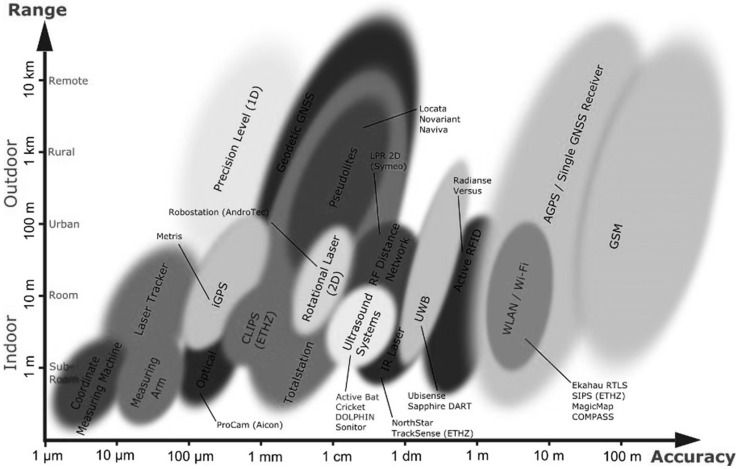
“Current positioning systems according to their accuracy and coverage area (with permission from [6]).”
BackgroundInfluentialIndoor Navigation of Emergency Agents
Renaudin, V., Yalak, O., Tomé, P., & Merminod, B. (2007) · Infoscience (Ecole Polytechnique Fédérale de Lausanne) · Cited by 95
Research works printed but not linked: 1
- IHS Technology NFC-Enabled Cellphone Shipments to Soar Fourfold in Next Five Years. Available online:http://press.ihs.com/press-release/design-supply-chain/nfc-enabled-cellphone-shipments-soar-fourfold-next-five-years.
Cited by
Location based services: ongoing evolution and research agenda
Huang, H., Gartner, G., Krisp, J. M., Raubal, M., & Van de Weghe, N. (2018) · Journal of Location Based Services · doi:10.1080/17489725.2018.1508763 · Cited by 316
Indoor Localization Improved by Spatial Context—A Survey
Gu, F., Hu, X., Ramezani, M., Acharya, D., Khoshelham, K., Valaee, S., & Shang, J. (2020) · ACM Computing Surveys · doi:10.1145/3322241 · Cited by 172
“In the research works [40, 120], NFC tags deployed at specific locations were used as NFC landmarks for indoor navigation.”
MethodGao, Y., Liu, S., Atia, M., & Noureldin, A. (2015) · Sensors · doi:10.3390/s150923286 · Cited by 167
“), passive beacons (like passive RFID, Near Field Communication (NFC) [1,2]), and manmade or natural landmarks, etc.”
BackgroundRobust Pedestrian Dead Reckoning Based on MEMS-IMU for Smartphones
Kuang, J., Niu, X., & Chen, X. (2018) · Sensors · doi:10.3390/s18051391 · Cited by 149
“Therefore, indoor localization technology is flourishing, and many different techniques have been designed and developed for tracking pedestrians’ positions when in indoor environments, such as Wi-Fi [2,3], Bluetooth/iBeacon [4,5], radio frequency identification (RFID) [6,7], near-field communication (NFC) [8], ultra-…”
BackgroundA Survey of NFC Sensors Based on Energy Harvesting for IoT Applications
Lazaro, A., Villarino, R., & Girbau, D. (2018) · Sensors · doi:10.3390/s18113746 · Cited by 144
“NFC systems are, therefore, gaining importance in the Internet of Things (IoT) scenario [3,4].”
Background
Metadata
- Authors
- Ozdenizci, B., Coskun, V., & Ok, K.
- Affiliations
- NFC Lab-Istanbul, Department of Information Technologies, ISIK University, Istanbul 34980, Turkey
- Işık University (TR)
- ORCID
- Ok, Kerem
- Venue
- Sensors
- Publisher
- MDPI AG
- Published
- 2015-03-27
- Volume
- 15
- Issue
- 4
- Pages
- 7571-7595
- ISSN
- 1424-8220 (ISSN-L)
- PMC
- PMC4431189
- OpenAlex
- W2074542010
- Cited by
- 96
- References
- 23
- Citations by year
- 2026: 6 · 2025: 3 · 2024: 11 · 2023: 5 · 2022: 6 · 2021: 3 · 2020: 12 · 2019: 16 · 2018: 11 · 2017: 10 · 2016: 9 · 2015: 4
- FWCI
- 5.46
- Type
- journal article
- Language
- en
- Open access
- gold
- dx.doi.org
- Licence
- Locations
- Sensors (publishedVersion, cc-by)
- PubMed Central (publishedVersion, cc-by)
- PubMed (publishedVersion)
- Akademik Açık Erişim (Işık Üniversitesi) (submittedVersion, cc-by-nc-nd)
- DOAJ (DOAJ: Directory of Open Access Journals) (submittedVersion, cc-by-sa)
- Topics
- Physical Sciences › Engineering › Electrical and Electronic Engineering › Indoor and Outdoor Localization Technologies
- Physical Sciences › Computer Science › Computer Networks and Communications › RFID technology advancements
- Social Sciences › Transportation › Human Mobility and Location-Based Analysis
- Keywords
- indoor navigation, near field communication, NFC tags, location update, GPS-denied environments, mobile navigation application, privacy and security, user preferences, prototype testing
About these checks
Registry, retraction, Cites and statistics results are computed, not judged, with one exception: a printed reference that no index lists is read once by a model before it counts as a citation error. Claims are extracted by a model and kept only when their quote appears verbatim in the text; each cited source is then checked, with a model’s help, for whether it says what the claim relies on. Those verdicts can be wrong — read the claim’s quote and the cited source before relying on one.
Statistics and arithmetic are recomputed, not judged.
Confidence bands are shown only for fields calibrated on our annotated test set. None is calibrated yet, so no band is shown.
What counts as a claim ›How we measure confidence ›How we check this ›
Are you an author, or do you see a problem with this page? Request a review
How to cite
Cite CoChat for the checks on this page, and the paper for its own findings.
- This page
- CoChat. (2026). Citation check: NFC Internal: An Indoor Navigation System. https://app.cochat.ai/papers/10.3390/s150407571
- The paper
- Ozdenizci, B., Coskun, V., & Ok, K. (2015). NFC Internal: An Indoor Navigation System. Sensors. https://doi.org/10.3390/s150407571
Data sources
Bibliographic data: Semantic Scholar, OpenAlex, Crossref.
Contains information from the Semantic Scholar Academic Graph Datasets, made available under the ODC Attribution License (ODC-BY 1.0).
Semantic Scholar’s data is described in: Kinney, R., et al. (2023). The Semantic Scholar Open Data Platform. arXiv:2301.10140.
