

The DOI matches its Crossref record; 28 of the 28 references it cites were found in a registry or an index.
Harvesting Entropy for Random Number Generation for Internet of Things Constrained Devices Using On-Board Sensors
Open accessAbstract
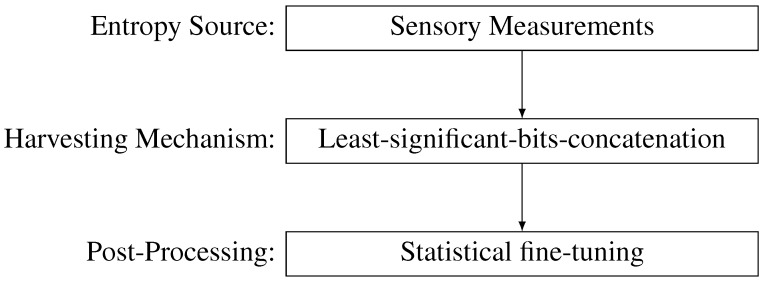
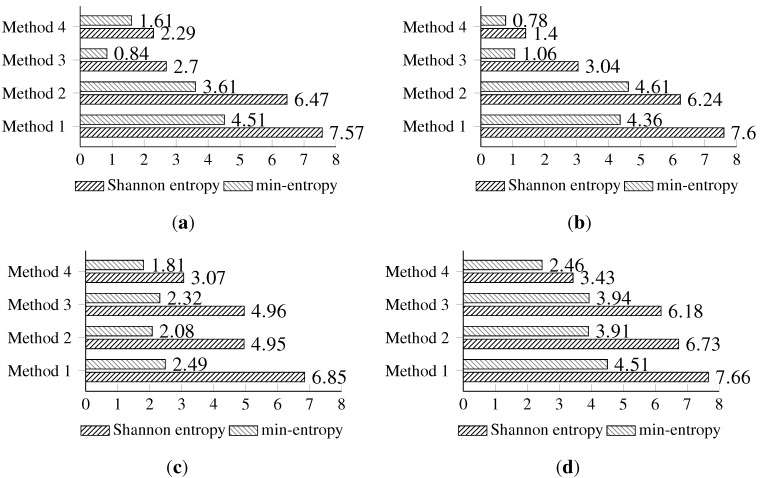
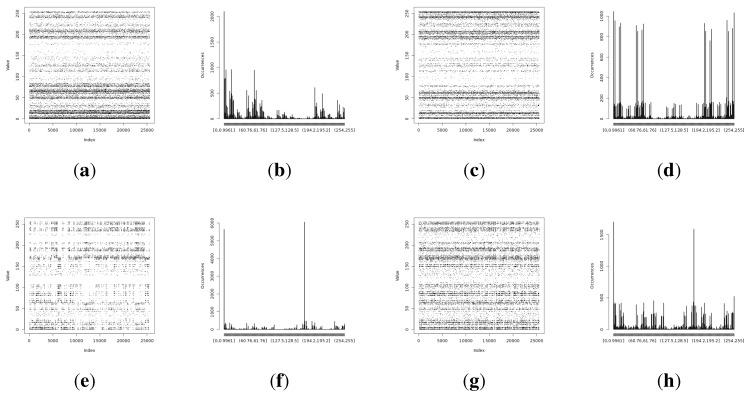
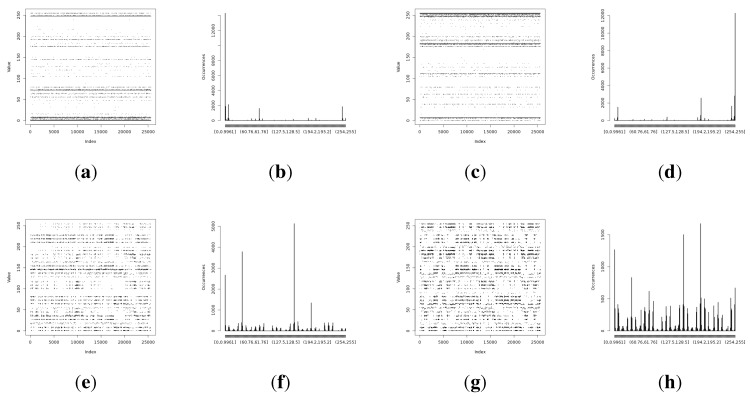
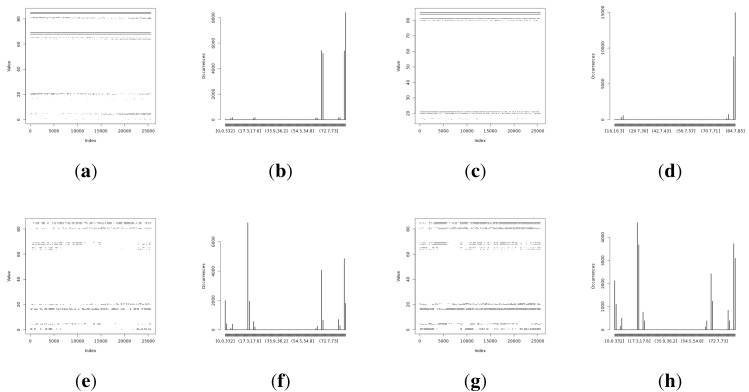
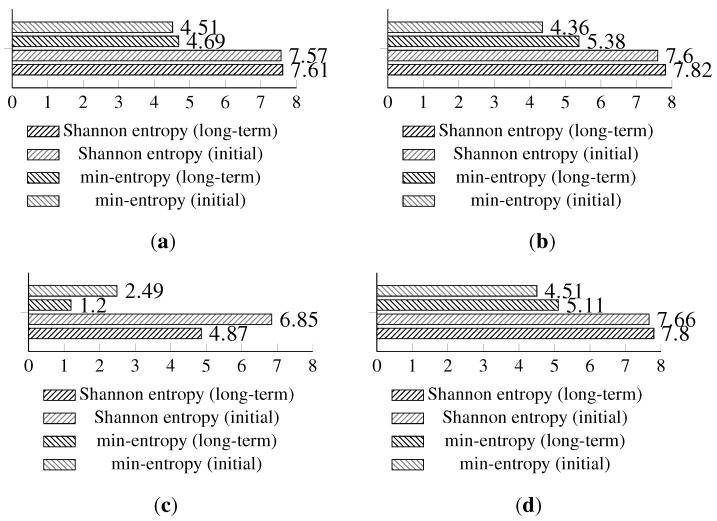
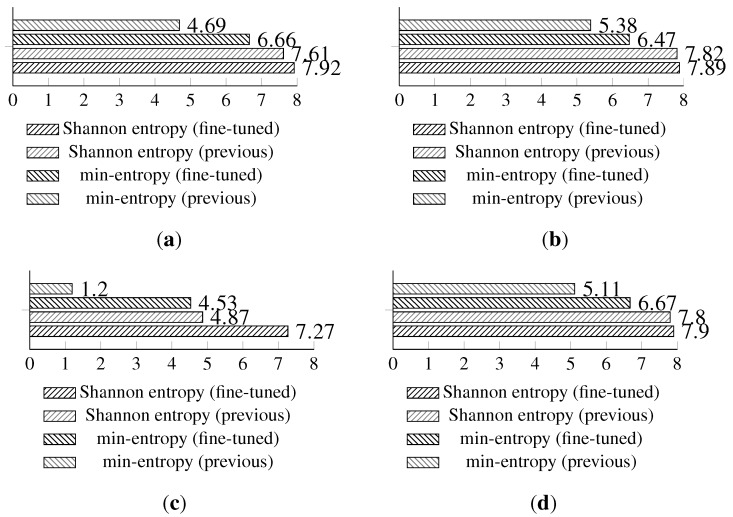
Entropy in computer security is associated with the unpredictability of a source of randomness. The random source with high entropy tends to achieve a uniform distribution of random values. Random number generators are one of the most important building blocks of cryptosystems. In constrained devices of the Internet of Things ecosystem, high entropy random number generators are hard to achieve due to hardware limitations. For the purpose of the random number generation in constrained devices, this work proposes a solution based on the least-significant bits concatenation entropy harvesting method. As a potential source of entropy, on-board integrated sensors (i.e., temperature, humidity and two different light sensors) have been analyzed. Additionally, the costs (i.e., time and memory consumption) of the presented approach have been measured. The results obtained from the proposed method with statistical fine tuning achieved a Shannon entropy of around 7.9 bits per byte of data for temperature and humidity sensors. The results showed that sensor-based random number generators are a valuable source of entropy with very small RAM and Flash memory requirements for constrained devices of the Internet of Things.
Overview
The claims and statistics of this paper haven’t been checked yet.
Run the check — free, no account needed. It reads the open-access text and checks the sources it cites.
Integrity signals
Registry
Cites
Statistics
Figures
Verification
Claims the paper makes
The claims and statistics of this paper haven’t been checked yet.
Run the check — free, no account needed. It reads the open-access text and checks the sources it cites.
Claims other papers make about this one
Each is checked against this paper’s own text: does it say what the citing paper says it does?
The cited source says what the claim attributes to it.
In the citing paper
“The other popular entropy estimator is min-entropy that recommended by NIST [89].”
From True Random Number Generators Using Electrical Noise (2019) · cites this paper as [89]
Self-check
Percentages, sums and reported differences re-computed from the paper’s own numbers.
The self-check needs the paper’s full text.
Citations
Cites
1 retracted
Recommendation for Random Bit Generator (RBG) Constructions
Barker, E. B., Kelsey, J. M., McKay, K. A., Roginsky, A. L., & Turan, M. S. (2022) · doi:10.6028/nist.sp.800-90c.3pd · Cited by 58
RetractedKocher, P. C., Jaffe, J. S., & Jun, B. (1999) · Lecture notes in computer science · doi:10.1007/3-540-48405-1_25 · Cited by 7,569
Bassham, L. E., Rukhin, A. L., Soto, J., Nechvatal, J. R., Smid, M. E., Barker, E. B., Leigh, S. D., Levenson, M., Vangel, M., Banks, D. L., et al. (2010) · NIST Special Publication 800-22 Revision 1a · doi:10.6028/nist.sp.800-22r1a · Cited by 3,617
Rukhin, A., Sota, J., Nechvatal, J., Smid, M., Barker, E., Leigh, S., Levenson, M., Vangel, M., Banks, D., Heckert, A., et al. (2000) · doi:10.6028/nist.sp.800-22 · Cited by 1,867
On the features and challenges of security and privacy in distributed internet of things
Román, R., Zhou, J., & López, J. (2013) · Computer Networks · doi:10.1016/j.comnet.2012.12.018 · Cited by 1,471
Agrawal, D., Archambeault, B. R., Rao, J. R., & Rohatgi, P. (2003) · Lecture notes in computer science · doi:10.1007/3-540-36400-5_4 · Cited by 783
A Provably Secure True Random Number Generator with Built-In Tolerance to Active Attacks
Sunar, B., Martin, W. J., & Stinson, D. R. (2007) · IEEE Transactions on Computers · doi:10.1109/tc.2007.250627 · Cited by 673
Recommendation for the Entropy Sources Used for Random Bit Generation
Turan, M. S., Barker, E., Kelsey, J., McKay, K. A., Baish, M. L., & Boyle, M. (2018) · NIST Special Publication 800-90B · doi:10.6028/nist.sp.800-90b · Cited by 489
Practical Timing Side Channel Attacks against Kernel Space ASLR
Hund, R., Willems, C., & Holz, T. (2013) · IEEE Symposium on Security and Privacy (S&P) · doi:10.1109/sp.2013.23 · Cited by 398
Security Challenges in the IP-based Internet of Things
Heer, T., García-Morchón, Ó., Hummen, R., Keoh, S. L., Kumar, S., & Wehrle, K. (2011) · Wireless Personal Communications · doi:10.1007/s11277-011-0385-5 · Cited by 378
Datagram Transport Layer Security
Rescorla, E., & Modadugu, N. (2006) · doi:10.17487/rfc4347 · Cited by 334
Randomness Requirements for Security
Eastlake, D., Schiller, J. I., & Crocker, S. D. (2005) · doi:10.17487/rfc4086 · Cited by 239
Toward a Lightweight Authentication and Authorization Framework for Smart Objects
Hernández-Ramos, J. L., Pawlowski, M. P., Jara, A. J., Skármeta, A., & Ladid, L. (2015) · IEEE Journal on Selected Areas in Communications · doi:10.1109/jsac.2015.2393436 · Cited by 145
Self-citationNiyato, D. T., Hossain, E., & Camorlinga, S. G. (2009) · IEEE Journal on Selected Areas in Communications · doi:10.1109/jsac.2009.090506 · Cited by 143
Taylor, A. S., Harper, R. H. R., Swan, L., Izadi, S., Sellen, A. J., & Perry, M. (2006) · Personal and Ubiquitous Computing · doi:10.1007/s00779-006-0076-5 · Cited by 138
Securing the IP-based internet of things with HIP and DTLS
García-Morchón, Ó., Keoh, S. L., Kumar, S., Moreno-Sánchez, P., Vidal-Meca, F., & Ziegeldorf, J. H. (2013) · ACM Conference on Security and Privacy in Wireless and Mobile Networks (WiSec) · doi:10.1145/2462096.2462117 · Cited by 92
Get Your Hands Off My Laptop: Physical Side-Channel Key-Extraction Attacks on PCs
Genkin, D., Pipman, I., & Tromer, E. (2014) · Lecture notes in computer science · doi:10.1007/978-3-662-44709-3_14 · Cited by 85
Fossati, T. (2016) · doi:10.17487/rfc7925 · Cited by 80
TinyRNG: A Cryptographic Random Number Generator for Wireless Sensors Network Nodes
Francillon, A., & Castelluccia, C. (2007) · International Symposium on Modeling and Optimization in Mobile, Ad Hoc, and Wireless Networks (WiOpt) · doi:10.1109/wiopt.2007.4480051 · Cited by 77
Optimized ECC Implementation for Secure Communication between Heterogeneous IoT Devices
Marín, L., Pawlowski, M. P., & Jara, A. J. (2015) · Sensors · doi:10.3390/s150921478 · Cited by 58
Self-citationPANATIKI: A Network Access Control Implementation Based on PANA for IoT Devices
Moreno-Sánchez, P., López, R., & Skármeta, A. (2013) · Sensors · doi:10.3390/s131114888 · Cited by 36
Denial of service mitigation approach for IPv6‐enabled smart object networks
Oliveira, L., Rodrigues, J. J. P. C., de Sousa, A., & Lloret, J. (2012) · Concurrency and Computation Practice and Experience · doi:10.1002/cpe.2850 · Cited by 32
Entropy harvesting from physical sensors
Hennebert, C., Hossayni, H., & Lauradoux, C. (2013) · ACM Conference on Security and Privacy in Wireless and Mobile Networks (WiSec) · doi:10.1145/2462096.2462122 · Cited by 28
A Network Access Control Framework for 6LoWPAN Networks
Oliveira, L., Rodrigues, J. J. P. C., de Sousa, A., & Lloret, J. (2013) · Sensors · doi:10.3390/s130101210 · Cited by 28
Extending Extensible Authentication Protocol over IEEE 802.15.4 Networks
Pawlowski, M. P., Jara, A. J., & OGORZAŁEK, M. J. (2014) · International Conference on Innovative Mobile and Internet Services in Ubiquitous Computing (IMIS) · doi:10.1109/imis.2014.93 · Cited by 15
Self-citationWireless Sensor Networks in IPv4/IPv6 Transition Scenarios
Oliveira, L., Rodrigues, J. J. P. C., Elias, A. G. F., & Han, G. (2014) · Wireless Personal Communications · doi:10.1007/s11277-014-2048-9 · Cited by 7
Fabbri, M., & Callegari, S. (2014) · IEEE International Conference on Electronics, Circuits and Systems (ICECS) · doi:10.1109/icecs.2014.7049950 · Cited by 4
A hybrid approach for anomaly detection on large-scale networks using HWDS and entropy
de Assis, M. V. O., Rodrigues, J. J. P. C., & Proença, M. L. (2013) · International Conference on Software, Telecommunications and Computer Networks (SoftCOM) · doi:10.1109/softcom.2013.6671845 · Cited by 3
Research works printed but not linked: 4
- Yang, 2013, Editorial on Internet of Things: Standards, Technology and Applications, Int. J. Ad Hoc Ubiquitous Comput., 13, 155
- Kocher, P., Jaffe, J., and Jun, B. (1999). Advances in Cryptology—CRYPTO’99, Springer.
- Agrawal, D., Archambeault, B., Rao, J.R., and Rohatgi, P. (2003). Cryptographic Hardware and Embedded Systems-CHES 2002, Springer.
- Genkin, D., Pipman, I., and Tromer, E. (2014). Cryptographic Hardware and Embedded Systems—CHES 2014, Springer.
Cited by
Sorted by citations
True Random Number Generators Using Electrical Noise
Gong, L., Zhang, J., Liu, H., Sang, L., & Wang, Y. (2019) · IEEE Access · doi:10.1109/access.2019.2939027 · Cited by 77
“NIST SP-800.”
BackgroundSensor-Based Entropy Source Analysis and Validation for Use in IoT Environments
Răstoceanu, F., Rughinis, R. V., Ciocîrlan, Ș.-D., & Enache, M. F. (2021) · Electronics · doi:10.3390/electronics10101173 · Cited by 11
Pawlowski, M. P., Jara, A. J., & OGORZAŁEK, M. J. (2015) · Mobile Information Systems · doi:10.1155/2015/506284 · Cited by 8
Self-citationEntropy as a Service: A Lightweight Random Number Generator for Decentralized IoT Applications
Ullah, I., Meratnia, N., & Havinga, P. (2020) · IEEE International Conference on Pervasive Computing and Communications Workshops (PerCom Workshops) · doi:10.1109/percomworkshops48775.2020.9156205 · Cited by 6
MindCrypt: The Brain as a Random Number Generator for SoC-Based Brain-Computer Interfaces
Eichler, G., Seyoum, B. B., Chiu, K.-L., & Carloni, L. P. (2023) · IEEE International Conference on Computer Design: VLSI in Computers and Processors (ICCD) · doi:10.1109/iccd58817.2023.00021 · Cited by 4
Metadata
- Authors
- Pawlowski, M., Jara, A., & Ogorzalek, M.
- Affiliations
- Jagiellonian University (PL)
- HES-SO University of Applied Sciences and Arts Western Switzerland (CH)
- Department of Information Technologies, Faculty of Physics, Astronomy and Applied Computer Science, Jagiellonian University, Krakow 30-348, Poland
- Corresponding author
- Pawlowski, Marcin
- Venue
- Sensors
- Publisher
- MDPI AG
- Published
- 2015-10-22
- Volume
- 15
- Issue
- 10
- Pages
- 26838-26865
- ISSN
- 1424-8220 (ISSN-L)
- PMC
- PMC4634515
- OpenAlex
- W1753039820
- Cited by
- 15
- References
- 28
- Citations by year
- 2026: 2 · 2025: 3 · 2023: 1 · 2022: 1 · 2021: 2 · 2020: 3 · 2019: 1 · 2018: 1 · 2015: 1
- FWCI
- 0.65
- Type
- journal article
- Language
- en
- Open access
- gold
- dx.doi.org
- Licence
- Locations
- Sensors (publishedVersion, cc-by)
- PubMed Central (publishedVersion, cc-by)
- PubMed (publishedVersion)
- DOAJ (DOAJ: Directory of Open Access Journals) (submittedVersion, cc-by-sa)
- Funders
- Sciex-NMSch (13.121)
- SAFESENS ENIAC (621272)
- EU Horizon 2020 (649849, 644672)
- Topics
- Physical Sciences › Computer Science › Artificial Intelligence › Cryptographic Implementations and Security
- Physical Sciences › Computer Science › Hardware and Architecture › Physical Unclonable Functions (PUFs) and Hardware Security
- Physical Sciences › Engineering › Electrical and Electronic Engineering › Arduino and IoT Applications
- Keywords
- random number generation, resource-constrained devices, Internet of Things, onboard sensors, temperature sensors, humidity sensor, photodetectors, Shannon entropy, hardware randomness
About these checks
Registry, retraction, Cites and statistics results are computed, not judged, with one exception: a printed reference that no index lists is read once by a model before it counts as a citation error. Claims are extracted by a model and kept only when their quote appears verbatim in the text; each cited source is then checked, with a model’s help, for whether it says what the claim relies on. Those verdicts can be wrong — read the claim’s quote and the cited source before relying on one.
Statistics and arithmetic are recomputed, not judged.
Confidence bands are shown only for fields calibrated on our annotated test set. None is calibrated yet, so no band is shown.
What counts as a claim ›How we measure confidence ›How we check this ›
Are you an author, or do you see a problem with this page? Request a review
