

The DOI matches its Crossref record; 24 of the 24 references it cites were found in a registry or an index; none of the 20 sources its claims cite is checked for support yet.
Recommendation for the Entropy Sources Used for Random Bit Generation
Open accessAbstract
Reports on Computer Systems TechnologyThe Information Technology Laboratory (ITL) at the National Institute of Standards and Technology (NIST) promotes the U.S. economy and public welfare by providing technical leadership for the Nation's measurement and standards infrastructure.ITL develops tests, test methods, reference data, proof of concept implementations, and technical analyses to advance the development and productive use of information technology.ITL's responsibilities include the development of management, administrative, technical, and physical standards and guidelines for the cost-effective security and privacy of other than national security-related information in Federal information systems.The Special Publication 800-series reports on ITL's research, guidelines, and outreach efforts in information system security, and its collaborative activities with industry, government, and academic organizations.
Overview
CoChat Summary
TL;DR
NIST SP 800-90B specifies design principles, requirements, and validation tests for entropy sources used by Random Bit Generators, including health tests, IID testing, and min-entropy estimators. It defines separate IID and non-IID validation tracks and provides approved continuous health tests and entropy estimation methods.
Key findings
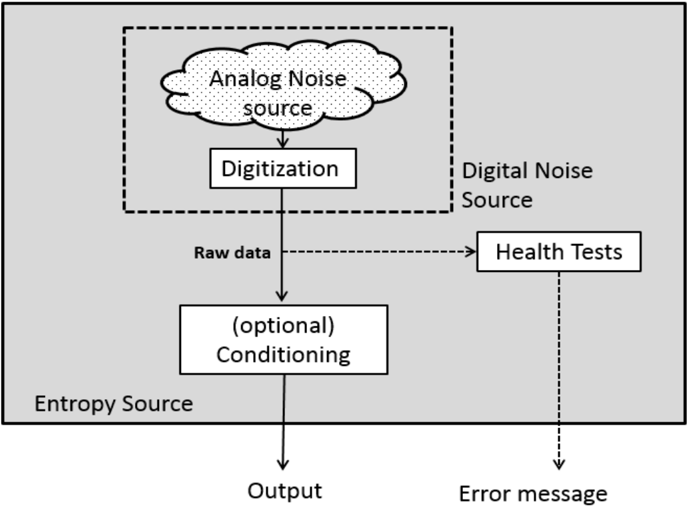
- The entropy source model consists of a noise source, an optional conditioning component, and health tests; validation requires at least 1,000,000 sequential noise-source samples, and restart tests use 1000 restarts × 1000 consecutive samples in a 1000×1000 matrix.
- Two approved continuous health tests are specified: the Repetition Count test and the Adaptive Proportion test; the recommended false positive probability is between 2^-20 and 2^-40, startup tests run continuous tests over at least 1024 consecutive samples, and for α = 2^-20 and H = 2.0 bits per sample the Repetition Count cutoff is C = 11.
- The IID track uses the Most Common Value estimate; the non-IID track requires taking the minimum of ten estimators: Most Common Value, Collision, Markov, Compression, t-Tuple, Longest Repeated Substring, Multi Most Common in Window, Lag, MultiMMC, and LZ78Y; Collision, Markov, and Compression are applied only to binary inputs.
- IID testing uses permutation testing with 10,000 permutations plus chi-square tests, with type I error 0.001; vetted conditioning components include HMAC, CMAC, CBC-MAC, approved hash functions, Hash_df, and Block_Cipher_df.
Methods
- Design and validation framework: entropy source validation is performed by an NVLAP-accredited laboratory with CAVP/CMVP review, based on documentation, data collection, restart tests, and conditioning-component entropy assessment.
- Statistical analysis: IID assumption is tested via permutation and chi-square procedures; entropy is estimated using the IID Most Common Value estimate or the non-IID battery of ten estimators; health testing uses the Repetition Count and Adaptive Proportion tests or developer-defined alternatives.
- Data and sample requirements: a sequential dataset of at least 1,000,000 samples is required, a conditioned sequential dataset of at least 1,000,000 outputs is required for non-vetted conditioning components, restart data form a 1000×1000 matrix, and alphabets larger than 256 symbols are reduced to at most 256 symbols.
Limitations
- Stated: the testing approach assumes the developer understands the behavior of the randomness source and has made a good-faith effort to produce a suitable entropy source; the entropy estimation methods rely on statistical assumptions that may not hold for all noise sources and should not replace in-depth analysis.
- Stated: continuous health tests are resource-constrained and usually detect only gross failures; the Repetition Count test detects only catastrophic failures, and continuous tests may allow poor entropy outputs before an alarm is signaled.
- Evident from the text: this is a recommendation/specification rather than an empirical study, and validation depends on submitter documentation and laboratory testing; some requirements may be out-of-scope for CAVP or CMVP validation testing.
Model-written summary. Check it against the paper before relying on it.
Integrity signals
Registry
Cites
Statistics
Figures


Verification
Claims the paper makes
0 Valid · 2 Not valid · 15 Not checked · 96 Own results and interpretations
A result the paper states — it cites no source for it, so there is none to check. The quote shows it is in the paper.
In the paper
“For example, a noise source evaluated at eight bits of min-entropy per sample has a cutoff value of six repetitions to ensure a false-positive rate of approximately once per 10 12 samples generated.”
plainstates a cause- Asserted: passes — The authors put it forward as true.
- Checkable: passes — It can be checked against evidence.
- Load-bearing: unclear — It is unclear whether the paper’s conclusions depend on it.
- Based: passes — The paper gives a reason why it holds.
A result the paper states — it cites no source for it, so there is none to check. The quote shows it is in the paper.
In the paper
“If that noise source somehow failed to the point that each sample had a 1/16 probability of being the same as the previous sample, so that it was providing only four bits of min-entropy per sample, it would still be expected to take about one million samples before the repetition count test would notice the problem.”
hedgedstates a cause- Asserted: passes — The authors put it forward as true.
- Checkable: passes — It can be checked against evidence.
- Load-bearing: unclear — It is unclear whether the paper’s conclusions depend on it.
- Based: passes — The paper gives a reason why it holds.
In the paper
“While the estimators (except for the Markov) were originally designed for application to independent outputs, the tests have performed well when applied to data with dependencies.”
What the sources say
- Not matchedcites [HD12]
Couldn’t be matched to a paper in Crossref, so it can’t be checked.
boosted- Asserted: passes — The authors put it forward as true.
- Checkable: passes — It can be checked against evidence.
- Load-bearing: unclear — It is unclear whether the paper’s conclusions depend on it.
- Based: passes — The paper gives a reason why it holds.
- Not matched
A conclusion the paper draws from its own results — it cites no other source for it, so there is none to check. The quote shows it is in the paper.
In the paper
“However, the conditioning component may reduce the entropy of the output.”
hedgedstates a possible cause- Asserted: passes — The authors put it forward as true.
- Checkable: passes — It can be checked against evidence.
- Load-bearing: passes — The paper’s conclusions depend on it.
- Based: passes — The paper gives a reason why it holds.
A conclusion the paper draws from its own results — it cites no other source for it, so there is none to check. The quote shows it is in the paper.
In the paper
“The entropy estimate of a noise source, calculated from a single, long-output sequence, might provide an overestimate if the noise source generates correlated sequences after restarts.”
hedgedstates a possible cause- Asserted: passes — The authors put it forward as true.
- Checkable: passes — It can be checked against evidence.
- Load-bearing: passes — The paper’s conclusions depend on it.
- Based: passes — The paper gives a reason why it holds.
35 more claims
Create a free account to see all 113 claims and every source verdict.
- Probably not a substantial claim. 60
- It may state two separate claims as one. 23
Self-check
Percentages, sums and reported differences re-computed from the paper’s own numbers.
Each contradiction between two passages listed here was confirmed by an independent check.
Rated minor: it would not touch a result — a value no result rests on, a p-value that stays on the same side of the significance level, or a conflict that is clerical, resolved elsewhere in the paper, or outside its own findings.
In the paper
§ 6.3.1 The Most Common Value Estimate
“𝑝𝑝 𝑢𝑢 = 0.4 + 2.576 √ 0.012 = 0.6895.”
§ 6.3.1 The Most Common Value Estimate
“The min-entropy estimate is -log2 (0.6822) = 0.5363.”
Citations
Cites
A tutorial on hidden Markov models and selected applications in speech recognition
Rabiner, L. R. (1989) · Proceedings of the IEEE · doi:10.1109/5.18626 · Cited by 22,743
Bellman, R. E. (2010) · doi:10.1515/9781400835386 · Cited by 14,588
Prediction and Entropy of Printed English
Shannon, C. E. (1951) · Bell System Technical Journal · doi:10.1002/j.1538-7305.1951.tb01366.x · Cited by 2,686
Data Compression: The Complete Reference
(2009) · Kybernetes · doi:10.1108/k.2009.06738eae.001 · Cited by 1,591
An Introduction to Probability Theory and its Applications.
Kendall, D. G., & Feller, W. (1951) · Journal of the Royal Statistical Society. Series A (General) · doi:10.2307/2980979 · Cited by 1,283
SHA-3 standard: permutation-based hash and extendable-output functions
National Institute of Standards and Technology (US) (2015) · doi:10.6028/nist.fips.202 · Cited by 783
Advanced Encryption Standard (AES)
National Institute of Standards and Technology (US) (2001) · doi:10.6028/nist.fips.197 · Cited by 642
“Balls into Bins” — A Simple and Tight Analysis
Raab, M., & Steger, A. (1998) · Lecture Notes in Computer Science · doi:10.1007/3-540-49543-6_13 · Cited by 455
Recommendation for Key Management Part 1: General
Barker, E. (2016) · doi:10.6028/nist.sp.800-57pt1r4 · Cited by 396
Self-citationNational Institute of Standards and Technology (US) (2015) · doi:10.6028/nist.fips.180-4 · Cited by 350
Cited by
Quantum random number generators
Herrero-Collantes, M., & Garcia-Escartin, J. C. (2017) · Reviews of Modern Physics · doi:10.1103/revmodphys.89.015004 · Cited by 791
“Other approaches to CSPRNGs use cryptographic protocols such as DES or AES as blocks that transform a string of bits using as their secret key a processed seed from the computer’s entropy pool.”
BackgroundMethodInfluentialMcGrath, T., Bagci, I. E., Wang, Z. M., Roedig, U., & Young, R. J. (2019) · Applied Physics Reviews · doi:10.1063/1.5079407 · Cited by 353
“Since the PUF can be considered as the generation and then permanent storage of a randomly generated key, pre-existing work on the standardisation of dedicated random number generators 98 may be a useful source to help define these areas.”
BackgroundRecommendation for Random Number Generation Using Deterministic Random Bit Generators
Barker, E. B., & Kelsey, J. M. (2015) · doi:10.6028/nist.sp.800-90ar1 · Cited by 304
Self-citationModule-Lattice-Based Key-Encapsulation Mechanism Standard
National Institute of Standards and Technology (US) (2024) · doi:10.6028/nist.fips.203 · Cited by 268
Recommendation for key management: part 1 - general
Barker, E. (2020) · doi:10.6028/nist.sp.800-57pt1r5 · Cited by 271
Self-citation
Metadata
- Authors
- Turan, M. S., Barker, E., Kelsey, J., McKay, K. A., Baish, M. L., & Boyle, M.
- Venue
- NIST Special Publication 800-90B
- Published
- 2018-01
- OpenAlex
- W2784781042
- Cited by
- 489
- References
- 24
- Citations by year
- 2026: 59 · 2025: 63 · 2024: 64 · 2023: 66 · 2022: 58 · 2021: 38 · 2020: 41 · 2019: 34 · 2018: 17
- Type
- report
- Language
- en
- Open access
- gold
- doi.org
- Funders
- Information Technology Laboratory
- Topics
- Physical Sciences › Computer Science › Artificial Intelligence › Cryptographic Implementations and Security
- Physical Sciences › Physics and Astronomy › Atomic and Molecular Physics, and Optics › Quantum Information and Cryptography
- Physical Sciences › Computer Science › Hardware and Architecture › Physical Unclonable Functions (PUFs) and Hardware Security
- Keywords
- entropy source, random bit generation, random number generation, cryptographic randomness, entropy estimation
About these checks
Registry, retraction, Cites and statistics results are computed, not judged, with one exception: a printed reference that no index lists is read once by a model before it counts as a citation error. Claims are extracted by a model and kept only when their quote appears verbatim in the text; each cited source is then checked, with a model’s help, for whether it says what the claim relies on. Those verdicts can be wrong — read the claim’s quote and the cited source before relying on one.
A language model drew the claims from the paper on 2026-09-28, under version 3 of the claim definition (model deepseek-v4.1-flash, prompt extract-v3).
A second model labelled each claim on 2026-09-28 (model jev-1.13-20260917, definition revision gold-guideline-v0.2).
Statistics and arithmetic are recomputed, not judged.
Confidence bands are shown only for fields calibrated on our annotated test set. None is calibrated yet, so no band is shown.
What counts as a claim ›How we measure confidence ›How we check this ›
Are you an author, or do you see a problem with this page? Request a review
How to cite
Cite CoChat for the checks on this page, and the paper for its own findings.
- This page
- CoChat. (2026). Citation check: Recommendation for the Entropy Sources Used for Random Bit Generation. https://app.cochat.ai/papers/10.6028/nist.sp.800-90b
- The paper
- Turan, M. S., Barker, E., Kelsey, J., McKay, K. A., Baish, M. L., & Boyle, M. (2018). Recommendation for the Entropy Sources Used for Random Bit Generation. NIST Special Publication 800-90B. https://doi.org/10.6028/nist.sp.800-90b
Data sources
Bibliographic data: Semantic Scholar, OpenAlex, Crossref.
Contains information from the Semantic Scholar Academic Graph Datasets, made available under the ODC Attribution License (ODC-BY 1.0).
Semantic Scholar’s data is described in: Kinney, R., et al. (2023). The Semantic Scholar Open Data Platform. arXiv:2301.10140.
