

The DOI matches its Crossref record; 40 of the 41 references it cites were found in a registry or an index.
Complex Human Activity Recognition Using Smartphone and Wrist-Worn Motion Sensors
Open accessAbstract
The position of on-body motion sensors plays an important role in human activity recognition. Most often, mobile phone sensors at the trouser pocket or an equivalent position are used for this purpose. However, this position is not suitable for recognizing activities that involve hand gestures, such as smoking, eating, drinking coffee and giving a talk. To recognize such activities, wrist-worn motion sensors are used. However, these two positions are mainly used in isolation. To use richer context information, we evaluate three motion sensors (accelerometer, gyroscope and linear acceleration sensor) at both wrist and pocket positions. Using three classifiers, we show that the combination of these two positions outperforms the wrist position alone, mainly at smaller segmentation windows. Another problem is that less-repetitive activities, such as smoking, eating, giving a talk and drinking coffee, cannot be recognized easily at smaller segmentation windows unlike repetitive activities, like walking, jogging and biking. For this purpose, we evaluate the effect of seven window sizes (2-30 s) on thirteen activities and show how increasing window size affects these various activities in different ways. We also propose various optimizations to further improve the recognition of these activities. For reproducibility, we make our dataset publicly available.
Overview
The claims and statistics of this paper haven’t been checked yet.
Free: it reads the open-access text and checks the first 5 claims that cite a source we can check. Create a free account to check every claim.
Integrity signals
Registry
Cites
Statistics
Figures
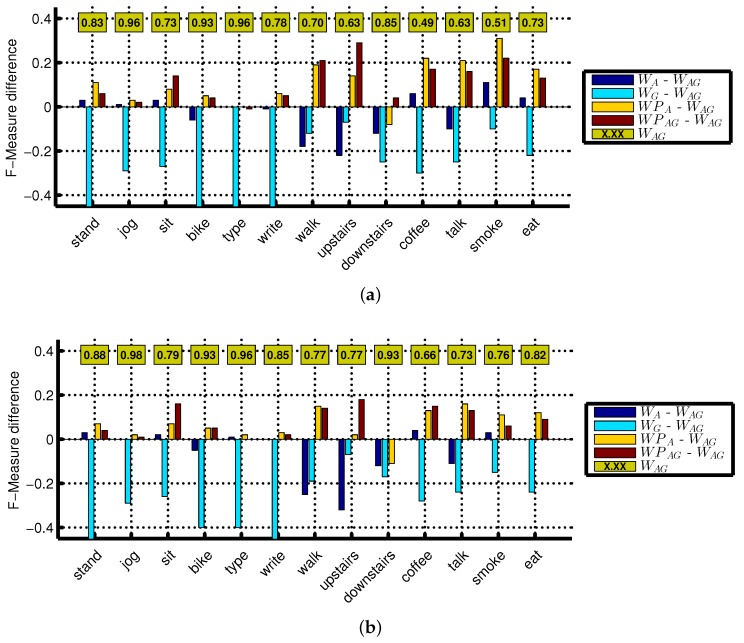
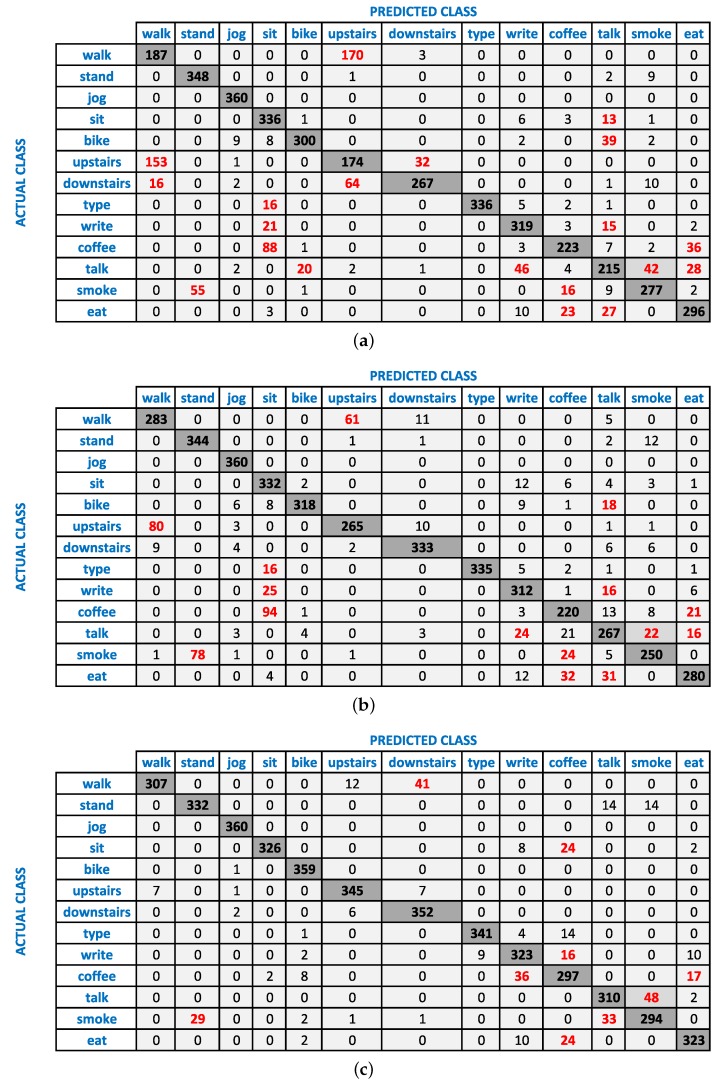

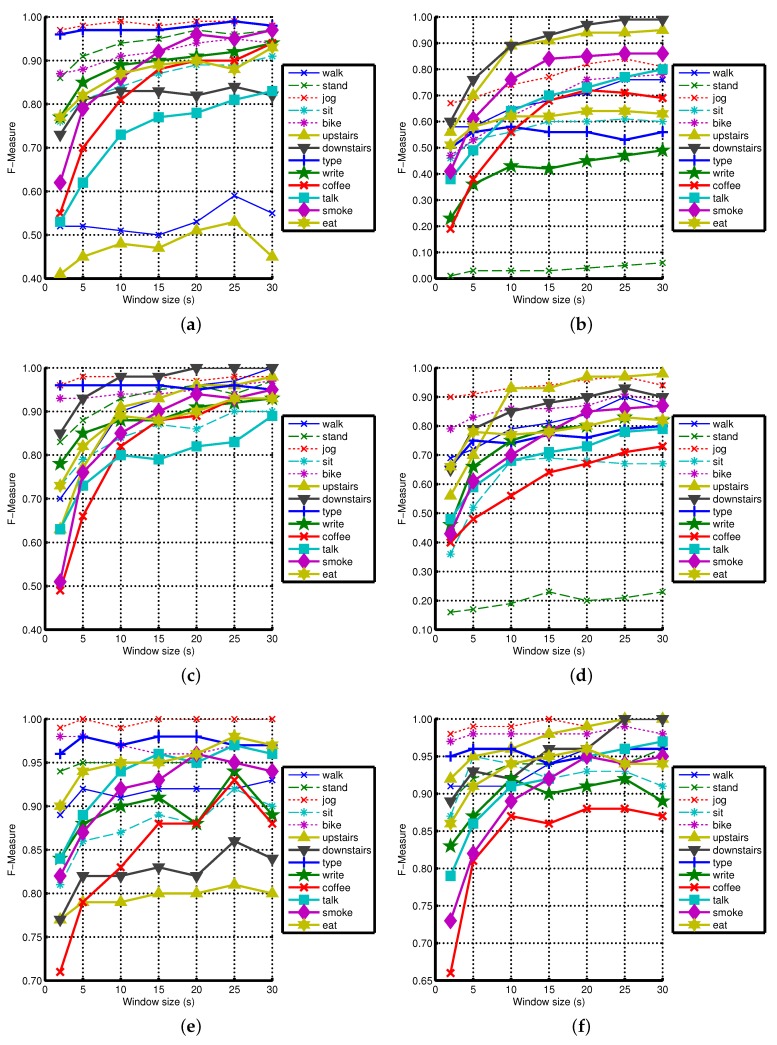


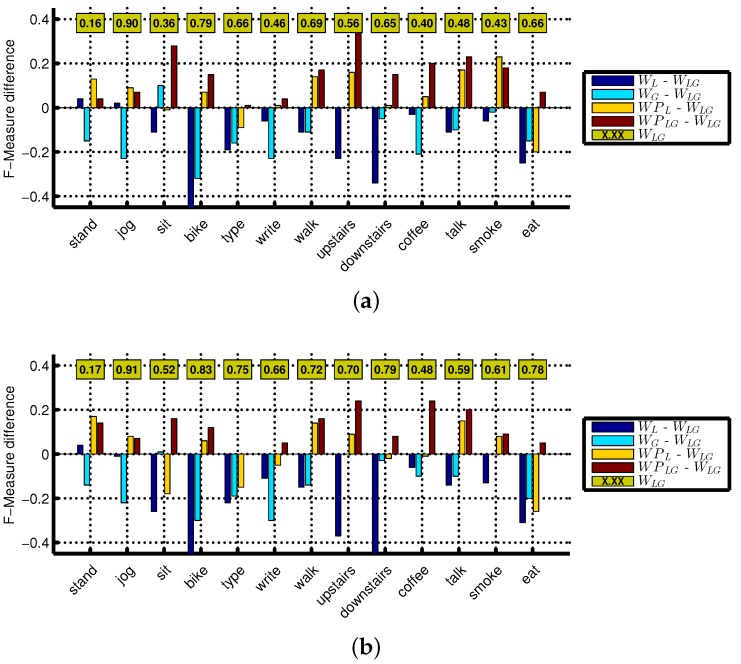


Verification
Claims the paper makes
The claims and statistics of this paper haven’t been checked yet.
Free: it reads the open-access text and checks the first 5 claims that cite a source we can check. Create a free account to check every claim.
Claims other papers make about this one
Each is checked against this paper’s own text: does it say what the citing paper says it does?
The source backs part of the claim, not all of it — or backs it for a different population, condition or comparison.
In the citing paper
“Basic activities demonstrate consistent and repeated patterns, facilitating their detection, whereas complex activities entail non-repetitive and context-sensitive motions that depend on extended temporal sequences, presenting considerable challenges for detection [7, 8].”
From Adaptive temporal attention mechanism and hybrid deep CNN model for wearable sensor-based human activity recognition (2025) · cites this paper as [8]
Experimental — accuracy not yet measuredIn the citing paper
“The UTwente dataset consists of 13 activities gathered from 10 people utilizing two smartphones (one in the right trouser pocket and the other on the wrist), equipped with accelerometer, gyroscope, linear acceleration, and magnetometer sensors at a frequency of 50 Hz.”
From Adaptive temporal attention mechanism and hybrid deep CNN model for wearable sensor-based human activity recognition (2025) · cites this paper as [8]
In the citing paper
“The UTwente dataset was chosen as a suitable benchmark for evaluation because of its diverse range of activities (13 in total, comprising 7 simple and 6 complicated activities), superior data quality, and the application of wearable sensors in real-world contexts (trouser pockets and wrists) [8].”
From Adaptive temporal attention mechanism and hybrid deep CNN model for wearable sensor-based human activity recognition (2025) · cites this paper as [8]
Self-check
Percentages, sums and reported differences re-computed from the paper’s own numbers.
The self-check needs the paper’s full text.
Citations
Cites
Scikit-learn: Machine Learning in Python
Pedregosa, F., Varoquaux, G., Gramfort, A., Michel, V., Thirion, B., Grisel, O., Blondel, M., Müller, A., Nothman, J., Louppe, G., et al. (2012) · arXiv · doi:10.48550/arxiv.1201.0490 · Cited by 71,016
The WEKA data mining software: an update
Hall, M., Frank, E., Holmes, G., Pfahringer, B., Reutemann, P., & Witten, I. H. (2009) · ACM SIGKDD Explorations Newsletter · doi:10.1145/1656274.1656278 · Cited by 17,750 · cited 1×
“As data are randomized before stratified cross-validation in the WEKA (Waikato Environment for Knowledge Analysis) tool [25], overlap in the data can cause using some data in both training and testing, which can lead to higher recognition performance.”
MethodA survey of mobile phone sensing
Lane, N., Miluzzo, E., Lu, H., Peebles, D., Choudhury, T., & Campbell, A. (2010) · IEEE Communications Magazine · doi:10.1109/mcom.2010.5560598 · Cited by 2,292
A tutorial on human activity recognition using body-worn inertial sensors
Bulling, A., Blanke, U., & Schiele, B. (2014) · ACM Computing Surveys · doi:10.1145/2499621 · Cited by 1,668 · cited 1×
“Activity recognition using body-worn motion sensors in general [19] and especially using smartphone sensors has been studied in recent years [1,2], and it is still being studied extensively [1,2,19–21].”
BackgroundMiluzzo, E., Lane, N. D., Fodor, K., Peterson, R., Lu, H., Musolesi, M., Eisenman, S. B., Zheng, X., & Campbell, A. T. (2008) · Proceedings of the 6th ACM conference on Embedded network sensor systems · doi:10.1145/1460412.1460445 · Cited by 1,032 · cited 1×
“They are implemented on mobile phones in various studies; i.e. , Naive Bayes in [37–39], decision tree in [40–42] and KNN in [31,32,39,43].”
MethodPreprocessing techniques for context recognition from accelerometer data
Figo, D., Diniz, P. C., Ferreira, D. R., & Cardoso, J. M. P. (2010) · Personal and Ubiquitous Computing · doi:10.1007/s00779-010-0293-9 · Cited by 578
The Jigsaw continuous sensing engine for mobile phone applications
Lu, H., Yang, J., Liu, Z., Lane, N. D., Choudhury, T., & Campbell, A. T. (2010) · Proceedings of the 8th ACM Conference on Embedded Networked Sensor Systems · doi:10.1145/1869983.1869992 · Cited by 560
Mobile Phone Sensing Systems: A Survey
Khan, W. Z., Xiang, Y., Aalsalem, M. Y., & Arshad, Q. (2013) · IEEE Communications Surveys & Tutorials · doi:10.1109/surv.2012.031412.00077 · Cited by 557 · cited 2×
“Activity recognition using body-worn motion sensors in general [19] and especially using smartphone sensors has been studied in recent years [1,2], and it is still being studied extensively [1,2,19–21].”
BackgroundFusion of Smartphone Motion Sensors for Physical Activity Recognition
Shoaib, M., Bosch, S., Incel, O., Scholten, H., & Havinga, P. (2014) · Sensors · doi:10.3390/s140610146 · Cited by 552 · cited 6×
“We had shown previously that the accelerometer performs poorly at recognizing walking upstairs and downstairs and needs additional gyroscope data for better recognition of these two activities [12].”
BackgroundMethodInfluentialSelf-citationA Survey of Online Activity Recognition Using Mobile Phones
Shoaib, M., Bosch, S., Incel, O., Scholten, H., & Havinga, P. (2015) · Sensors · doi:10.3390/s150102059 · Cited by 489 · cited 2×
“We selected three classifiers, which are commonly used for practical activity recognition: Naive Bayes, k-nearest neighbor (KNN) and decision tree [35,36].”
BackgroundMethodSelf-citation
Research works printed but not linked: 2
- Bieber, G., Fernholz, N., and Gaerber, M. (2013). HCI International 2013-Posters’ Extended Abstracts, Springer.
- Frank, J., Mannor, S., and Precup, D. (2011). Machine Learning and Knowledge Discovery in Databases, Springer.
Cited by
Nweke, H. F., Teh, Y. W., Al-garadi, M. A., & Alo, U. R. (2018) · Expert Systems with Applications · doi:10.1016/j.eswa.2018.03.056 · Cited by 930
Qiu, S., Zhao, H., Jiang, N., Wang, Z., Liu, L., An, Y., Zhao, H., Miao, X., Liu, R., & Fortino, G. (2022) · Information Fusion · doi:10.1016/j.inffus.2021.11.006 · Cited by 671
A survey on wearable sensor modality centred human activity recognition in health care
Wang, Y., Cang, S., & Yu, H. (2019) · Expert Systems with Applications · doi:10.1016/j.eswa.2019.04.057 · Cited by 409
Nweke, H. F., Teh, Y. W., Mujtaba, G., & Al-garadi, M. A. (2019) · Information Fusion · doi:10.1016/j.inffus.2018.06.002 · Cited by 394
Demrozi, F., Pravadelli, G., Bihorac, A., & Rashidi, P. (2020) · IEEE Access · doi:10.1109/access.2020.3037715 · Cited by 368
Metadata
- Authors
- Shoaib, M., Bosch, S., Incel, O., Scholten, H., & Havinga, P.
- Affiliations
- University of Twente (NL)
- Department of Computer Engineering, Galatasaray University, Ortakoy, 34349 Istanbul, Turkey
- Corresponding author
- Shoaib, Muhammad
- Venue
- Sensors
- Publisher
- MDPI AG
- Published
- 2016-03-24
- Volume
- 16
- Issue
- 4
- Pages
- 426
- ISSN
- 1424-8220 (ISSN-L)
- PMC
- PMC4850940
- OpenAlex
- W2304267454
- Cited by
- 423
- References
- 41
- Citations by year
- 2026: 28 · 2025: 24 · 2024: 34 · 2023: 42 · 2022: 48 · 2021: 62 · 2020: 58 · 2019: 52 · 2018: 37 · 2017: 29 · 2016: 9
- FWCI
- 28.79
- Type
- journal article
- Language
- en
- Open access
- gold
- doi.org
- Licence
- Locations
- Sensors (publishedVersion, cc-by)
- PubMed Central (publishedVersion, cc-by)
- PubMed (publishedVersion)
- University of Twente Research Information (publishedVersion, cc-by)
- University of Twente Research Information (submittedVersion, cc-by)
- Funders
- Galatasaray Üniversitesi (13.401.002)
- Topics
- Physical Sciences › Computer Science › Computer Vision and Pattern Recognition › Context-Aware Activity Recognition Systems
- Social Sciences › Transportation › Human Mobility and Location-Based Analysis
- Physical Sciences › Computer Science › Computer Vision and Pattern Recognition › Human Pose and Action Recognition
- Keywords
- human activity recognition, smartphone sensors, accelerometer, gyroscope, sensor placement, hand gestures, smoking detection, multimodal sensor fusion, activity recognition dataset
- MeSH terms
- Smartphone, Activities of Daily Living, Humans, Movement, Pattern Recognition, Automated, Smoking, Wrist, Walking, Accelerometry
About these checks
Registry, retraction, Cites and statistics results are computed, not judged, with one exception: a printed reference that no index lists is read once by a model before it counts as a citation error. Claims are extracted by a model and kept only when their quote appears verbatim in the text; each cited source is then checked, with a model’s help, for whether it says what the claim relies on. Those verdicts can be wrong — read the claim’s quote and the cited source before relying on one.
Statistics and arithmetic are recomputed, not judged.
Confidence bands are shown only for fields calibrated on our annotated test set. None is calibrated yet, so no band is shown.
What counts as a claim ›How we measure confidence ›How we check this ›
Are you an author, or do you see a problem with this page? Request a review
How to cite
Cite CoChat for the checks on this page, and the paper for its own findings.
- This page
- CoChat. (2026). Citation check: Complex Human Activity Recognition Using Smartphone and Wrist-Worn Motion Sensors. https://app.cochat.ai/papers/10.3390/s16040426
- The paper
- Shoaib, M., Bosch, S., Incel, O., Scholten, H., & Havinga, P. (2016). Complex Human Activity Recognition Using Smartphone and Wrist-Worn Motion Sensors. Sensors. https://doi.org/10.3390/s16040426
Data sources
Bibliographic data: Semantic Scholar, OpenAlex, Crossref.
Contains information from the Semantic Scholar Academic Graph Datasets, made available under the ODC Attribution License (ODC-BY 1.0).
Semantic Scholar’s data is described in: Kinney, R., et al. (2023). The Semantic Scholar Open Data Platform. arXiv:2301.10140.
