

An Ensemble Deep Convolutional Neural Network Model with Improved D-S Evidence Fusion for Bearing Fault Diagnosis
Open accessThe DOI matches its Crossref record; 46 of the 46 references it cites were found in a registry or an index.
Abstract
Intelligent machine health monitoring and fault diagnosis are becoming increasingly important for modern manufacturing industries. Current fault diagnosis approaches mostly depend on expert-designed features for building prediction models. In this paper, we proposed IDSCNN, a novel bearing fault diagnosis algorithm based on ensemble deep convolutional neural networks and an improved Dempster–Shafer theory based evidence fusion. The convolutional neural networks take the root mean square (RMS) maps from the FFT (Fast Fourier Transformation) features of the vibration signals from two sensors as inputs. The improved D-S evidence theory is implemented via distance matrix from evidences and modified Gini Index. Extensive evaluations of the IDSCNN on the Case Western Reserve Dataset showed that our IDSCNN algorithm can achieve better fault diagnosis performance than existing machine learning methods by fusing complementary or conflicting evidences from different models and sensors and adapting to different load conditions.
Overview
The claims and statistics of this paper haven’t been checked yet.
Free: it reads the open-access text and checks the first 5 claims that cite a source we can check. Create a free account to check every claim.
Integrity signals
Registry
Cites
Statistics
Figures


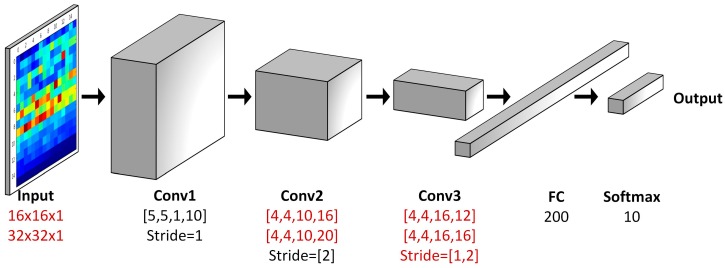

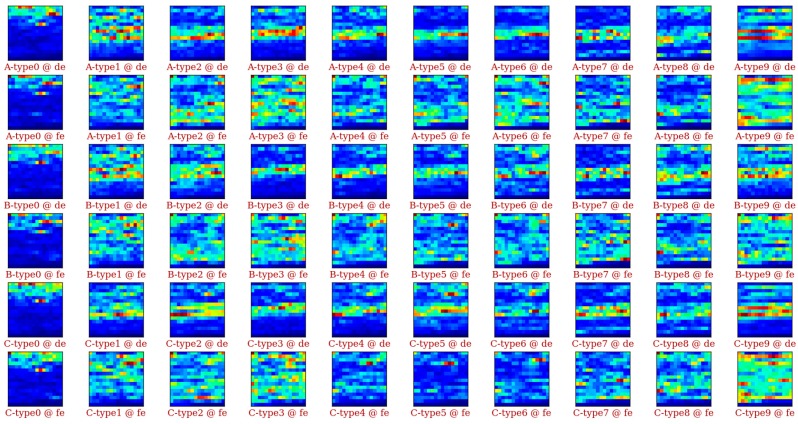


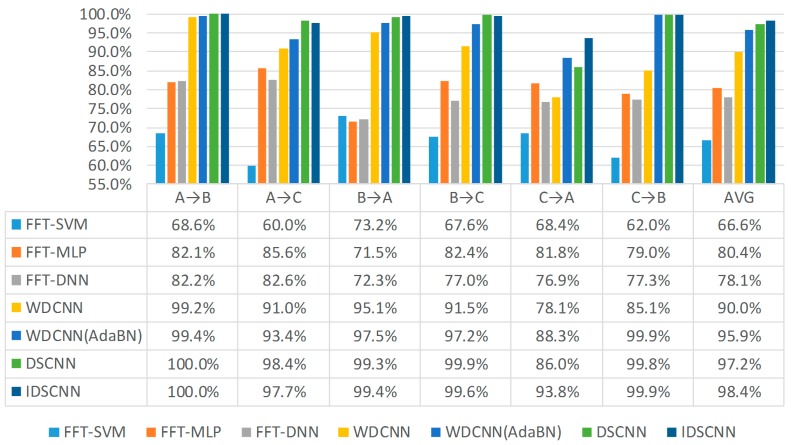
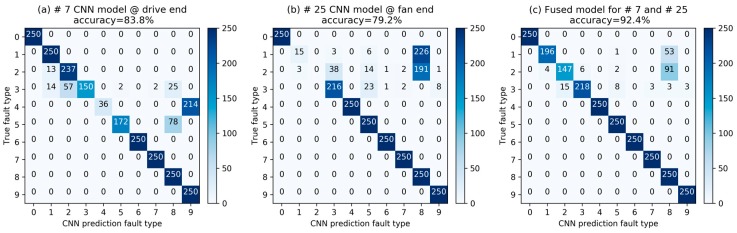

Verification
Claims the paper makes
The claims and statistics of this paper haven’t been checked yet.
Free: it reads the open-access text and checks the first 5 claims that cite a source we can check. Create a free account to check every claim.
Self-check
Percentages, sums and reported differences re-computed from the paper’s own numbers.
The self-check needs the paper’s full text.
Citations
Cites
Smith, W. A., & Randall, R. B. (2015) · Mechanical Systems and Signal Processing · doi:10.1016/j.ymssp.2015.04.021 · Cited by 2,719
Zhang, W., Peng, G., Li, C., Chen, Y., & Zhang, Z. (2017) · Sensors · doi:10.3390/s17020425 · Cited by 1,925
Jia, F., Lei, Y., Lin, J., Zhou, X., & Lu, N. (2016) · Mechanical Systems and Signal Processing · doi:10.1016/j.ymssp.2015.10.025 · Cited by 1,710 · cited 1×
“We can see that the DSCNN method, which combines the CNN models with traditional D-S evidence theory has higher accuracy than FFT-SVM, FFT-MLP, FFT-DNN [48], WDCNN [49] and WDCNN (AdaBN) [49] on all nine conditions but has lower accuracy than the WDCNN (AdaBN) model on C→A.”
On the dempster-shafer framework and new combination rules
Yager, R. R. (1987) · Information Sciences · doi:10.1016/0020-0255(87)90007-7 · Cited by 1,572 · cited 1×
“In this paper, we propose a novel algorithm that integrates deep neural networks with multiple sensor information with an improved Dempster–Shafer (D-S) evidence theory [30] based data fusion model for bearing fault diagnosis.”
Real-Time Motor Fault Detection by 1-D Convolutional Neural Networks
Ince, T., Kiranyaz, S., Eren, L., Askar, M., & Gabbouj, M. (2016) · IEEE Transactions on Industrial Electronics · doi:10.1109/tie.2016.2582729 · Cited by 1,407
Combining belief functions when evidence conflicts
Murphy, C. K. (2000) · Decision Support Systems · doi:10.1016/s0167-9236(99)00084-6 · Cited by 1,042 · cited 1×
“Here we take four modified D-S evidence fusion algorithms from Yager [44], Sun [45], Murphy [46] and Deng [47] for comprehensive analysis.”
Deep convolutional neural networks for multi-modality isointense infant brain image segmentation
Zhang, W., Li, R., Deng, H., Wang, L., Lin, W., Ji, S., & Shen, D. (2015) · NeuroImage · doi:10.1016/j.neuroimage.2014.12.061 · Cited by 817 · cited 1×
“Many classification problems have been successfully solved by various deep learning models such as deep belief network [22], deep Boltzmann machine [23], deep auto encoder [24], convolutional neural network (CNN) [25] and so on.”
Hierarchical adaptive deep convolution neural network and its application to bearing fault diagnosis
Guo, X., Chen, L., & Shen, C. (2016) · Measurement · doi:10.1016/j.measurement.2016.07.054 · Cited by 782 · cited 1×
“Guo [26] proposed a hierarchical adaptive deep convolution neural network (ADCNN) on bearing fault analysis, which first output the fault type and then analyze the fault size.”
Gearbox Fault Identification and Classification with Convolutional Neural Networks
Chen, Z., Li, C., & Sanchez, R.-V. (2015) · Shock and Vibration · doi:10.1155/2015/390134 · Cited by 391 · cited 2×
“As shown in Figure 1, we use root mean square (RMS) over a sub band of the frequency spectrum as feature for our CNN model, which has the advantage of maintaining the energy shape at the spectrum peaks [27,41].”
Tran, V. T., AlThobiani, F., & Ball, A. (2014) · Expert Systems with Applications · doi:10.1016/j.eswa.2013.12.026 · Cited by 386
Research works printed but not linked: 3
- Muralidharan, 2016, Bearing Fault Diagnosis Using Vibration Signals by Variational Mode Decomposition and Naïve Bayes Classifier, Int. J. Robot. Autom., 1, 1
- Xing, 2016, Quantitative MMM evaluation of weld levels based on information entropy and DS evidence theory, Chin. J. Sci. Instrum., 37, 610
- Kang, 2012, Multi-sensor information fusion algorithm based on DS evidence theory, J. Chin. Inert. Technol., 20, 670
Cited by
1D convolutional neural networks and applications: A survey
Kiranyaz, S., Avci, O., Abdeljaber, O., Ince, T., Gabbouj, M., & Inman, D. J. (2021) · Mechanical Systems and Signal Processing · doi:10.1016/j.ymssp.2020.107398 · Cited by 2,835
Applications of machine learning to machine fault diagnosis: A review and roadmap
Lei, Y., Yang, B., Jiang, X., Jia, F., Li, N., & Nandi, A. K. (2020) · Mechanical Systems and Signal Processing · doi:10.1016/j.ymssp.2019.106587 · Cited by 2,997
Deep learning and its applications to machine health monitoring
Zhao, R., Yan, R., Chen, Z., Mao, K., Wang, P., & Gao, R. X. (2019) · Mechanical Systems and Signal Processing · doi:10.1016/j.ymssp.2018.05.050 · Cited by 2,894
Deep Learning Algorithms for Bearing Fault Diagnostics—A Comprehensive Review
Zhang, S., Zhang, S., Wang, B., & Habetler, T. G. (2020) · IEEE Access · doi:10.1109/access.2020.2972859 · Cited by 913
“Similarly, to overcome the impact of load variations, a novel bearing fault diagnosis algorithm based on improved Dempster-Shafer theory CNN (IDS-CNN) is e ployed in [113].”
MethodA comprehensive review on convolutional neural network in machine fault diagnosis
Jiao, J., Zhao, M., Lin, J., & Liang, K. (2020) · Neurocomputing · doi:10.1016/j.neucom.2020.07.088 · Cited by 575
Metadata
- Authors
- Li, S., Liu, G., Tang, X., Lu, J., & Hu, J.
- Affiliations
- Guizhou University (CN)
- University of South Carolina (US)
- Corresponding author
- Hu, Jianjun
- Venue
- Sensors
- Publisher
- MDPI AG
- Published
- 2017-07-28
- Volume
- 17
- Issue
- 8
- Pages
- 1729
- ISSN
- 1424-8220 (ISSN-L)
- PMC
- PMC5579931
- OpenAlex
- W2741289421
- Semantic Scholar
- 3155ce032d96f273cbaa2d17f83af5905a3fa8ca
- Cited by
- 211
- References
- 45
- Citations by year
- 2026: 9 · 2025: 15 · 2024: 23 · 2023: 26 · 2022: 24 · 2021: 30 · 2020: 34 · 2019: 34 · 2018: 15 · 2017: 1
- FWCI
- 14.39
- Type
- journal article
- Language
- en
- Open access
- gold
- doi.org
- Licence
- Locations
- Sensors (publishedVersion, cc-by)
- PubMed Central (publishedVersion, cc-by)
- PubMed (publishedVersion)
- Scholar Commons (University of South Carolina) (submittedVersion, cc-by)
- DOAJ (DOAJ: Directory of Open Access Journals) (submittedVersion, cc-by-sa)
- Funders
- National Natural Science Foundation Project of China (51475097)
- Topics
- Physical Sciences › Engineering › Control and Systems Engineering › Machine Fault Diagnosis Techniques
- Physical Sciences › Engineering › Control and Systems Engineering › Fault Detection and Control Systems
- Health Sciences › Health Professions › Health Information Management › Artificial Intelligence in Healthcare
- Keywords
- bearing fault diagnosis, Dempster-Shafer theory, evidence combination, vibration signals, multi-sensor fusion, distance matrix, machine condition monitoring
About these checks
Registry, retraction, Cites and statistics results are computed, not judged, with one exception: a printed reference that no index lists is read once by a model before it counts as a citation error. Claims are extracted by a model and kept only when their quote appears verbatim in the text; each cited source is then checked, with a model’s help, for whether it says what the claim relies on. Those verdicts can be wrong — read the claim’s quote and the cited source before relying on one.
Statistics and arithmetic are recomputed, not judged.
Confidence bands are shown only for fields calibrated on our annotated test set. None is calibrated yet, so no band is shown.
What counts as a claim ›How we measure confidence ›How we check this ›
Are you an author, or do you see a problem with this page? Request a review
How to cite
Cite CoChat for the checks on this page, and the paper for its own findings.
- This page
- CoChat. (2026). Citation check: An Ensemble Deep Convolutional Neural Network Model with Improved D-S Evidence Fusion for Bearing Fault Diagnosis. https://app.cochat.ai/papers/10.3390/s17081729
- The paper
- Li, S., Liu, G., Tang, X., Lu, J., & Hu, J. (2017). An Ensemble Deep Convolutional Neural Network Model with Improved D-S Evidence Fusion for Bearing Fault Diagnosis. Sensors. https://doi.org/10.3390/s17081729
Data sources
Bibliographic data: Semantic Scholar, OpenAlex, Crossref.
Contains information from the Semantic Scholar Academic Graph Datasets, made available under the ODC Attribution License (ODC-BY 1.0).
Semantic Scholar’s data is described in: Kinney, R., et al. (2023). The Semantic Scholar Open Data Platform. arXiv:2301.10140.
