

The DOI matches its Crossref record; 1 of the 1 references it cites were found in a registry or an index.
An Ontology-Based Cybersecurity Framework for the Internet of Things
Open accessAbstract
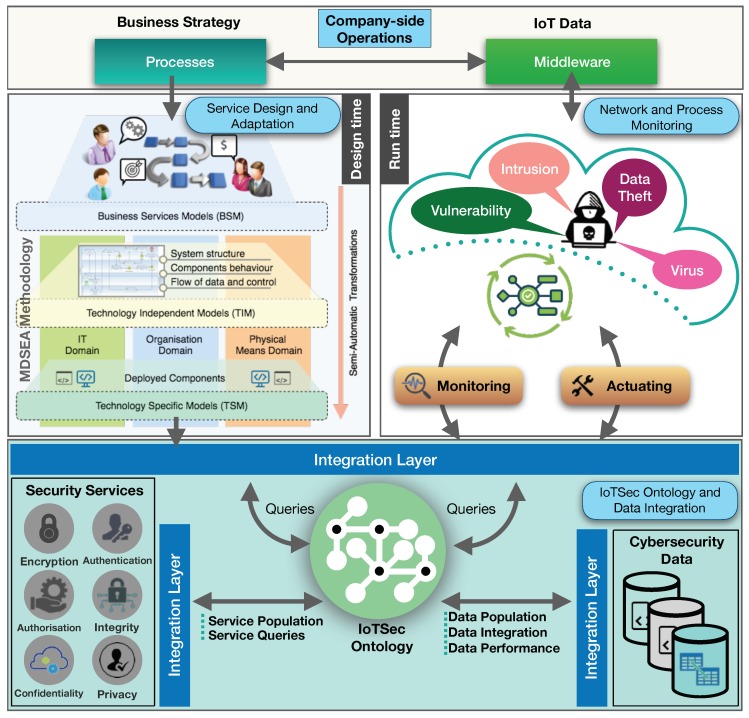
The use of sensors and actuators as a form of controlling cyber-physical systems in resource networks has been integrated and referred to as the Internet of Things (IoT). However, the connectivity of many stand-alone IoT systems through the Internet introduces numerous cybersecurity challenges as sensitive information is prone to be exposed to malicious users. This paper focuses on the improvement of IoT cybersecurity from an ontological analysis, proposing appropriate security services adapted to the threats. The authors propose an ontology-based cybersecurity framework using knowledge reasoning for IoT, composed of two approaches: (1) design time, which provides a dynamic method to build security services through the application of a model-driven methodology considering the existing enterprise processes; and (2) run time, which involves monitoring the IoT environment, classifying threats and vulnerabilities, and actuating in the environment ensuring the correct adaptation of the existing services. Two validation approaches demonstrate the feasibility of our concept. This entails an ontology assessment and a case study with an industrial implementation.
Overview
The claims and statistics of this paper haven’t been checked yet.
Run the check — free, no account needed. It reads the open-access text and checks the sources it cites.
Integrity signals
Registry
Cites
Statistics
Figures

Verification
Claims the paper makes
The claims and statistics of this paper haven’t been checked yet.
Run the check — free, no account needed. It reads the open-access text and checks the sources it cites.
Claims other papers make about this one
Each is checked against this paper’s own text: does it say what the citing paper says it does?
The cited source says what the claim attributes to it.
In the citing paper
“Finally, the authors consider that ontology in cybersecurity improves effectiveness in security operations, and helps analysts to extract relevant information to characterize the vulnerabilities.”
From A Review of Cybersecurity Guidelines for Manufacturing Factories in Industry 4.0 (2021) · cites this paper as [32]
The cited source says what the claim attributes to it.
In the citing paper
“Considering this situation, an ontology-based cybersecurity framework for IoT was proposed by [32].”
From A Review of Cybersecurity Guidelines for Manufacturing Factories in Industry 4.0 (2021) · cites this paper as [32]
Self-check
Percentages, sums and reported differences re-computed from the paper’s own numbers.
The self-check needs the paper’s full text.
Citations
Cites
Internet of Things in industries: A survey
Xu, L. D., He, W., & Li, S. (2014) · IEEE Transactions on Industrial Informatics · doi:10.1109/tii.2014.2300753 · Cited by 5,172
Research works printed but not linked: 42
- Ibarra-Esquer, J.E., González-Navarro, F.F., Flores-Rios, B.L., Burtseva, L., and Astorga-Vargas, M.A. (2017). Tracking the Evolution of the Internet of Things Concept Across Different Application Domains. Sensors, 17. · DOI
- Delmastro, 2012, Pervasive communications in healthcare, Comput. Commun., 35, 1284, 10.1016/j.comcom.2012.04.018 · DOI
- Polycarpou, E., Lambrinos, L., and Protopapadakis, E. (2013, January 4–7). Smart parking solutions for urban areas. Proceedings of the 2013 IEEE 14th International Symposium on “A World of Wireless, Mobile and Multimedia Networks” (WoWMoM), Madrid, Spain. · DOI
- Ancillotti, 2013, The role of communication systems in smart grids: Architectures, technical solutions and research challenges, Comput. Commun., 36, 1665, 10.1016/j.comcom.2013.09.004 · DOI
- Cai, 2014, IoT-Based Configurable Information Service Platform for Product Lifecycle Management, IEEE Trans. Ind. Inform., 10, 1558, 10.1109/TII.2014.2306391 · DOI
- Conti, 2012, Looking ahead in pervasive computing: Challenges and opportunities in the era of cyber–physical convergence, Pervasive Mob. Comput., 8, 2, 10.1016/j.pmcj.2011.10.001 · DOI
- Ashton, 2009, That ‘internet of things’ thing, RFID J., 22, 97
- Khan, 2018, IoT security: Review, blockchain solutions, and open challenges, Future Gener. Comput. Syst., 82, 395, 10.1016/j.future.2017.11.022 · DOI · Paper page
- Wolf, 2018, Safety and Security in Cyber-Physical Systems and Internet-of-Things Systems, Proc. IEEE, 106, 9, 10.1109/JPROC.2017.2781198 · DOI · Paper page
- Lin, 2017, A Survey on Internet of Things: Architecture, Enabling Technologies, Security and Privacy, and Applications, IEEE Internet Things J., 4, 1125, 10.1109/JIOT.2017.2683200 · DOI · Paper page
- (2018, January 16). Dell Data Security Survey Finds that a Lack of Security Knowledge Limits Business Initiatives. Available online: http://www.dell.com/learn/us/en/uscorp1/press-releases/dell-data-security-survey/.
- Singh, K., and Awasthi, A.K. (2013). A Review on Wireless Network Security. Quality, Reliability, Security and Robustness in Heterogeneous Networks, Springer. · DOI
- Mozzaquatro, B.A., Jardim-Goncalves, R., and Agostinho, C. (2015, January 12–13). Towards a reference ontology for security in the Internet of Things. Proceedings of the 2015 IEEE International Workshop on Measurements Networking (M&N), Coimbra, Portugal. · DOI
- Ficco, 2013, Security event correlation approach for cloud computing, Int. J. High Perform. Comput. Netw., 7, 173, 10.1504/IJHPCN.2013.056525 · DOI
- Ficco, 2016, Intrusion detection in federated clouds, Int. J. Comput. Sci. Eng., 13, 219
- Alam, 2011, Interoperability of Security-Enabled Internet of Things, Wirel. Pers. Commun., 61, 567, 10.1007/s11277-011-0384-6 · DOI
- Tao, 2018, Multi-layer cloud architectural model and ontology-based security service framework for IoT-based smart homes, Future Gener. Comput. Syst., 78, 1040, 10.1016/j.future.2016.11.011 · DOI
- Ekelhart, A., Fenz, S., and Neubauer, T. (2009, January 5–8). AURUM: A Framework for Information Security Risk Management. Proceedings of the 2009 42nd Hawaii International Conference on System Sciences, Waikoloa, HI, USA.
- Marotta, 2017, Cyber-insurance survey, Comput. Sci. Rev., 24, 35, 10.1016/j.cosrev.2017.01.001 · DOI
- Shahid, 2014, Secure communication for the Internet of Things—A comparison of link-layer security and IPsec for 6LoWPAN, Secur. Commun. Netw., 7, 2654, 10.1002/sec.406 · DOI
- Mozzaquatro, B.A., Agostinho, C., Melo, R., and Jardim-Goncalves, R. (2017). A Model-Driven Adaptive Approach for IoT Security. Model-Driven Engineering and Software Development: 4th International Conference, MODELSWARD 2016, Rome, Italy, February 19–21, 2016, Revised Selected Papers, Springer International Publishing.
- Bagosi, T., Calvanese, D., Hardi, J., Komla-Ebri, S., Lanti, D., Rezk, M., Rodríguez-Muro, M., Slusnys, M., and Xiao, G. (2014). The Ontop Framework for Ontology Based Data Access. The Semantic Web and Web Science: 8th Chinese Conference, CSWS 2014, Wuhan, China, August 8–12, 2014, Revised Selected Papers, Springer. · DOI
- Gennari, 2003, The evolution of Protégé: An environment for knowledge-based systems development, Int. J. Hum. Comput. Stud., 58, 89, 10.1016/S1071-5819(02)00127-1 · DOI
- Bazoun, 2014, SLMToolBox: An Implementation of MDSEA for Servitisation and Enterprise Interoperability, Enterprise Interoperability VI; Proceedings of the I-ESA Conferences, Volume 7, 101, 10.1007/978-3-319-04948-9_9 · DOI
- Ayuso, 2006, Netfilter’s connection tracking system, LOGIN USENIX Mag., 31, 34
- Zhou, Z., Chen, Z., Zhou, T., and Guan, X. (2010, January 30–31). The study on network intrusion detection system of Snort. Proceedings of the 2010 International Conference on Networking and Digital Society, Wenzhou, China. · DOI
- Kasinathan, P., Costamagna, G., Khaleel, H., Pastrone, C., and Spirito, M.A. (2013, January 4–8). An IDS Framework for Internet of Things Empowered by 6LoWPAN. Proceedings of the 2013 ACM SIGSAC Conference on Computer & Communications Security, Berlin, Germany. · DOI
- Suryn, W., Abran, A., and April, A. (2018, January 16). ISO/IEC SQuaRE. The Second Generation of Standards for Software Product Quality. Available online: https://www.semanticscholar.org/paper/ISO-%2F-IEC-SQuaRE-.-The-second-generation-of-for-Suryn-Abran/348575d1cc283f04e2a1695ccc6e0a221442653b.
- Boeker, 2014, Evaluating the Good Ontology Design Guideline (GoodOD) with the Ontology Quality Requirements and Evaluation Method and Metrics (OQuaRE), PLoS ONE, 9, 1
- Sirin, 2007, Pellet: A practical OWL-DL reasoner, Web Semant. Sci. Serv. Agents World Wide Web, 5, 51, 10.1016/j.websem.2007.03.004 · DOI
- Schmid, 2017, Enabling IoT Ecosystems through Platform Interoperability, IEEE Softw., 34, 54, 10.1109/MS.2017.2 · DOI
- Skouby, K.E., and Lynggaard, P. (2014). Smart home and smart city solutions enabled by 5G, IoT, AAI and CoT services. 2014 International Conference on Contemporary Computing and Informatics (IC3I), IEEE. · DOI
- Veeramachaneni, K., Arnaldo, I., Korrapati, V., Bassias, C., and Li, K. (2016, January 9–10). AI^2: Training a Big Data Machine to Defend. Proceedings of the 2016 IEEE 2nd International Conference on Big Data Security on Cloud (BigDataSecurity), IEEE International Conference on High Performance and Smart Computing (HPSC), and IEEE International Conference on Intelligent Data and Security (IDS), New York, NY, USA. · DOI
- Mikroyannidis, 2010, Ontology management and evolution for business intelligence, Int. J. Inf. Manag., 30, 559, 10.1016/j.ijinfomgt.2009.10.002 · DOI
- Forbes, D.E., Wongthongtham, P., Terblanche, C., and Pakdeetrakulwong, U. (2018). Ontology Engineering. Ontology Engineering Applications in Healthcare and Workforce Management Systems, Springer International Publishing. · DOI
- Mavroeidis, V., and Bromander, S. (2017, January 11–13). Cyber Threat Intelligence Model: An Evaluation of Taxonomies, Sharing Standards, and Ontologies within Cyber Threat Intelligence. Proceedings of the 2017 European Intelligence and Security Informatics Conference (EISIC), Athens, Greece. · DOI
- Jones, C.L., Bridges, R.A., Huffer, K.M.T., and Goodall, J.R. (2015, January 7–9). Towards a Relation Extraction Framework for Cyber-Security Concepts. Proceedings of the 10th Annual Cyber and Information Security Research Conference, Oak Ridge, TN, USA. · DOI
- Abie, H., and Balasingham, I. (2012, January 24–26). Risk-based Adaptive Security for Smart IoT in eHealth. Proceedings of the 7th International Conference on Body Area Networks, Oslo, Norway. · DOI
- Caraguay, 2014, SDN: Evolution and Opportunities in the Development IoT Applications, Int. J. Distrib. Sens. Netw., 10, 735142, 10.1155/2014/735142 · DOI
- Salahuddin, 2017, Softwarization of Internet of Things Infrastructure for Secure and Smart Healthcare, Computer, 50, 74, 10.1109/MC.2017.195 · DOI · Paper page
- Liyanage, M., Ahmad, I., Okwuibe, J., de Oca, E.M., Mai, H.L., López, O., and Uriarte, M. (2018). Software Defined Security Monitoring in 5G Networks. A Comprehensive Guide to 5G Security, John Wiley & Sons. · DOI
- Nobre, J.C., Mozzaquatro, B.A., and Granville, L.Z. (2018). Network-Wide Initiatives to Control Measurement Mechanisms: A Survey. IEEE Commun. Surv. Tutor. · DOI
Cited by
Sorted by citations
A Review of Cybersecurity Guidelines for Manufacturing Factories in Industry 4.0
Mullet, V., Sondi, P., & Ramat, E. (2021) · IEEE Access · doi:10.1109/access.2021.3056650 · Cited by 161
“Considering this situation, an ontology-based cybersecurity framework for IoT was proposed by [32].”
MethodBhandari, G., Lyth, A., Shalaginov, A., & Grønli, T.-M. (2023) · Electronics · doi:10.3390/electronics12020298 · Cited by 79
Natural Language Processing Model for Automatic Analysis of Cybersecurity-Related Documents
Georgescu, T.-M. (2020) · Symmetry · doi:10.3390/sym12030354 · Cited by 55
Metadata
- Authors
- Mozzaquatro, B. A., Agostinho, C., Goncalves, D., Martins, J., & Jardim-Goncalves, R.
- Affiliations
- Universidade Nova de Lisboa (PT)
- Uninova (PT)
- University of Surrey, 388 Stag Hill, Guildford GU2 7XH, UK
- Faculdade de Ciências e Tecnologia, Universidade NOVA de Lisboa, 2829-516 Caparica, Portugal
- Corresponding author
- Mozzaquatro, Bruno Augusti
- Venue
- Sensors
- Publisher
- MDPI AG
- Published
- 2018-09-12
- Volume
- 18
- Issue
- 9
- Pages
- 3053
- ISSN
- 1424-8220 (ISSN-L)
- PMC
- PMC6163186
- OpenAlex
- W2891787071
- Cited by
- 129
- References
- 1
- Citations by year
- 2026: 10 · 2025: 19 · 2024: 15 · 2023: 21 · 2022: 19 · 2021: 20 · 2020: 13 · 2019: 12
- FWCI
- 6.97
- Type
- journal article
- Language
- en
- Open access
- gold
- dx.doi.org
- Licence
- Locations
- Sensors (publishedVersion, cc-by)
- Europe PMC (PubMed Central) (publishedVersion, other-oa)
- PubMed Central (publishedVersion, cc-by)
- PubMed (publishedVersion)
- DOAJ (DOAJ: Directory of Open Access Journals) (submittedVersion, cc-by-sa)
- Funders
- Coordenação de Aperfeiçoamento de Pessoal de Nível Superior (BEX 0966/15-0)
- Horizon 2020 Framework Programme (636909)
- Topics
- Physical Sciences › Computer Science › Computer Networks and Communications › IoT and Edge/Fog Computing
- Physical Sciences › Computer Science › Artificial Intelligence › Semantic Web and Ontologies
- Physical Sciences › Computer Science › Computer Networks and Communications › Access Control and Trust
- Keywords
- Internet of Things, Internet of Things security, ontological framework, security services, threat classification, vulnerability classification, model-driven security, knowledge reasoning, runtime monitoring, cyber-physical systems, Industrial Internet of Things
About these checks
Registry, retraction, Cites and statistics results are computed, not judged, with one exception: a printed reference that no index lists is read once by a model before it counts as a citation error. Claims are extracted by a model and kept only when their quote appears verbatim in the text; each cited source is then checked, with a model’s help, for whether it says what the claim relies on. Those verdicts can be wrong — read the claim’s quote and the cited source before relying on one.
Statistics and arithmetic are recomputed, not judged.
Confidence bands are shown only for fields calibrated on our annotated test set. None is calibrated yet, so no band is shown.
What counts as a claim ›How we measure confidence ›How we check this ›
Are you an author, or do you see a problem with this page? Request a review
