

Real-Time Underwater Image Recognition with FPGA Embedded System for Convolutional Neural Network
Open accessThe DOI matches its Crossref record; 30 of the 30 references it cites were found in a registry or an index.
Abstract
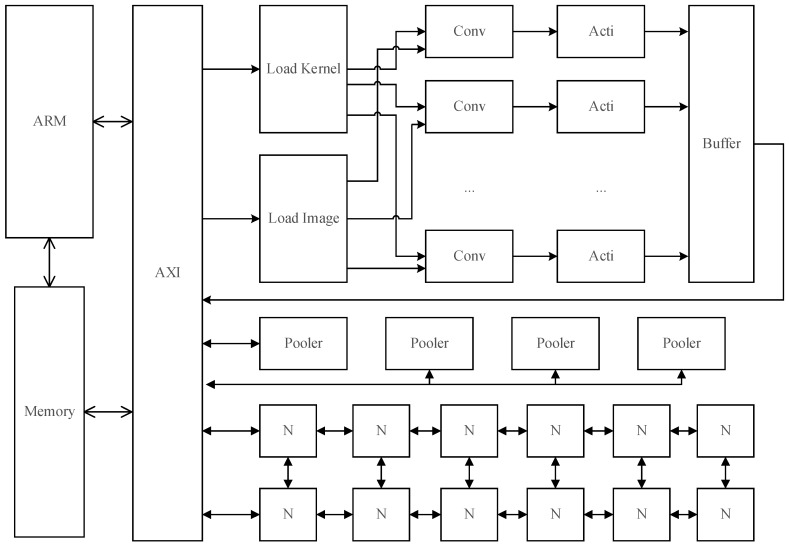
The underwater environment is still unknown for humans, so the high definition camera is an important tool for data acquisition at short distances underwater. Due to insufficient power, the image data collected by underwater submersible devices cannot be analyzed in real time. Based on the characteristics of Field-Programmable Gate Array (FPGA), low power consumption, strong computing capability, and high flexibility, we design an embedded FPGA image recognition system on Convolutional Neural Network (CNN). By using two technologies of FPGA, parallelism and pipeline, the parallelization of multi-depth convolution operations is realized. In the experimental phase, we collect and segment the images from underwater video recorded by the submersible. Next, we join the tags with the images to build the training set. The test results show that the proposed FPGA system achieves the same accuracy as the workstation, and we get a frame rate at 25 FPS with the resolution of 1920 × 1080. This meets our needs for underwater identification tasks.
Overview
The claims and statistics of this paper haven’t been checked yet.
Free: it reads the open-access text and checks the first 5 claims that cite a source we can check. Create a free account to check every claim.
Integrity signals
Registry
Cites
Statistics
Figures






Verification
Claims the paper makes
The claims and statistics of this paper haven’t been checked yet.
Free: it reads the open-access text and checks the first 5 claims that cite a source we can check. Create a free account to check every claim.
Claims other papers make about this one
Each is checked against this paper’s own text: does it say what the citing paper says it does?
The cited source says what the claim attributes to it.
In the citing paper
“FPGA is wildly utilized in various tasks including deep learning [199, 247, 331–334].”
From Review of deep learning: concepts, CNN architectures, challenges, applications, future directions (2021) · cites this paper as [333]
Self-check
Percentages, sums and reported differences re-computed from the paper’s own numbers.
The self-check needs the paper’s full text.
Citations
Cites
ImageNet classification with deep convolutional neural networks
Krizhevsky, A., Sutskever, I., & Hinton, G. E. (2017) · Communications of the ACM · doi:10.1145/3065386 · Cited by 112,155
LeCun, Y., Bengio, Y., & Hinton, G. (2015) · Nature · doi:10.1038/nature14539 · Cited by 84,126
Deep learning in neural networks: an overview
Schmidhuber, J. (2015) · Neural Networks · doi:10.1016/j.neunet.2014.09.003 · Cited by 18,570
Hinton, G., Deng, L., Yu, D., Dahl, G., Mohamed, A.-R., Jaitly, N., Senior, A., Vanhoucke, V., Nguyen, P., Sainath, T., et al. (2012) · IEEE Signal Processing Magazine · doi:10.1109/msp.2012.2205597 · Cited by 10,260
Mastering the game of Go without human knowledge
Silver, D., Schrittwieser, J., Simonyan, K., Antonoglou, I., Huang, A., Guez, A., Hubert, T., Baker, L., Lai, M., Bolton, A., et al. (2017) · Nature · doi:10.1038/nature24270 · Cited by 9,084 · cited 1×
“In the smart games area, in 2016, AlphaGo, of Google’s DeepMind division, bet Go world champion Lee Sedol, ranked 9-dan professional [22].”
BackgroundGoing Deeper with Embedded FPGA Platform for Convolutional Neural Network
Qiu, J., Wang, J., Yao, S., Guo, K., Li, B., Zhou, E., Yu, J., Tang, T., Xu, N., Song, S., et al. (2016) · Proceedings of the 2016 ACM/SIGDA International Symposium on Field-Programmable Gate Arrays · doi:10.1145/2847263.2847265 · Cited by 1,252 · cited 2×
“Next, the dynamic-precision data quantization method and a convolver design that is efficient for all layer types in CNN is proposed to improve the bandwidth and resource utilization, and a prototype of FPGA system is designed and implemented [24].”
MethodSpeeding up Convolutional Neural Networks with Low Rank Expansions
Jaderberg, M., Vedaldi, A., & Zisserman, A. (2014) · Proceedings of the British Machine Vision Conference 2014 · doi:10.5244/c.28.88 · Cited by 1,164
Joint Training of a Convolutional Network and a Graphical Model for Human Pose Estimation
Tompson, J., Jain, A., LeCun, Y., & Bregler, C. (2014) · arXiv (Cornell University) · doi:10.48550/arxiv.1406.2984 · Cited by 915
Dynamic Image Networks for Action Recognition
Bilen, H., Fernando, B., Gavves, E., Vedaldi, A., & Gould, S. (2016) · 2016 IEEE Conference on Computer Vision and Pattern Recognition (CVPR) · doi:10.1109/cvpr.2016.331 · Cited by 571 · cited 1×
“Without complicated pre-processing of the image, it can analyze the original image directly [16].”
BackgroundA Survey and Evaluation of FPGA High-Level Synthesis Tools
Nane, R., Sima, V.-M., Pilato, C., Choi, J., Fort, B., Canis, A., Chen, Y. T., Hsiao, H., Brown, S., Ferrandi, F., et al. (2016) · IEEE Transactions on Computer-Aided Design of Integrated Circuits and Systems · doi:10.1109/tcad.2015.2513673 · Cited by 532 · cited 4×
“However, the computing capability of traditional low power CPU is very weak, and it must be paired with a GPU for these applications [6].”
MethodInfluential
Cited by
Review of deep learning: concepts, CNN architectures, challenges, applications, future directions
Alzubaidi, L., Zhang, J., Humaidi, A. J., Al-Dujaili, A., Duan, Y., Al-Shamma, O., Santamaría, J., Fadhel, M. A., Al-Amidie, M., & Farhan, L. (2021) · Journal of Big Data · doi:10.1186/s40537-021-00444-8 · Cited by 7,906
A systematic literature review on hardware implementation of artificial intelligence algorithms
Talib, M. A., Majzoub, S., Nasir, Q., & Jamal, D. (2021) · The Journal of Supercomputing · doi:10.1007/s11227-020-03325-8 · Cited by 188
Optimizing the Hyperparameter Tuning of YOLOv5 for Underwater Detection
Isa, I. S., Rosli, M. S. A. B., Yusof, U. K., Maruzuki, M. I. F., & Sulaiman, S. N. (2022) · IEEE Access · doi:10.1109/access.2022.3174583 · Cited by 96
Classical and state-of-the-art approaches for underwater image defogging: a comprehensive survey
Zhou, J., Zhang, D., & Zhang, W. (2020) · Frontiers of Information Technology & Electronic Engineering · doi:10.1631/fitee.2000190 · Cited by 68
Wu, H., Hu, Y., Wang, W., Mei, X., & Xian, J. (2022) · Sensors · doi:10.3390/s22197420 · Cited by 63
“Good network coverage is required for the latter, even though it is small and inexpensive [10].”
A Power-Efficient Optimizing Framework FPGA Accelerator Based on Winograd for YOLO
Bao, C., Xie, T., Feng, W., Chang, L., & Yu, C. (2020) · IEEE Access · doi:10.1109/access.2020.2995330 · Cited by 66
“Among them, application-specific integrated circuits (ASICs) and field-programmable gate arrays (FPGAs) are notable [9], and FPGAs can solve the specificity problem of ASICs with the advantages of high parallelism, high flexibility and low power consumption [10].”
BackgroundFPGA-based implementation of classification techniques: A survey
Saidi, A., Othman, S. B., Dhouibi, M., & Saoud, S. B. (2021) · Integration · doi:10.1016/j.vlsi.2021.08.004 · Cited by 55
Szymak, P., Piskur, P., & Naus, K. (2020) · Remote Sensing · doi:10.3390/rs12183020 · Cited by 49
Muñoz, A. M., Moron-Fernández, M.-J., Cascado-Caballero, D., Díaz-del-Río, F., & Real, P. (2023) · Sensors · doi:10.3390/s23104986 · Cited by 50
“Despite its limitations, onboard processing is capable of providing feasible solutions in some scenarios, such as image enhancement or basic neural networks with a low number of layers for detection tasks [27,28].”
BackgroundImage mining applications for underwater environment management-A review and research agenda
Nair, R. S., Agrawal, R., Domnic, S., & Kumar, A. (2021) · International Journal of Information Management Data Insights · doi:10.1016/j.jjimei.2021.100023 · Cited by 34
Zhang, Y., Jiang, Y. L., Qi, H., Zhao, M., Wang, Y., Wang, K., & Wei, F. (2022) · Sensors · doi:10.3390/s23010197 · Cited by 23
Self-citationAdaptive Subsampling for ROI-Based Visual Tracking: Algorithms and FPGA Implementation
Iqbal, O., Muro, V. I. T., Katoch, S., Spanias, A., & Jayasuriya, S. (2022) · IEEE Access · doi:10.1109/access.2022.3200755 · Cited by 20
“To address this issue, there has been increasing research efforts geared towards joint optimization of embedded systems and image sensors for reducing overall system power consumption [22], [23], [24], [25].”
BackgroundUnderwater Image Recognition Detector using Deep ConvNet
Lakshmi, M. D., & Santhanam, S. M. (2020) · National Conference on Communications · doi:10.1109/ncc48643.2020.9056058 · Cited by 16
“Minghao Zhao et al. [13] proposed an embedded FPGA image recognition system on CNN and achieved the better classification accuracy on submersible collected underwater video frames.”
BackgroundA Method for Underwater Human–Robot Interaction Based on Gestures Tracking with Fuzzy Control
Jiang, Y. L., Zhao, M., Wang, C., Wei, F., & Qi, H. (2021) · International Journal of Fuzzy Systems · doi:10.1007/s40815-021-01086-x · Cited by 11
Self-citationA PCB Alignment System Using RST Template Matching with CUDA on Embedded GPU Board
Le, M.-T., Tu, C., Guo, S., & Lien, J.-J. J. (2020) · Sensors · doi:10.3390/s20092736 · Cited by 10
Kaur, M., & Vijay, S. (2022) · Multimedia Tools and Applications · doi:10.1007/s11042-022-12535-6 · Cited by 10
“used different algorithms to detect an object underwater [18].”
MethodA power-efficient optimizing framework FPGA accelerator for YOLO
Li, S., Yu, C., Xie, T., & Feng, W. (2022) · International Congress on Image and Signal Processing (CISP) · doi:10.1109/cisp-bmei56279.2022.9980321 · Cited by 10
“FPGA-based deep learning acceleration is currently the main model acceleration method on the embedded side [6, 7, 8, 9, 10, 11, 12, 13].”
MethodAccelerating Event Detection with DGCNN and FPGAs
Han, Z., Jiang, J., Qiao, L., Dou, Y., Xu, J., & Kan, Z. (2020) · Electronics · doi:10.3390/electronics9101666 · Cited by 8
Zhang, Y. (2021) · Computational Intelligence and Neuroscience · doi:10.1155/2021/4953288 · Cited by 8
“As an effective deep learning method, convolutional neural network (CNN) has achieved good application results in the fields of image recognition and speech recognition [8, 9].”
MethodA Novel Hardware–Software Co-Design and Implementation of the HOG Algorithm
Ghaffari, S., Soleimani, P., Li, K. F., & Capson, D. W. (2020) · Sensors · doi:10.3390/s20195655 · Cited by 7
Transmission line fault detection using deep learning technique
Hlalele, T. S. (2024) · International Conference on Advances in Artificial Intelligence (ICAAI) · doi:10.1145/3704137.3704170 · Cited by 7
“…of this article make use of the Field-Programmable Gate Array (FPGA)’s increased flexibility, reduced power consumption, and robust processing capacity [23] to construct an embedded field-programmable gate array (FPGA) image identification system that utilizes a convolutional neural network (CNN).”
Single Event Upset and Single Event Transient Detection in FPGA-based Search and Rescue Systems
Alkady, G. I., Shokry, B., Khafagy, S., Zaher, Z., Morsy, N., Abouelghit, F. A., Amer, H. H., & Çiço, B. (2022) · Mediterranean Conference on Embedded Computing (MECO) · doi:10.1109/meco55406.2022.9797101 · Cited by 6
Kabir, E., Poudel, A., Aklah, Z. T., Huang, M., & Andrews, D. (2022) · Lecture notes in computer science · doi:10.1007/978-3-031-19983-7_3 · Cited by 7
Dolphin movement direction recognition using contour-skeleton information
Qi, H., Xue, M., Peng, X., Wang, C., & Jiang, Y. L. (2020) · Multimedia Tools and Applications · doi:10.1007/s11042-020-09659-y · Cited by 5
“They used the feature points [11, 15, 21] and the color information [18, 28] of the environment, the color distribution [27] and shapes [23] of artificial landmarks for.”
MethodSelf-citationSpatio-temporal dependence-based tensor fusion for thermocline analysis in Argo data
Jiang, Y. L., Lin, S., Ruan, J., & Qi, H. (2020) · Proceedings of the Institution of Mechanical Engineers Part I Journal of Systems and Control Engineering · doi:10.1177/0959651820933735 · Cited by 4
Self-citationXu, X., Yang, J., Cheng, L., Ma, C., Tong, F. M., Mingzhe, G., & Cao, X. (2025) · Sensors · doi:10.3390/s25185767 · Cited by 3
“However, existing algorithms face severe challenges; for example, the original DCP algorithm achieves only 2-3 FPS on embedded CPUs [23].”
Optimized PCA Infused Liquid Neural Network Deployment for FPGA-Based Embedded Systems
Deka, B., Chatterjee, S., Chintalapudi, S., Nikitha, J., Kodavali, L., & Babu, K. K. (2025) · Journal of Electronics Electromedical Engineering and Medical Informatics · doi:10.35882/jeeemi.v7i2.681 · Cited by 3
“The main research gap for embedded system is Robustness and Reliability [5], [19], [20]and the other one is the hardware-software co-design [21].”
Underwater Motion and Activity Recognition using Acoustic Wireless Networks
Hu, H., Sun, Z. Y., & Su, L. (2020) · International Conference on Communications · doi:10.1109/icc40277.2020.9148998 · Cited by 6
“Although there are several image-based underwater aquatic animals classification techniques such as [1][2], underwater cameras are expensive and are susceptible to underwater conditions such as light, transparency and depth.”
BackgroundZhao, W., Qi, H., Jiang, Y. L., Wang, C., & Wei, F. (2020) · Proceedings of the Institution of Mechanical Engineers Part I Journal of Systems and Control Engineering · doi:10.1177/0959651820958208 · Cited by 2
Self-citationRadar Jamming Image Recognition based on Deep Learning and Computer Vision
Cheng, Y. (2024) · International Conference on Integrated Circuits and Communication Systems (ICICACS) · doi:10.1109/icicacs60521.2024.10498348 · Cited by 2
“In general, after feature extraction on a very small image, it is converted into a million dimensional convolutional feature vector [10].”
Image Neural Network Classifier by Detail Attributes
Sai, S. V., & Nikonov, V. (2023) · Pattern Recognition and Image Analysis · doi:10.1134/s1054661823020116 · Cited by 1
“As part of further research, it is planned to implement the neural classifier in a video system on a chip based on FPGA [14] and CUDA technologies [1] in order to implement efficient algorithms of compression and transmission of images with high quality.”
MethodPino, A. V., Noboa, J. F. M., Carrasco, L. J. P., & Erazo, O. (2024) · Revista Científica y Tecnológica UPSE · doi:10.26423/rctu.v11i2.838 · Cited by 3
Efficient Analog Ultrasonic Detection for Autonomous Drone Navigation in GPS-Denied Environments
Prashasti, Grover, A., & Chatterjee, S. (2025) · International Conference on Networks and Cryptology (NETCRYPT) · doi:10.1109/netcrypt65877.2025.11102407 · Cited by 1
A Method of Adaptive Quantization for the Coefficients of a Discrete Wavelet Transformation
Sai, S. V. (2023) · Optoelectronics Instrumentation and Data Processing · doi:10.3103/s8756699023020115 · Cited by 1
“Among the promising directions in the development of this method are (a) the creation of a neural network block classifier, which can accelerate the compression algorithm due to the execution of parallel matrix calculations applied in neural networks and the CUDA technology [23], (b) the hardware implementation of a c…”
MethodConstruction of Image Segmentation and Recognition System Based on Deep Neural Network Algorithm
Wang, Z., & Duan, L. (2023) · International Conference on 3D Immersion, Interaction and Multi-sensory Experiences (ICDIIME) · doi:10.1109/icdiime59043.2023.00099 · Cited by 1
“The loss back propagation algorithm promotes the self-learning of model parameters, and finally realizes the modeling of the complex relationship between pixels in the image[3].”
BackgroundEnhancing ROV Navigation with Object detection using Yolov8 and Conv2d layer
Yashwanth, J., Poreddy, M. R., Annapurani, K., Malleswari, T. Y. J. N., & Ushasukhanya, S. (2024) · International Conference on Recent Trends in Computer Science and Technology (ICRTCST) · doi:10.1109/icrtcst61793.2024.10578466 · Cited by 1
Automated Optimization for FPGA-Based Sonar Object Recognition Systems
Tung, P.-H., Jeng, G.-S., Lai, B.-C. C., & Hung, Y.-X. (2024) · IEEE Asia Pacific Conference on Circuits and Systems (APCCAS) · doi:10.1109/apccas62602.2024.10808639 · Cited by 1
Fatemi, S. B., Ahmadi, M., & Dadjoo, M. (2025) · Journal of the Indian Society of Remote Sensing · doi:10.1007/s12524-025-02223-x · Cited by 1
“It also provides a Green − Red Green + Red (Ahamed et al., 2011) 2 Green Leaf Index (Zhao et al. 2019) (GLI) 2 × Green − Red − Blue 2 × Green + Red + Blue (Gobron et al., 2000) 3 Visible Atmospherically Resistant Index (VARI) Green − Red Green + Red − Blue (Gitelson et al., 2002) 4 Shape Index (IF) (Zhang et al. 2019)…”
Study on the Extraction of Target Contours of Underwater Images
Tong, L., Wei, F., Pan, Y., & Wang, K. (2020) · Lecture notes in computer science · doi:10.1007/978-3-030-57884-8_30 · Cited by 1
Self-citationResearch on Quality Control of Marine Monitoring Data Based on Extreme Learning Machine
Li, Y., Liu, F., Wang, K., Huang, H., Wei, F., & Qi, H. (2020) · Lecture notes in computer science · doi:10.1007/978-3-030-57884-8_29 · Cited by 1
Self-citationOn Determining Suitable Embedded Devices for Deep Learning Models
Padilla, D. E., Rashwan, H. A., & Puig, D. (2021) · Frontiers in artificial intelligence and applications · doi:10.3233/faia210147 · Cited by 2
Abnormality Detection in Kidney Ultrasound Images by Various Classifiers with FPGA
Vijayakumari, B., & Rashmita, S. (2022) · IETE Journal of Research · doi:10.1080/03772063.2022.2089245 · Cited by 1
“In recent days, convolutional neural network algorithm is also implemented with FPGA to recognize underwater images [23].”
MethodJiang, H., Zhang, C., Huang, R., Qi, W. D., & Su, R. (2022) · Sensors · doi:10.3390/s22249600 · Cited by 1
Design of real-time object classification acceleration platform based on SDSoC
Zhang, B., Liu, Y., & Zhang, Y. (2023) · International Conference on Computer Science and Communication Technology (ICCSCT) · doi:10.1117/12.3009413 · Cited by 1
The use of Open-Source Boards for Data Collection and Machine Learning in Remote Deployments
Kiarie, G., Kabi, J. N., Mugambi, L., & Maina, C. W. (2023) · IEEE AFRICON · doi:10.1109/africon55910.2023.10293682 · Cited by 1
“In order to study the underwater environment, researchers have developed a Xilinx ZYNQ 7000 series FPGA development board based real time image recognition system [44].”
BackgroundMethodFPGA-Based Real-Time Embedded Fish Embryo Detection System
Wang, M., Feng, G., Chen, M., Ye, R., & Wang, Y. (2022) · Mobile Information Systems · doi:10.1155/2022/8021288
“[24] built an FPGA-based underwater image recognition system.”
An image correction algorithm and implementation for remote sensing camera
Liu, M., Huang, W., Tian, J., & Lei, L. (2023) · Applied Optics and Photonics China (AOPC) · doi:10.1117/12.2651869
“Real time control, diversified functions, system integration and miniaturization are an important development direction of video electronics system([1-3]).”
BackgroundUnderwater image enhancement based on unsupervised adaptive uncertainty distribution
Xu, Y., Li, F., Shi, K., & Li, P. (2024) · Conference on Frontiers in Optical Imaging and Technology: Imaging Detection and Target Recognition · doi:10.1117/12.3014202
“Due to the lack of effective information for target recognition in severely degraded underwater images [2] , the reliability and accuracy of unmanned underwater detection technology are weakened.”
BackgroundLiu, B., & Guo, B. (2025) · Applied Mathematics and Nonlinear Sciences · doi:10.2478/amns-2025-0744
Li, Y., Ryan, M. J., Robson, S., & Liu, Y. (2025) · Ecoproduction · doi:10.1007/978-3-031-88926-4_3 · Cited by 1
FPGA-based real-time underwater object detection system for AUVs
Qi, Z., Song, Q., Xue, Y., Wang, Q., & Qiao, F. (2025) · Journal of Real-Time Image Processing · doi:10.1007/s11554-025-01782-z
“Zhao et al. [17] proposed an FPGA embedded underwater image processing system based on CNN, which achieves real-time performance.”
Performance Evaluation of Underwater Image Enhancement Algorithm on Embedded Systems
Narvekar, P. R., & Dixit, M. R. (2025) · International Conference on Sustainable Technologies for Humanity and Smart World (HSWTech) · doi:10.1109/hswtech64936.2025.11278150
“In another attempt 4% power consumption is reduced, wherein a dynamic partial reconfiguration technology is used for runtime switching among two edge detection operators (FASTX and Sobel) and this is deployed on a programmable gate array [5].”
Varade, G., & Mitra, N. (2026) · SSRN Electronic Journal · doi:10.2139/ssrn.6095119
Accelerating Active Learning for Image Classification Through FPGA-Based Implementation
Barbieri, A., Flores, C. A., Valenzuela, W. E., & Saavedra, F. (2026) · Sensors · doi:10.3390/s26123743
“CPU/GPU platforms tend to have high power consumption, while FPGAs enable fine-grained parallelism, dataflow control, and techniques such as block shutdown and clock/frequency scaling, accelerating classification while maintaining lower power consumption than general-purpose solutions [16,23–26].”
Zero-LUT Open-Set Plankton Classification on Edge MPSoC and GPU Platforms
Trejo, D. S., González-García, M., Bandera, A. J., & Hernández‐León, S. (2026) · Electronics · doi:10.3390/electronics15173933
AI‐Driven Intelligent and Explainable SONAR for Underwater Acoustic Sensing
Javaid, S., Khan, N., Rahman, A., & Saeed, N. (2026) · IET Radar Sonar & Navigation · doi:10.1049/rsn2.70249
Metadata
- Authors
- Zhao, M., Hu, C., Wei, F., Wang, K., Wang, C., & Jiang, Y.
- Affiliations
- Jilin University (CN)
- Corresponding author
- Jiang, Yu
- Venue
- Sensors
- Publisher
- MDPI AG
- Published
- 2019-01-16
- Volume
- 19
- Issue
- 2
- Pages
- 350
- ISSN
- 1424-8220 (ISSN-L)
- PMC
- PMC6359710
- OpenAlex
- W2908675692
- Cited by
- 55
- References
- 30
- Citations by year
- 2026: 4 · 2025: 7 · 2024: 6 · 2023: 7 · 2022: 11 · 2021: 6 · 2020: 14
- FWCI
- 3.46
- Type
- journal article
- Language
- en
- Open access
- gold
- dx.doi.org
- Licence
- Locations
- Sensors (publishedVersion, cc-by)
- Europe PMC (PubMed Central) (publishedVersion, other-oa)
- PubMed Central (publishedVersion, cc-by)
- PubMed (publishedVersion)
- DOAJ (DOAJ: Directory of Open Access Journals) (submittedVersion, cc-by-sa)
- Topics
- Physical Sciences › Computer Science › Computer Vision and Pattern Recognition › Advanced Neural Network Applications
- Physical Sciences › Engineering › Electrical and Electronic Engineering › Embedded Systems and FPGA Applications
- Physical Sciences › Computer Science › Hardware and Architecture › Embedded Systems Design Techniques
- Keywords
- underwater image recognition, FPGA, convolutional neural networks, embedded systems, real-time processing, underwater video, parallel convolution, pipelined architecture, low power consumption
About these checks
Registry, retraction, Cites and statistics results are computed, not judged, with one exception: a printed reference that no index lists is read once by a model before it counts as a citation error. Claims are extracted by a model and kept only when their quote appears verbatim in the text; each cited source is then checked, with a model’s help, for whether it says what the claim relies on. Those verdicts can be wrong — read the claim’s quote and the cited source before relying on one.
Statistics and arithmetic are recomputed, not judged.
Confidence bands are shown only for fields calibrated on our annotated test set. None is calibrated yet, so no band is shown.
What counts as a claim ›How we measure confidence ›How we check this ›
Are you an author, or do you see a problem with this page? Request a review
Data sources
Bibliographic data: Semantic Scholar, OpenAlex, Crossref.
Contains information from the Semantic Scholar Academic Graph Datasets, made available under the ODC Attribution License (ODC-BY 1.0).
Semantic Scholar’s data is described in: Kinney, R., et al. (2023). The Semantic Scholar Open Data Platform. arXiv:2301.10140.
