

Real-Time Underwater Image Recognition with FPGA Embedded System for Convolutional Neural Network
Open accessThe DOI matches its Crossref record; 30 of the 30 references it cites were found in a registry or an index.
Abstract
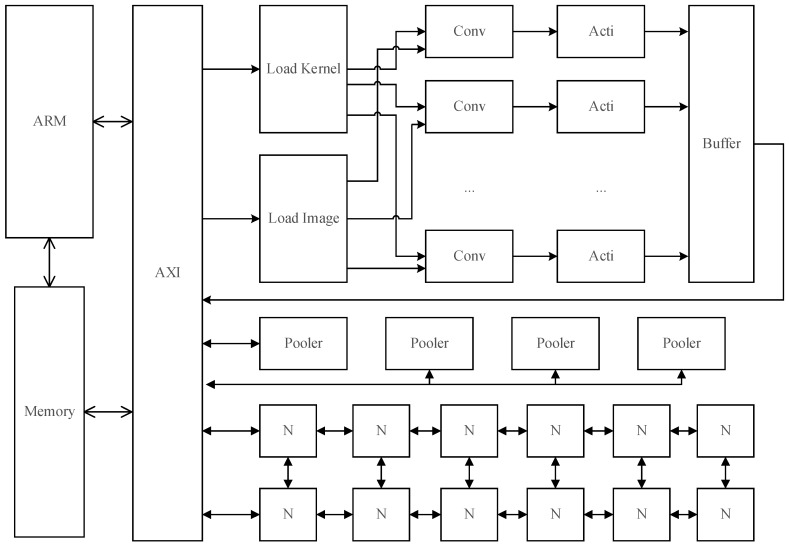
The underwater environment is still unknown for humans, so the high definition camera is an important tool for data acquisition at short distances underwater. Due to insufficient power, the image data collected by underwater submersible devices cannot be analyzed in real time. Based on the characteristics of Field-Programmable Gate Array (FPGA), low power consumption, strong computing capability, and high flexibility, we design an embedded FPGA image recognition system on Convolutional Neural Network (CNN). By using two technologies of FPGA, parallelism and pipeline, the parallelization of multi-depth convolution operations is realized. In the experimental phase, we collect and segment the images from underwater video recorded by the submersible. Next, we join the tags with the images to build the training set. The test results show that the proposed FPGA system achieves the same accuracy as the workstation, and we get a frame rate at 25 FPS with the resolution of 1920 × 1080. This meets our needs for underwater identification tasks.
Overview
The claims and statistics of this paper haven’t been checked yet.
Free: it reads the open-access text and checks the first 5 claims that cite a source we can check. Create a free account to check every claim.
Integrity signals
Registry
Cites
Statistics
Figures






Verification
Claims the paper makes
The claims and statistics of this paper haven’t been checked yet.
Free: it reads the open-access text and checks the first 5 claims that cite a source we can check. Create a free account to check every claim.
Claims other papers make about this one
Each is checked against this paper’s own text: does it say what the citing paper says it does?
The cited source says what the claim attributes to it.
In the citing paper
“FPGA is wildly utilized in various tasks including deep learning [199, 247, 331–334].”
From Review of deep learning: concepts, CNN architectures, challenges, applications, future directions (2021) · cites this paper as [333]
Self-check
Percentages, sums and reported differences re-computed from the paper’s own numbers.
The self-check needs the paper’s full text.
Citations
Cites
ImageNet classification with deep convolutional neural networks
Krizhevsky, A., Sutskever, I., & Hinton, G. E. (2017) · Communications of the ACM · doi:10.1145/3065386 · Cited by 112,155
LeCun, Y., Bengio, Y., & Hinton, G. (2015) · Nature · doi:10.1038/nature14539 · Cited by 84,126
Deep learning in neural networks: an overview
Schmidhuber, J. (2015) · Neural Networks · doi:10.1016/j.neunet.2014.09.003 · Cited by 18,570
Hinton, G., Deng, L., Yu, D., Dahl, G., Mohamed, A.-R., Jaitly, N., Senior, A., Vanhoucke, V., Nguyen, P., Sainath, T., et al. (2012) · IEEE Signal Processing Magazine · doi:10.1109/msp.2012.2205597 · Cited by 10,260
Mastering the game of Go without human knowledge
Silver, D., Schrittwieser, J., Simonyan, K., Antonoglou, I., Huang, A., Guez, A., Hubert, T., Baker, L., Lai, M., Bolton, A., et al. (2017) · Nature · doi:10.1038/nature24270 · Cited by 9,084 · cited 1×
“In the smart games area, in 2016, AlphaGo, of Google’s DeepMind division, bet Go world champion Lee Sedol, ranked 9-dan professional [22].”
BackgroundGoing Deeper with Embedded FPGA Platform for Convolutional Neural Network
Qiu, J., Wang, J., Yao, S., Guo, K., Li, B., Zhou, E., Yu, J., Tang, T., Xu, N., Song, S., et al. (2016) · Proceedings of the 2016 ACM/SIGDA International Symposium on Field-Programmable Gate Arrays · doi:10.1145/2847263.2847265 · Cited by 1,252 · cited 2×
“Next, the dynamic-precision data quantization method and a convolver design that is efficient for all layer types in CNN is proposed to improve the bandwidth and resource utilization, and a prototype of FPGA system is designed and implemented [24].”
MethodSpeeding up Convolutional Neural Networks with Low Rank Expansions
Jaderberg, M., Vedaldi, A., & Zisserman, A. (2014) · Proceedings of the British Machine Vision Conference 2014 · doi:10.5244/c.28.88 · Cited by 1,164
Joint Training of a Convolutional Network and a Graphical Model for Human Pose Estimation
Tompson, J., Jain, A., LeCun, Y., & Bregler, C. (2014) · arXiv (Cornell University) · doi:10.48550/arxiv.1406.2984 · Cited by 915
Dynamic Image Networks for Action Recognition
Bilen, H., Fernando, B., Gavves, E., Vedaldi, A., & Gould, S. (2016) · 2016 IEEE Conference on Computer Vision and Pattern Recognition (CVPR) · doi:10.1109/cvpr.2016.331 · Cited by 571 · cited 1×
“Without complicated pre-processing of the image, it can analyze the original image directly [16].”
BackgroundA Survey and Evaluation of FPGA High-Level Synthesis Tools
Nane, R., Sima, V.-M., Pilato, C., Choi, J., Fort, B., Canis, A., Chen, Y. T., Hsiao, H., Brown, S., Ferrandi, F., et al. (2016) · IEEE Transactions on Computer-Aided Design of Integrated Circuits and Systems · doi:10.1109/tcad.2015.2513673 · Cited by 532 · cited 4×
“However, the computing capability of traditional low power CPU is very weak, and it must be paired with a GPU for these applications [6].”
MethodInfluentialNotes on Convolutional Neural NetworksPreprint
Bouvrie, J. (2006) · CogPrints (University of Southampton) · Cited by 435
CNP: An FPGA-based processor for Convolutional Networks
Farabet, C., Poulet, C., Han, J. Y., & LeCun, Y. (2009) · 2009 International Conference on Field Programmable Logic and Applications · doi:10.1109/fpl.2009.5272559 · Cited by 367
DLAU: A Scalable Deep Learning Accelerator Unit on FPGA
Wang, C., Gong, L., Yu, Q., Li, X., Xie, Y., & Zhou, X. (2016) · IEEE Transactions on Computer-Aided Design of Integrated Circuits and Systems · doi:10.1109/tcad.2016.2587683 · Cited by 302 · cited 2×
“designed the deep learning accelerator unit ( L ), hich is a scalable accelerator for large-scale deep learning networks, u ing field-programmable gat array (FPGA) as the hardware prototy e [23].”
BackgroundSelf-citationEfficient and accurate approximations of nonlinear convolutional networks
Zhang, X., Zou, J., Ming, X., He, K., & Sun, J. (2015) · 2015 IEEE Conference on Computer Vision and Pattern Recognition (CVPR) · doi:10.1109/cvpr.2015.7298809 · Cited by 262
High-resolution wide-band fast Fourier transform spectrometers
Klein, B., Hochgürtel, S., Krämer, I., Bell, A., Meyer, K., & Güsten, R. (2012) · Astronomy & Astrophysics · doi:10.1051/0004-6361/201218864 · Cited by 260
A new AUV navigation system exploiting unscented Kalman filter
Allotta, B., Caiti, A., Costanzi, R., Fanelli, F., Fenucci, D., Meli, E., & Ridolfi, A. (2016) · Ocean Engineering · doi:10.1016/j.oceaneng.2015.12.058 · Cited by 234 · cited 1×
“Moreover, AUV cannot respond to the surrounding environment in time [5].”
BackgroundFPGA-based accelerator for long short-term memory recurrent neural networks
Guan, Y., Yuan, Z., Sun, G., & Cong, J. (2017) · 2017 22nd Asia and South Pacific Design Automation Conference (ASP-DAC) · doi:10.1109/aspdac.2017.7858394 · Cited by 180 · cited 1×
“Image recognition, in the context of machine vision, is the ability of software to identify objects, places, people, writing, and actions in images [7].”
BackgroundLarge-Scale FPGA-Based Convolutional Networks
Farabet, C., LeCun, Y., Kavukcuoglu, K., Martini, B., Akselrod, P., Talay, S., & Culurciello, E. (2011) · Cambridge University Press eBooks · doi:10.1017/cbo9781139042918.020 · Cited by 145
High-resolution wide-band fast Fourier transform spectrometers
Klein, B., Hochgürtel, S., Krämer, I., Bell, A., Meyer, K., & Güsten, R. (2012) · Springer Link (Chiba Institute of Technology) · doi:10.1051/0004-6361/201218864/pdf · Cited by 138
A quantitative analysis on microarchitectures of modern CPU-FPGA platforms
Choi, Y., Cong, J., Fang, Z., Hao, Y., Reinman, G., & Wei, P. (2016) · ACM/IEEE Design Automation Conference (DAC) · doi:10.1145/2897937.2897972 · Cited by 116 · cited 1×
“Those two factors combined can significantly improve parallel performance [14].”
BackgroundMethodology for high level estimation of FPGA power consumption
Degalahal, V., & Tuan, T. (2005) · Asia and South Pacific Design Automation Conference (ASP-DAC) · doi:10.1145/1120725.1120986 · Cited by 93 · cited 1×
“However, the computing capability of traditional low power CPU is very weak, and it must be paired with a GPU for these applications [6].”
BackgroundMaganda, M. A. N., & Arias-Estrada, M. (2005) · International Conference on ReConFigurable Computing and FPGAs (ReConFig) · doi:10.1109/reconfig.2005.34 · Cited by 88
Marsh, L., Copley, J., Huvenne, V. A. I., Tyler, P. A., & Facility, T. I. R. (2013) · Deep Sea Research Part II Topical Studies in Oceanography · doi:10.1016/j.dsr2.2013.02.007 · Cited by 38
A parallel FP-growth algorithm on World Ocean Atlas data with multi-core CPU
Jiang, Y. L., Zhao, M., Hu, C., He, L., Bai, H., & Wang, J. (2018) · The Journal of Supercomputing · doi:10.1007/s11227-018-2297-6 · Cited by 33
Self-citationA Machine Learning Approach to Argo Data Analysis in a Thermocline
Jiang, Y. L., Gou, Y., Zhang, T., Wang, K., & Hu, C. (2017) · Sensors · doi:10.3390/s17102225 · Cited by 30
Self-citationSidescan sonar image processing for AUV navigation
Zerr, B., Mailfert, G., Bertholom, A., & Ayreault, H. (2005) · MTS/IEEE OCEANS Conference (OCEANS) · doi:10.1109/oceanse.2005.1511696 · Cited by 29 · cited 2×
“The navigation system mainly occupies the power supply of the submarine, whose power cannot provide any more than 100 watts to the traditional microcomputer [4].”
BackgroundHigh-resolution temperature and salinity model analysis using support vector regression
Jiang, Y. L., Zhang, T., Gou, Y., He, L., Bai, H., & Hu, C. (2018) · Journal of Ambient Intelligence and Humanized Computing · doi:10.1007/s12652-018-0896-y · Cited by 28
Self-citationBit-Width Based Resource Partitioning for CNN Acceleration on FPGA
Guo, J., Yin, S., Ouyang, P., Liu, L., & Wei, S. (2017) · IEEE International Symposium on Field-Programmable Custom Computing Machines (FCCM) · doi:10.1109/fccm.2017.13 · Cited by 21 · cited 4×
“On a Xilinx Virtex-7 FPGA, their design approach achieved performance over the state-of-the-art FPGA-based CNN accelerators from 5.48× to 7.25×, and by 6.21× on average, when they evaluated the popular CNNs [25].”
BackgroundInfluentialA highly scalable and efficient parallel design of N-body simulation on FPGA
Sozzo, E. D., Tucci, L. D., & Santambrogio, M. D. (2017) · IEEE International Symposium on Parallel & Distributed Processing, Workshops and Phd Forum · doi:10.1109/ipdpsw.2017.43 · Cited by 9
Design and implementation of multi-rate data exchange system for radar signal processing
Lifeng, W., Hu, S., & Teng, L. (2009) · IET Conference Publications · doi:10.1049/cp.2009.0473 · Cited by 2
Cited by
Review of deep learning: concepts, CNN architectures, challenges, applications, future directions
Alzubaidi, L., Zhang, J., Humaidi, A. J., Al-Dujaili, A., Duan, Y., Al-Shamma, O., Santamaría, J., Fadhel, M. A., Al-Amidie, M., & Farhan, L. (2021) · Journal of Big Data · doi:10.1186/s40537-021-00444-8 · Cited by 7,906
A systematic literature review on hardware implementation of artificial intelligence algorithms
Talib, M. A., Majzoub, S., Nasir, Q., & Jamal, D. (2021) · The Journal of Supercomputing · doi:10.1007/s11227-020-03325-8 · Cited by 188
Optimizing the Hyperparameter Tuning of YOLOv5 for Underwater Detection
Isa, I. S., Rosli, M. S. A. B., Yusof, U. K., Maruzuki, M. I. F., & Sulaiman, S. N. (2022) · IEEE Access · doi:10.1109/access.2022.3174583 · Cited by 96
Classical and state-of-the-art approaches for underwater image defogging: a comprehensive survey
Zhou, J., Zhang, D., & Zhang, W. (2020) · Frontiers of Information Technology & Electronic Engineering · doi:10.1631/fitee.2000190 · Cited by 68
Wu, H., Hu, Y., Wang, W., Mei, X., & Xian, J. (2022) · Sensors · doi:10.3390/s22197420 · Cited by 63
“Good network coverage is required for the latter, even though it is small and inexpensive [10].”
Metadata
- Authors
- Zhao, M., Hu, C., Wei, F., Wang, K., Wang, C., & Jiang, Y.
- Affiliations
- Jilin University (CN)
- Corresponding author
- Jiang, Yu
- Venue
- Sensors
- Publisher
- MDPI AG
- Published
- 2019-01-16
- Volume
- 19
- Issue
- 2
- Pages
- 350
- ISSN
- 1424-8220 (ISSN-L)
- PMC
- PMC6359710
- OpenAlex
- W2908675692
- Cited by
- 55
- References
- 30
- Citations by year
- 2026: 4 · 2025: 7 · 2024: 6 · 2023: 7 · 2022: 11 · 2021: 6 · 2020: 14
- FWCI
- 3.46
- Type
- journal article
- Language
- en
- Open access
- gold
- dx.doi.org
- Licence
- Locations
- Sensors (publishedVersion, cc-by)
- Europe PMC (PubMed Central) (publishedVersion, other-oa)
- PubMed Central (publishedVersion, cc-by)
- PubMed (publishedVersion)
- DOAJ (DOAJ: Directory of Open Access Journals) (submittedVersion, cc-by-sa)
- Topics
- Physical Sciences › Computer Science › Computer Vision and Pattern Recognition › Advanced Neural Network Applications
- Physical Sciences › Engineering › Electrical and Electronic Engineering › Embedded Systems and FPGA Applications
- Physical Sciences › Computer Science › Hardware and Architecture › Embedded Systems Design Techniques
- Keywords
- underwater image recognition, FPGA, convolutional neural networks, embedded systems, real-time processing, underwater video, parallel convolution, pipelined architecture, low power consumption
About these checks
Registry, retraction, Cites and statistics results are computed, not judged, with one exception: a printed reference that no index lists is read once by a model before it counts as a citation error. Claims are extracted by a model and kept only when their quote appears verbatim in the text; each cited source is then checked, with a model’s help, for whether it says what the claim relies on. Those verdicts can be wrong — read the claim’s quote and the cited source before relying on one.
Statistics and arithmetic are recomputed, not judged.
Confidence bands are shown only for fields calibrated on our annotated test set. None is calibrated yet, so no band is shown.
What counts as a claim ›How we measure confidence ›How we check this ›
Are you an author, or do you see a problem with this page? Request a review
Data sources
Bibliographic data: Semantic Scholar, OpenAlex, Crossref.
Contains information from the Semantic Scholar Academic Graph Datasets, made available under the ODC Attribution License (ODC-BY 1.0).
Semantic Scholar’s data is described in: Kinney, R., et al. (2023). The Semantic Scholar Open Data Platform. arXiv:2301.10140.
