

Nyquist Zone Index and Chirp Rate Estimation of LFM Signal Intercepted by Nyquist Folding Receiver Based on Random Sample Consensus and Fractional Fourier Transform
Open accessThe DOI matches its Crossref record; 29 of the 30 references it cites were found in a registry or an index; 1 of the 13 sources its claims cite were checked for support.
Abstract
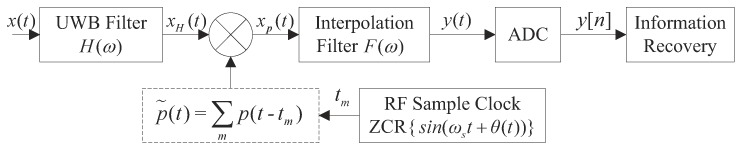
The Nyquist folding receiver (NYFR) can achieve a high-probability interception of an ultra-wideband (UWB) signal with fewer devices, while the output of the NYFR is converted into a hybrid modulated signal of the local oscillator (LO) and the received signal, which requires the matching parameter estimation methods. The linear frequency modulation (LFM) signal is a typical low probability of intercept (LPI) radar signal. In this paper, an estimation method of both the Nyquist Zone (NZ) index and the chirp rate for the LFM signal intercepted by NYFR was proposed. First, according to the time-frequency characteristics of the LFM signal, the accurate NZ and the rough chirp rate was estimated based on least squares (LS) and random sample consensus (RANSAC). Then, the information of the LO was removed from the hybrid modulated signal by the known NZ, and the precise chirp rate was obtained by using the fractional Fourier transform (FrFT). Moreover, a fast search method of FrFT optimal order was presented, which could obviously reduce the computational complexity. The simulation demonstrated that the proposed method could precisely estimate the parameters of the hybrid modulated output signal of the NYFR.
Overview
CoChat Summary
TL;DR
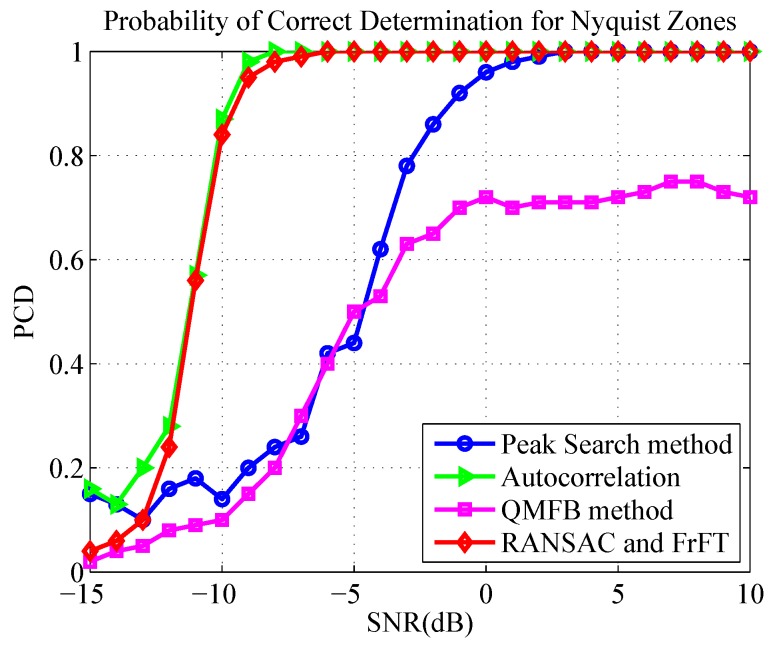
This paper proposes a two-stage method using RANSAC and fractional Fourier transform (FrFT) to estimate the Nyquist Zone (NZ) index and chirp rate of an LFM signal intercepted by a Nyquist folding receiver (NYFR). Simulations show accurate NZ determination and chirp-rate estimation, with NZ correct probability >90% for SNR ≥ −9 dB and 100% for SNR ≥ −7 dB.
Key findings
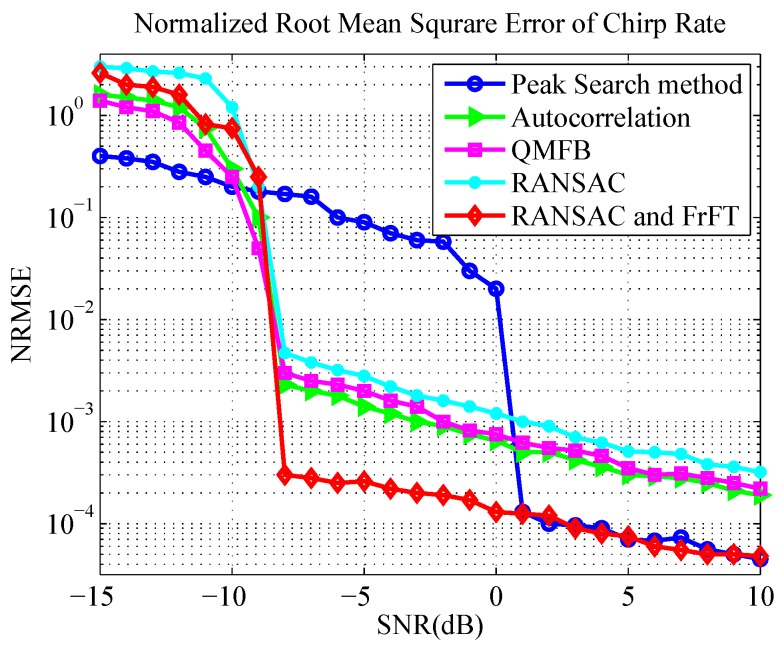
- The proposed RANSAC + FrFT method estimated the NZ index with probability >90% when SNR ≥ −9 dB and 100% when SNR ≥ −7 dB; chirp-rate estimation was stable when SNR ≥ −8 dB.
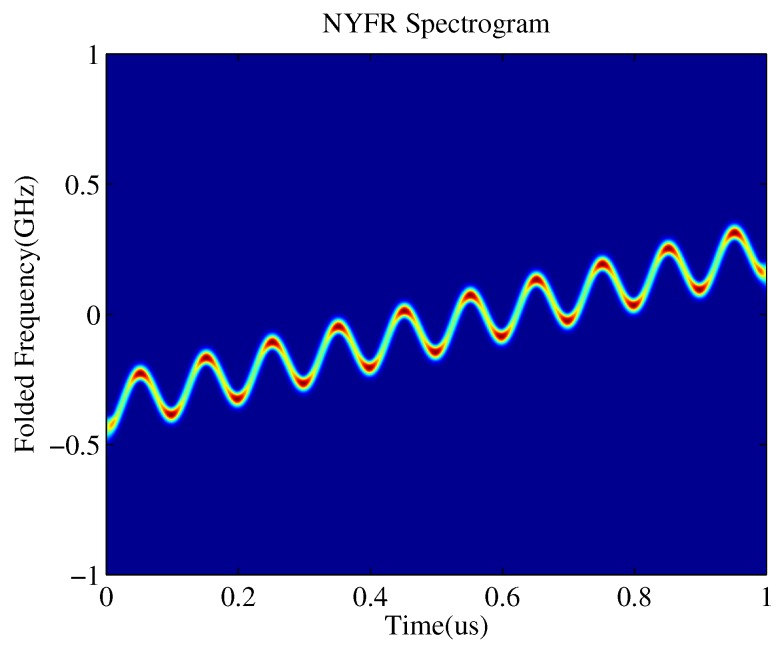
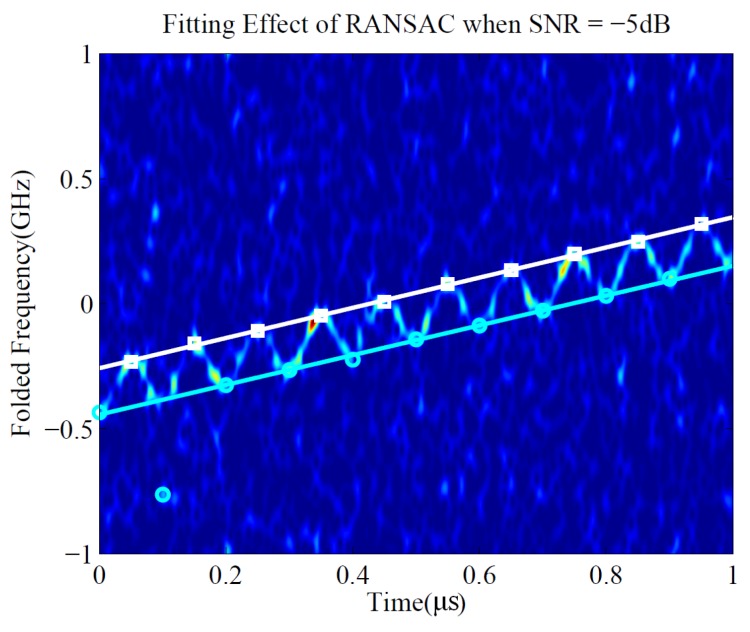
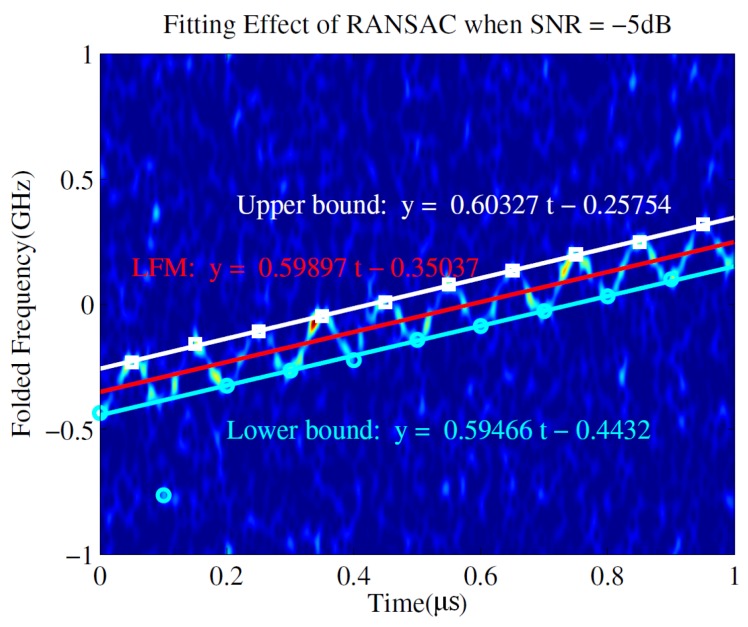
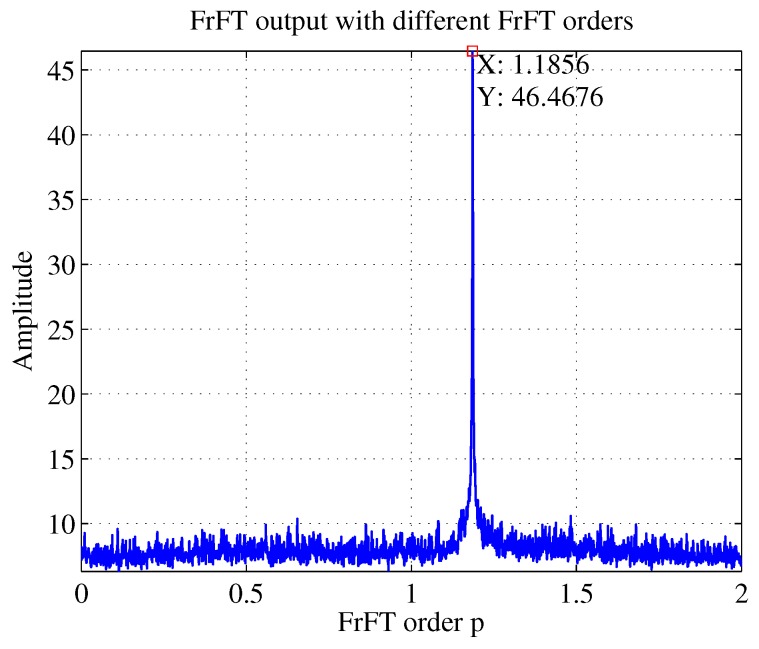
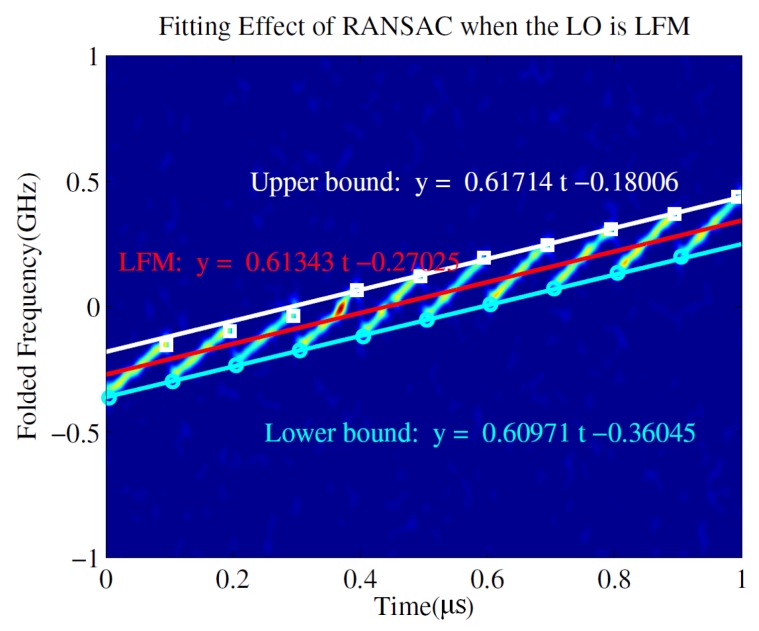
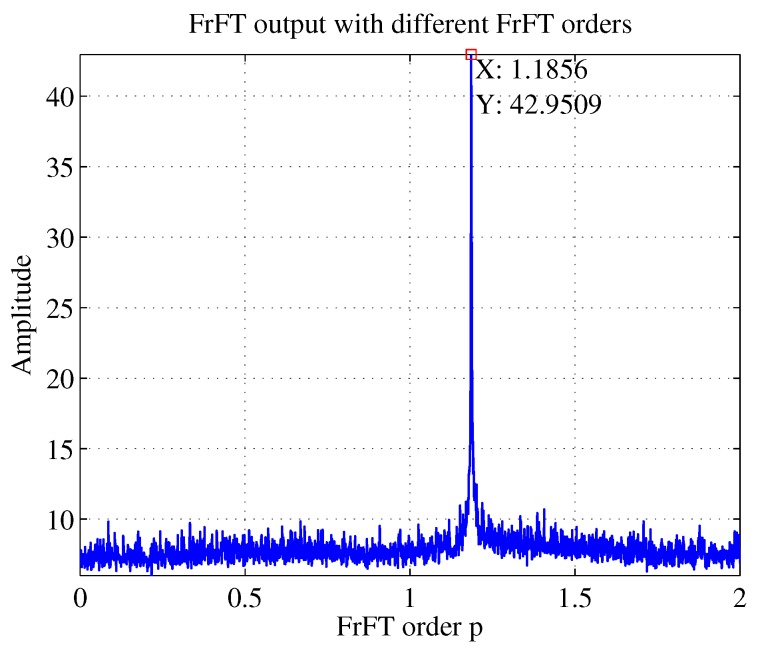
- In the worked example, the true LFM had starting frequency 7.65 GHz in the 4th NZ, folded to −0.35 GHz, and chirp rate 6×10^14 Hz/s. RANSAC gave intercept −0.35037 GHz and chirp rate 5.9897×10^14 Hz/s; FrFT gave 6.002×10^14 Hz/s.
- The NZ estimate used Δf = 0.18845 GHz with mf = 2.5 and fsin = 10 MHz, yielding m̂ = 3.7691, whose ceiling correctly gave the 4th NZ.
- The fast FrFT order search increased accuracy exponentially with approximation order while processing time grew only linearly; required accuracy was generally obtained at the 2nd or 3rd order. The method failed below about −9 dB SNR.
Methods
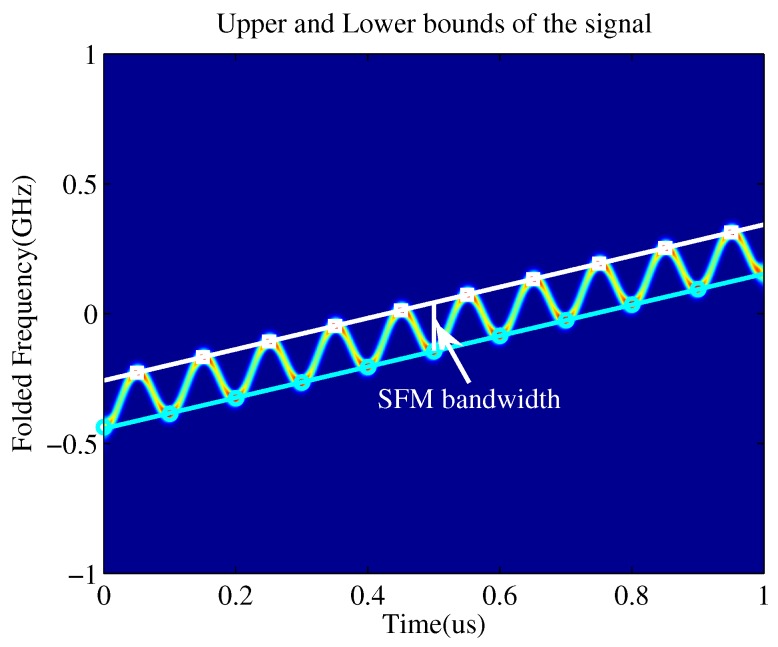
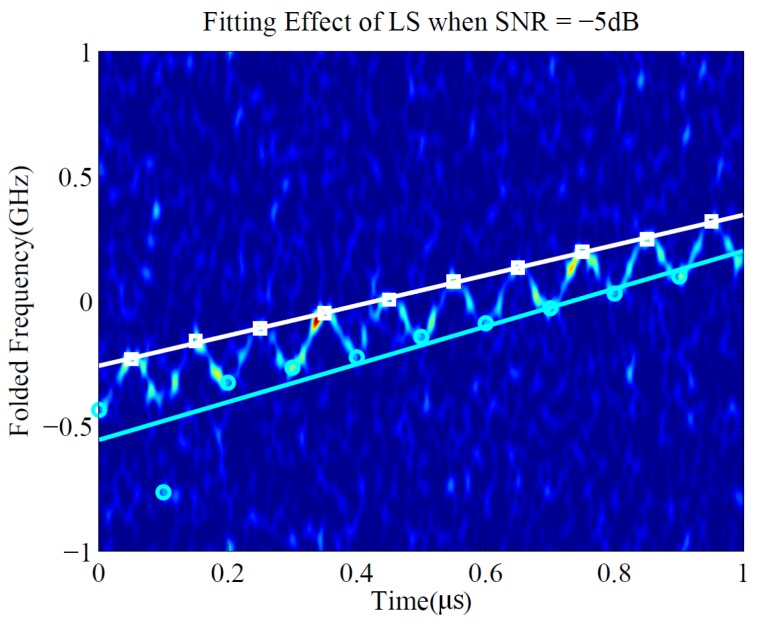
- The NYFR output for an LFM input is modeled as an LFM/SFM hybrid modulated signal. STFT time–frequency characteristic points are extracted at peaks and valleys, then upper and lower boundaries are fitted using LS and RANSAC.
- The longitudinal interval between fitted boundaries estimates the SFM modulation bandwidth and thus the NZ index via m̂ = Δf/(2mf fsin), taking the ceiling. The center line gives rough chirp rate and starting frequency.
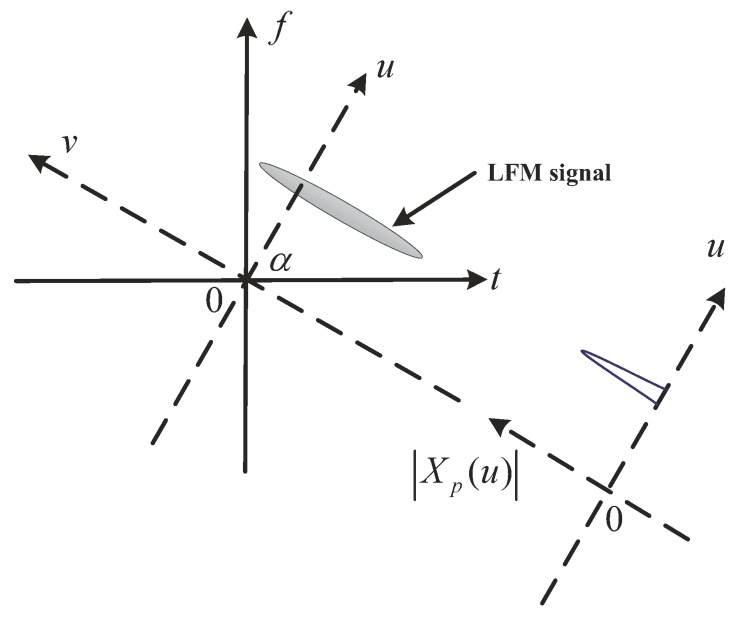
- After removing the LO-dependent SFM using the estimated NZ, FrFT estimates the precise chirp rate. A stepwise-refinement fast search finds the optimal FrFT order starting from the RANSAC rough estimate. Monte Carlo simulations used 200 runs per SNR and compared PCD for NZ and NRMSE of chirp rate against spectrum peak search, autocorrelation, and QMFB methods.
Limitations
- The paper states that it assumed the received signal contained only a single LFM and that the LFM frequency range did not cross NZ junctions; processing of multiple signals in NYFR is left for further study.
- The paper states that the peak-search-based method fails when SNR is below about −9 dB because the peak is submerged in noise.
- The text makes evident that RANSAC alone does not use all sampling points and its frequency resolution is limited by the STFT window length; the autocorrelation comparison method is interval-dependent and not suitable for short pulses less than an LO frequency modulation period. Evaluation is simulation-based, with no hardware experimental validation reported.
Model-written summary. Check it against the paper before relying on it.
Integrity signals
Registry
Cites
Statistics
Figures

Verification
Claims the paper makes
1 Valid · 2 Not valid · 9 Not checked · 38 Own results and interpretations
The cited sources support only part of this claim — read each source’s verdict below.
In the paper
“RANSAC works better than LS method because RANSAC only needs to select a set of inliers to get a good model, instead of selecting all the data points.”
§ Nyquist Zone Index and Chirp Rate Estimation of LFM Signal Intercepted by Nyquist Folding Receiver Based on Random Sample Consensus and Fractional Fourier Transform > 3. Parameter Estimation of LFM Signal Intercepted by NYFR > 3.2. NZ Index Estimation Method Based on Random Sample Consensus (RANSAC)
What the sources say
- Partly supportedcites [25] Fischler M.A. Bolles R.C. Random sample consensus: A paradigm for model fitting with applications to image analysis and automated cartography Commun. ACM 1981 24 381 395 10.1145/358669.358692 sourceExperimental — accuracy not yet measured
Section II describes RANSAC fitting an initial model from a small subset and expanding it with consistent points, and the Experimental Results report a case where RANSAC succeeded after a least-squares pruning heuristic failed. The claim overstates this as general superiority over least squares: the paper demonstrates the advantage in the presence of gross errors and says least squares can refine a model once a consensus set is found. (LLM, conf=0.85)
- Not checked — no full text of the sourcecites [26] Matas J. Chum O. Randomized RANSAC with Td,d test Image Vis. Comput. 2004 22 837 842 10.1016/j.imavis.2004.02.009 source
plainstates a cause- Asserted: passes — The authors put it forward as true.
- Checkable: passes — It can be checked against evidence.
- Load-bearing: passes — The paper’s conclusions depend on it.
- Based: passes — The paper gives a reason why it holds.
- Rests on an assumption not shown here.
- Partly supported
A result the paper states — it cites no source for it, so there is none to check. The quote shows it is in the paper.
In the paper
“the estimation performance of the chirp rate was outstanding and stable when SNR ≥−8 dB.”
§ Nyquist Zone Index and Chirp Rate Estimation of LFM Signal Intercepted by Nyquist Folding Receiver Based on Random Sample Consensus and Fractional Fourier Transform > 4. Simulations and Discussion
plainstates an association- Asserted: passes — The authors put it forward as true.
- Checkable: passes — It can be checked against evidence.
- Load-bearing: passes — The paper’s conclusions depend on it.
- Based: passes — The paper gives a reason why it holds.
- Rests on 2 assumptions not shown here.
A result the paper states — it cites no source for it, so there is none to check. The quote shows it is in the paper.
In the paper
“The correct ratio of NZ index estimation was greater than 90% when SNR ≥−9 dB”
§ Nyquist Zone Index and Chirp Rate Estimation of LFM Signal Intercepted by Nyquist Folding Receiver Based on Random Sample Consensus and Fractional Fourier Transform > 4. Simulations and Discussion
plainstates an association- Asserted: passes — The authors put it forward as true.
- Checkable: passes — It can be checked against evidence.
- Load-bearing: passes — The paper’s conclusions depend on it.
- Based: passes — The paper gives a reason why it holds.
- Rests on 2 assumptions not shown here.
A result the paper reports from its own data — it cites no other source for it, so there is none to check. The quote shows it is in the paper.
In the paper
“The simulation demonstrated that the proposed method could precisely estimate the parameters of the hybrid modulated output signal of the NYFR.”
- Also stated in: § 5. Conclusions · plain
“The simulation results showed the validity and reliability of the proposed method.”
§ Nyquist Zone Index and Chirp Rate Estimation of LFM Signal Intercepted by Nyquist Folding Receiver Based on Random Sample Consensus and Fractional Fourier Transform > Abstract
plainstates a cause- Asserted: passes — The authors put it forward as true.
- Checkable: passes — It can be checked against evidence.
- Load-bearing: passes — The paper’s conclusions depend on it.
- Based: passes — The paper gives a reason why it holds.
- Rests on 2 assumptions not shown here.
- Also stated in: § 5. Conclusions · plain
A result the paper states — it cites no source for it, so there is none to check. The quote shows it is in the paper.
In the paper
“and reached 100% when SNR ≥−7 dB.”
§ Nyquist Zone Index and Chirp Rate Estimation of LFM Signal Intercepted by Nyquist Folding Receiver Based on Random Sample Consensus and Fractional Fourier Transform > 4. Simulations and Discussion
plainstates an association- Asserted: passes — The authors put it forward as true.
- Checkable: passes — It can be checked against evidence.
- Load-bearing: passes — The paper’s conclusions depend on it.
- Based: passes — The paper gives a reason why it holds.
- Rests on 2 assumptions not shown here.
29 more claims
Create a free account to see all 50 claims and every source verdict.
- The quote only partly states this claim. 1
- It may state two separate claims as one. 14
- Probably not a substantial claim. 2
Self-check
Percentages, sums and reported differences re-computed from the paper’s own numbers.
Each contradiction between two passages listed here was confirmed by an independent check.
Rated minor: it would not touch a result — a value no result rests on, a p-value that stays on the same side of the significance level, or a conflict that is clerical, resolved elsewhere in the paper, or outside its own findings.
In the paper
§ Nyquist Zone Index and Chirp Rate Estimation of LFM Signal Intercepted by Nyquist Folding Receiver Based on Random Sample Consensus and Fractional Fourier Transform > 3. Parameter Estimation of LFM Signal Intercepted by NYFR > 3.1. NZ Index Estimation Method Based on LS
“(5)∂∂a∑i=1N[yi−(axi+b)]2=−2∑i=1N(yi−a^xi−b^)=0,”
§ Nyquist Zone Index and Chirp Rate Estimation of LFM Signal Intercepted by Nyquist Folding Receiver Based on Random Sample Consensus and Fractional Fourier Transform > 3. Parameter Estimation of LFM Signal Intercepted by NYFR > 3.1. NZ Index Estimation Method Based on LS
“(6)∂∂b∑i=1N[yi−(axi+b)]2=−2∑i=1N(yi−a^xi−b^)=0,”
Citations
Cites
Fischler, M. A., & Bolles, R. C. (1981) · Communications of the ACM · doi:10.1145/358669.358692 · Cited by 25,893
The restricted isometry property and its implications for compressed sensing
Candès, E. J. (2008) · Comptes Rendus. Mathématique · doi:10.1016/j.crma.2008.03.014 · Cited by 3,686
Analog-to-digital converter survey and analysis
Walden, R. H. (1999) · IEEE Journal on Selected Areas in Communications · doi:10.1109/49.761034 · Cited by 2,186 · cited 1×
“, sample rate) [3] and analog bandwidth (i.”
BackgroundDigital computation of the fractional Fourier transform
Ozaktas, H. M., Arikan, O., Kutay, M. A., & Bozdagt, G. (1996) · IEEE Transactions on Signal Processing · doi:10.1109/78.536672 · Cited by 1,187 · cited 1×
“The most representative one is the decomposition fast algorithm proposed in [29], where the definition of FrFT is rewritten as:”
BackgroundBeyond Nyquist: Efficient Sampling of Sparse Bandlimited Signals
Tropp, J. A., Laska, J. N., Duarte, M. F., Romberg, J. K., & Baraniuk, R. G. (2010) · IEEE Transactions on Information Theory · doi:10.1109/tit.2009.2034811 · Cited by 1,089 · cited 1×
“Compared with the Gegenbauer system [5,6] and many other compress sensing (CS) based architectures [10,11] that require full signal reconstruction, the NYFR basically preserves the signal structure, and the information reconstruction can be relatively simple with conventional signal analysis methods [12].”
Photonic analog-to-digital converters
Valley, G. C. (2007) · Optics Express · doi:10.1364/oe.15.001955 · Cited by 784
Analysis of multicomponent LFM signals by a combined Wigner-Hough transform
Barbarossa, S. (1995) · IEEE Transactions on Signal Processing · doi:10.1109/78.388866 · Cited by 419 · cited 1×
“In the literature, there are many studies focused on the LFM signal intercepted by the conventional receiver, such as fractional Fourier transform (FrFT) [14], Radon-ambiguity transform [15], and combined Wigner–Hough transform [16,17].”
BackgroundAnalog-to-Information Conversion via Random Demodulation
Kirolos, S., Laska, J., Wakin, M., Duarte, M., Baron, D., Ragheb, T., Massoud, Y., & Baraniuk, R. (2006) · 2006 IEEE Dallas/CAS Workshop on Design, Applications, Integration and Software · doi:10.1109/dcas.2006.321036 · Cited by 393
Xampling: Signal Acquisition and Processing in Union of Subspaces
Mishali, M., Eldar, Y. C., & Elron, A. J. (2011) · IEEE Transactions on Signal Processing · doi:10.1109/tsp.2011.2161472 · Cited by 311
Randomized RANSAC with T, test
Matas, J., & Chum, O. (2004) · Image and Vision Computing · doi:10.1016/j.imavis.2004.02.009 · Cited by 281 · cited 1×
“The RANSAC algorithm iteratively repeats the above steps until the obtained consensus set in a certain iteration has enough inliers [26].”
Method
Cited by
Wan, T., Jiang, K., Ji, H., & Tang, B. (2021) · Defence Technology · doi:10.1016/j.dt.2021.09.019 · Cited by 20
Machine Learning Approach to Chirp Rate Estimation of Linear Frequency Modulated Radars
Young, A., Luong, D., Balaji, B., et al. (2020) · Integrated Communications, Navigation and Surveillance Conference (ICNS) · doi:10.1109/icns50378.2020.9222944 · Cited by 3
Classifying Linear Frequency Modulated Radar Signals Using Matched Filters
Luong, D., Young, A., Balaji, B., et al. (2022) · IEEE Canadian Conference on Electrical and Computer Engineering (CCECE) · doi:10.1109/ccece49351.2022.9918404 · Cited by 3
“Wigner-Ville time-frequency analysis [2] and the fractional Fourier transform [3] are two techniques that have been applied to this problem.”
MethodImplementation and verification of Nonlinear chirp signals in hardware system
Sysak, D., Jaromi, G., & Biernacki, P. (2021) · IEEE Region 10 Symposium (TENSYMP) · doi:10.1109/tensymp52854.2021.9550831 · Cited by 2
A New Method for Parameter Estimation of Cross-Channel Ultra-Wideband LFM Signal
Fan, X., & Li, B. (2020) · Journal of Physics Conference Series · doi:10.1088/1742-6596/1544/1/012130
“RANSAC was proposed by Fischler and Bolles for the first time[6].”
BackgroundMethodSelf-citationXinqun, L. I. U., Li, T., Yingxiao, Z. H. A. O., & Jinlin, P. E. N. G. (2023) · IEICE Transactions on Electronics · doi:10.1587/transele.2022ecs6012
Self-citationLiu, X. (2025) · International Conference on Computer Application and Information Security (ICCAIS) · doi:10.1117/12.3061935 · Cited by 1
Self-citation
Metadata
- Authors
- Liu, X., Li, T., Fan, X., & Chen, Z.
- Affiliations
- National University of Defense Technology (CN)
- Artificial Intelligence Research Center (AIRC), National Innovation Institute of Defense Technology (NIIDT), NO.2 Fengtai South Road, Fengtai District, Beijing 100071, China
- Corresponding author
- Li, Tao
- Venue
- Sensors
- Publisher
- MDPI AG
- Published
- 2019-03-26
- Volume
- 19
- Issue
- 6
- Pages
- 1477
- ISSN
- 1424-8220 (ISSN-L)
- PMC
- PMC6471702
- OpenAlex
- W2924508530
- Cited by
- 8
- References
- 30
- Citations by year
- 2025: 1 · 2023: 1 · 2022: 1 · 2021: 3 · 2020: 2
- FWCI
- 1.10
- Type
- journal article
- Language
- en
- Open access
- gold
- dx.doi.org
- Licence
- Locations
- Sensors (publishedVersion, cc-by)
- Europe PMC (PubMed Central) (publishedVersion, cc-by)
- PubMed Central (publishedVersion, cc-by)
- PubMed (publishedVersion)
- DOAJ (DOAJ: Directory of Open Access Journals) (submittedVersion, cc-by-sa)
- Topics
- Physical Sciences › Engineering › Aerospace Engineering › Radar Systems and Signal Processing
- Physical Sciences › Engineering › Aerospace Engineering › Advanced SAR Imaging Techniques
- Physical Sciences › Mathematics › Applied Mathematics › Mathematical Analysis and Transform Methods
- Keywords
- linear frequency modulation signals, chirp rate estimation, low probability of intercept radar, RANSAC, fractional Fourier transform, parameter estimation
About these checks
Registry, retraction, Cites and statistics results are computed, not judged, with one exception: a printed reference that no index lists is read once by a model before it counts as a citation error. Claims are extracted by a model and kept only when their quote appears verbatim in the text; each cited source is then checked, with a model’s help, for whether it says what the claim relies on. Those verdicts can be wrong — read the claim’s quote and the cited source before relying on one.
The claim verdicts this report counts are experimental: their accuracy is not yet measured.
A language model drew the claims from the paper on 2026-10-10, under version 3 of the claim definition (model deepseek-v4.1-flash, prompt extract-v3).
A second model labelled each claim on 2026-10-10 (model jev-1.13-20260917, definition revision gold-guideline-v0.2).
Cited sources are checked with a language model’s help (gpt-6-sol).
Statistics and arithmetic are recomputed, not judged.
Confidence bands are shown only for fields calibrated on our annotated test set. None is calibrated yet, so no band is shown.
What counts as a claim ›How we measure confidence ›How we check this ›
Are you an author, or do you see a problem with this page? Request a review
Data sources
Bibliographic data: Semantic Scholar, OpenAlex, Crossref.
Contains information from the Semantic Scholar Academic Graph Datasets, made available under the ODC Attribution License (ODC-BY 1.0).
Semantic Scholar’s data is described in: Kinney, R., et al. (2023). The Semantic Scholar Open Data Platform. arXiv:2301.10140.
