

Sensor Data Acquisition and Multimodal Sensor Fusion for Human Activity Recognition Using Deep Learning
Open accessThe DOI matches its Crossref record; 49 of the 49 references it cites were found in a registry or an index; 5 of the 32 sources its claims cite were checked for support.
Abstract
In this paper, we perform a systematic study about the on-body sensor positioning and data acquisition details for Human Activity Recognition (HAR) systems. We build a testbed that consists of eight body-worn Inertial Measurement Units (IMU) sensors and an Android mobile device for activity data collection. We develop a Long Short-Term Memory (LSTM) network framework to support training of a deep learning model on human activity data, which is acquired in both real-world and controlled environments. From the experiment results, we identify that activity data with sampling rate as low as 10 Hz from four sensors at both sides of wrists, right ankle, and waist is sufficient in recognizing Activities of Daily Living (ADLs) including eating and driving activity. We adopt a two-level ensemble model to combine class-probabilities of multiple sensor modalities, and demonstrate that a classifier-level sensor fusion technique can improve the classification performance. By analyzing the accuracy of each sensor on different types of activity, we elaborate custom weights for multimodal sensor fusion that reflect the characteristic of individual activities.
Overview
CoChat Summary
TL;DR
The paper builds an eight-IMU testbed and LSTM framework to study on-body sensor placement, sampling rate, and multimodal fusion for human activity recognition. It finds that 10 Hz data from four sensors—both wrists, right ankle, and waist—is sufficient for ADLs, and classifier-level fusion improves recognition accuracy up to 94.47%.
Key findings
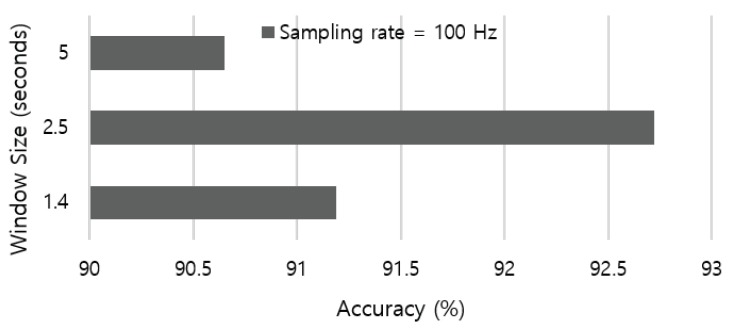
- Activity data with sampling rate as low as 10 Hz from four sensors at both wrists, right ankle, and waist was sufficient for recognizing ADLs including eating and driving; a 2.5 s sliding window outperformed other settings, with 25 samples covering 2.5 s.
- The four-sensor baseline achieved 93.0% recognition accuracy. Among three-sensor combinations, right wrist, right ankle, and waist was most competitive; with two sensors, placing one on the upper half and one on the lower half performed better than both on the upper or both on the lower half. Right wrist tended to outperform left wrist, and right ankle played a more critical role than waist.
- Single-modality accuracy was 92.18% for accelerometer, 85.22% for magnetometer, and 78.33% for gyroscope. Multimodal fusion reached up to 93.07% with stacking/voting, while soft-voting achieved 94.47% versus hard-voting at 93.48%, a 2.48% improvement over single-modal recognition.
- Activity-specific weights increased accuracy by 7.65% for walking upstairs and 36.97% for walking downstairs. Static activities were best detected by accelerometer, and fusing additional sensors could degrade sitting/standing accuracy; stair walking was often confused with plain walking.
Methods
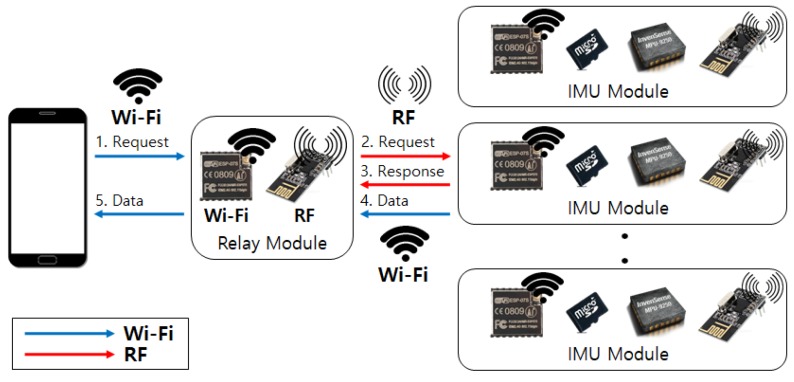
- A testbed with eight body-worn IMU sensors (MPU-9250) and an Android mobile device collected data from five researchers (two males, three females; ages 34–48; heights 160–175 cm; all right-handed) over three workdays, about three hours per subject, in real-world and controlled environments. Final configuration used four sensors on left/right wrist, right ankle, and waist.
- Raw sensor data were fed to an LSTM network with a 2.5 s sliding window and 50% overlap; parameters included batch size 150, one stacked LSTM layer, hidden neuron size 32, 25 steps, and keep probability 0.8. Evaluation used 10-fold cross-validation and leave-one-subject-out cross-validation with jittering data augmentation.
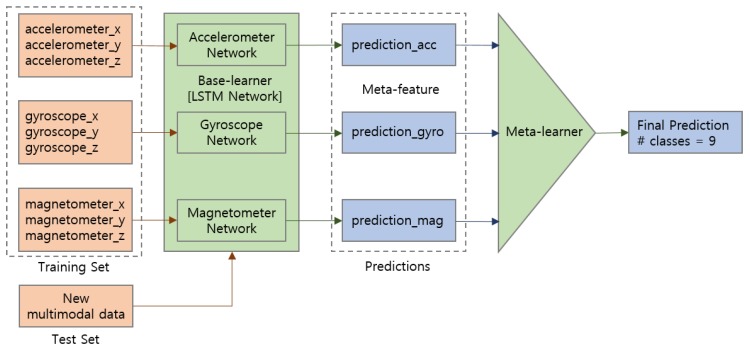
- Sensor fusion used classifier-level two-level ensembles: LSTM base learners per modality, stacking with Random Forest/kNN/SVM meta-learners (Random Forest adopted), and soft/hard voting with weights based on sensor accuracy or activity-specific characteristics.
Limitations
- The paper states that experiments used a small number of test subjects within the institution, that the meta-learner was evaluated only with classical algorithms (RF, kNN, SVM), and that future work should include large-scale/long-term experiments, additional sensing modalities, and online weight learning.
- Evident from the text: the pilot involved only five right-handed subjects with limited demographic variation, gyroscope data were used without calibration, and stair walking versus plain walking produced equivocal results.
Model-written summary. Check it against the paper before relying on it.
Integrity signals
Registry
Cites
Statistics
Figures




Verification
Claims the paper makes
4 Valid · 0 Not valid · 13 Not checked · 50 Own results and interpretations
The sources with a verdict support this claim; the rest weren’t checked yet, have no full text we could read, or their verdicts aren’t rated yet.
In the paper
“Authors of [18] surveyed ADLs and their occurrence in public HAR datasets, and we find that six primitive activity labels including walking, standing, sitting, lying, walking upstairs, and walking downstairs can cover daily activities listed in time-use survey results.”
§ Sensor Data Acquisition and Multimodal Sensor Fusion for Human Activity Recognition Using Deep Learning > 3. Testbed and Data Acquisition > 3.2. ADLs
What the sources say
- Not checked yetcites [37] (2019, April 09). The General Social Survey—Statistics Canada, Available online: https://www150.statcan.gc.ca/n1/pub/89f0115x/89f0115x2013001-eng.htm.
- Not checked yetcites [38] (2019, April 09). The time use Survey—Statistics Korea, Available online: http://kostat.go.kr/portal/eng/pressReleases/11/6/index.board.
- Supportedcites [18] Micucci, D., Mobilio, M., and Napoletano, P. (2017). UniMiB SHAR: A Dataset for Human Activity Recognition Using Acceleration Data from Smartphones. Appl. Sci., 7. source
Section 2.2 states that the authors analyzed ADLs across 24 publicly available datasets, and Figure 1 shows their occurrence in those datasets. The six-label coverage of time-use survey results is explicitly framed as the citing authors’ own finding, not a finding attributed to this source. (LLM, conf=0.94)
plain- Asserted: passes — The authors put it forward as true.
- Checkable: passes — It can be checked against evidence.
- Load-bearing: passes — The paper’s conclusions depend on it.
- Based: passes — The paper gives a reason why it holds.
The cited sources support only part of this claim — read each source’s verdict below.
In the paper
“However, as the dataset adopts heterogeneous sensors on limited position of the human body, it is not sufficient to evaluate the recognition performance according to the sensor position and sampling rate.”
§ Sensor Data Acquisition and Multimodal Sensor Fusion for Human Activity Recognition Using Deep Learning > 2. Related Work > 2.2. Mobile Sensing and Public Datasets
What the sources say
- Partly supportedcites [15] Vaizman, 2017, Recognizing Detailed Human Context in the Wild from Smartphones and Smartwatches, IEEE Pervasive Comput. sourceExperimental — accuracy not yet measured
Our copy supports the descriptive premise: the dataset is built from a phone app plus a companion Pebble smartwatch, with heterogeneous sensors sampled at different rates (Table 2, 'Sensor measurements' / 'EVALUATION AND RESULTS': accelerometer/gyro/magnetometer 40Hz, watch accelerometer 25Hz, compass and location variable, audio 22,050Hz reduced to MFCC), and body placement is limited to the wrist watch (DATA COLLECTION: 'the majority of the subjects (93%) were right handed, and chose to wear the smartwatch on their left wrist') plus the subjects' own phone in unconstrained positions. However, no passage states or argues that the dataset is insufficient to evaluate recognition performance as a function of sensor position or sampling rate; the paper instead treats unconstrained device placement as a desired in-the-wild condition to be overcome (Related work) and evaluates sensor modality/fusion, not position or sampling-rate effects (Performance evaluation; Fig. 3). That insufficiency conclusion is the citing authors' own inference, so only part of what is attributed to this source is in it. (LLM, conf=0.68)
- Not checked yetcites [16] Vaizman, Y., Ellis, K., Lanckriet, G., and Weibel, N. (2018, January 21–26). ExtraSensory App: Data Collection In-the-Wild with Rich User Interface to Self-Report Behavior. Proceedings of the 2018 CHI Conference on Human Factors in Computing Systems (CHI ’18), Montreal QC, Canada. source
plainstates a cause- Asserted: passes — The authors put it forward as true.
- Checkable: passes — It can be checked against evidence.
- Load-bearing: unclear — It is unclear whether the paper’s conclusions depend on it.
- Based: passes — The paper gives a reason why it holds.
- Partly supported
A result the paper reports from its own data — it cites no other source for it, so there is none to check. The quote shows it is in the paper.
In the paper
“From the experiment results, we identify that activity data with sampling rate as low as 10 Hz from four sensors at both sides of wrists, right ankle, and waist is sufficient in recognizing Activities of Daily Living (ADLs) including eating and driving activity.”
§ Sensor Data Acquisition and Multimodal Sensor Fusion for Human Activity Recognition Using Deep Learning > Abstract
plainstates a cause- Asserted: passes — The authors put it forward as true.
- Checkable: passes — It can be checked against evidence.
- Load-bearing: passes — The paper’s conclusions depend on it.
- Based: passes — The paper gives a reason why it holds.
- Rests on an assumption not shown here.
A result the paper reports from its own data — it cites no other source for it, so there is none to check. The quote shows it is in the paper.
In the paper
“We adopt a two-level ensemble model to combine class-probabilities of multiple sensor modalities, and demonstrate that a classifier-level sensor fusion technique can improve the classification performance.”
§ Sensor Data Acquisition and Multimodal Sensor Fusion for Human Activity Recognition Using Deep Learning > Abstract
boostedstates a cause- Asserted: passes — The authors put it forward as true.
- Checkable: passes — It can be checked against evidence.
- Load-bearing: passes — The paper’s conclusions depend on it.
- Based: passes — The paper gives a reason why it holds.
- Rests on an assumption not shown here.
A result the paper reports from its own data — it cites no other source for it, so there is none to check. The quote shows it is in the paper.
In the paper
“Participants experienced significant discomfort incurred by the sensor on the chest; we dropped the chest sensor in the final testbed configuration for its feasibility.”
§ Sensor Data Acquisition and Multimodal Sensor Fusion for Human Activity Recognition Using Deep Learning > 3. Testbed and Data Acquisition > 3.4. Final Testbed Configuration
plainstates a cause- Asserted: passes — The authors put it forward as true.
- Checkable: passes — It can be checked against evidence.
- Load-bearing: passes — The paper’s conclusions depend on it.
- Based: passes — The paper gives a reason why it holds.
41 more claims
Create a free account to see all 67 claims and to verify the 27 references still open.
- Probably not a substantial claim. 9
- It may state two separate claims as one. 12
- The quote only partly states this claim. 1
Claims other papers make about this one
Each is checked against this paper’s own text: does it say what the citing paper says it does?
The cited source doesn’t support the claim as written.
In the citing paper
“However, due to the lack of proper filtration and feature extraction techniques applied, the system was not able to recognize the ADL correctly.”
From A Multimodal IoT-Based Locomotion Classification System Using Features Engineering and Recursive Neural Network (2023) · cites this paper as [17]
Checked by a reasoning model — may be wrong.
Experimental — accuracy not yet measuredThe source backs part of the claim, not all of it — or backs it for a different population, condition or comparison.
In the citing paper
“In sensor-based HAR leveraging the temporal nature of IMU signals allows for the application of augmentation methods grounded in signal processing [32,34,99,132,141,178,193].”
From Past, Present, and Future of Sensor-based Human Activity Recognition Using Wearables: A Surveying Tutorial on a Still Challenging Task (2025) · cites this paper as [34]
Experimental — accuracy not yet measured
Citations
Cites
Hochreiter, S., & Schmidhuber, J. (1997) · Neural Computation · doi:10.1162/neco.1997.9.8.1735 · Cited by 102,318 · cited 2×
“As a variation of RNN architecture, LSTM [25] network is renowned for its capability to learn long-term dependencies in time-series data by the selective forget-and-update procedure.”
BackgroundMethodA systematic analysis of performance measures for classification tasks
Sokolova, M., & Lapalme, G. (2009) · Information Processing & Management · doi:10.1016/j.ipm.2009.03.002 · Cited by 7,515 · cited 1×
“On the other hand, macro-averaging F1-score is a harmonic mean of precision and recall measures, and takes both false positives and false negatives into account based on a per-class average [42].”
BackgroundDeep Convolutional and LSTM Recurrent Neural Networks for Multimodal Wearable Activity Recognition
Ordóñez, F., & Roggen, D. (2016) · Sensors · doi:10.3390/s16010115 · Cited by 2,761 · cited 1×
“Thus, LSTM network model is renowned for its performance on HAR domains [32].”
BackgroundDeep learning for sensor-based activity recognition: A survey
Wang, J., Chen, Y., Hao, S., Peng, X., & Hu, L. (2019) · Pattern Recognition Letters · doi:10.1016/j.patrec.2018.02.010 · Cited by 2,014 · cited 1×
“Besides the body-worn sensors, object sensors such as Radio Frequency Identifier (RFID) tags are widely used to infer human activities based on the movements detected in smart home environments [27].”
Background(2013) · RECERCAT (Consorci de Serveis Universitaris de Catalunya) · Cited by 1,959
Introducing a New Benchmarked Dataset for Activity Monitoring
Reiss, A., & Stricker, D. (2012) · 2012 16th International Symposium on Wearable Computers · doi:10.1109/iswc.2012.13 · Cited by 1,456 · cited 1×
“Previous work in the HAR literature empirically adopted 5.12 s-long window size [35,39].”
InfluentialThe Opportunity challenge: A benchmark database for on-body sensor-based activity recognition
Chavarriaga, R., Sagha, H., Calatroni, A., Digumarti, S. T., Tröster, G., Millán, J. D. R., & Roggen, D. (2013) · Pattern Recognition Letters · doi:10.1016/j.patrec.2012.12.014 · Cited by 742 · cited 1×
“Human activity recognition has been investigated using various sensor modalities [26].”
BackgroundUm, T. T., Pfister, F. M. J., Pichler, D., Endo, S., Lang, M., Hirche, S., Fietzek, U., & Kulić, D. (2017) · Proceedings of the 19th ACM International Conference on Multimodal Interaction · doi:10.1145/3136755.3136817 · Cited by 729 · cited 1×
“We apply the jittering method to simulate additive sensor noise using random parameters as described in [47] for label-preserving augmentation.”
MethodUnobtrusive Sensing and Wearable Devices for Health Informatics
Zheng, Y.-L., Ding, X.-R., Poon, C. C. Y., Lo, B. P. L., Zhang, H., Zhou, X.-L., Yang, G.-Z., Zhao, N., & Zhang, Y.-T. (2014) · IEEE Transactions on Biomedical Engineering · doi:10.1109/tbme.2014.2309951 · Cited by 722
Human Activity Recognition Using Wearable Sensors by Deep Convolutional Neural Networks
Jiang, W., & Yin, Z. (2015) · Proceedings of the 23rd ACM international conference on Multimedia · doi:10.1145/2733373.2806333 · Cited by 676 · cited 2×
“In this paper, we adopt a deep neural network architecture to recognize human activity from raw data input, which has shown promising results when adopted for interpreting human activities without complex data pre-processing for feature extraction [21–23].”
Method
Cited by
Items 201–236 of 236
A Review of Sensor Fusion Techniques
Zaim, H. Ç., & YOLAÇAN, E. (2024) · Ömer Halisdemir Üniversitesi Mühendislik Bilimleri Dergisi · doi:10.28948/ngumuh.1455086
Deep Interaction Feature Fusion for Robust Human Activity Recognition
Oh, Y., Kim, S., & Bui, A. A. T. (2024) · Communications in computer and information science · doi:10.1007/978-981-97-9003-6_7 · Cited by 1
Human Activity Recognition with Consumer Devices and Real-Life Perspectives
Matey-Sanz, M., & Matey-Sanz, M. (2024) · Tesis Doctorals en Xarxa (Consorci de Serveis Universitaris de Catalunya) · doi:10.6035/14101.2024.663821
Classification of Human Activity Recognition Using Machine Learning on the WISDM Dataset
Abdulmajeed, S. W. (2024) · Al-Iraqia Journal of Scientific Engineering Research · doi:10.58564/ijser.3.3.2024.222
A Hybrid Approach for Smart Home Activity Recognition Using Sensor Data and Deep Learning Techniques
Kavitha, K. V. N., Pandey, S., Saha, P., & Patel, A. R. (2025) · Advances in systems analysis, software engineering, and high performance computing book series · doi:10.4018/979-8-3693-5448-3.ch007
Transfer Learning Approach for Human Activity Recognition using EfficientNet
Rajalaxmi, R. R., Thamilselvan, R., Sudharsana, P. P., Ponharishkumar, S., Ragavi, S., & Sanjeev Rathan, R. (2025) · OPJU International Technology Conference on Smart Computing for Innovation and Advancement in Industry (OTCON) · doi:10.1109/otcon65728.2025.11070766
“The model utilized in this research work is basically based on Long Short-Term Memory (LSTM) [26]networks ideal for identifying temporal patterns.”
Encoding Human Activity Recognition: Local Coordinate Coding on Multimodal Sensory Data
Noor, K., Haider, T., Aziz, S., Zulfiqar, Z., Khan, M. H., & Farid, M. S. (2024) · International Conference on Innovative Computing (ICIC) · doi:10.1109/icic63915.2024.11116285
“Several deep network architectures have been proposed for human activity recognition (HAR) like Convolutional Neural Networks (CNNs) [22], Recurrent Neural Networks (RNNs) [23], Gated Recurrent Units (GRUs) [24], and hybrid models [25].”
Xu, M., Li, X., Fu, Y., Hu, D., Zhang, Y., Wei, W., Gao, Y., Lin, K., Yang, B., Cao, J., et al. (2025) · Frontiers in Neurology · doi:10.3389/fneur.2025.1571330
A Roadmap for Multimodal Fusion in IoT-Enabled Context-Aware Recommender Systems
Chafiki, M. E. A., Stitini, O., & Kaloun, S. (2025) · International Conference on Intelligent Systems: Theories and Applications · doi:10.1109/sita67914.2025.11273453
“1) Early Fusion (Feature-Level): This approach involves combining data at the earliest possible stage, typically by concatenating raw or pre-processed features from different modalities into a single, high-dimensional feature vector before feeding them into a model [11].”
Human Activity Recognition: Innovations, Impacts, and Implications for Society
Reshi, B. A., & Kumar, V. (2025) · IEEE Technology and Society Magazine · doi:10.1109/mts.2025.3627977
Upadhyay, M. N. (2025) · Journal of Global Research in Multidisciplinary Studies(JGRMS) · doi:10.5281/zenodo.16831976
Ετερογενή δεδομένα για μηχανική μάθηση: η περίπτωση της πρόβλεψης φορτίου
Λογδανίδης, Π. Ι. (2019) · University of Thessaly Institutional Repository (University of Thessaly)
Alfakir, A. (2021) · TSpace (University of Toronto)
An introduction to multimodal data representation
Thomas, K. V., Rattan, P., & Nair, R. R. (2026) · Elsevier eBooks · doi:10.1016/b978-0-443-27528-9.00003-6
Wu, J., & Yang, H. (2025) · IEEE International Conference on Advances in Electrical Engineering and Computer Applications (AEECA) · doi:10.1109/aeeca65693.2025.00120
“Existing systems are unable to effectively integrate such multimodal and high-dimensional data, which limits their ability to provide useful insights for efficient and adaptive training recommendations [1].”
Dynamic GCN-TCN-CapsNet: A Lightweight Hybrid Model for Real-Time Gait Recognition
Venkatesh, V., Anushiadevi, R., Ramneshkar, B., Tiwary, A. R., & Rani Swaroop, B. (2026) · Communications in computer and information science · doi:10.1007/978-3-032-16038-6_27
Jannu, P. K., Mohammad, J. A., Panchali, S. H., Kavirayani, U. M., Mylavarapu, K. B., & Pilli, J. (2025) · Journal of Computer Science and Technology Studies · doi:10.32996/jcsts.2025.7.9.92
“A single waist-worn sensor might not be enough to identify combinatorial events with greater granularity, such as eating and driving[3].”
Ahmed, S. (2022) · Institutional Repositories DataBase (IRDB)
Kurniawan, A., Hidayat, D. R., Saputra, Z. I., Ayubi, W. S., Rustin, S. N., Mulya, M. R. R., & Mandolang, C. F. M. (2026) · Advanced Mechanical and Mechatronic Systems · doi:10.53623/amms.v2i2.999
“The fusion of these complementary sensor modalities was demonstrated to substantially enhance activity discrimination capabilities compared to single-sensor configurations [7, 8].”
Siewert, S. B., Denn, R., Koushik, A., Gada, V., Aralikatti, A., Satheesh, S., & Littleton, S. D. (2026) · Machine Learning from Challenging Data · doi:10.1117/12.3094971
Research on Early Recognition Model of Respiratory Failure Based on Multimodal Monitoring Data
Yang, R., & Deng, J. (2026) · IEEE Access · doi:10.1109/access.2026.3693831
“Graph-based representations and knowledge-enhanced embeddings are also being integrated to infuse clinical semantics into multimodal fusion frameworks [15].”
Optimized Deep Learning for HAR in Uncontrolled Environments with Hybrid Feature Fusion
Choudhury, N. A., & Soni, B. (2026) · Transactions on computer systems and networks · doi:10.1007/978-981-95-7206-9_6
Dual-Sensor Fingerprint Authentication System
Gupta, S. S., Mallick, S., Chattopadhyay, A., Das, A., Sengupta, R., & Nag, S. (2026) · EPJ Web of Conferences · doi:10.1051/epjconf/202637001023
Aplicação da Arquitetura LSTM na Previsão da Inflação
Michalski, J. E. S., & Flores, J. H. F. (2026) · Anais do Computer on the Beach · doi:10.14210/cotb.v17.p221-227
Enhancing human activity recognition through GAN-augmented data and multi-branch CNN-LSTM networks
Shahid, A., Khan, M. H., Nisar, M. A., & Farid, M. S. (2026) · Knowledge-Based Systems · doi:10.1016/j.knosys.2026.116783 · Cited by 1
Multimodal Data Fusion for a Self-Adaptive, Smart, Serious-Game Ecosystem Under Development
Tao, X., Chen, P., & Eckert, M. (2026) · Sensors · doi:10.3390/s26165132
“Instead, the system performs timestamp-based temporal alignment on a unified system timeline, since multimodal sensor streams commonly operate at different sampling rates and require window-level aggregation before fusion [15,19].”
Optimizing Human Activity Recognition with Ensemble Deep Learning on Wearable Sensor Data
Ashfaq, N., Sadiq, I., Junaid, M., Khan, M. H., & Farid, M. S. (2024) · International Journal of Innovations in Science and Technology · doi:10.33411/ijist/1069
Akinrolabu, O. A. A. M. O. O. E. O. A. &. O. D., & Onyesolu, M. O. (2026) · Iconic Research and Engineering Journals · doi:10.64388/irev10i2-1722556
Humcareadl: A diverse multimodal dataset and HyMCL-Net for robust human activity recognition
Ashraf, A., Ali, M. H., Ashfaq, N., Khan, M. H., & Farid, M. S. (2026) · Multimedia Tools and Applications · doi:10.1007/s11042-026-21905-3
Ultra-Lightweight Edge-AI Framework for Real-Time HAR Applications
Gokul, M., Maheshkumar, T., Lingesh, S., & Sasirekha, S. P. (2026) · International Conference Computational Vision and Bio Inspired Computing · doi:10.1109/iccvbic71195.2026.11688988
“Even though lightweight HAR research has made progress, there is still a gap between prototypes and deployable systems [13].”
A Systematic Review of various Fusion Techniques for Human Activity Recognition
Gill, S. K., & Sharma, A. (2024) · International Journal of Intelligent Systems and Applications in Engineering · Cited by 1
Human Activity Recognition using LSTM with depth data
Sinha, K. P., Kumar, P., & Ghosh, R. (2023) · International Journal of Intelligent Systems and Applications in Engineering
KÖKSAL, F. (2026) · Pattern Recognition Letters · doi:10.1016/j.patrec.2026.10.005
Multimodal Sensor Fusion Using Deep Neural Networks for Human Activity RecognitionPreprint
Jansi Rani, S., & Karpagam, V. (2026) · SSRN Electronic Journal · doi:10.2139/ssrn.7589367
Huang, Q. (2025) · International Conference on Mechanical Automation and Engineering Applications (ICMAEA) · doi:10.1109/icmaea64564.2025.11725783
“These limitations result in suboptimal feedback, insufficient personalization, and unreliable motion quantification, especially when used in dynamic, real-world exercise scenarios [2].”
Metadata
- Authors
- Chung, S., Lim, J., Noh, K. J., Kim, G., & Jeong, H.
- Affiliations
- Electronics and Telecommunications Research Institute (KR)
- Corresponding author
- Chung, Seungeun
- Venue
- Sensors
- Publisher
- MDPI AG
- Published
- 2019-04-10
- Volume
- 19
- Issue
- 7
- Pages
- 1716
- ISSN
- 1424-8220 (ISSN-L)
- PMC
- PMC6479605
- OpenAlex
- W2940096514
- Cited by
- 215
- References
- 48
- Citations by year
- 2026: 22 · 2025: 33 · 2024: 35 · 2023: 36 · 2022: 31 · 2021: 32 · 2020: 21 · 2019: 5
- FWCI
- 9.94
- Type
- journal article
- Language
- en
- Open access
- gold
- dx.doi.org
- Licence
- Locations
- Sensors (publishedVersion, cc-by)
- PubMed Central (publishedVersion, cc-by)
- PubMed (publishedVersion)
- DOAJ (DOAJ: Directory of Open Access Journals) (submittedVersion, cc-by-sa)
- Funders
- Electronics and Telecommunications Research Institute
- Topics
- Physical Sciences › Computer Science › Computer Vision and Pattern Recognition › Context-Aware Activity Recognition Systems
- Physical Sciences › Engineering › Biomedical Engineering › Gait Recognition and Analysis
- Physical Sciences › Computer Science › Computer Vision and Pattern Recognition › Human Pose and Action Recognition
- Keywords
- human activity recognition, inertial measurement unit, multimodal sensor fusion, ensemble learning, LSTM networks, activities of daily living, sampling frequency, sensor placement, eating
- MeSH terms
- Wearable Electronic Devices, Deep Learning, Standing Position, Activities of Daily Living, Algorithms, Automobile Driving, Humans, Human Activities, Monitoring, Physiologic, Biosensing Techniques, Walking, Multimodal Imaging
About these checks
Registry, retraction, Cites and statistics results are computed, not judged, with one exception: a printed reference that no index lists is read once by a model before it counts as a citation error. Claims are extracted by a model and kept only when their quote appears verbatim in the text; each cited source is then checked, with a model’s help, for whether it says what the claim relies on. Those verdicts can be wrong — read the claim’s quote and the cited source before relying on one.
The claim verdicts this report counts are experimental: their accuracy is not yet measured.
A language model drew the claims from the paper on 2026-10-05, under version 3 of the claim definition (model deepseek-v4.1-flash, prompt extract-v3).
A second model labelled each claim on 2026-10-05 (model jev-1.13-20260917, definition revision gold-guideline-v0.2).
Cited sources are checked with a language model’s help (gpt-6-sol and qwen3.8-omni-flash).
Statistics and arithmetic are recomputed, not judged.
Confidence bands are shown only for fields calibrated on our annotated test set. None is calibrated yet, so no band is shown.
What counts as a claim ›How we measure confidence ›How we check this ›
Are you an author, or do you see a problem with this page? Request a review
Data sources
Bibliographic data: Semantic Scholar, OpenAlex, Crossref.
Contains information from the Semantic Scholar Academic Graph Datasets, made available under the ODC Attribution License (ODC-BY 1.0).
Semantic Scholar’s data is described in: Kinney, R., et al. (2023). The Semantic Scholar Open Data Platform. arXiv:2301.10140.
