

Sensor Data Acquisition and Multimodal Sensor Fusion for Human Activity Recognition Using Deep Learning
Open accessThe DOI matches its Crossref record; 49 of the 49 references it cites were found in a registry or an index; 5 of the 32 sources its claims cite were checked for support.
Abstract
In this paper, we perform a systematic study about the on-body sensor positioning and data acquisition details for Human Activity Recognition (HAR) systems. We build a testbed that consists of eight body-worn Inertial Measurement Units (IMU) sensors and an Android mobile device for activity data collection. We develop a Long Short-Term Memory (LSTM) network framework to support training of a deep learning model on human activity data, which is acquired in both real-world and controlled environments. From the experiment results, we identify that activity data with sampling rate as low as 10 Hz from four sensors at both sides of wrists, right ankle, and waist is sufficient in recognizing Activities of Daily Living (ADLs) including eating and driving activity. We adopt a two-level ensemble model to combine class-probabilities of multiple sensor modalities, and demonstrate that a classifier-level sensor fusion technique can improve the classification performance. By analyzing the accuracy of each sensor on different types of activity, we elaborate custom weights for multimodal sensor fusion that reflect the characteristic of individual activities.
Overview
CoChat Summary
TL;DR
The paper builds an eight-IMU testbed and LSTM framework to study on-body sensor placement, sampling rate, and multimodal fusion for human activity recognition. It finds that 10 Hz data from four sensors—both wrists, right ankle, and waist—is sufficient for ADLs, and classifier-level fusion improves recognition accuracy up to 94.47%.
Key findings
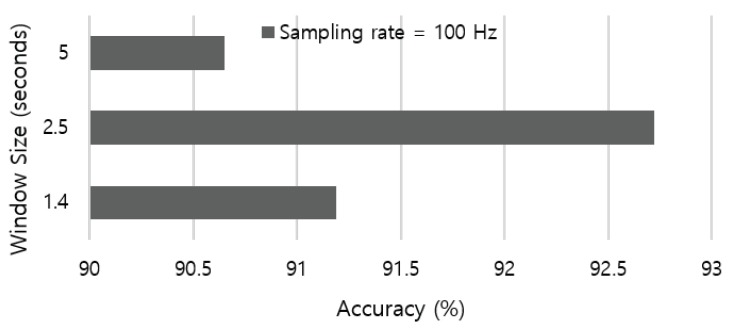
- Activity data with sampling rate as low as 10 Hz from four sensors at both wrists, right ankle, and waist was sufficient for recognizing ADLs including eating and driving; a 2.5 s sliding window outperformed other settings, with 25 samples covering 2.5 s.
- The four-sensor baseline achieved 93.0% recognition accuracy. Among three-sensor combinations, right wrist, right ankle, and waist was most competitive; with two sensors, placing one on the upper half and one on the lower half performed better than both on the upper or both on the lower half. Right wrist tended to outperform left wrist, and right ankle played a more critical role than waist.
- Single-modality accuracy was 92.18% for accelerometer, 85.22% for magnetometer, and 78.33% for gyroscope. Multimodal fusion reached up to 93.07% with stacking/voting, while soft-voting achieved 94.47% versus hard-voting at 93.48%, a 2.48% improvement over single-modal recognition.
- Activity-specific weights increased accuracy by 7.65% for walking upstairs and 36.97% for walking downstairs. Static activities were best detected by accelerometer, and fusing additional sensors could degrade sitting/standing accuracy; stair walking was often confused with plain walking.
Methods
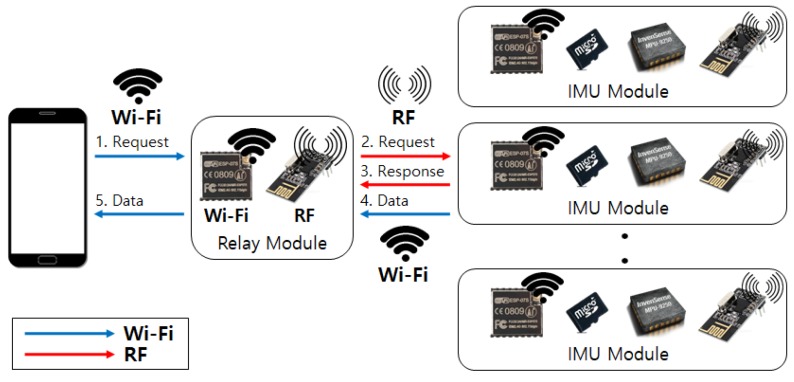
- A testbed with eight body-worn IMU sensors (MPU-9250) and an Android mobile device collected data from five researchers (two males, three females; ages 34–48; heights 160–175 cm; all right-handed) over three workdays, about three hours per subject, in real-world and controlled environments. Final configuration used four sensors on left/right wrist, right ankle, and waist.
- Raw sensor data were fed to an LSTM network with a 2.5 s sliding window and 50% overlap; parameters included batch size 150, one stacked LSTM layer, hidden neuron size 32, 25 steps, and keep probability 0.8. Evaluation used 10-fold cross-validation and leave-one-subject-out cross-validation with jittering data augmentation.
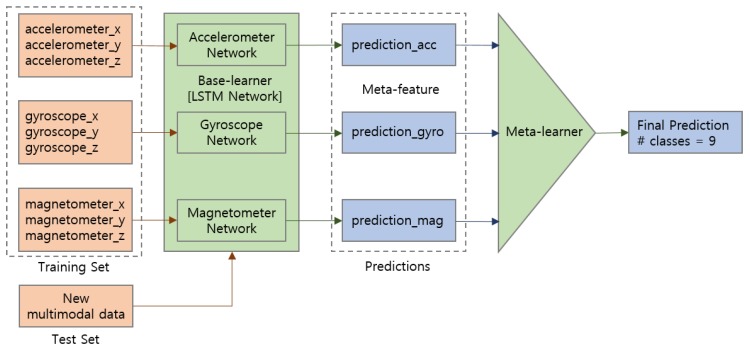
- Sensor fusion used classifier-level two-level ensembles: LSTM base learners per modality, stacking with Random Forest/kNN/SVM meta-learners (Random Forest adopted), and soft/hard voting with weights based on sensor accuracy or activity-specific characteristics.
Limitations
- The paper states that experiments used a small number of test subjects within the institution, that the meta-learner was evaluated only with classical algorithms (RF, kNN, SVM), and that future work should include large-scale/long-term experiments, additional sensing modalities, and online weight learning.
- Evident from the text: the pilot involved only five right-handed subjects with limited demographic variation, gyroscope data were used without calibration, and stair walking versus plain walking produced equivocal results.
Model-written summary. Check it against the paper before relying on it.
Integrity signals
Registry
Cites
Statistics
Figures




Verification
Claims the paper makes
4 Valid · 0 Not valid · 13 Not checked · 50 Own results and interpretations
The sources with a verdict support this claim; the rest weren’t checked yet, have no full text we could read, or their verdicts aren’t rated yet.
In the paper
“Authors of [18] surveyed ADLs and their occurrence in public HAR datasets, and we find that six primitive activity labels including walking, standing, sitting, lying, walking upstairs, and walking downstairs can cover daily activities listed in time-use survey results.”
§ Sensor Data Acquisition and Multimodal Sensor Fusion for Human Activity Recognition Using Deep Learning > 3. Testbed and Data Acquisition > 3.2. ADLs
What the sources say
- Not checked yetcites [37] (2019, April 09). The General Social Survey—Statistics Canada, Available online: https://www150.statcan.gc.ca/n1/pub/89f0115x/89f0115x2013001-eng.htm.
- Not checked yetcites [38] (2019, April 09). The time use Survey—Statistics Korea, Available online: http://kostat.go.kr/portal/eng/pressReleases/11/6/index.board.
- Supportedcites [18] Micucci, D., Mobilio, M., and Napoletano, P. (2017). UniMiB SHAR: A Dataset for Human Activity Recognition Using Acceleration Data from Smartphones. Appl. Sci., 7. source
Section 2.2 states that the authors analyzed ADLs across 24 publicly available datasets, and Figure 1 shows their occurrence in those datasets. The six-label coverage of time-use survey results is explicitly framed as the citing authors’ own finding, not a finding attributed to this source. (LLM, conf=0.94)
plain- Asserted: passes — The authors put it forward as true.
- Checkable: passes — It can be checked against evidence.
- Load-bearing: passes — The paper’s conclusions depend on it.
- Based: passes — The paper gives a reason why it holds.
The cited sources support only part of this claim — read each source’s verdict below.
In the paper
“However, as the dataset adopts heterogeneous sensors on limited position of the human body, it is not sufficient to evaluate the recognition performance according to the sensor position and sampling rate.”
§ Sensor Data Acquisition and Multimodal Sensor Fusion for Human Activity Recognition Using Deep Learning > 2. Related Work > 2.2. Mobile Sensing and Public Datasets
What the sources say
- Partly supportedcites [15] Vaizman, 2017, Recognizing Detailed Human Context in the Wild from Smartphones and Smartwatches, IEEE Pervasive Comput. sourceExperimental — accuracy not yet measured
Our copy supports the descriptive premise: the dataset is built from a phone app plus a companion Pebble smartwatch, with heterogeneous sensors sampled at different rates (Table 2, 'Sensor measurements' / 'EVALUATION AND RESULTS': accelerometer/gyro/magnetometer 40Hz, watch accelerometer 25Hz, compass and location variable, audio 22,050Hz reduced to MFCC), and body placement is limited to the wrist watch (DATA COLLECTION: 'the majority of the subjects (93%) were right handed, and chose to wear the smartwatch on their left wrist') plus the subjects' own phone in unconstrained positions. However, no passage states or argues that the dataset is insufficient to evaluate recognition performance as a function of sensor position or sampling rate; the paper instead treats unconstrained device placement as a desired in-the-wild condition to be overcome (Related work) and evaluates sensor modality/fusion, not position or sampling-rate effects (Performance evaluation; Fig. 3). That insufficiency conclusion is the citing authors' own inference, so only part of what is attributed to this source is in it. (LLM, conf=0.68)
- Not checked yetcites [16] Vaizman, Y., Ellis, K., Lanckriet, G., and Weibel, N. (2018, January 21–26). ExtraSensory App: Data Collection In-the-Wild with Rich User Interface to Self-Report Behavior. Proceedings of the 2018 CHI Conference on Human Factors in Computing Systems (CHI ’18), Montreal QC, Canada. source
plainstates a cause- Asserted: passes — The authors put it forward as true.
- Checkable: passes — It can be checked against evidence.
- Load-bearing: unclear — It is unclear whether the paper’s conclusions depend on it.
- Based: passes — The paper gives a reason why it holds.
- Partly supported
A result the paper reports from its own data — it cites no other source for it, so there is none to check. The quote shows it is in the paper.
In the paper
“From the experiment results, we identify that activity data with sampling rate as low as 10 Hz from four sensors at both sides of wrists, right ankle, and waist is sufficient in recognizing Activities of Daily Living (ADLs) including eating and driving activity.”
§ Sensor Data Acquisition and Multimodal Sensor Fusion for Human Activity Recognition Using Deep Learning > Abstract
plainstates a cause- Asserted: passes — The authors put it forward as true.
- Checkable: passes — It can be checked against evidence.
- Load-bearing: passes — The paper’s conclusions depend on it.
- Based: passes — The paper gives a reason why it holds.
- Rests on an assumption not shown here.
A result the paper reports from its own data — it cites no other source for it, so there is none to check. The quote shows it is in the paper.
In the paper
“We adopt a two-level ensemble model to combine class-probabilities of multiple sensor modalities, and demonstrate that a classifier-level sensor fusion technique can improve the classification performance.”
§ Sensor Data Acquisition and Multimodal Sensor Fusion for Human Activity Recognition Using Deep Learning > Abstract
boostedstates a cause- Asserted: passes — The authors put it forward as true.
- Checkable: passes — It can be checked against evidence.
- Load-bearing: passes — The paper’s conclusions depend on it.
- Based: passes — The paper gives a reason why it holds.
- Rests on an assumption not shown here.
A result the paper reports from its own data — it cites no other source for it, so there is none to check. The quote shows it is in the paper.
In the paper
“Participants experienced significant discomfort incurred by the sensor on the chest; we dropped the chest sensor in the final testbed configuration for its feasibility.”
§ Sensor Data Acquisition and Multimodal Sensor Fusion for Human Activity Recognition Using Deep Learning > 3. Testbed and Data Acquisition > 3.4. Final Testbed Configuration
plainstates a cause- Asserted: passes — The authors put it forward as true.
- Checkable: passes — It can be checked against evidence.
- Load-bearing: passes — The paper’s conclusions depend on it.
- Based: passes — The paper gives a reason why it holds.
41 more claims
Create a free account to see all 67 claims and to verify the 27 references still open.
- Probably not a substantial claim. 9
- It may state two separate claims as one. 12
- The quote only partly states this claim. 1
Claims other papers make about this one
Each is checked against this paper’s own text: does it say what the citing paper says it does?
The cited source doesn’t support the claim as written.
In the citing paper
“However, due to the lack of proper filtration and feature extraction techniques applied, the system was not able to recognize the ADL correctly.”
From A Multimodal IoT-Based Locomotion Classification System Using Features Engineering and Recursive Neural Network (2023) · cites this paper as [17]
Checked by a reasoning model — may be wrong.
Experimental — accuracy not yet measuredThe source backs part of the claim, not all of it — or backs it for a different population, condition or comparison.
In the citing paper
“In sensor-based HAR leveraging the temporal nature of IMU signals allows for the application of augmentation methods grounded in signal processing [32,34,99,132,141,178,193].”
From Past, Present, and Future of Sensor-based Human Activity Recognition Using Wearables: A Surveying Tutorial on a Still Challenging Task (2025) · cites this paper as [34]
Experimental — accuracy not yet measured
Citations
Cites
Hochreiter, S., & Schmidhuber, J. (1997) · Neural Computation · doi:10.1162/neco.1997.9.8.1735 · Cited by 102,318 · cited 2×
“As a variation of RNN architecture, LSTM [25] network is renowned for its capability to learn long-term dependencies in time-series data by the selective forget-and-update procedure.”
BackgroundMethodA systematic analysis of performance measures for classification tasks
Sokolova, M., & Lapalme, G. (2009) · Information Processing & Management · doi:10.1016/j.ipm.2009.03.002 · Cited by 7,515 · cited 1×
“On the other hand, macro-averaging F1-score is a harmonic mean of precision and recall measures, and takes both false positives and false negatives into account based on a per-class average [42].”
BackgroundDeep Convolutional and LSTM Recurrent Neural Networks for Multimodal Wearable Activity Recognition
Ordóñez, F., & Roggen, D. (2016) · Sensors · doi:10.3390/s16010115 · Cited by 2,761 · cited 1×
“Thus, LSTM network model is renowned for its performance on HAR domains [32].”
BackgroundDeep learning for sensor-based activity recognition: A survey
Wang, J., Chen, Y., Hao, S., Peng, X., & Hu, L. (2019) · Pattern Recognition Letters · doi:10.1016/j.patrec.2018.02.010 · Cited by 2,014 · cited 1×
“Besides the body-worn sensors, object sensors such as Radio Frequency Identifier (RFID) tags are widely used to infer human activities based on the movements detected in smart home environments [27].”
Background(2013) · RECERCAT (Consorci de Serveis Universitaris de Catalunya) · Cited by 1,959
Introducing a New Benchmarked Dataset for Activity Monitoring
Reiss, A., & Stricker, D. (2012) · 2012 16th International Symposium on Wearable Computers · doi:10.1109/iswc.2012.13 · Cited by 1,456 · cited 1×
“Previous work in the HAR literature empirically adopted 5.12 s-long window size [35,39].”
InfluentialThe Opportunity challenge: A benchmark database for on-body sensor-based activity recognition
Chavarriaga, R., Sagha, H., Calatroni, A., Digumarti, S. T., Tröster, G., Millán, J. D. R., & Roggen, D. (2013) · Pattern Recognition Letters · doi:10.1016/j.patrec.2012.12.014 · Cited by 742 · cited 1×
“Human activity recognition has been investigated using various sensor modalities [26].”
BackgroundUm, T. T., Pfister, F. M. J., Pichler, D., Endo, S., Lang, M., Hirche, S., Fietzek, U., & Kulić, D. (2017) · Proceedings of the 19th ACM International Conference on Multimodal Interaction · doi:10.1145/3136755.3136817 · Cited by 729 · cited 1×
“We apply the jittering method to simulate additive sensor noise using random parameters as described in [47] for label-preserving augmentation.”
MethodUnobtrusive Sensing and Wearable Devices for Health Informatics
Zheng, Y.-L., Ding, X.-R., Poon, C. C. Y., Lo, B. P. L., Zhang, H., Zhou, X.-L., Yang, G.-Z., Zhao, N., & Zhang, Y.-T. (2014) · IEEE Transactions on Biomedical Engineering · doi:10.1109/tbme.2014.2309951 · Cited by 722
Human Activity Recognition Using Wearable Sensors by Deep Convolutional Neural Networks
Jiang, W., & Yin, Z. (2015) · Proceedings of the 23rd ACM international conference on Multimedia · doi:10.1145/2733373.2806333 · Cited by 676 · cited 2×
“In this paper, we adopt a deep neural network architecture to recognize human activity from raw data input, which has shown promising results when adopted for interpreting human activities without complex data pre-processing for feature extraction [21–23].”
Method
Cited by
Items 101–200 of 236
Multimodal Sensor Data Fusion and Ensemble Modeling for Human Locomotion Activity Recognition
Oh, S. W., Jeong, H., Chung, S., Lim, J., & Noh, K. J. (2023) · ACM International Joint Conference on Pervasive and Ubiquitous Computing (UbiComp) · doi:10.1145/3594739.3610753 · Cited by 13
“There has already been a lot of research showing that sensor data fusion can improve recognition performance[1, 3, 6, 8, 9, 14].”
BackgroundSelf-citationEstimation of three-dimensional ground reaction forces using low-cost smart insoles
Zhang, D. H., Liu, Y., Exell, T., Huang, Y., Zhou, D., & Guo, L. (2025) · Intelligent Sports and Health · doi:10.1016/j.ish.2024.12.005 · Cited by 12
Anbalagan, E., & Anbhazhagan, S. M. (2023) · Expert Systems with Applications · doi:10.1016/j.eswa.2023.120337 · Cited by 12
Deep Learning Techniques for Radar-Based Continuous Human Activity Recognition
Mehta, R., Sharifzadeh, S., Palade, V., Tan, B., Daneshkhah, A., & Karayaneva, Y. (2023) · Machine Learning and Knowledge Extraction · doi:10.3390/make5040075 · Cited by 14
A Multi-Sensor Dataset for Human Activity Recognition Using Inertial and Orientation Data
Rivas-Caicedo, J. L., Saldaña-Aristizábal, L., Niño-Tejada, K., & Patarroyo-Montenegro, J. F. (2025) · Data · doi:10.3390/data10080129 · Cited by 13
Amawi, A. T., Grivas, G. V., & Alkasasbeh, W. J. (2026) · Frontiers in Public Health · doi:10.3389/fpubh.2026.1822194 · Cited by 14
“These data are typically acquired through multimodal sources, including wearable sensors, mobile applications (207), self-reported questionnaires (208), and video-tracking systems (209), which require synchronization and standardization to ensure temporal alignment across data streams.”
Zhang, Y., Hu, Z., Berger, U., & Pan, S. (2023) · ACM/IEEE International Conference on Information Processing in Sensor Networks (IPSN) · doi:10.1145/3583120.3586960 · Cited by 11
“Fusing on-body and off-body sensing is prevalent in indoor occupant sensing, given multimodal signals can provide complementary information for the same target, and therefore achieve robust information inference [7, 9, 12, 22, 36].”
BackgroundMadokoro, H., Nix, S., Woo, H., & Sato, K. (2021) · Applied Sciences · doi:10.3390/app112411807 · Cited by 11
Xi, Y., Huang, T., & Yang, Z. (2026) · Frontiers in Neurorobotics · doi:10.3389/fnbot.2026.1785114 · Cited by 11
“Approaches like King et al.'s (2017) data fusion techniques and Chung et al.'s (2019) multimodal acquisition frameworks have laid the ground-work.”
CIM: A Novel Clustering-based Energy-Efficient Data Imputation Method for Human Activity Recognition
Hussein, D., & Bhat, G. (2023) · ACM Transactions on Embedded Computing Systems · doi:10.1145/3609111 · Cited by 11
“In general, several recent studies have performed HAR with multiple sensors and concluded that multiple sensors offer benefits in accuracy and robustness [1, 5, 30].”
BackgroundSingle Accelerometer to Recognize Human Activities Using Neural Networks
Vakacherla, S. S., Kantharaju, P., Mevada, M. N., & Kim, M. (2023) · Journal of Biomechanical Engineering · doi:10.1115/1.4056767 · Cited by 11
Hsu, Y.-C., Wang, H., Zhao, Y., Chen, F., & Tsui, K.-L. (2021) · Journal of Medical Internet Research · doi:10.2196/30135 · Cited by 9
Human Activity Recognition Using Time Series Pattern Recognition Model-Based on Tsfresh Features
Luqian, S., & Yuyuan, Z. (2021) · International Wireless Communications and Mobile Computing Conference (IWCMC) · doi:10.1109/iwcmc51323.2021.9498859 · Cited by 9
Physiotherapy-based human activity recognition using deep learning
Deotale, D., Verma, M., Suresh, P., & Kumar, N. (2023) · Neural Computing and Applications · doi:10.1007/s00521-023-08307-4 · Cited by 11
Zhao, M., Xu, H. X., Zhong, W., Ming, X., Li, M., Hu, X., Jia, K., & Wang, D. (2023) · Sensors and Actuators A Physical · doi:10.1016/j.sna.2023.114549 · Cited by 9
An Optimal Feature Selection Method for Human Activity Recognition Using Multimodal Sensory Data
Haider, T., Khan, M. H., & Farid, M. S. (2024) · Information · doi:10.3390/info15100593 · Cited by 9
Recognition of Human Activities Based on Ambient Audio and Vibration Data
Koch, M., Pfitzinger, T., Schlenke, F., Kohlmorgen, F., Groll, R., & Wöhrle, H. (2024) · IEEE Access · doi:10.1109/access.2024.3457912 · Cited by 8
A Segmentation Scheme for Knowledge Discovery in Human Activity Spotting
Uslu, G., & Baydere, Ş. (2022) · IEEE Transactions on Cybernetics · doi:10.1109/tcyb.2021.3137753 · Cited by 11
StrokeRehab: A Benchmark Dataset for Sub-second Action Identification.
Kaku, A., Liu, K., Parnandi, A., Rajamohan, H. R., Venkataramanan, K., Venkatesan, A., Wirtanen, A., Pandit, N. G., Schambra, H. M., & Fernandez‐Granda, C. (2022) · PubMed · Cited by 12
Baseline Model Training in Sensor-Based Human Activity Recognition: An Incremental Learning Approach
Xiao, J., Chen, L., Chen, H., & Hong, X. (2021) · IEEE Access · doi:10.1109/access.2021.3077764 · Cited by 8
“The accuracy improvement comes from their capability to extract non-linear high-level features from sensor data using deep neural networks, e.g., Convolutional Neural Network (CNN) or Long Short-Term Memory (LSTM) [30], [31].”
BackgroundPerformance benchmarking of multimodal data-driven approaches in industrial settings
Altinses, D., & Schwung, A. (2025) · Machine Learning with Applications · doi:10.1016/j.mlwa.2025.100691 · Cited by 10
Hand gesture recognition via deep data optimization and 3D reconstruction
Mustafa, Z., Nsour, H., & Tahir, S. B. U. D. (2023) · PeerJ Computer Science · doi:10.7717/peerj-cs.1619 · Cited by 7
“Due to their decreasing rate and actual size, IMUs have subsequently become a standard technology found in telephones, smart watches, and smart bands ( Chung et al., 2019 ).”
BackgroundBiodegradable flexible triboelectric nanogenerator for winter sports monitoring
Liu, B., Xie, Z., Feng, Q., Wang, Y., Zhang, M., Lu, Z., Mao, Y., & Zhang, S. (2024) · Frontiers in Materials · doi:10.3389/fmats.2024.1400258 · Cited by 7
The Significance of IoT and Deep Learning in Activity Recognition
Thakur, D., & Saini, J. K. (2023) · Studies in computational intelligence · doi:10.1007/978-3-031-35783-1_18 · Cited by 8
Tasmin, M., Ishtiak, T., Ruman, S. U., Suhan, A. U. R. C., Islam, N. M. S., Jahan, S., Ahmed, S., Zulminan, M. S., Saleheen, A. R., & Rahman, R. M. (2020) · IEEE International Conference on Intelligent Systems · doi:10.1109/is48319.2020.9199934 · Cited by 10
“Sensor data for human activity recognition works are collected from wearable devices, smartphones and indoor infrastructure of wireless sensors [8].”
BackgroundManivannan, A., Willemse, E. J., Balamurali, B. T., Chin, W. C. B., Zhou, Y., Tunçer, B., Barrat, A., & Bouffanais, R. (2022) · IEEE Sensors Journal · doi:10.1109/jsen.2022.3157806 · Cited by 8
Epileptic Seizure Detection Based on Attitude Angle Signal of Wearable Device
Wang, J., Hu, D., Lai, X., Jiang, T., Jiang, T., Gao, F., Vidal, P., & Cao, J. (2025) · IEEE Transactions on Instrumentation and Measurement · doi:10.1109/tim.2025.3529058 · Cited by 6
“However, the study by Chung et al. [22] found that the size of the sliding window may directly or indirectly affect the final recognition accuracy.”
Heravi, M. Y., Jang, Y., & PhD, H. C. (2025) · Journal of Construction Engineering and Management · doi:10.1061/jcemd4.coeng-15888 · Cited by 6
Hasan, M. S., Ahmed, A., Rasool, N., Jabe, M. M. N., Zeng, X., & Pirzado, F. A. (2025) · Sensors · doi:10.3390/s25247688 · Cited by 6
“…Adaptive Lab Mentor (ALM) framework is at the intersection of three essential research domains: integrating Generative AI (LLM) [28] into Intelligent Tutoring Systems (ITS) [29], modernizing experiential learning environments, and using multimodal sensor fusion [30] for real-time fault diagnosis.”
Recognition of Human Activity from ECG and IMU Signals Using Deep Learning Networks
Mekruksavanich, S., Jantawong, P., & Jitpattanakul, A. (2022) · IEEE Region 10 Symposium (TENSYMP) · doi:10.1109/tensymp54529.2022.9864495 · Cited by 6
“The term ”human activity recogni-tion” relates to processing this signal data to extract useful information about daily human routines and physical activity patterns [3].”
BackgroundMekruksavanich, S., Jantawong, P., Hnoohom, N., & Jitpattanakul, A. (2022) · Research, Invention, and Innovation Congress: Innovative Electricals and Electronics (RI2C) · doi:10.1109/ri2c56397.2022.9910287 · Cited by 6
Dew Aeroponics: Dew-Enabled Smart Aeroponics System in Agriculture 4.0
Ghosh, B., Roy, S., Ahmed, N., & De, D. (2023) · Internet of things · doi:10.1007/978-981-99-4590-0_13 · Cited by 8
Forensic detection of heterogeneous activity in data using deep learning methods
Nyarko, B. N. E., Wu, B., Zhou, J., Odoom, J., Danso, S. A., & Gyarteng, E. S. A. (2023) · Intelligent Systems with Applications · doi:10.1016/j.iswa.2023.200303 · Cited by 6
A Topic-Guided Self-Attention Network for Daily Mental Wellbeing Prediction Using Mobile Devices
Xu, Z., Liu, G., Zhao, G., Zhang, Z., Li, C., & Wang, C. (2024) · IEEE Transactions on Affective Computing · doi:10.1109/taffc.2024.3471654 · Cited by 6
Kazemimoghadam, M., & Fey, N. P. (2020) · Sensors · doi:10.3390/s20185390 · Cited by 6
“[26] confirmed si ilar outcomes in a set of daily”
BackgroundResultJo, S.-H., Woo, J., & Jeong, J. H. (2025) · Expert Systems with Applications · doi:10.1016/j.eswa.2025.126739 · Cited by 5
IoT-Based System for Human Localization Activity Recognition Using Hybrid Deep Learning Techniques
Younis, M. C., Fadil, Z. J., & Bahnam, B. S. (2025) · INTELIGENCIA ARTIFICIAL · doi:10.4114/intartif.vol28iss75pp298-314 · Cited by 6
HAR-AttenNet: Multi-Head Transformer for Precise Human Activity Recognition Using Wearable Devices
Samoon, S., Laghari, G., Malkani, Y. A., & Shah, S. A. A. (2025) · VAWKUM Transactions on Computer Sciences · doi:10.21015/vtcs.v13i2.2179 · Cited by 5
Oh, S. W., Jeong, H., Chung, S., Lim, J., & Noh, K. J. (2024) · ACM International Joint Conference on Pervasive and Ubiquitous Computing (UbiComp) · doi:10.1145/3675094.3678462 · Cited by 5
“This reduces extraneous noise that may be present in the motion sensor data [2, 5], which was originally sampled at 100Hz.”
Self-citationA Multimodal Human Sensing System for Assisted Living
Sonia, S., & Semwal, T. (2020) · EAI Endorsed Transactions on Pervasive Health and Technology · doi:10.4108/eai.26-11-2020.167285 · Cited by 5
“…response, heat flux, and a 2-d accelerometer Multi-modal Sensing for Human Activity Modeling in the Real World Eight body-worn Inertial Measurement Units [31] Multiple properties Deep Learning Foot-mounted inertial sensors and multi-sensor fusion [32] Inertia, vibration Hybrid NN/HMM model Table 1.”
MethodMyDigitalFootprint: An extensive context dataset for pervasive computing applications at the edge
Campana, M. G., & Delmastro, F. (2020) · Pervasive and Mobile Computing · doi:10.1016/j.pmcj.2020.101309 · Cited by 9
A metaplastic neural network technique for human activity recognition for Alzheimer’s patients
Zaghdoud, A., & Jemai, O. (2023) · International Conference on Innovations in Intelligent Systems and Applications (INISTA) · doi:10.1109/inista59065.2023.10310437 · Cited by 6
“Recent developments driven by deep learning and sensor technology, as discussed in articles such as HAR with Deep Learning Models and HAR using multimodal sensor fusion, have rendered activity recognition more accurate and robust [5].”
BackgroundRFiDAR: Contactless RFID and Radar Data Fusion for Enhanced Human Activity Recognition
Khan, M. Z., Taylor, W., Usman, M., Ahmad, J. E., Ramzan, N., Khawaja, B. A., Vallappil, A. K., Imran, M. A., & Abbasi, Q. H. (2025) · IEEE Internet of Things Magazine · doi:10.1109/iotm.001.2400222 · Cited by 4
“Both methods have proven effective in applications such as fall detection and user interaction tracking, which are essential for elder care and disability support [13].”
Robot Object Detection and Tracking Based on Image–Point Cloud Instance Matching
Wang, H., Zhu, R., Ye, Z., & Li, Y. (2026) · Sensors · doi:10.3390/s26020718 · Cited by 4
“Effectively integrating these complementary modalities while maintaining real-time performance and system stability remains one of the core challenges in robotic perception systems [4,5].”
A multimodal spatio-temporal graph neural network framework for fatigue detection in tennis serving
Yuan, Y., Wang, L., Hui, J., & Jiao, J. (2026) · Frontiers in Bioengineering and Biotechnology · doi:10.3389/fbioe.2026.1828589 · Cited by 4
Keyvanpour, M. R., Mehrmolaei, S., Shojaeddini, S. V., & Esmaeili, F. (2023) · Multimedia Tools and Applications · doi:10.1007/s11042-023-16795-8 · Cited by 4
“They are used usually used in roofed places such as office buildings or houses [60].”
Deep Learning and the Internet of Things
Byabazaire, J., Tirana, J., Chouliaras, A., Koutsos, V., Aslanidis, T., Panagiotidis, I., & Chatzopoulos, D. (2025) · Wiley eBooks · doi:10.1002/9781394280490.ch8 · Cited by 5
Dmytryk, N., & Leivadeas, A. (2022) · Electronics · doi:10.3390/electronics11223816 · Cited by 4
Walking Trajectory Estimation Using Multi-Sensor Fusion and a Probabilistic Step Model
Rabb, E., & Steckenrider, J. J. (2022) · Sensors · doi:10.2139/ssrn.4181217 · Cited by 4
Kang, K.-Y., Lee, S., Kang, H., Kim, J., Tack, G., & Choi, J. (2022) · Applied Sciences · doi:10.3390/app12147243 · Cited by 4
Human activity detection using smartphone sensor data in real-time based on deep learning approaches
Bera, S., Pati, A., & Parhi, M. (2023) · AIP conference proceedings · doi:10.1063/5.0137525 · Cited by 4
A Study on the Influence of Sensors in Frequency and Time Domains on Context Recognition
de Souza, P., Silva, D., de Andrade, I., Dias, J., Lima, J. P., Teichrieb, V., Quintino, J. P., da Silva, F. Q. B., & Santos, A. L. M. (2023) · Sensors · doi:10.3390/s23125756 · Cited by 4
Classifying Participant Standing and Sitting Postures Using Channel State Information
Custance, O., Khan, S., & Parkinson, S. (2023) · Electronics · doi:10.3390/electronics12214500 · Cited by 5
Human Activity Recognition implenting the Yolo models
Garcia-Garcia, S., & Pinto-Elías, R. (2022) · International Conference on Mechatronics, Electronics and Automotive Engineering (ICMEAE) · doi:10.1109/icmeae58636.2022.00029 · Cited by 5
Sequence-to-Sequence Modeling for Action Identification at High Temporal ResolutionPreprint
Kaku, A., Liu, K., Parnandi, A., Rajamohan, H. R., Venkataramanan, K., Venkatesan, A., Wirtanen, A., Pandit, N. G., Schambra, H. M., & Fernandez‐Granda, C. (2021) · arXiv (Cornell University) · doi:10.48550/arxiv.2111.02521 · Cited by 5
“There also exist several works that perform action classification from kinematic data (Attal et al., 2015; Chung et al., 2019).”
Fire Hawks Optimizer with hybrid deep learning driven fall detection on multimodal sensor data
Bhavani, K. D., & Ukrit, M. F. (2024) · Multimedia Tools and Applications · doi:10.1007/s11042-024-19970-7 · Cited by 3
“Chung et al. [18] conducted a systematic analysis of the on-body sensor positioning and data acquisition parts for HAR system.”
A robust weighted late fusion approach for IoT
Nirala, V., & Ratneshwer (2025) · Internet of Things · doi:10.1016/j.iot.2025.101857 · Cited by 3
Chouhan, S. A. (2026) · Scientific Reports · doi:10.1038/s41598-026-41734-6 · Cited by 3
Brunyé, T. T., Petrimoulx, M. V., & Cantelon, J. A. (2026) · Sensors · doi:10.3390/s26072034 · Cited by 3
Toward Wearable Sensor-Based Human Activity Recognition: A Survey
Zou, H., Chen, Z., Pan, Y., & Li, J. (2026) · IEEE Internet of Things Journal · doi:10.1109/jiot.2026.3702134 · Cited by 3
“However, most research related to the term “multimodal” on supporting models remains focused on the fusion of sensing data with multimodalities [197], [215].”
Zha, M., Zhu, L., Zhu, Y., Li, J., & Hu, T. (2024) · Intelligent Systems with Applications · doi:10.1016/j.iswa.2024.200363 · Cited by 3
A flexible capacitive sensor with microstructure for handwriting recognition
Song, Y., Wu, L., Wang, F., Wang, H., Liu, T., & Hu, R. (2025) · Engineering Research Express · doi:10.1088/2631-8695/adc5c4 · Cited by 3
Zoghlami, F., Kaden, M., Villmann, T., Schneider, G., & Heinrich, H. (2021) · IEEE International Conference on Industrial Technology (ICIT) · doi:10.1109/icit46573.2021.9453551 · Cited by 3
“In this context, depth cameras and Inertial measurement units (IMUs) are mainly used in indoor fusion applications for tracking motions and body activities information like illustrated in [11] and [12].”
User-centric Activity Recognition and Prediction Model using Machine Learning Algorithms
Roy, N., Ahmed, R., Huq, M. R., & Shahriar, M. M. (2021) · International Journal of Advanced Computer Science and Applications · doi:10.14569/ijacsa.2021.0121265 · Cited by 2
Evaluating Classical Machine Learning Algorithms for Multimodal Human Activity Recognition
Fabian, C. L., Rosales, M. D., Orillaza, N. S., & Hizon, J. R. E. (2025) · International Conference on Advanced Machine Learning and Data Science (AMLDS) · doi:10.1109/amlds63918.2025.11159408 · Cited by 2
“With the widespread use of wearable devices, Human Activity Recognition (HAR) has become a rapidly expanding research area in mobile and wearable computing [1] [2] [3].”
Wibowo, I. K., Fatichah, C., Suciati, N., & Muchammad Ainun Fakhri, S. (2025) · International Electronics Symposium (IES) · doi:10.1109/ies67184.2025.11162000 · Cited by 3
“Several researchers [18][19][20][21][22] utilized multiple IMU sensors attached to their bodies, such as on the right wrist, left wrist, waist, right ankle, left ankle, cervix, chest, waist area, right wrist, and left wrist.”
TCP-HAR: On-Device Transferable and Copyright-Preserving Human Activity Recognition
Sacco, A., Palermo, B., Figliolino, G., Contoli, C., Marchetto, G., & Esposito, F. (2026) · Pervasive and Mobile Computing · doi:10.1016/j.pmcj.2026.102163 · Cited by 2
Applications of Object Detection and Localization
Elhanashi, A., & Saponara, S. (2026) · Springer eBooks · doi:10.1007/978-981-95-4846-0_5 · Cited by 2
Alonazi, M., Abro, I. A., Abdelhaq, M., Alsaqour, R. A., Jalal, A., & Liu, H. (2026) · Bioengineering · doi:10.3390/bioengineering13070718 · Cited by 3
“The integration of wearable sensing and computer vision technologies has shown significant potential for sports-performance assessment, rehabilitation evaluation, biomechanical analysis, and movement-quality assessment [3].”
Finding Points-of-Interest (PoIs) from Life-logging and Location Trace Data
Chung, S., Hwang, I., Lim, J., & Jeong, H. T. (2019) · International Conference on Information and Communication Technology Convergence (ICTC) · doi:10.1109/ictc46691.2019.8940021 · Cited by 2
“The trace data is collected from thirty subjects using our smartphone-based life-logging system [2], [3].”
MethodSelf-citationA Design of Smart Beaker Structure and Interaction Paradigm Based on Multimodal Fusion Understanding
Dong, D., Feng, Z., Yuan, J. H., Meng, X., Meng, J., & Kong, D. (2020) · IEEE Access · doi:10.1109/access.2020.3025229 · Cited by 2
“[25] studied sensor and data acquisition by human activity recognition (HAR) systems and the multi-modal fusion of activities of daily life (ADL) identified by different sensors.”
BackgroundSRNF-PAR: Strawberry and Recurrent Neural Framework-based Physiotherapy Activity Recognition
Deotale, D., Verma, M., Suresh, P., & Bharadwaj, A. (2024) · International Conference on Reliability, Infocom Technologies and Optimization (Trends and Future Directions) (ICRITO) · doi:10.1109/icrito61523.2024.10522121 · Cited by 2
“To anticipate the 3D positions of joints using an object recognition method, the employed individual depth data obtained from the Microsoft Kinect [12].”
Methodİnsan aktivite tanıması için yeni bir veri kümesi ve derin öğrenme modelleri ile sınıflandırılması
Vurgun, Y., & Kıran, M. S. (2024) · Gazi Üniversitesi Mühendislik-Mimarlık Fakültesi Dergisi · doi:10.17341/gazimmfd.1325926 · Cited by 2
Analysis of Multimodal Sensor Systems for Identifying Basic Walking Activities
Mitchell, J. K., Dehghani-Sanij, A. A., Xie, S. Q., & O’Connor, R. J. (2025) · Technologies · doi:10.3390/technologies13040152 · Cited by 3
“In the literature, Human Activity Recognition (HAR) studies can be separated into two categories that focus on convenience, typically making use of a smartphone or smart-watch [9,19], or accuracy by implementing a multimodal sensor system which can be cumbersome to wear [9,20,21].”
Trading and Pricing Sensor Data in Competing Edge Servers with Double Auction Markets
Shi, B., Song, Z., & Xu, J. (2021) · Journal of Sensors · doi:10.1155/2021/9651117 · Cited by 2
Human Activities Analysis Using Machine Learning Approaches
Gaur, D., & Dubey, S. K. (2021) · Algorithms for intelligent systems · doi:10.1007/978-981-16-5747-4_39 · Cited by 2
Ding, M., Abdullah, Q. D. L., & Hamid, S. B. A. (2022) · Mathematical Problems in Engineering · doi:10.1155/2022/2474047 · Cited by 2
“A long-term and short-term memory network framework was developed to support the training of deep learning models for human activity data obtained in the real world and controlled environment [1].”
BackgroundRetractedMultimodal deep learning model for human handover classification
Monir, I. A., Fakhr, M. W., & El-Bendary, N. (2022) · Bulletin of Electrical Engineering and Informatics · doi:10.11591/eei.v11i2.3690 · Cited by 2
“Continuing in the same line a work [16] performs systematic-study on on-body sensor positioning and data acquisition.”
Sensor fusion with multi-modal ground sensor network for endangered animal protection in large areas
Siewert, S. B., Zapata-Rivera, L. F., Aranzazu-Suescun, C., Waldron, G., Mangar, R., Raval, D., Vaddkkepurakkal, P., & Alshehri, F. (2024) · Signal processing, sensor fusion, and target recognition. Conference · doi:10.1117/12.3012684 · Cited by 1
Peng, S. S., Li, M., Song, B., Yu, D., Luo, Y., Yang, Q., Feng, Y., Yu, K., & Li, J. (2024) · Sensors · doi:10.3390/s24216857 · Cited by 1
“For instance, Chung et al. [10] and Fayyad et al. [11] have applied deep learning to better integrate data from multiple sensors for more accurate motion state recognition and positioning.”
BackgroundAdvancing Human Activity Recognition Using Ensemble Deep CNN-GRU Network
Khan, M. H., Ashfaq, N., Asif, A., & Farid, M. S. (2025) · Lecture notes in networks and systems · doi:10.1007/978-3-031-91235-1_8 · Cited by 1
Janaane, R., Preethika, S., Shweta, N., Nithiyaishwarya, A. R., Rajagopal, S., & Soangra, R. (2025) · International Conference on Sensors and Related Networks (SENNET) · doi:10.1109/sennet64220.2025.11135997 · Cited by 1
“Key variables—Time, Activity, Duration, and Location—enable behavioral analysis [25].”
Raza, M. O., Bhatti, S., Rasheed, J., & Aşuroğlu, T. (2025) · International Conference on Software, Knowledge, Information Management and Applications (SKIMA) · doi:10.1109/skima66621.2025.11155627 · Cited by 1
“Scientists investigated the cooperative effects of combining data streams from many sensors [11], including vital sensors, gyroscopes, and accelerometers [12].”
Dyadic Human-Robot Interaction: Emerging Technologies, Challenges, and Opportunities
Adebayo, S., Dessing, J. C., & McLoone, S. (2025) · Transactions on computer systems and networks · doi:10.1007/978-981-96-9471-6_1 · Cited by 1
Multi-modal sensor fusion and federated learning for TinyML on resource-constrained IoT devices
Do, P. H., Le, T. D., Dinh, T. D., & Pham, V. D. (2025) · International Journal of Parallel Emergent and Distributed Systems · doi:10.1080/17445760.2025.2592705 · Cited by 1
Li, C., Sun, J., Gao, Y., Feng, C., Wang, Z., Zhang, H., & Niu, W. (2026) · Biomedical Signal Processing and Control · doi:10.1016/j.bspc.2026.109820 · Cited by 1
Deep locomotion prediction learning over biosensors, ambient sensors, and computer vision
Javeed, M., Jalal, A., AlHammadi, D. A., & Lee, B. (2026) · PLoS ONE · doi:10.1371/journal.pone.0342793 · Cited by 1
PWLF: A Robust Weighted Late Multimodal Fusion Approach
Nirala, V., & Ratneshwer (2025) · International Conference on Intelligent Computing and Systems at the Edge (ICEdge) · doi:10.1109/icedge67252.2025.11412698 · Cited by 1
“Chung et al. [7] used a two-level ensemble model with IMU sensors (accelerometers, gyroscopes, magnetometers).”
Zhijie, X., Siek, H. L., & Lin, H. (2026) · Sensors and Materials · doi:10.18494/sam5902 · Cited by 1
Hammad, I. (2021) · DalSpace (Dalhousie University) · Cited by 3
Data Fusion for Human Activity Recognition Based on RF Sensing and IMU Sensor
Yu, Z., Zahid, A., Taylor, W., Abbas, H. T., Heidari, H., Imran, M. A., & Abbasi, Q. H. (2022) · Lecture notes of the Institute for Computer Sciences, Social Informatics and Telecommunications Engineering · doi:10.1007/978-3-030-95593-9_1 · Cited by 3
Autonomous Vehicles: A Survey on Sensor Fusion, Lane Detection and Drivable Area Segmentation
Morkar, T., Sonawane, S., Mahajan, A., & Shinde, S. V. (2022) · Smart innovation, systems and technologies · doi:10.1007/978-981-16-9447-9_52 · Cited by 1
Han, M. (2023) · International Journal of Human-Computer Interaction · doi:10.1080/10447318.2023.2277487 · Cited by 1
“Due to their decreasing rate and actual size, IMUs have subsequently become a standard technology found in tele-phones, smart watches, and smart bands (Chung et al., 2019).”
BackgroundRetractedDesign of human lower limb motion data acquisition system based on multi-sensor
Pang, P., Shi, Y., Liu, G., & Tang, L. (2024) · Journal of Physics Conference Series · doi:10.1088/1742-6596/2704/1/012034 · Cited by 1
“The system transmits the collected data to the host computer for storage through wireless transmission [5-6] .”
BackgroundHaresamudram, H., Tang, C. I., Suh, S., Lukowicz, P., & Ploetz, T. (2024) · arXiv · Cited by 31
“However, leveraging the temporal nature of accelerometer signals allows for the application of augmentation methods grounded in signal processing [29, 32, 95, 125, 134, 171, 184].”
Virtual Reality Tool for Learning Sign Language in Spanish
Viloria, A., Llerena, I., & Lezama, O. B. P. (2020) · Advances in intelligent systems and computing · doi:10.1007/978-3-030-53036-5_27
Learning probabilistic interaction models
BAYDOUN, M. (2020) · CINECA IRIS Institutial Research Information System (University of Genoa) · doi:10.15167/baydoun-mohamad_phd2020-02-26
Tasmin, M., Ruman, S. U., Ishtiak, T., Suhan, A. U. R. C., Alvi, R. H., Zulminan, M. S., & Rahman, R. M. (2021) · Studies in systems, decision and control · doi:10.1007/978-3-030-78124-8_6
Rfidar: Augmenting Human Activity Recognition Through Contactless Fusion of RFID and Radar DataPreprint
Khan, M. Z., Taylor, W., Ahmad, J. E., Usman, M., Ansari, S., Imran, M. A., & Abbasi, Q. H. (2024) · SSRN Electronic Journal · doi:10.2139/ssrn.4824678 · Cited by 2
Metadata
- Authors
- Chung, S., Lim, J., Noh, K. J., Kim, G., & Jeong, H.
- Affiliations
- Electronics and Telecommunications Research Institute (KR)
- Corresponding author
- Chung, Seungeun
- Venue
- Sensors
- Publisher
- MDPI AG
- Published
- 2019-04-10
- Volume
- 19
- Issue
- 7
- Pages
- 1716
- ISSN
- 1424-8220 (ISSN-L)
- PMC
- PMC6479605
- OpenAlex
- W2940096514
- Cited by
- 215
- References
- 48
- Citations by year
- 2026: 22 · 2025: 33 · 2024: 35 · 2023: 36 · 2022: 31 · 2021: 32 · 2020: 21 · 2019: 5
- FWCI
- 9.94
- Type
- journal article
- Language
- en
- Open access
- gold
- dx.doi.org
- Licence
- Locations
- Sensors (publishedVersion, cc-by)
- PubMed Central (publishedVersion, cc-by)
- PubMed (publishedVersion)
- DOAJ (DOAJ: Directory of Open Access Journals) (submittedVersion, cc-by-sa)
- Funders
- Electronics and Telecommunications Research Institute
- Topics
- Physical Sciences › Computer Science › Computer Vision and Pattern Recognition › Context-Aware Activity Recognition Systems
- Physical Sciences › Engineering › Biomedical Engineering › Gait Recognition and Analysis
- Physical Sciences › Computer Science › Computer Vision and Pattern Recognition › Human Pose and Action Recognition
- Keywords
- human activity recognition, inertial measurement unit, multimodal sensor fusion, ensemble learning, LSTM networks, activities of daily living, sampling frequency, sensor placement, eating
- MeSH terms
- Wearable Electronic Devices, Deep Learning, Standing Position, Activities of Daily Living, Algorithms, Automobile Driving, Humans, Human Activities, Monitoring, Physiologic, Biosensing Techniques, Walking, Multimodal Imaging
About these checks
Registry, retraction, Cites and statistics results are computed, not judged, with one exception: a printed reference that no index lists is read once by a model before it counts as a citation error. Claims are extracted by a model and kept only when their quote appears verbatim in the text; each cited source is then checked, with a model’s help, for whether it says what the claim relies on. Those verdicts can be wrong — read the claim’s quote and the cited source before relying on one.
The claim verdicts this report counts are experimental: their accuracy is not yet measured.
A language model drew the claims from the paper on 2026-10-05, under version 3 of the claim definition (model deepseek-v4.1-flash, prompt extract-v3).
A second model labelled each claim on 2026-10-05 (model jev-1.13-20260917, definition revision gold-guideline-v0.2).
Cited sources are checked with a language model’s help (gpt-6-sol and qwen3.8-omni-flash).
Statistics and arithmetic are recomputed, not judged.
Confidence bands are shown only for fields calibrated on our annotated test set. None is calibrated yet, so no band is shown.
What counts as a claim ›How we measure confidence ›How we check this ›
Are you an author, or do you see a problem with this page? Request a review
Data sources
Bibliographic data: Semantic Scholar, OpenAlex, Crossref.
Contains information from the Semantic Scholar Academic Graph Datasets, made available under the ODC Attribution License (ODC-BY 1.0).
Semantic Scholar’s data is described in: Kinney, R., et al. (2023). The Semantic Scholar Open Data Platform. arXiv:2301.10140.
