

Human Activity Recognition Based on Residual Network and BiLSTM
Open accessThe DOI matches its Crossref record; 40 of the 40 references it cites were found in a registry or an index.
Abstract
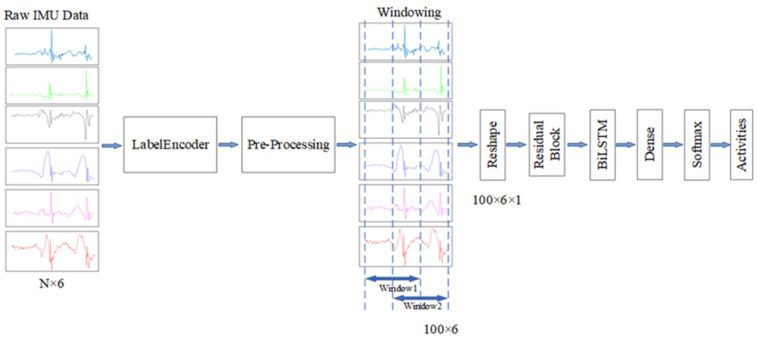
Due to the wide application of human activity recognition (HAR) in sports and health, a large number of HAR models based on deep learning have been proposed. However, many existing models ignore the effective extraction of spatial and temporal features of human activity data. This paper proposes a deep learning model based on residual block and bi-directional LSTM (BiLSTM). The model first extracts spatial features of multidimensional signals of MEMS inertial sensors automatically using the residual block, and then obtains the forward and backward dependencies of feature sequence using BiLSTM. Finally, the obtained features are fed into the Softmax layer to complete the human activity recognition. The optimal parameters of the model are obtained by experiments. A homemade dataset containing six common human activities of sitting, standing, walking, running, going upstairs and going downstairs is developed. The proposed model is evaluated on our dataset and two public datasets, WISDM and PAMAP2. The experimental results show that the proposed model achieves the accuracy of 96.95%, 97.32% and 97.15% on our dataset, WISDM and PAMAP2, respectively. Compared with some existing models, the proposed model has better performance and fewer parameters.
Overview
The claims and statistics of this paper haven’t been checked yet.
Free: it reads the open-access text and checks the first 5 claims that cite a source we can check. Create a free account to check every claim.
Integrity signals
Registry
Cites
Statistics
Figures








Verification
Claims the paper makes
The claims and statistics of this paper haven’t been checked yet.
Free: it reads the open-access text and checks the first 5 claims that cite a source we can check. Create a free account to check every claim.
Claims other papers make about this one
Each is checked against this paper’s own text: does it say what the citing paper says it does?
The source backs part of the claim, not all of it — or backs it for a different population, condition or comparison.
In the citing paper
“On the other hand, in the field of action recognition by videos, it has been proven efficient to train the models with a time series of frames [11].”
From DS-MS-TCN: Otago Exercises Recognition With a Dual-Scale Multi-Stage Temporal Convolutional Network (2024) · cites this paper as [11]
Experimental — accuracy not yet measuredThe check wasn’t confident either way, so it gives no verdict — never disputed.
In the citing paper
“All of these studies reported the advantages of MS-TCNs over the state-of-the-art CNN-LSTM.”
From DS-MS-TCN: Otago Exercises Recognition With a Dual-Scale Multi-Stage Temporal Convolutional Network (2024) · cites this paper as [11]
Experimental — accuracy not yet measuredThe check wasn’t confident either way, so it gives no verdict — never disputed.
In the citing paper
“Recently, multi-stage temporal convolutional networks (MSTCNs) were applied for action recognition by videos [11]. Then, there were several studies applying MS-TCNs for sensor data on food intake prediction [12] and physical activity recognition [13].”
From DS-MS-TCN: Otago Exercises Recognition With a Dual-Scale Multi-Stage Temporal Convolutional Network (2024) · cites this paper as [11]
Experimental — accuracy not yet measured
Self-check
Percentages, sums and reported differences re-computed from the paper’s own numbers.
The self-check needs the paper’s full text.
Citations
Cites
Deep Residual Learning for Image Recognition
He, K., Zhang, X., Ren, S., & Sun, J. (2016) · 2016 IEEE Conference on Computer Vision and Pattern Recognition (CVPR) · doi:10.1109/cvpr.2016.90 · Cited by 235,474 · cited 3×
“In the shallow network, the residual module can be also beneficial to improve network performance [30].”
BackgroundMethodInfluentialLearning long-term dependencies with gradient descent is difficult
Bengio, Y., Simard, P., & Frasconi, P. (1994) · IEEE Transactions on Neural Networks · doi:10.1109/72.279181 · Cited by 8,542 · cited 1×
“However, Bengio et al. [31] inform that RNN networks can recognize the data for only a moment, owing to the vanishing and exploding gradient issue.”
BackgroundActivity recognition using cell phone accelerometers
Kwapisz, J. R., Weiss, G. M., & Moore, S. A. (2011) · ACM SIGKDD Explorations Newsletter · doi:10.1145/1964897.1964918 · Cited by 2,912 · cited 3×
“In the existing studies, researches placed the smart device on the waist [6], pants pocket [7], or wrist [8], using the inertial measurement unit (IMU) in the smart device to collect human activity data.”
MethodIntroducing a New Benchmarked Dataset for Activity Monitoring
Reiss, A., & Stricker, D. (2012) · 2012 16th International Symposium on Wearable Computers · doi:10.1109/iswc.2012.13 · Cited by 1,456 · cited 1×
“The sampling frequency of the sensor is 100 Hz [34].”
BackgroundLSTM-CNN Architecture for Human Activity Recognition
Xia, K., Huang, J., & Wang, H. (2020) · IEEE Access · doi:10.1109/access.2020.2982225 · Cited by 851 · cited 1×
“Reference Accuracy F w Params WISDM CNN [15] 93.32% - - TSE-CNN [17] 95.7% 94.01% 9223 SC-CNN [6] 97.08% - 1,176,972 CNN-GRU [21] 97.21% 97.22% - LSTM-CNN [40] 95”
InfluentialReal-time human activity recognition from accelerometer data using Convolutional Neural Networks
Ignatov, A. (2018) · Applied Soft Computing · doi:10.1016/j.asoc.2017.09.027 · Cited by 814 · cited 3×
“In recent years, many CNN-based HAR methods which extracted features automatically have been proposed [15–17].”
MethodInfluentialSensor-based and vision-based human activity recognition: A comprehensive survey
Minh Dang, L., Min, K., Wang, H., Jalil Piran, M., Hee Lee, C., & Moon, H. (2020) · Pattern Recognition · doi:10.1016/j.patcog.2020.107561 · Cited by 730
Human Activity Recognition Using Wearable Sensors by Deep Convolutional Neural Networks
Jiang, W., & Yin, Z. (2015) · Proceedings of the 23rd ACM international conference on Multimedia · doi:10.1145/2733373.2806333 · Cited by 676 · cited 1×
“In [18], a deep convolutional neural network is proposed to perform an effective HAR.”
MethodDeep Learning Models for Real-time Human Activity Recognition with Smartphones
Wan, S., Qi, L., Xu, X., Tong, C., & Gu, Z. (2020) · Mobile Networks and Applications · doi:10.1007/s11036-019-01445-x · Cited by 594
Ramanujam, E., Perumal, T., & Padmavathi, S. (2021) · IEEE Sensors Journal · doi:10.1109/jsen.2021.3069927 · Cited by 455 · cited 1×
“Unlike the traditional machine learning, deep learning (DL) can process the preprocessed IMU data without extracting hand-crafted features and is widely used in the activity recognition [13,14].”
Background
Research works printed but not linked: 1
- Mahmud S. Tonmoy M.T.H. Bhaumik K.K. Rahman A.K.M.M. Amin M.A. Shoyaib M. Khan M.A.H. Ali A.A. Human Activity Recognition from Wearable Sensor Data Using Self-Attention arXiv 2020 2003.09018
Cited by
Items 101–178 of 178
A Sequential-Data Approach for Human Gait Parameter Estimation and Surgical Event Inference
Hamid, S., Khosa, I., Iftikhar, M. A., Usman, M. R., & Usman, M. A. (2024) · IEEE Access · doi:10.1109/access.2024.3493389 · Cited by 3
Alblwi, A. (2024) · Journal of Computational Science · doi:10.1016/j.jocs.2024.102377 · Cited by 3
Human Activity Recognition Using Efficientnet-B0 Deep Learning Model
Silpa, A. S., Benifa, J. V. B., Anu, K. P., & Vijayakumar, A. (2023) · International Conference on Intelligent Computing and Control for Engineering and Business Systems (ICCEBS) · doi:10.1109/iccebs58601.2023.10448623 · Cited by 3
Evolution from Handcrafted to Learned Representation Methods for Vision-Based Activity Recognition
Nagpal, D., & Gupta, S. (2023) · Advances in intelligent systems and computing · doi:10.1007/978-981-99-3608-3_53 · Cited by 3
Knowledge Extraction over Heterogeneous Data for Tunnel Engineering Scenarios Based on BiLSTM
Fu, L., Xu, Z., Min, M., Li, R., & Zhang, Q. (2023) · International Conference on Digital Society and Intelligent Systems (DSInS) · doi:10.1109/dsins60115.2023.10455423 · Cited by 2
“is unidirectional, limiting its ability to directly incorporate information from future time steps.”
BackgroundUsing AI-Based Techniques with Prisoners Who Suffer from Mental Illness
Pokhriyal, S., Bahuguna, R., Dixit, A. K., Memoria, M., Saxena, S., & Bhatt, V. (2024) · International Conference on Smart Devices (ICSD) · doi:10.1109/icsd60021.2024.10751522 · Cited by 2
“[11] Understanding human emotions requires paying close attention to a person's facial expressions as well as their general demeanor, which is something that has made major advancements in the study of cognitive science.”
WASENN: Wavelet Assisted Stochastic Enabled Neural Network for Human Activity Recognition
Sengupta, R., Polian, I., & Hayes, J. P. (2025) · IEEE Transactions on Circuits and Systems I Regular Papers · doi:10.1109/tcsi.2025.3540564 · Cited by 2
“We also aimed to design a hybrid network that achieves an accuracy of 98% comparable with the best-published works [10], [12].”
InfluentialRuder, M. C., Bacco, V. E. D., Patel, K., Zheng, R., Madden, K., Adili, A. F., & Kobsar, D. (2025) · Sensors · doi:10.3390/s25206318 · Cited by 2
“The model implemented in this study was structured identically to the architecture outlined by Li and Wang [17].”
InfluentialDual-Stream Sparse Transformer for Gait Recognition Based on Inertial Signals
Xia, Y., & Wang, H. (2025) · IEEE Sensors Journal · doi:10.1109/jsen.2025.3620838 · Cited by 2
“Li and Wang [14] developed a model based on cascaded residual blocks and bidirectional LSTM to extract spatial features from sensor data.”
Salama, A., Saatchi, R., Bagheri, M., Saleem, M., & Shad, M. U. (2025) · Algorithms · doi:10.3390/a18120780 · Cited by 2
Wong, C., Chen, H.-C., & Feng, H.-M. (2026) · Cybernetics & Systems · doi:10.1080/01969722.2026.2624545 · Cited by 2
“(Nafea, Abdul, and Muhammad 2024) 94.94% 94.91% CNN-Attention (Khan and Ahmad 2021) 95.38% 95.37% Attention-based methods 93.16% BiLSTM (Li and Wang 2022) 97.15% 97.35% Hybrid Learning (Ding, Abdel-Basset, and Mohamed 2023) 97.52% 97.51 97.85% TCM (Wei and Wang 2024) 98.35% 98.29% Feature Extraction and Fusion (Zeng e…”
InfluentialA multi-resolution CNN-LSTM architecture for sensor-based human activity recognition
Pareek, G., Singh, R. K., & Nigam, S. (2026) · Neural Computing and Applications · doi:10.1007/s00521-025-11719-z · Cited by 2
“Hybrid models that combine CNN, LSTM, and attention mechanisms [25, 26, 37] further illustrate the benefits of attention in sequential modeling.”
Telemedicine Based on Human Activity Recognition in Elderly Healthcare
Nia, R. G. N. N., Arzehgar, A., Dehdeleh, V., & Eslami, S. (2023) · Studies in health technology and informatics · doi:10.3233/shti230323 · Cited by 2
“In [6], a model is presented that combines residual block and bi-directional LSTM to extract features from multidimensional signals of microelectromechanical system inertial sensors, and the features are classified using a Softmax layer.”
MethodA Review of Deep Learning Techniques for Human Activity Recognition
Dhattarwal, A., & Ratnoo, S. (2023) · Lecture notes in networks and systems · doi:10.1007/978-3-031-27409-1_28 · Cited by 2
A Supervised Autoencoder for Human Activity Recognition with Inertial Sensors
An, J., Kwon, Y., & Cho, Y.-S. (2023) · IEEE International Conference on Big Data (BigData) · doi:10.1109/bigdata59044.2023.10416944 · Cited by 2
“Following the same preprocessing approach in previous study [16], [34] with different sensor data for neural network modeling, we perform the Z-score normalization for each sensor.”
MethodInfluentialSports Action Recognition and Standardized Training using Puma Optimization Based Residual Network
Huang, S. (2024) · International Conference on Intelligent Algorithms for Computational Intelligence Systems (IACIS) · doi:10.1109/iacis61494.2024.10721909 · Cited by 2
Unveiling Human Activity Patterns in Smart Cities Through a CNN-LSTM Approach
Ameur, I., Ameur, M. E. A., Ameur, M., & Degha, H. E. (2025) · Lecture notes in networks and systems · doi:10.1007/978-3-031-82112-7_4 · Cited by 2
Wang, X. (2025) · International Journal of Knowledge Management · doi:10.4018/ijkm.372448 · Cited by 2
Maria Anthony Kumar, L., Murugan, S., & Therasa Alphonsa, A. (2023) · International Journal of Electrical and Electronics Engineering · doi:10.14445/23488379/ijeee-v10i5p101 · Cited by 2
“Young Li and Luping Wang [19] present a DL method related to bi-directional LSTM (BiLSTM) and residual block.”
Convolutional Neural Network in Motion Detection for Physiotherapy Exercise Movement
Laistulloh, D. F., Handayani, A. N., Asmara, R. A., & Taw, P. (2024) · Knowledge Engineering and Data Science · doi:10.17977/um018v7i12024p27-39 · Cited by 2
Human Activity Recognition with Smartphones using Machine Learning Algorithm
Ghamya, K., Prema, K., Reddy, D. A., Varaprasad, K., Sai, K. N., & Tejesh, S. (2024) · International Conference on Knowledge Engineering and Communication Systems (ICKECS) · doi:10.1109/ickecs61492.2024.10617109 · Cited by 2
Enhancing Human Activity Recognition using PSOOptimized 1D CNN-GRU Model on Wearable Sensor Data
K.Ramalakshmi, Shukla, V. K., Raj, J. R. F., & Krishnan, R. S. (2025) · International Conference on Soft Computing for Security Applications (ICSCSA) · doi:10.1109/icscsa66339.2025.11171374 · Cited by 1
“Li and Wang [13] used a Residual Network with BiLSTM to model complex activity patterns.”
InfluentialLu, K., Liu, J., & Shi, Y. (2024) · E3S Web of Conferences · doi:10.1051/e3sconf/202452802006 · Cited by 1
Complex Indoor and Outdoor Scene Sensing Method Based on Satellite+Cellular Networks
Ding, Z., Yuan, G., Hu, E., Hu, Z. Y., Jiang, S., & Zeng, F. (2024) · International Conference on Virtual Reality, Image and Signal Processing (VRISP) · doi:10.1145/3700003.3700006 · Cited by 1
“Then, we innovatively propose to use CNN-BiLSTM to extract and classify the features in time series, combined with before and after data, so as to achieve accurate classification of scenes and scene switching [ 11 ] .”
Deep - learning based Human Activity Detection Model
Raveen, R., Rufai, S. Z., Haq, I. U., & Shah, H. A. (2024) · International Conference on Communication, Computing and Energy Efficient Technologies (I3CEET) · doi:10.1109/i3ceet61722.2024.10993627 · Cited by 1
“Three classifiers are utilized, which are as follows: Logistic regression : - it is one of the popular supervised machine learning algorithm that solve the problem of classification where sigmoid activation function is used that perform well in various human action detection technique[12].”
Device independent human activity recognition using deep learning technique
Kundu, S., Mallik, M., Saha, J., & Chowdhury, C. (2025) · Multimedia Tools and Applications · doi:10.1007/s11042-025-20960-6 · Cited by 1
SarcoNet: A Pilot Study on Integrating Clinical and Kinematic Features for Sarcopenia Classification
Balakrishnan, M., Kumar, J. S., Mathunny, J. J., Karthik, V., & Devaraj, A. (2025) · Diagnostics · doi:10.3390/diagnostics15192513 · Cited by 1
A systematic review of deep learning-based models for elderly and human activity recognition
Dalal, M., & Mittal, P. (2025) · Computer Science Review · doi:10.1016/j.cosrev.2025.100879 · Cited by 1
Kolawole, A. O., Irhebhude, M. E., & Odion, P. O. (2025) · Science Journal of University of Zakho · doi:10.25271/sjuoz.2025.13.3.1499 · Cited by 1
Mahalakshmi, S., & Nagarajan, V. (2025) · International Conference on Communication, Computer, and Information Technology (IC3IT) · doi:10.1109/ic3it66137.2025.11341216 · Cited by 1
Bayat, N., Tran, A., Kim, J.-H., & Park, J. (2026) · IEEE Transactions on Instrumentation and Measurement · doi:10.1109/tim.2026.3657490 · Cited by 1
“Long short-term memory (LSTM) models and bi-directional LSTM (BiLSTM) networks are also popular models for HAR, especially for temporal learning [68], [69], [70], often paired with CNN to capture temporal information [54], [71], [72].”
Chen, Y., Yang, L., Yang, J., Li, Y., & Zhou, J. (2026) · CHI Conference on Human Factors in Computing Systems · doi:10.1145/3772318.3791432 · Cited by 1
“The hybrid architecture [44], utilizing CNNs to extract local temporal motifs and BiLSTMs to model temporal context [9, 37], is specifically selected to address this multimodal temporal complexity.”
Self-citationMekruksavanich, S., & Jitpattanakul, A. (2026) · Lecture notes in networks and systems · doi:10.1007/978-3-032-26217-2_10 · Cited by 1
Human Activity Recognition Based on Extraction of Multi-feature Using Inertial Sensors
Chen, G., & Li, Y. (2023) · IEEE International Conference on Frontiers Technology of Information and Computer (ICFTIC) · doi:10.1109/icftic59930.2023.10456356 · Cited by 1
Self-citationAmbient Intelligence Ecosystem for Elderly Pattern Detection and Care Using Social Robots
Ramos, R. G., Domingo, J. D., Zalama, E., & Gómez‐García‐Bermejo, J. (2024) · IEEE International Conference on Internet of Things (iThings) and IEEE Green Computing and Communications (GreenCom) and IEEE Cyber, Physical and Social Computing (CPSCom) and IEEE Smart Data (SmartData) · doi:10.1109/ithings-greencom-cpscom-smartdata-cybermatics62450.2024.00061 · Cited by 1
“Alternative methodologies utilise smartphones for activity detection, such as the study conducted by Wan, S. et al. in [20], which achieved an accuracy over 90%.”
MethodYang, H. (2025) · Scientific Reports · doi:10.1038/s41598-025-05429-8 · Cited by 1
“This prevents features from being excessively transformed or attenuated in deep networks 21,22 .”
Human activity recognition: new approaches based on machine learning and deep learning
Garcia-Gonzalez, D. (2023) · RUC (Universidade Da Coruña) · doi:10.13140/rg.2.2.15979.71205 · Cited by 1
Liu, L., Wang, K., LI, Y., & Liu, Z. (2022) · Journal of Mechanics in Medicine and Biology · doi:10.1142/s021951942250066x
Self-citationAVALIAÇÃO DE MEDIDAS PARA RECUPERAÇÃO DE CURVAS SOBRE MOVIMENTOS CORPORAIS
Merencia, A. P., Lee, H., Takaki, W. S. R., Spolaôr, N., Maciel, M., & Chung, W. F. (2023) · Revista Foco · doi:10.54751/revistafoco.v16n3-112
Self-attention-based Human Activity Detection Using Wearable Sensors
Diwakar, S., Dwivedi, D., SINGH, S. P., & Sharma, M. K. (2023) · Lecture notes in electrical engineering · doi:10.1007/978-981-99-0969-8_66
SVMDnet: A Novel Framework for Elderly Activity Recognition based on Transfer Learning
Nagpal, D., & Gupta, S. (2023) · International Journal on Recent and Innovation Trends in Computing and Communication · doi:10.17762/ijritcc.v12i1.7910
Experimental analysis of accelerometer data for human activity recognition
AlAmeri, M., & Memon, Q. A. (2023) · International Conference on Mathematical and Statistical Physics, Computational Science, Education and Communication (ICMSCE) · doi:10.1117/12.3011422
Exploiting Spatial and Temporal Features for Deep Learning Based Human Activity Recognition
Cao, W., Shi, G., & Zhang, T. (2023) · IEEE International Conference on Parallel and Distributed Systems (ICPADS) · doi:10.1109/icpads60453.2023.00294
An Embedded System-Based Keypoint Detection Method for the Barthel Index Measurement
Chen, Y.-R., Huang, K.-Y., Chen, P., & Lee, Y.-T. (2024) · International Conference on Applied System Innovation · doi:10.1109/icasi60819.2024.10547808
A Survey on Deep Learning Based Human Activity Recognition System
Thomas, A. L., & Judith, J. E. (2024) · Communications in computer and information science · doi:10.1007/978-3-031-73065-8_10
A Multibranch LSTM-CNN Model for Human Activity Recognition
Kabir, S., Ahmed, M. U., Hossen, M. M., & Chowdhury, M. E. H. (2024) · Studies in computational intelligence · doi:10.1007/978-3-031-71821-2_6
Boulahia, M. A., Benharzallah, S., Titouna, F., & Dilekh, T. (2024) · International Conference on Innovative and Intelligent Information Technologies (IC3IT) · doi:10.1109/ic3it63743.2024.10869423
Research on Sentiment Analysis of Ceramic Review Texts Based on BERT-BiGRU-Attention
Wang, J., Yang, L., & Luan, W. (2024) · International Conference on Image Processing, Computer Vision and Machine Learning (ICICML) · doi:10.1109/icicml63543.2024.10958026
“In sentiment analysis tasks, BERT’s feature extraction capability significantly enhances sentiment classification accuracy, and it has been proven effective when combined with models such as BiLSTM [14] , BiGRU, and Attention mechanisms to further boost model performance.”
Badhagouni, S. K., Raju, V., Yoganand, B. V., & Pushkarna, G. (2025) · AIP conference proceedings · doi:10.1063/5.0262819
Liu, Z. (2025) · Applied and Computational Engineering · doi:10.54254/2755-2721/2025.mh24964
A Hybrid Deep Learning Approach with MAOA Optimization for Enhanced Human Activity Recognition
Soni, V., Meena, S., Yadav, H., Sinha, A., & Semwal, V. B. (2025) · International Conference on Recent Advances in Information Technology · doi:10.1109/rait65068.2025.11088909
“Similarly, Li and Wang [18] extended this hybrid architecture by incorporating residual connections and BiLSTM layers, improving sequential dependency modeling.”
Kim, H., Lim, Y., & Kim, D. (2025) · Journal of the Korean Society for Precision Engineering · doi:10.7736/jkspe.025.058
Human Activity Detection Using Improved Structure of ResNet101 Deep Learning Model
Hasan, F. M., Mahmood, S. A., & Saeed, E. M. H. (2025) · Lecture notes in networks and systems · doi:10.1007/978-981-96-5535-9_29
Bhattacharya, D., Sahoo, K. K., Singh, P., & Mahmud, M. (2025) · Lecture notes in networks and systems · doi:10.1007/978-981-96-3860-4_12
Dias, T. S., Mendes, J. J. A., Lopes, H. S., Silva, T. H., & Pichorim, S. F. (2025) · Biomedical Signal Processing and Control · doi:10.1016/j.bspc.2025.108736
HUMAN ACTION RECOGNITION NETWORK CLASSIFIER LEVERAGING SVM-DIRECTED MACHINE LEARNING
Banu, R. (2025) · International Journal of Apllied Mathematics · doi:10.12732/ijam.v38i10s.1021
“In the paper [8, 9] discusses about author developed a novel based 1D-CNN deep learning approach for recognizing human activities in this work, which focused on sensor-based activity detection.”
Advancing Model Explainability in Pervasive Computing
Huang, Y. (2024) · Repository KITopen (Karlsruhe Institute of Technology) · doi:10.5445/ir/1000177453
Flexibilní elektronika a Smart textilie
Justa, J. (2023) · Digital Library (University of West Bohemia)
Snoussi, K. (2025) · Espace ÉTS (ETS)
Ruder, M. (2025) · MacSphere (McMaster University) · doi:10.71548/8076
Das, S., Saha, A., & Chowdhury, C. (2026) · Lecture notes in computer science · doi:10.1007/978-3-032-15621-1_31
Oylum, K. N., & Bilgin, T. T. (2025) · The European Journal of Research and Development · doi:10.56038/ejrnd.v5i1.669
Action Graph-driven Video Synthesis System: An Improved Machine Learning Architecture
Kumar, S., Sandhu, A., & Singh, G. (2025) · International Symposium on Advanced Electrical and Communication Technologies (ISAECT) · doi:10.1109/isaect68904.2025.11318761
“The study ignore the temporal features that limits its applicability [10].”
Shang, L. (2026) · Egyptian Informatics Journal · doi:10.1016/j.eij.2025.100881
Intelligent Healing Spaces: AI-Powered Pose Tracking for Physiotherapy Rehabilitation
Naik, D. N., Jamage, M., Pitre, A., Pokharkar, P., & Patil, R. (2025) · IEEE International Conference for Women in Computing (InCoWoCo) · doi:10.1109/incowoco68239.2025.11406219
“The system aims at helping people avoid injuries and perform exercises properly [12].”
Hybrid Deep Learning Models for Free-Living Imbalanced Human Activity Recognition: Comparative Study
Prathama, A. H., Milliaan, J., & Ghandy (2026) · Jurnal RESTI (Rekayasa Sistem dan Teknologi Informasi) · doi:10.29207/resti.v10i2.6936
Deep Sequential Learning for Complex Human Activity Recognition Using Video-Based Motion Features
Mehta, M. R., Chawla, Y., & Shah, M. K. (2026) · World Conference on Computational Science and Technology (WcCST) · doi:10.1109/wccst67302.2026.11496253
“A model developed by Microsoft Research in 2015, ResNet (an abbreviation for Residual Network) took first place in the ILSVRC competition [16].”
Rani, G. J., & Hashmi, M. F. (2026) · Neural Computing and Applications · doi:10.1007/s00521-026-12008-z
“Bi-LSTM [ 12] 97.32 - - 99 CNN [ 39] 98.20 The CCFST model achieves high accuracy; however, certain activities exhibit similar sEMG signal characteristics, enabling differentiation difficult, as given in Fig.”
InfluentialRuder, M. C., Bacco, V. E. D., Madden, K., Adili, A. F., & Kobsar, D. (2026) · Gait & Posture · doi:10.1016/j.gaitpost.2026.110232
Research on Electric Shock Diagnosis under Insulation Defects Based on Bi-GRU-ATT
Liu, R., Liu, Y., Wu, Z., Guo, F., & Cai, H. (2026) · Asia Conference on Power and Electrical Engineering (ACPEE) · doi:10.1109/acpee69242.2026.11524339
“An adjustable resistor box is used to simulate varying degrees of insulation degradation, while pork tissue is adopted to represent the equivalent electrical characteristics of the human body [3].”
Bao, M. (2026) · Scientific Reports · doi:10.1038/s41598-026-58913-0
“In basketball games, some actions or events have a greater impact on the outcome, such as shooting motions, breakthrough timing, or pick-and-roll coordination of key players 25 .”
A Multi-Modal Spatio-Temporal Framework for Collective Activity Recognition
Zahra, I., & Jalal, A. (2026) · International Conference on IT and Industrial Technologies (ICIT) · doi:10.1109/icit68548.2026.11577725
“Each participant’s GAT-enriched feature sequence {fₜ}ₜ₌₁ᵀ is processed simultaneously in forward and reverse temporal directions by a Bidirectional LSTM [15]:”
Boulahia, M. A., Benharzallah, S., Laouid, A., Titouna, F., & Dilekh, T. (2026) · Multimedia Tools and Applications · doi:10.1007/s11042-026-21796-4
“Li & Wang (2022) proposed a ResNet-BiLSTM hybrid model and reached 97.15% accu - racy [30].”
InfluentialGEN‐HAR : Generative Diffusion Learning for Human Activity Recognition
Singh, R., Ata-us-Samad, Sharma, A., Bhatia, V., & Aleem, A. (2026) · Wiley eBooks · doi:10.1002/9781394403158.ch10
Shen, Z., Gao, B., & Shi, M. (2026) · World Congress on Medical Physics and Biomedical Engineering, September 7 - 12, 2009, Munich, Germany · doi:10.1007/978-3-032-20291-8_18
길인호, Ha, S., Oh, J., Lee, D., Hwang, S., No, J. K., & Kim, W. (2026) · Sensors · doi:10.3390/s26175678
Xie, D., Yan, P., Li, Y., Wang, Q., & Liu, J. (2026) · Sensors · doi:10.3390/s26185879
“Hybrid architectures such as CNN-LSTM [24] and CNN-BiGRU [25] have emerged as widely adopted benchmark models, in which CNNs extract spatial features, and RNNs capture the temporal evolution of sequential information.”
Self-citationA Novel Transfer Learning based Multi-Feature Fusion Framework for Elderly Activity Recognition
Nagpal, D., & Gupta, S. (2023) · International Journal of Intelligent Systems and Applications in Engineering
Metadata
- Authors
- Li, Y., & Wang, L.
- Affiliations
- Sun Yat-sen University (CN)
- Corresponding author
- Wang, Luping
- Venue
- Sensors
- Publisher
- MDPI AG
- Published
- 2022-01-14
- Volume
- 22
- Issue
- 2
- Pages
- 635
- ISSN
- 1424-8220 (ISSN-L)
- PMC
- PMC8778132
- OpenAlex
- W4206703604
- Cited by
- 156
- References
- 40
- Citations by year
- 2026: 17 · 2025: 34 · 2024: 43 · 2023: 47 · 2022: 15
- FWCI
- 11.37
- Type
- journal article
- Language
- en
- Open access
- gold
- doi.org
- Licence
- Locations
- Sensors (publishedVersion, cc-by)
- PubMed Central (publishedVersion, cc-by)
- PubMed (publishedVersion)
- DOAJ (DOAJ: Directory of Open Access Journals) (submittedVersion, cc-by-sa)
- Topics
- Physical Sciences › Computer Science › Computer Vision and Pattern Recognition › Context-Aware Activity Recognition Systems
- Physical Sciences › Engineering › Biomedical Engineering › Gait Recognition and Analysis
- Physical Sciences › Computer Science › Computer Vision and Pattern Recognition › Human Pose and Action Recognition
- Keywords
- human activity recognition, inertial sensors, MEMS sensors, residual blocks, bidirectional LSTM, spatial feature extraction, temporal feature extraction, wearable sensors, WISDM, PAMAP2
- MeSH terms
- Deep Learning, Humans, Human Activities, Running, Walking, Neural Networks, Computer
About these checks
Registry, retraction, Cites and statistics results are computed, not judged, with one exception: a printed reference that no index lists is read once by a model before it counts as a citation error. Claims are extracted by a model and kept only when their quote appears verbatim in the text; each cited source is then checked, with a model’s help, for whether it says what the claim relies on. Those verdicts can be wrong — read the claim’s quote and the cited source before relying on one.
Statistics and arithmetic are recomputed, not judged.
Confidence bands are shown only for fields calibrated on our annotated test set. None is calibrated yet, so no band is shown.
What counts as a claim ›How we measure confidence ›How we check this ›
Are you an author, or do you see a problem with this page? Request a review
Data sources
Bibliographic data: Semantic Scholar, OpenAlex, Crossref.
Contains information from the Semantic Scholar Academic Graph Datasets, made available under the ODC Attribution License (ODC-BY 1.0).
Semantic Scholar’s data is described in: Kinney, R., et al. (2023). The Semantic Scholar Open Data Platform. arXiv:2301.10140.
