

Human Activity Recognition Based on Residual Network and BiLSTM
Open accessThe DOI matches its Crossref record; 40 of the 40 references it cites were found in a registry or an index.
Abstract
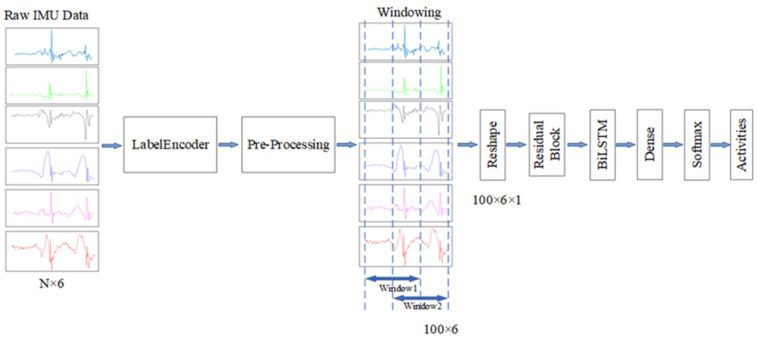
Due to the wide application of human activity recognition (HAR) in sports and health, a large number of HAR models based on deep learning have been proposed. However, many existing models ignore the effective extraction of spatial and temporal features of human activity data. This paper proposes a deep learning model based on residual block and bi-directional LSTM (BiLSTM). The model first extracts spatial features of multidimensional signals of MEMS inertial sensors automatically using the residual block, and then obtains the forward and backward dependencies of feature sequence using BiLSTM. Finally, the obtained features are fed into the Softmax layer to complete the human activity recognition. The optimal parameters of the model are obtained by experiments. A homemade dataset containing six common human activities of sitting, standing, walking, running, going upstairs and going downstairs is developed. The proposed model is evaluated on our dataset and two public datasets, WISDM and PAMAP2. The experimental results show that the proposed model achieves the accuracy of 96.95%, 97.32% and 97.15% on our dataset, WISDM and PAMAP2, respectively. Compared with some existing models, the proposed model has better performance and fewer parameters.
Overview
The claims and statistics of this paper haven’t been checked yet.
Free: it reads the open-access text and checks the first 5 claims that cite a source we can check. Create a free account to check every claim.
Integrity signals
Registry
Cites
Statistics
Figures








Verification
Claims the paper makes
The claims and statistics of this paper haven’t been checked yet.
Free: it reads the open-access text and checks the first 5 claims that cite a source we can check. Create a free account to check every claim.
Claims other papers make about this one
Each is checked against this paper’s own text: does it say what the citing paper says it does?
The source backs part of the claim, not all of it — or backs it for a different population, condition or comparison.
In the citing paper
“On the other hand, in the field of action recognition by videos, it has been proven efficient to train the models with a time series of frames [11].”
From DS-MS-TCN: Otago Exercises Recognition With a Dual-Scale Multi-Stage Temporal Convolutional Network (2024) · cites this paper as [11]
Experimental — accuracy not yet measuredThe check wasn’t confident either way, so it gives no verdict — never disputed.
In the citing paper
“All of these studies reported the advantages of MS-TCNs over the state-of-the-art CNN-LSTM.”
From DS-MS-TCN: Otago Exercises Recognition With a Dual-Scale Multi-Stage Temporal Convolutional Network (2024) · cites this paper as [11]
Experimental — accuracy not yet measuredThe check wasn’t confident either way, so it gives no verdict — never disputed.
In the citing paper
“Recently, multi-stage temporal convolutional networks (MSTCNs) were applied for action recognition by videos [11]. Then, there were several studies applying MS-TCNs for sensor data on food intake prediction [12] and physical activity recognition [13].”
From DS-MS-TCN: Otago Exercises Recognition With a Dual-Scale Multi-Stage Temporal Convolutional Network (2024) · cites this paper as [11]
Experimental — accuracy not yet measured
Self-check
Percentages, sums and reported differences re-computed from the paper’s own numbers.
The self-check needs the paper’s full text.
Citations
Cites
Deep Residual Learning for Image Recognition
He, K., Zhang, X., Ren, S., & Sun, J. (2016) · 2016 IEEE Conference on Computer Vision and Pattern Recognition (CVPR) · doi:10.1109/cvpr.2016.90 · Cited by 235,474 · cited 3×
“In the shallow network, the residual module can be also beneficial to improve network performance [30].”
BackgroundMethodInfluentialLearning long-term dependencies with gradient descent is difficult
Bengio, Y., Simard, P., & Frasconi, P. (1994) · IEEE Transactions on Neural Networks · doi:10.1109/72.279181 · Cited by 8,542 · cited 1×
“However, Bengio et al. [31] inform that RNN networks can recognize the data for only a moment, owing to the vanishing and exploding gradient issue.”
BackgroundActivity recognition using cell phone accelerometers
Kwapisz, J. R., Weiss, G. M., & Moore, S. A. (2011) · ACM SIGKDD Explorations Newsletter · doi:10.1145/1964897.1964918 · Cited by 2,912 · cited 3×
“In the existing studies, researches placed the smart device on the waist [6], pants pocket [7], or wrist [8], using the inertial measurement unit (IMU) in the smart device to collect human activity data.”
MethodIntroducing a New Benchmarked Dataset for Activity Monitoring
Reiss, A., & Stricker, D. (2012) · 2012 16th International Symposium on Wearable Computers · doi:10.1109/iswc.2012.13 · Cited by 1,456 · cited 1×
“The sampling frequency of the sensor is 100 Hz [34].”
BackgroundLSTM-CNN Architecture for Human Activity Recognition
Xia, K., Huang, J., & Wang, H. (2020) · IEEE Access · doi:10.1109/access.2020.2982225 · Cited by 851 · cited 1×
“Reference Accuracy F w Params WISDM CNN [15] 93.32% - - TSE-CNN [17] 95.7% 94.01% 9223 SC-CNN [6] 97.08% - 1,176,972 CNN-GRU [21] 97.21% 97.22% - LSTM-CNN [40] 95”
InfluentialReal-time human activity recognition from accelerometer data using Convolutional Neural Networks
Ignatov, A. (2018) · Applied Soft Computing · doi:10.1016/j.asoc.2017.09.027 · Cited by 814 · cited 3×
“In recent years, many CNN-based HAR methods which extracted features automatically have been proposed [15–17].”
MethodInfluentialSensor-based and vision-based human activity recognition: A comprehensive survey
Minh Dang, L., Min, K., Wang, H., Jalil Piran, M., Hee Lee, C., & Moon, H. (2020) · Pattern Recognition · doi:10.1016/j.patcog.2020.107561 · Cited by 730
Human Activity Recognition Using Wearable Sensors by Deep Convolutional Neural Networks
Jiang, W., & Yin, Z. (2015) · Proceedings of the 23rd ACM international conference on Multimedia · doi:10.1145/2733373.2806333 · Cited by 676 · cited 1×
“In [18], a deep convolutional neural network is proposed to perform an effective HAR.”
MethodDeep Learning Models for Real-time Human Activity Recognition with Smartphones
Wan, S., Qi, L., Xu, X., Tong, C., & Gu, Z. (2020) · Mobile Networks and Applications · doi:10.1007/s11036-019-01445-x · Cited by 594
Ramanujam, E., Perumal, T., & Padmavathi, S. (2021) · IEEE Sensors Journal · doi:10.1109/jsen.2021.3069927 · Cited by 455 · cited 1×
“Unlike the traditional machine learning, deep learning (DL) can process the preprocessed IMU data without extracting hand-crafted features and is widely used in the activity recognition [13,14].”
BackgroundMulti-input CNN-GRU based human activity recognition using wearable sensors
Dua, N., Singh, S. N., & Semwal, V. B. (2021) · Computing · doi:10.1007/s00607-021-00928-8 · Cited by 432 · cited 2×
“To solve the problem, Long Short-Term Memory (LSTM) network has been widely used in HAR because of its advantages in extracting long-term dependence within time series [20,21].”
MethodInfluentialDeep Residual Bidir-LSTM for Human Activity Recognition Using Wearable Sensors
Zhao, Y., Yang, R., Chevalier, G., Xu, X., & Zhang, Z. (2018) · Mathematical Problems in Engineering · doi:10.1155/2018/7316954 · Cited by 348
LSTM Networks Using Smartphone Data for Sensor-Based Human Activity Recognition in Smart Homes
Mekruksavanich, S., & Jitpattanakul, A. (2021) · Sensors · doi:10.3390/s21051636 · Cited by 335 · cited 1×
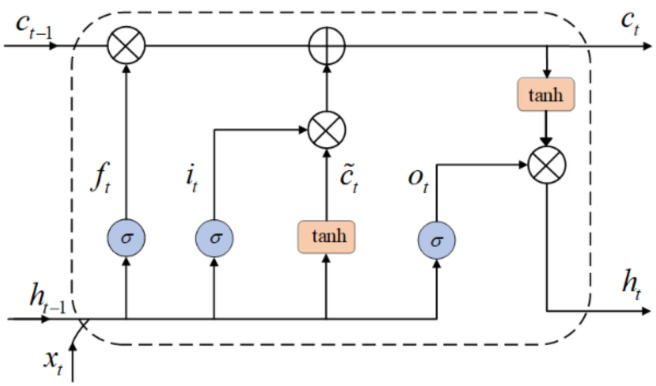
“LSTM is a special type of RNN that solves the problem of long-time dependence of time series due to its special memory cells [32].”
BackgroundHuman Activity Recognition from Accelerometer Data Using a Wearable Device
Casale, P., Pujol, O., & Radeva, P. (2011) · Lecture Notes in Computer Science · doi:10.1007/978-3-642-21257-4_36 · Cited by 335 · cited 1×
“Therefore, sensor-based approaches are more suitable for human activity recognition [5].”
BackgroundA Review on Human Activity Recognition Using Vision-Based Method
Zhang, S., Wei, Z., Nie, J., Huang, L., Wang, S., & Li, Z. (2017) · Journal of Healthcare Engineering · doi:10.1155/2017/3090343 · Cited by 328 · cited 1×
“The HAR technologies could be divided into two categories: camera-based and sensor-based [3,4].”
BackgroundClassification Accuracies of Physical Activities Using Smartphone Motion Sensors
Wu, W., Dasgupta, S., Ramirez, E. E., Peterson, C., & Norman, G. J. (2012) · Journal of Medical Internet Research · doi:10.2196/jmir.2208 · Cited by 316 · cited 1×
“In [9], a k-nearest neighbor (KNN) model was used to classify human action, but some similar activities could not be distinguished.”
MethodDanHAR: Dual Attention Network for multimodal human activity recognition using wearable sensors
Gao, W., Zhang, L., Teng, Q., He, J., & Wu, H. (2021) · Applied Soft Computing · doi:10.1016/j.asoc.2021.107728 · Cited by 214
Deep ConvLSTM With Self-Attention for Human Activity Decoding Using Wearable Sensors
Singh, S. P., Sharma, M. K., Lay-Ekuakille, A., Gangwar, D., & Gupta, S. (2021) · IEEE Sensors Journal · doi:10.1109/jsen.2020.3045135 · Cited by 199 · cited 1×
“The proposed model was trained by minimizing the cross entropy using the Adam optimizer as in [37].”
MethodSensor-Based Human Activity Recognition with Spatio-Temporal Deep Learning
Nafea, O., Abdul, W., Muhammad, G., & Alsulaiman, M. (2021) · Sensors · doi:10.3390/s21062141 · Cited by 160 · cited 2×
“A lot of recent work on HAR focused on the hybrid model of CNN and RNN. Nafea et al. [25] proposed a model using CNN with varying kernel dimensions along with BiLSTM to obtain features at different resolutions.”
BackgroundMethodTSE-CNN: A Two-Stage End-to-End CNN for Human Activity Recognition
Huang, J., Lin, S., Wang, N., Dai, G., Xie, Y., & Zhou, J. (2020) · IEEE Journal of Biomedical and Health Informatics · doi:10.1109/jbhi.2019.2909688 · Cited by 145 · cited 3×
“In recent years, many CNN-based HAR methods which extracted features automatically have been proposed [15–17].”
BackgroundMethodInfluentialZhao, C., Huang, X., Li, Y., & Iqbal, M. Y. (2020) · Sensors · doi:10.3390/s20247109 · Cited by 143 · cited 1×
“As the scale of raw data from different sensors varies greatly, the unprocessed data with big fluctuation affected the performance of network [35].”
BackgroundSelf-citationMekruksavanich, S., & Jitpattanakul, A. (2021) · Electronics · doi:10.3390/electronics10141685 · Cited by 138 · cited 1×
“In [27], four deep learning hybrid models composed of CNN and RNN were studied to recognize complex activities.”
MethodST-DeepHAR: Deep Learning Model for Human Activity Recognition in IoHT Applications
Abdel-Basset, M., Hawash, H., Chakrabortty, R. K., Ryan, M., Elhoseny, M., & Song, H. (2021) · IEEE Internet of Things Journal · doi:10.1109/jiot.2020.3033430 · Cited by 136 · cited 1×
“[28] proposed a dual-channel network composed of convolutional residual network, LSTM, and attention mechanism.”
BackgroundStacked Lstm Network for Human Activity Recognition Using Smartphone Data
Ullah, M., Ullah, H., Khan, S. D., & Cheikh, F. A. (2019) · 2019 8th European Workshop on Visual Information Processing (EUVIP) · doi:10.1109/euvip47703.2019.8946180 · Cited by 134 · cited 1×
“[22] proposed a stacked LSTM network for recognizing human behaviors using smartphone data.”
BackgroundCNN based approach for activity recognition using a wrist-worn accelerometer
Panwar, M., Ram Dyuthi, S., Chandra Prakash, K., Biswas, D., Acharyya, A., Maharatna, K., Gautam, A., & Naik, G. R. (2017) · 2017 39th Annual International Conference of the IEEE Engineering in Medicine and Biology Society (EMBC) · doi:10.1109/embc.2017.8037349 · Cited by 128
Human Activity Recognition Based on Motion Sensor Using U-Net
Zhang, Y., Zhang, Z., Zhang, Y., Bao, J., Zhang, Y., & Deng, H. (2019) · IEEE Access · doi:10.1109/access.2019.2920969 · Cited by 121 · cited 1×
“In the existing studies, researches placed the smart device on the waist [6], pants pocket [7], or wrist [8], using the inertial measurement unit (IMU) in the smart device to collect human activity data.”
MethodQi, W., Su, H., Yang, C., Ferrigno, G., De Momi, E., & Aliverti, A. (2019) · Sensors · doi:10.3390/s19173731 · Cited by 111 · cited 1×
“Qi et al. [19] proposed a fast and robust deep convolutional neural network to identify 12 complex human activities collected from a smartphone and the accuracy reached 94.18% in the experiment.”
BackgroundInfluentialQi, J., Yang, P., Hanneghan, M., Tang, S., & Zhou, B. (2019) · IEEE Internet of Things Journal · doi:10.1109/jiot.2018.2846359 · Cited by 110 · cited 1×
“HAR has received a lot of attention in recent years for its applications in smart homes, fall detection for the elderly, sports training, medical rehabilitation, and misbehavior recognition [1,2].”
BackgroundHuman Activities Recognition in Android Smartphone Using Support Vector Machine
Tran, D. N., & Phan, D. D. (2016) · 2016 7th International Conference on Intelligent Systems, Modelling and Simulation (ISMS) · doi:10.1109/isms.2016.51 · Cited by 103 · cited 1×
“[12] designed a HAR system based on SVM by extracting 248 features to recognize six activities.”
MethodKernel fusion based extreme learning machine for cross-location activity recognition
Wang, Z., Wu, D., Gravina, R., Fortino, G., Jiang, Y., & Tang, K. W. (2017) · Information Fusion · doi:10.1016/j.inffus.2017.01.004 · Cited by 98 · cited 1×
“Wang et al. [11] used extreme learning machine to recognize eight activities and achieved an accuracy of 70%.”
BackgroundOnline human activity recognition employing hierarchical hidden Markov models
Asghari, P., Soleimani, E., & Nazerfard, E. (2019) · Journal of Ambient Intelligence and Humanized Computing · doi:10.1007/s12652-019-01380-5 · Cited by 80 · cited 1×
“HAR has received a lot of attention in recent years for its applications in smart homes, fall detection for the elderly, sports training, medical rehabilitation, and misbehavior recognition [1,2].”
BackgroundNew Sensor Data Structuring for Deeper Feature Extraction in Human Activity Recognition
Alemayoh, T. T., Lee, J. H., & Okamoto, S. (2021) · Sensors · doi:10.3390/s21082814 · Cited by 59 · cited 6×
“Alemayoh et al. [6] proposed a double-channel CNN to identify human behavior by accelerometer and gyroscope in the smartphone strapped to the waist.”
BackgroundMethodResultInfluentialA Comparison of Unidirectional and Bidirectional LSTM Networks for Human Activity Recognition
Alawneh, L. M., Mohsen, B., Al-Zinati, M., Shatnawi, A. S., & Al‐Ayyoub, M. (2020) · IEEE International Conference on Pervasive Computing and Communications Workshops (PerCom Workshops) · doi:10.1109/percomworkshops48775.2020.9156264 · Cited by 56 · cited 1×
“[24] compared the results of the LSTM and BiLSTM models on the sensor-based HAR dataset.”
ResultDeep Learning for Activity Recognition in Older People Using a Pocket-Worn Smartphone
Nan, Y., Lovell, N. H., Redmond, S. J., Wang, K., Delbaere, K., & van Schooten, K. S. (2020) · Sensors · doi:10.3390/s20247195 · Cited by 46 · cited 1×
“Nan et al. [26] proposed a multichannel CNN-LSTM network for smartphone-based HAR in elderly people.”
BackgroundA Wearable Activity Recognition Device Using Air-Pressure and IMU Sensors
Yang, D., Huang, J., Tu, X., Ding, G., Shen, T., & Xiao, X. (2019) · IEEE Access · doi:10.1109/access.2018.2890004 · Cited by 45 · cited 1×
“To evaluate the performance of the proposed model for HAR, the followed metrics [36] were used for evaluation generally.”
MethodA robust convolutional neural network for online smartphone-based human activity recognition
Almaslukh, B., Al-Muhtadi, J. F., & Artoli, A. M. (2018) · Journal of Intelligent & Fuzzy Systems · doi:10.3233/jifs-169699 · Cited by 34 · cited 1×
“Unlike the traditional machine learning, deep learning (DL) can process the preprocessed IMU data without extracting hand-crafted features and is widely used in the activity recognition [13,14].”
BackgroundReal-Time Human Activity Recognition System Based on Capsule and LoRa
Shi, L., Xu, H., Ji, W., Zhang, B., Sun, X., & Li, J. (2020) · IEEE Sensors Journal · doi:10.1109/jsen.2020.3004411 · Cited by 33 · cited 1×
“As in [38], the learning rate is firstly set to several constants, i.”
BackgroundHDL: Hierarchical Deep Learning Model based Human Activity Recognition using Smartphone Sensors
Su, T., Sun, H., Ma, C., Jiang, L., & Xu, T. (2019) · International Joint Conference on Neural Networks (IJCNN) · doi:10.1109/ijcnn.2019.8851889 · Cited by 33 · cited 1×
“To solve the problem, Long Short-Term Memory (LSTM) network has been widely used in HAR because of its advantages in extracting long-term dependence within time series [20,21].”
MethodMachine Learning Algorithms for Activity-Intensity Recognition Using Accelerometer Data
Gomes, E. R., Bertini, L., Campos, W. R., Sobral, A. P. B., Mocaiber, I., & Copetti, A. (2021) · Sensors · doi:10.3390/s21041214 · Cited by 28 · cited 1×
“The paper [10] compared the performance of three classifiers, KNN, SVM, and RF, and the RF has the highest accuracy.”
MethodBiLSTM regression model for face sketch synthesis using sequential patterns
Radman, A., & Suandi, S. A. (2021) · Neural Computing and Applications · doi:10.1007/s00521-021-05916-9 · Cited by 22 · cited 1×
“In the BiLSTM, the output layer y t is expressed as follow [33]: where, the → h t and ← h t represent the forward and backward results of LSTM units.”
Background
Research works printed but not linked: 1
- Mahmud, S., Tonmoy, M.T.H., Bhaumik, K.K., Rahman, A.K.M.M., Amin, M.A., Shoyaib, M., Khan, M.A.H., and Ali, A.A. (2020). Human Activity Recognition from Wearable Sensor Data Using Self-Attention. arXiv.
Cited by
Wearable Sensor-Based Human Activity Recognition with Transformer Model
Dirgová Luptáková, I., Kubovčík, M., & Pospíchal, J. (2022) · Sensors · doi:10.3390/s22051911 · Cited by 270
“Li et al. [29] joined 2D convolution layers followed by a BiLSTM layer.”
MethodBhattacharya, D., Sharma, D., Kim, W., Ijaz, M. F., & Singh, P. K. (2022) · Biosensors · doi:10.3390/bios12060393 · Cited by 141
Connecting the indispensable roles of IoT and artificial intelligence in smart cities: A survey
Nguyen, H., Nawara, D., & Kashef, R. F. (2024) · Journal of Information and Intelligence · doi:10.1016/j.jiixd.2024.01.003 · Cited by 95
Omaye, J. D., Ogbuju, E., Ataguba, G., Jaiyeoba, O., Aneke, J., & Oladipo, F. O. (2024) · Artificial Intelligence in Agriculture · doi:10.1016/j.aiia.2024.04.002 · Cited by 94
Wang, Y., Xu, H., Liu, Y., Wang, M., Wang, Y., Yang, Y., Zhou, S., Zeng, J., Xu, J., Li, S., et al. (2023) · IEEE Sensors Journal · doi:10.1109/jsen.2023.3242603 · Cited by 74
“Li and Wang [22] designed a deep learning model based on residual blocks and bidirectional LSTM (Bi-LSTM), where the HAR recognition accuracy of the model has a certain improvement.”
Background
Metadata
- Authors
- Li, Y., & Wang, L.
- Affiliations
- Sun Yat-sen University (CN)
- Corresponding author
- Wang, Luping
- Venue
- Sensors
- Publisher
- MDPI AG
- Published
- 2022-01-14
- Volume
- 22
- Issue
- 2
- Pages
- 635
- ISSN
- 1424-8220 (ISSN-L)
- PMC
- PMC8778132
- OpenAlex
- W4206703604
- Cited by
- 156
- References
- 40
- Citations by year
- 2026: 17 · 2025: 34 · 2024: 43 · 2023: 47 · 2022: 15
- FWCI
- 11.37
- Type
- journal article
- Language
- en
- Open access
- gold
- doi.org
- Licence
- Locations
- Sensors (publishedVersion, cc-by)
- PubMed Central (publishedVersion, cc-by)
- PubMed (publishedVersion)
- DOAJ (DOAJ: Directory of Open Access Journals) (submittedVersion, cc-by-sa)
- Topics
- Physical Sciences › Computer Science › Computer Vision and Pattern Recognition › Context-Aware Activity Recognition Systems
- Physical Sciences › Engineering › Biomedical Engineering › Gait Recognition and Analysis
- Physical Sciences › Computer Science › Computer Vision and Pattern Recognition › Human Pose and Action Recognition
- Keywords
- human activity recognition, inertial sensors, MEMS sensors, residual blocks, bidirectional LSTM, spatial feature extraction, temporal feature extraction, wearable sensors, WISDM, PAMAP2
- MeSH terms
- Deep Learning, Humans, Human Activities, Running, Walking, Neural Networks, Computer
About these checks
Registry, retraction, Cites and statistics results are computed, not judged, with one exception: a printed reference that no index lists is read once by a model before it counts as a citation error. Claims are extracted by a model and kept only when their quote appears verbatim in the text; each cited source is then checked, with a model’s help, for whether it says what the claim relies on. Those verdicts can be wrong — read the claim’s quote and the cited source before relying on one.
Statistics and arithmetic are recomputed, not judged.
Confidence bands are shown only for fields calibrated on our annotated test set. None is calibrated yet, so no band is shown.
What counts as a claim ›How we measure confidence ›How we check this ›
Are you an author, or do you see a problem with this page? Request a review
Data sources
Bibliographic data: Semantic Scholar, OpenAlex, Crossref.
Contains information from the Semantic Scholar Academic Graph Datasets, made available under the ODC Attribution License (ODC-BY 1.0).
Semantic Scholar’s data is described in: Kinney, R., et al. (2023). The Semantic Scholar Open Data Platform. arXiv:2301.10140.
